
- Your sales manager resume should read like your first pitch: a leadership story built on outcomes, not a list of duties.
- Keep it ATS-safe and easy to scan: one clean column, standard headings, no graphics/skill bars, and mirror the job’s keywords (pipeline management, forecasting, CRM optimization).
- Show you can build the engine, not just close deals: coaching, process discipline, system fixes, and repeatable team results.
- Turn experience bullets into proof: use metrics wherever possible, add brief context, and use ranges/percentages when exact numbers aren’t available.
- Tailor for the sales environment (Retail, B2B, Inside, Enterprise) and avoid deal-breakers like passive “responsible for” language, missing metrics, and forcing a one-page resume when you’re senior.
Great sales managers don’t just sell products. They sell confidence. They inspire teams, manage chaos, and build systems that generate revenue. Your resume, as your first pitch, must do the exact same thing. It needs to persuade, lead, and deliver undeniable results, just as you do in the field.
In today’s hyper-competitive market, a sales manager resume cannot be a passive list of job duties. It must be an active, compelling sales document that tells a story of targets crushed, teams mentored, and strategic plans that made a measurable impact. Most resumes say what a candidate was responsible for. A great sales manager resume proves what they achieved. This is precisely why ‘responsible for’ kills your resume. This guide will deconstruct the psychology of what VPs of Sales and hiring managers truly look for. We will move beyond generic advice and provide specific frameworks, in-depth examples, and advanced strategies to build a narrative that turns potential into profit, and an application into an interview.
Deconstruct the Recruiter’s Query: What VPs of Sales Really Want
When a VP of Sales or a recruiter scans your resume, they are not just reading. They are running a diagnostic. They have a mental checklist, and your resume has seconds to provide the answers. (This is the entire concept behind the 6-second resume rule). They are evaluating you on two key traits: your ability to lead people and your ability to deliver outcomes. Your resume must make those things visible instantly.
Beyond the simple checklist, they are subconsciously asking deeper, more critical questions:
- Can you build or fix? Are you a “peacetime” manager who can maintain a high-performing team, or a “wartime” manager who can turn around a failing territory? Your bullets must show this.
- Are you a data-driver or a gut-feeling guesser? Do you mention “forecasting,” “CRM optimization,” and “pipeline management”? Or do you just talk about “motivation”? They want a leader who uses data to drive decisions.
- Do you mentor or just manage? Do your bullets talk about “training,” “mentoring,” and “reducing rep ramp-up time”? Or do they just list team quotas? Great managers multiply their success through their people.
- Are you a strategic thinker? Did you just hit quotas, or did you improve the system? Did you design a new compensation plan? Identify a new market vertical? Partner with marketing to improve lead quality?
When a recruiter reads your resume, they should not just think, “This person hit their numbers.” They should think: “This person knows how to build the engine that hits the numbers.”
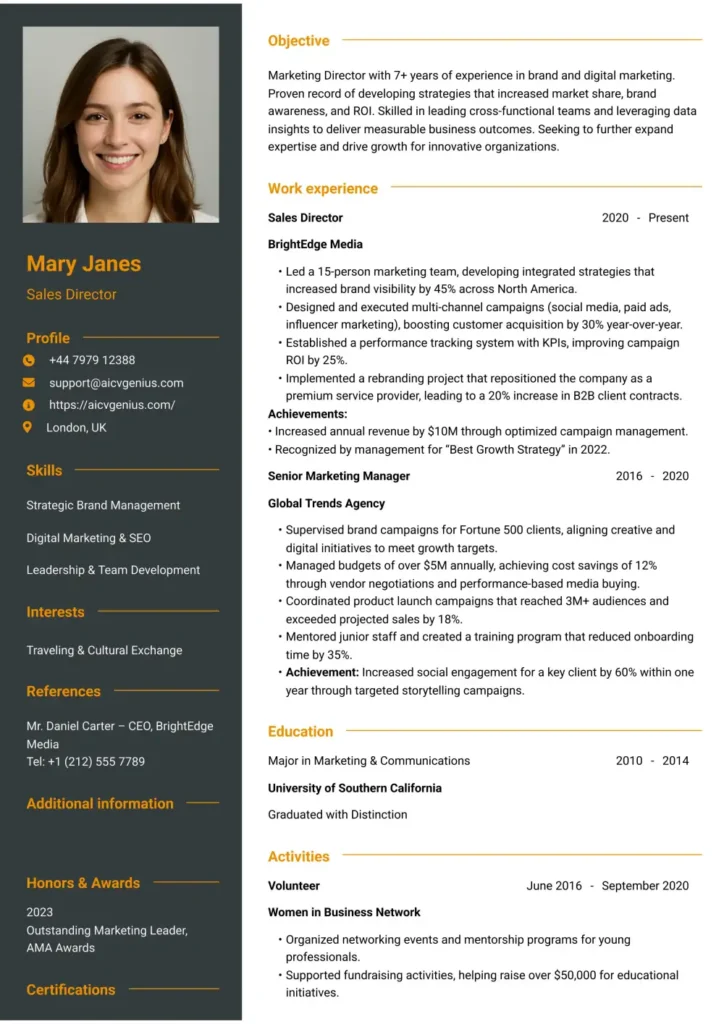
Building Your Resume’s Foundation: ATS and Core Structure
Before you can impress a human, you must pass the robotic gatekeeper. From there, your document’s structure must guide the human reader to the most important information immediately.
The First Hurdle: Beating the ATS Gatekeeper
Before any human reads your resume, a robot must parse it. The Applicant Tracking System (ATS) is a filter designed to save recruiters time. It scans your document for keywords, job titles, and skills. If your resume is not formatted for an ATS, you are invisible. (This is why a powerful ATS-friendly resume is non-negotiable). For a sales manager, specific keywords are non-negotiable.
- Layout Kills: Avoid two-column layouts. An ATS reads left-to-right, top-to-bottom. It will read “Company A” then “Skills” then “Company B,” creating a nonsensical profile. A single, clean column is the safest bet.
- Graphic Gimmicks: Do not use skill bars, graphs, or icons to show your proficiency in Salesforce. The ATS cannot read these and a human recruiter will find them amateurish. Prove your skill with a metric, not a graphic.
- Keyword Alignment: The ATS is looking for exact matches. If the job description asks for “pipeline management,” “forecasting,” and “CRM optimization,” those exact phrases must be in your resume.
- Standard Headings: Use standard section titles like “Professional Experience,” “Skills,” and “Education.” A creative heading like “My Sales Journey” will be skipped by the bot.
The Anatomy of a Pitch: Structuring Your Resume for Maximum Impact
Sales is storytelling, and your resume should be structured like a persuasive pitch: open with a powerful hook, prove your value with data, and close with undeniable results.
1. Header: The First Impression
This is simple, but crucial. Make it clean and professional. Your Name | Job Title (e.g., “Senior Sales Manager” or “B2B Sales Director”) | City, State, Zip | Phone | Email | LinkedIn URL (customized, not the default numbers) | Portfolio/Brag Book Link (Optional, but powerful if you have a clean site with case studies).
2. Professional Summary: The Executive Pitch
This is your 30-second elevator pitch. It must be dense with value, summarizing your leadership style, market experience, and biggest quantifiable wins. Avoid generic fluff like “results-oriented” and “team player.” Show, don’t tell.
Example 1 (SaaS B2B): “SaaS Sales Manager with 7+ years of experience leading high-performance B2B teams. Proven track record of exceeding targets by 25-40% through strategic pipeline management and CRM optimization. Expert in building and mentoring teams that consistently shorten the sales cycle.”
Example 2 (Enterprise Sales): “Enterprise Sales Director with a decade of experience navigating complex, 12-18 month sales cycles. Specializes in 7-figure contract negotiation and C-suite relationship building. Grew new territory from $0 to $15M in 3 years.”
Example 3 (Retail/B2C): “Dynamic Regional Sales Manager with 8+ years in multi-state retail. Drove a 30% increase in regional revenue by designing and implementing a new rep training program that boosted ATV and conversion rates.”
3. Core Competencies: The Sales Stack
This is your keyword-optimized skills section. (It should align with the top skills employers want). Grouping them logically makes you look organized and strategic. Do not list soft skills here (like “communication”); prove those in your bullet points.
- Sales Leadership: Team Leadership & Mentoring, Performance Improvement, Hiring & Onboarding, Compensation Plan Design
- Sales Operations: Revenue Forecasting & Budget Management, Pipeline Management, Sales Strategy, Territory Planning
- Technical Stack: CRM Optimization (Salesforce, HubSpot), Sales Enablement (Outreach, Gong), Data Analysis (Tableau, Excel)
- Go-to-Market: Business Development, B2B/B2C/Enterprise Sales, Channel Partnerships, Contract Negotiation
4. Experience: The Proof of Performance
This is the core of your resume. Every bullet point must be a quantifiable achievement, not a job duty. Start every bullet with a strong action verb (e.g., “Led,” “Built,” “Increased,” “Reduced”).
❌Weak Bullet (Duty):
“Responsible for managing a team of 10 sales reps.”
✅Strong Bullet (Achievement):
“Led a team of 10 account executives to achieve 132% of annual quota ($11.2M) in a competitive market.”
❌Weak Bullet (Duty):
“Handled sales training.”
✅Strong Bullet (Achievement):
“Designed and launched a new 4-week sales onboarding program, reducing new rep ramp-up time by 30%.”
More High-Impact Bullet Examples:
Revenue & Growth:
- ✅ Expanded into 3 new territories, generating $4.5M in new pipeline within 8 months through strategic market analysis.
- ✅ Grew average deal size by 28% by shifting team focus from transactional sales to enterprise-level solution selling.
- ✅ Captured a 15% market share increase by identifying and penetrating an untapped (e.g., healthcare) vertical.
Team Building & Leadership:
- ✅ Hired and trained a team of 8 SDRs from scratch, which went on to generate 40% of all qualified opportunities in FY24.
- ✅ Mentored 5 junior reps, 3 of whom were promoted to senior roles within 18 months.
- ✅ Implemented a new performance review framework, resulting in a 25% decrease in voluntary team attrition.
Process & Strategy:
- ✅ Partnered with marketing to refine lead scoring, improving MQL-to-SQL conversion rate from 11% to 19%.
- ✅ Redesigned the Salesforce dashboard for real-time KPI tracking, improving forecast accuracy to 95% quarter-over-quarter.
- ✅ Automated 3 key reporting functions using CRM tools, saving an estimated 20 hours of manual team admin work per week.
5. Education & Certifications
Keep this section brief. Your experience is what matters most. List your degree, university, and graduation year. Certifications are highly valuable in sales – list them prominently.
- Salesforce Certified Administrator/Professional
- HubSpot Sales Software Certification
- Gong Certified Revenue Professional
- (Degree Name, University Name, City, State)
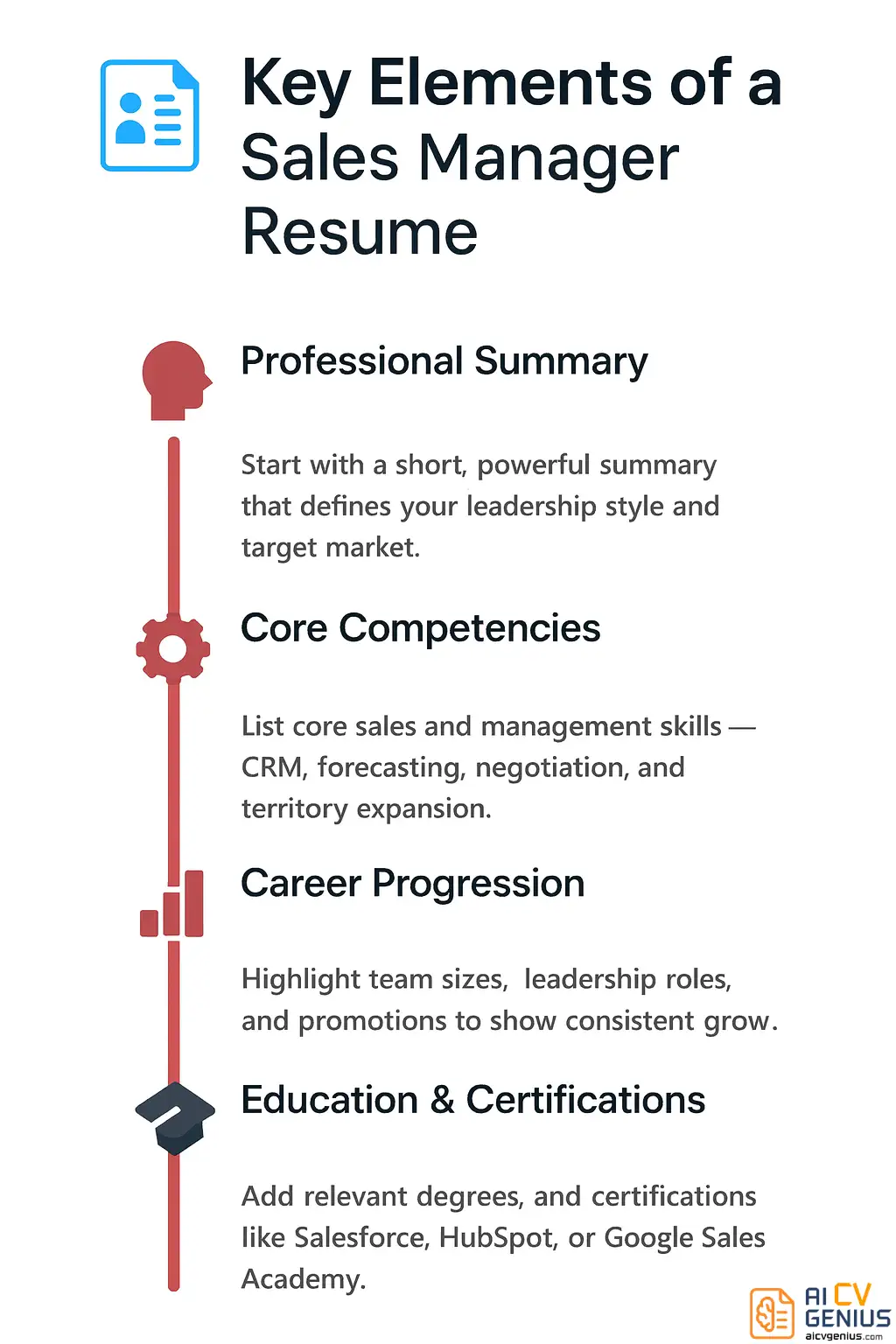
From Responsibilities to Revenue: Crafting Your High-Impact Experience
The “Professional Experience” section is where the hiring manager’s scan becomes a deep read. This is where you prove your value. It’s not just about what you did; it’s about the results you generated, the context of those results, and the leadership you demonstrated.
The Language of Sales: Use Metrics Like Undeniable Proof Points
Every sales manager is judged by numbers. Your resume must be saturated with them. Do not say “managed sales team” – say “led a sales team that generated $5.2M in annual revenue.” Numbers anchor your credibility and prove your impact.
Where to find your numbers:
- CRM Dashboards: Quota attainment (team and personal), average deal size, sales cycle length, conversion rates (MQL-SQL, SQL-Closed).
- Performance Reviews: Look for documented achievements and praise from leadership.
- Team Reports: Rep turnover/retention, ramp-up time, team productivity metrics.
What if you don’t have exact numbers? Estimate. Use ranges or percentages. “Improved rep productivity by approx. 20%” is far more powerful than “Improved rep productivity.”
The STAR Framework: Adding Context to Your Achievements
Each bullet point can follow the STAR logic – Situation, Task, Action, Result. It’s a simple and powerful way to add context to your achievements.
Situation: Sales dropped 10% in Q1 due to a new competitor. Task: Identify the market gap and retrain the team. Action: Led competitive analysis, identified our key differentiator, and built a new pitch deck focused on TCO. Result: Recovered the 10% and added 15% growth by Q3, capturing 5 key accounts from the new competitor.
Your resume bullet would be: “Reversed a 10% market share loss by designing a new competitive pitch deck, leading to 15% growth and 5 new enterprise accounts by Q3.”
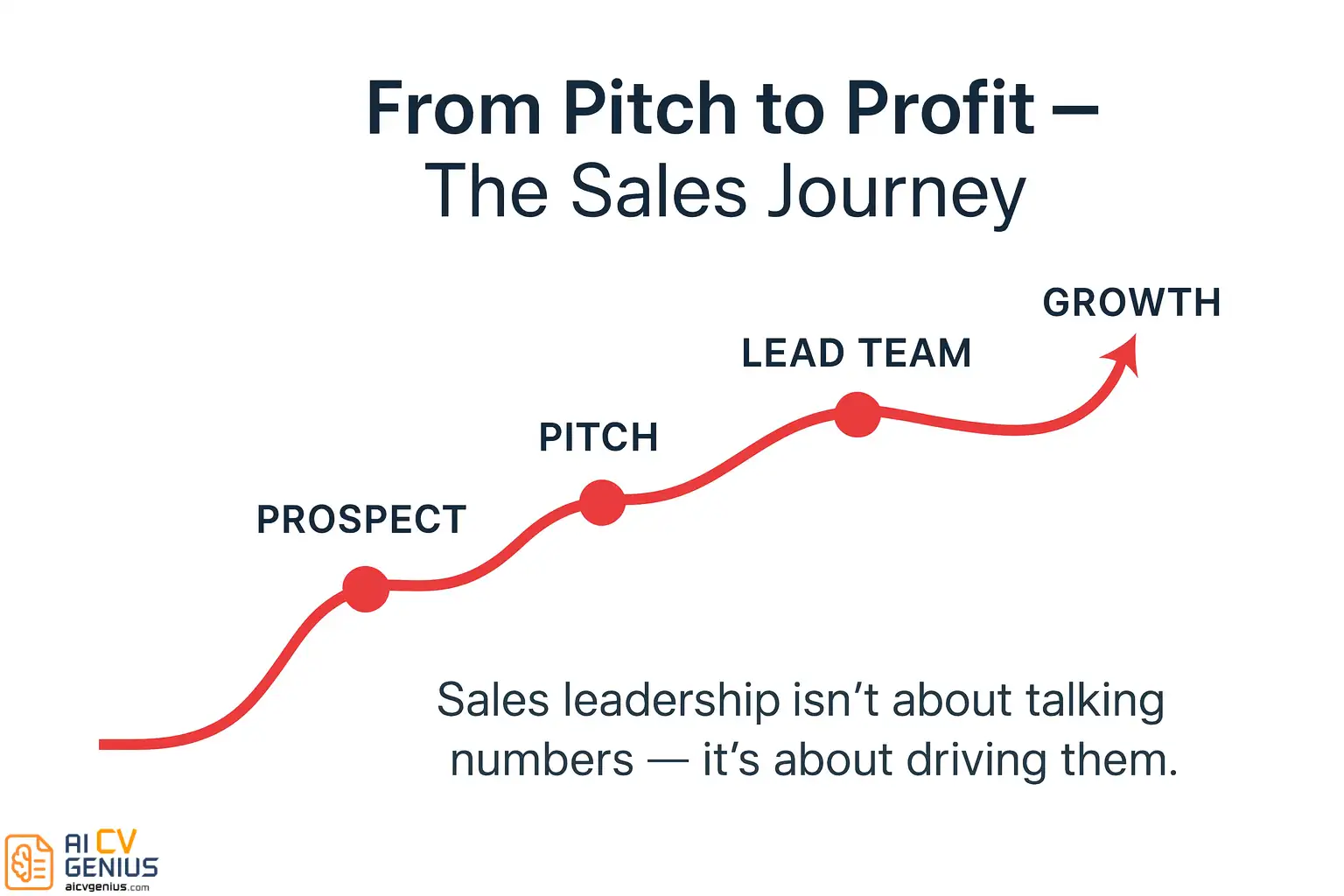
Prove Your Leadership, Not Just Your Sales Numbers
Great sales managers multiply results through people. A resume that only shows your quota is a red flag. It suggests you might be a “super-rep” who will compete with your own team. You must prove you are a leader.
- ✅ Coached 5 junior reps, 3 of whom were promoted to senior roles within 18 months.
- ✅ Implemented a weekly “film review” call using Gong, improving team-wide talk-to-listen ratio by 35%.
- ⭐ Advanced Tip: Show you can handle tough situations. “Managed 3 reps on performance improvement plans, with 2 successfully returning to quota-carrying status.”
The 7-Second Hook: Adding a “Career Highlights” Section
For an experienced manager, this section is a game-changer. Place it directly below your Professional Summary. It’s a 3-4 bullet point highlight reel that guarantees the recruiter sees your biggest wins, even if they only scan for 7 seconds.
Career Highlights
- Revenue Growth: Grew Central Region from $8M to $14.5M in 2 years (181% growth).
- Team Building: Hired and scaled the SDR team from 4 to 15 reps, resulting in a 200% increase in qualified pipeline.
- Strategic Win: Led the RFI/RFP process to secure the company’s first $5M+ F500 contract.
- President’s Club: Awarded “Sales Manager of the Year” 3 consecutive years (2022-2024).
The Complete Sales Manager Resume Example (Putting It All Together)
Theory is one thing; practice is another. Let’s apply every strategy we’ve discussed to build a complete, two-page sales manager resume example from top to bottom. We’ll use a fictional candidate, Michael Chen, who is targeting a B2B SaaS Sales Director role.
MICHAEL CHEN
B2B SaaS Sales Director
San Francisco, CA 94105 | (555) 123-4567 | m.chen@email.com | linkedin.com/in/michaelchensales
PROFESSIONAL SUMMARY
Dynamic SaaS Sales Director with 12+ years of experience building and leading high-performance B2B teams. Proven track record of scaling revenue from $5M to $25M in 3 years. Expert in moving teams from transactional sales to complex, multi-stakeholder enterprise solution selling. Data-driven leader who leverages CRM optimization and data analysis to achieve 95%+ forecast accuracy and drive sustainable growth.
CAREER HIGHLIGHTS
- Revenue Scalability: Grew Annual Recurring Revenue (ARR) for the Enterprise division from $5M to $25M (400% growth) in 3 years.
- Team Leadership: Hired, trained, and scaled the sales team from 8 to 30 reps; coached 6 team members into management roles.
- Process Improvement: Implemented a new MEDDIC-based sales methodology, increasing average deal size by 45% and shortening the sales cycle by 20%.
- Awards: President’s Club Winner (Top 3% of Managers) 4 times (2021, 2022, 2023, 2024).
CORE COMPETENCIES
|
|
|
|
PROFESSIONAL EXPERIENCE
Director of Sales, Enterprise B2B | TechSolutions Inc. | San Francisco, CA (2020 – Present)
- Led a team of 4 managers and 30 account executives to achieve 125% of annual quota ($25M) in FY24 through strategic territory realignment and penetrating 3 new industry verticals.
- Designed and launched a new 6-week sales onboarding program, reducing new rep ramp-up time from 9 months to 6 months (a 33% improvement).
- Partnered with Marketing and Product to refine lead scoring and product feedback loops, improving MQL-to-SQL conversion rate from 15% to 22%.
- Restructured the Salesforce dashboard for real-time KPI tracking and C-level reporting, improving quarterly forecast accuracy from 80% to 95%+.
Senior Sales Manager, Mid-Market | InnovateCorp | San Jose, CA (2016 – 2020)
- Managed a team of 12 mid-market reps, achieving 115%+ of quota for 4 consecutive years and growing the territory from $5M to $12M ARR.
- Pioneered the team’s transition to a solution-selling model, increasing average deal size by $25K (40%) and successfully moving upmarket.
- Coached 5 junior reps, 4 of whom were promoted to senior roles or “President’s Club” winners within 18 months.
- Reduced voluntary team attrition from 20% to 5% by implementing a new mentorship program and weekly 1:1 “film review” sessions using Gong.
Account Executive | DataWeaver Ltd. | Austin, TX (2013 – 2016)
- Exceeded personal quota by 150%+ for 3 consecutive years, earning “Top Rep of the Year” in 2015.
- Selected by management to mentor all new hires on the West Coast team, helping 3 new reps hit quota within their first 6 months.
EDUCATION & CERTIFICATIONS
- Salesforce Certified Administrator | Salesforce (2019)
- Gong Certified Revenue Professional | Gong.io (2021)
- Bachelor of Science in Business Administration, Marketing | University of Texas at Austin (2013)
Advanced Strategies & FAQs
A great resume isn’t just well-structured; it’s a meticulously tailored sales document that anticipates and answers every unasked question. This section covers the finer points that separate a good resume from a deal-closing one.
Tailor Your Pitch: Different Resumes for Different Sales Roles
There isn’t just one kind of sales manager. Your resume must be tailored to the specific archetype of the role you want. Do not use a one-size-fits-all document.
| Type | Focus Area | Resume Strategy & Keywords |
|---|---|---|
| Retail Sales Manager | Customer experience, foot traffic, UPT, and store performance. | Emphasize: Store P&L, Inventory Management, Visual Merchandising, Staff Training, UPT & ATV Growth. |
| B2B Sales Manager | Pipeline management, client acquisition, and mid-market deals. | Emphasize: SaaS, Pipeline Velocity, CRM Optimization, Lead Generation, Demo-to-Close Rate. |
| Inside Sales Manager | Remote teams, call/email targets, and high-velocity metrics. | Emphasize: Digital Tools (Outreach, SalesLoft), Call Metrics, Cadence Building, SDR/BDR Management. |
| Enterprise Sales Director | C-suite relationships, complex/long sales cycles, large contracts. | Emphasize: 7-Figure Deals, Contract Negotiation, Strategic Alliances, Multi-Stakeholder Selling. |
Common Mistakes to Avoid (The Deal-Breakers)
- ❌ Using passive language: “Was responsible for…” is weak. Use “Led,” “Built,” “Optimized,” “Increased.”
- ❌ No metrics: A sales resume without numbers is not a sales resume. It’s a list of chores.
- ❌ Ignoring soft skills: You must prove soft skills with metrics. Don’t say “good motivator.” Say “Reduced team turnover by 25%.”
- ❌ The “Super-Rep” Resume: Focusing only on your personal sales numbers and not your team’s achievements.
- ❌ A One-Page Resume (If You’re Experienced): For managers with 10+ years, a one-page resume is often a red flag. It shows you can’t properly detail your leadership and strategic impact. Two pages is standard and expected for senior roles.
Soft Skills That Seal the Deal (And How to Prove Them)
Prove these skills with your bullet points; don’t just list them.
- Communication: “Presented quarterly business reviews (QBRs) to C-level stakeholders.”
- Negotiation: “Restructured a $2M enterprise deal to a multi-year agreement, increasing LTV by 40%.”
- Adaptability: “Pivoted team strategy during COVID-19 to focus on 2 high-growth verticals, preventing a quarterly loss.”
- Strategic Thinking: “Developed a new channel partnership program that accounted for 15% of all new revenue.”
Pros & Cons of Using a Resume Template
Using one of the best resume templates can be a smart move, but you must be strategic.
| Pros | Cons |
|---|---|
| ✅ Saves time with proven, recruiter-approved layout. | ❌ Needs heavy customization to fill with your specific metrics. |
| ✅ Ensures design consistency and ATS-safety. | ❌ Can look generic if you pick a “creative” template with graphics. |
| ✅ Makes achievements easy to read and scan quickly. | ❌ Can feel impersonal if you don’t inject your “voice” in the summary. |
In-Depth FAQs for a Sales Manager Resume
- “Designed and launched a new sales playbook…”
- “Partnered with marketing to redefine MQL criteria…”
- “Segmented sales territories based on market potential…”
These are strategic actions, not just day-to-day management.
Final Thoughts: Your Resume is Your First Close
A strong sales manager resume isn’t just a record of your past – it’s a data-driven forecast of your future performance. It’s a reflection of your leadership philosophy. Every figure should have a story, and every bullet point should lead to a measurable result. Numbers open the door; the story of how you achieved them seals the deal. When you combine data, strategy, and proof of leadership, your resume becomes what every great sales pitch aspires to be – irresistible. Explore more resources to improve your CV and refine your pitch with our best resume templates.