

- Core idea: Interview questions are not random, most fall into predictable categories, and your job is to tell a coherent story about how you think, work, and deliver.
- Personal + behavioral: Prepare a tight introduction and a small set of STAR stories that prove your strengths with specific actions, decisions, and outcomes.
- Situational + technical: Show your reasoning out loud, ask clarifying questions, explain tradeoffs, and connect your approach to the role’s real requirements.
- Motivation + fit + curveballs: Be clear on why this role and what you value, then handle pressure questions by staying calm, buying a second to think, and answering with grounded examples.
- Prep strategy: Use common questions to reduce anxiety and stay consistent, but avoid memorized scripts that sound robotic, practice themes and stories so you can adapt naturally.
The interview process can often feel like a high-stakes guessing game. In truth, most interviews are built on a foundation of predictable, time-tested questions. Recruiters are not trying to trick you; they are trying to deconstruct who you are, how you think, and how you would perform within their team.
The secret to success is not memorizing 50 different scripts. It is about understanding the intent behind the question. What does “What are your weaknesses?” really ask?
This guide provides a comprehensive look at the top 50 interview questions still widely used today. We have organized them into five key categories, complete with the psychology behind them and clear examples, so you can stop guessing and start having a confident conversation.
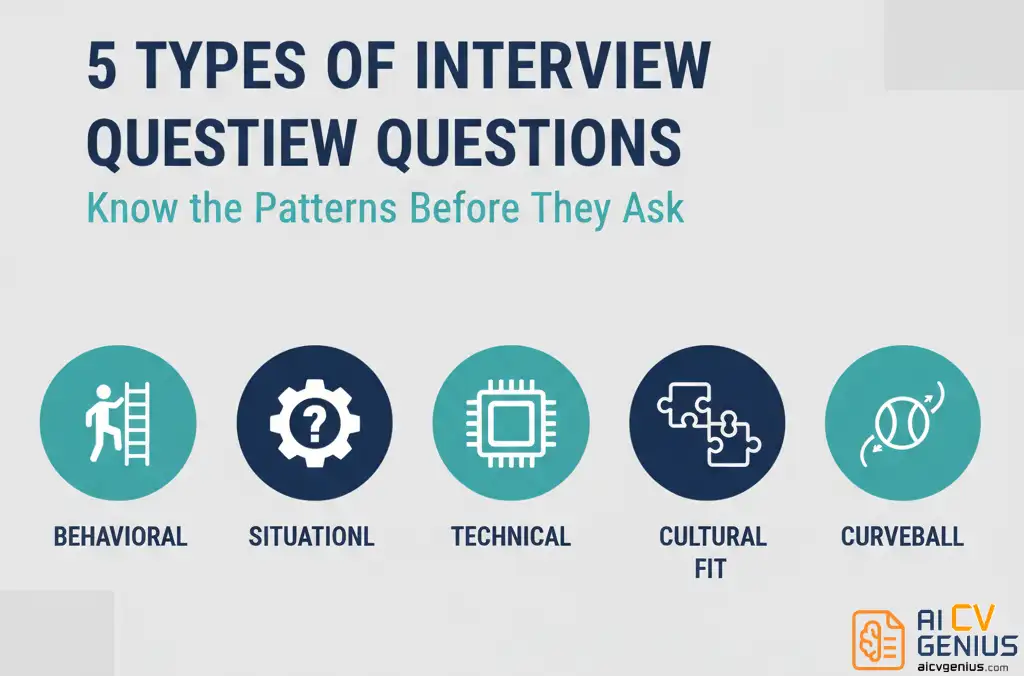
The Core Interview Question Categories
Personal Introduction Questions
This section covers the “get to know you” phase. These questions are designed as a warm-up, but they serve a critical purpose: they test your self-awareness, your core motivation, and your ability to present a coherent narrative about yourself. The goal is to see how you frame your own story.
- ❓ 1. Tell me about yourself.
This is your professional elevator pitch. Keep it to 90 seconds. Focus on: Present (your current role and an achievement) → Past (how you got here) → Future (why you are excited about this specific opportunity). - ❓ 2. What are your strengths?
Choose 2–3 skills that are directly relevant to the job description. Back each one with a tiny, powerful example: “I’m deeply analytical. I recently identified a data trend that led to a 15% shift in our marketing strategy.” - ❓ 3. What are your weaknesses?
This is a test of self-awareness. Pick a genuine, manageable weakness. Show you are actively working on it. “I used to be a people-pleaser and would overcommit, leading to stress. I now use a clear prioritization system and have learned to say ‘no’ respectfully when my plate is full.” - ❓ 4. Why do you want this job?
Show you have done your research. Your answer should have two parts: 1. What you admire about the company (its mission, product, or culture). 2. How this specific role is a perfect fit for your skills and career goals. - ❓ 5. Why should we hire you?
This is your chance to connect the dots. Summarize your unique value proposition: “You should hire me because I have the proven technical skills in [Skill X] and the collaborative, team-first mindset required to succeed in your [Team Y] environment.” - ❓ 6. How did you hear about us?
Show genuine interest. If you found it on a generic job board, go one step further: “I first saw the posting on LinkedIn, but I’ve been following [Company’s project or leader] for a while, and I was excited to see an opening.” - ❓ 7. Describe yourself in three words.
Choose traits aligned with the role. “Curious, dependable, and proactive” are more powerful than generic words like “nice.”
Behavioral Questions (Using the STAR Method)
This is where the interview truly begins. Behavioral questions operate on the principle that past performance is the best predictor of future behavior. They are not interested in what you would do; they want to know what you did. Your tool for every answer here should be the STAR method (Situation, Task, Action, Result) to provide concrete, evidence-based stories.
- ❓ 8. Tell me about a time you faced a challenge at work.
They are testing resilience. Choose a story where you stayed calm, identified the core problem, and implemented a logical solution. - ❓ 9. Describe a time you showed leadership.
Leadership is not about a title. Talk about a time you mentored someone, coordinated a project, or took initiative to improve a process. - ❓ 10. Tell me about a time you made a mistake.
This is about accountability. Show humility, explain what you did to fix it immediately, and (most importantly) what you learned or what process you changed. - ❓ 11. Describe a time you worked in a team.
Focus on collaboration. Highlight your role, but give credit to the team. Show how you communicated and compromised to reach a shared goal. - ❓ 12. Give an example of a goal you reached and how.
Show your process. How did you set the goal? How did you track it? What steps did you take? End with a measurable result. - ❓ 13. Tell me about a time you disagreed with your boss.
This tests your conflict-resolution skills. Choose a story about a professional, data-driven disagreement. Show how you presented your case respectfully and, ultimately, committed to the final decision (even if it was not yours). - ❓ 14. How do you handle stress or pressure?
Give a concrete example. “On my last product launch, multiple things went wrong. I paused, created a priority list of what had to get done, and communicated the new timeline to stakeholders. It’s about triage, not panic.” - ❓ 15. Tell me about a time you went above and beyond.
Choose a story that shows initiative and passion, not just a willingness to work late. How did you anticipate a need or create value?
Situational Questions
Situational questions are forward-looking hypotheticals: “What would you do if…?” The interviewer is not looking for a single correct answer. They are testing your critical thinking, your problem-solving process, and your professional judgment under pressure. How do you navigate ambiguity?
- ❓ 16. What would you do if a project was behind schedule?
Show your framework: 1. Assess the situation to understand why it’s late. 2. Communicate clearly with stakeholders. 3. Prioritize the ‘must-have’ deliverables and re-scope if possible. - ❓ 17. How would you handle a difficult client?
Empathy first, solutions second. “I would first listen actively to understand their frustration. After validating their concern, I would clearly explain the situation and offer two practical, forward-moving solutions.” - ❓ 18. If two managers gave you conflicting tasks, what would you do?
This tests communication and prioritization. “I would seek clarity. I’d bring both tasks to one manager, explain the conflict, and ask for help in prioritizing which one would bring more value to the business right now.” - ❓ 19. How would you manage a team with low morale?
Show emotional intelligence. “My first step would be to find out why morale is low, likely through one-on-one conversations. From there, I’d focus on creating small wins, ensuring public recognition for good work, and protecting the team from blockers.” - ❓ 20. What would you do if you made an error others hadn’t noticed?
This is an integrity test. The only answer is: “I would own it immediately. I’d proactively inform my manager, explain the potential impact, and come prepared with a solution or correction plan.” - ❓ 21. Imagine you’re asked to take on unfamiliar work. How do you adapt?
Show curiosity and resourcefulness. “I’m a fast learner. My first step would be to research the topic, identify colleagues who are experts, and ask targeted questions. I’m comfortable being a beginner as long as I’m learning.” - ❓ 22. How do you handle missing a deadline?
This is about proactive communication. “I would communicate the delay as early as possible. I would explain the ‘why,’ provide a new, realistic deadline, and detail my plan to get there. Surprising people is the real failure.”
Technical or Role-Specific Questions
These questions are purely about your competency. They are designed to validate the skills you listed on your resume. Whether you are a developer, a marketer, or a financial analyst, your answers should be clear, confident, and, where possible, backed by brief examples of how you have applied that knowledge.
- ❓ 23. What tools or software do you use daily?
Be specific and relevant. Don’t just list them. “My primary tool is Figma for design, but I’m also highly proficient in Asana for project tracking and Jira for bug reporting.” - ❓ 24. How do you stay current in your industry?
Show proactive learning habits. “I subscribe to industry newsletters like [Newsletter], listen to podcasts like [Podcast], and I’m currently taking an online course in [Specific Skill].” - ❓ 25. Describe your workflow for managing multiple projects.
Show your organizational method. “I use a digital system, like Asana, to map out all tasks. I start each day by identifying the single most important priority for each project and time-blocking my calendar.” - ❓ 26. How do you ensure quality in your work?
Describe your review process. “I have a personal checklist. For code, I always write unit tests. For reports, I always do a final data-check against the source before submitting.” - ❓ 27. How do you approach problem-solving?
Have a structured method. “I first work to define the real problem, not just the symptom. Then I brainstorm 3-4 potential solutions and analyze the pros and cons of each before executing one.” - ❓ 28. How do you handle feedback?
Show a growth mindset. “I genuinely appreciate it. I listen without getting defensive, ask clarifying questions to make sure I understand, and always thank the person for their time. Feedback is data for improvement.” - ❓ 29. Describe a time you improved a process.
Show initiative. “The team was manually entering data, which took 5 hours a week. I built a simple automation script that cut that time down to 20 minutes, freeing us up for more analytical work.” - ❓ 30. What’s your biggest technical strength?
Be specific and link it to an impact. “My biggest strength is my ability to translate complex data into a simple story. I’m not just an Excel expert; I’m an expert at using Excel to persuade leadership.”
Career Motivation & Values
Here, the interviewer is assessing long-term fit and ambition. Are you just looking for a job, or do you want this job? They want to see that your personal growth ambitions align with the opportunities the company can provide, ensuring you will be motivated and engaged.
- ❓ 31. Where do you see yourself in five years?
Show ambition that aligns with the company. “I hope to have become a true expert in this field. I’m excited by the prospect of potentially mentoring junior team members or taking the lead on larger, more complex projects within this department.” - ❓ 32. What motivates you?
Be authentic. “I’m motivated by two things: solving a complex problem and seeing my work help a teammate. I love the feeling of untangling a difficult challenge and I also thrive on collaborative success.” - ❓ 33. How do you define success?
Balance results with process. “For me, success is not just about hitting the target. It’s about how we hit it. Did we do it efficiently? Did the team work well together? Did I learn something I can apply to the next project?” - ❓ 34. What kind of work environment do you thrive in?
Be honest, and align with what you know about them. “I thrive in a collaborative and transparent environment. I do my best work when I can openly brainstorm with colleagues and receive clear, consistent feedback.” - ❓ 35. How do you prioritize work-life balance?
Show maturity and responsibility. “I see it as a necessity for long-term performance. I’m very focused and productive during my work hours, which allows me to fully disconnect and recharge in the evenings so I can come back fresh.”
Cultural Fit & Interpersonal Questions
Skills can be taught, but personality is harder to change. These questions explore your emotional intelligence and interpersonal skills. The company is trying to picture you in their meetings, collaborating with their people. How do you handle conflict, feedback, and teamwork?
- ❓ 36. How do you handle working with difficult people?
Be diplomatic. “I find that most ‘difficult’ behavior comes from a place of stress or a different priority. I try to understand their perspective first. I stay calm, focus on the shared goal, and keep our interactions professional and solution-oriented.” - ❓ 37. Describe your communication style.
Aim for balance. “I would describe my style as clear and adaptable. I believe in being direct and transparent, but I always tailor my message to the audience – whether I’m in a technical deep-dive with an engineer or a high-level summary with an executive.” - ❓ 38. What do you value in a manager?
Be professional. “I value transparency, trust, and a clear sense of direction. I work best with a manager who provides autonomy to get my work done but is available for guidance and regular feedback.” - ❓ 39. How do you handle feedback from peers?
Show you are not defensive. “I welcome it. I see feedback from peers as a way to ensure our team’s work is as strong as possible. I’ll listen, ask questions, and integrate their suggestions if it improves the outcome.” - ❓ 40. What do you contribute to team culture?
Be authentic. “I’m generally the calm, positive one on the team. I try to be the person who checks in on my colleagues, and I’m always the first to offer help if someone seems overwhelmed.”
Curveball Questions (for Creativity or Pressure)
Finally, the curveballs. These unusual questions are designed to do one thing: see how you react when you do not have a prepared answer. Do you panic, get defensive, or do you play along with creativity and poise? There is no wrong answer, only a wrong reaction. Take a breath, smile, and think for a second.
- ❓ 41. If you could have dinner with anyone, who would it be?
Pick someone relevant to your professional inspiration. “I would choose [Author/Innovator] because their work on [Topic] fundamentally changed how I approach my own work.” - ❓ 42. Describe your dream project.
Show passion that aligns with the role. “My dream project would be to build a [Product/System] from the ground up, collaborating with every department from design to launch.” - ❓ 43. If you won the lottery, would you still work?
This tests your motivation. “Absolutely. After a short vacation, I’d want to work on meaningful projects. I’m driven by solving problems, and I would miss that challenge.” - ❓ 44. How do you react to failure?
Show resilience. “I treat it as data. I give myself a moment to be frustrated, but then I become analytical: What went wrong? Why? What is the one lesson I can take from this to make sure it never happens again?” - ❓ 45. How do you stay productive on slow days?
Show initiative. “I use slow periods to invest. I’ll organize my files, document a process, or work on a professional development course. I like to be prepared for the next busy period.” - ❓ 46. What’s one skill you’re currently improving?
Be specific. “I’m actively improving my data visualization skills. I’m learning Tableau in my spare time because I know it’s a key part of telling a good data story.” - ❓ 47. What’s your biggest professional accomplishment?
Have your best STAR story ready. Pick one with a clear, measurable result that showcases a key strength. - ❓ 48. How do you handle uncertainty?
Show flexibility. “I break it down. In uncertain situations, I focus on what I can control. I ask clarifying questions, map out a plan for the known parts, and build in flexibility for the unknown.” - ❓ 49. What would your colleagues say about you?
Be positive but credible. “I think they would say I’m reliable. They know that if I say I’ll do something, it will get done. They’d probably also say I’m the person who always has snacks.” - ❓ 50. Do you have any questions for us?
The answer is ALWAYS YES. This shows your engagement. Ask about the team, the challenges, or the manager’s expectations. (e.g., “What does success look like in this role in the first 90 days?” or “What is your favorite part about working here?”)
Analysis, Final Thoughts & FAQs
Pros & Cons of Preparing with Common Questions
| Pros | Cons |
|---|---|
| ✅ Confidence: Builds massive confidence and reduces anxiety. | ❌ Robotic Answers: Over-rehearsing can make you sound unnatural. |
| ✅ Structure: Helps you anticipate patterns and structure your thoughts. | ❌ Missed Cues: You might miss what the interviewer is really asking. |
| ✅ Self-Awareness: Forces you to inventory your own stories and skills. | ❌ Wrong Focus: Some creative roles prefer less-structured answers. |
Final Thoughts
Preparation does not mean memorization; it means understanding yourself. When you practice these 50 interview questions, focus on the core themes behind them: curiosity, integrity, resilience, and collaboration.
The best candidates do not sound perfect. They sound real.
They show they have learned from mistakes, they celebrate their wins, and they are humble enough to keep growing.