
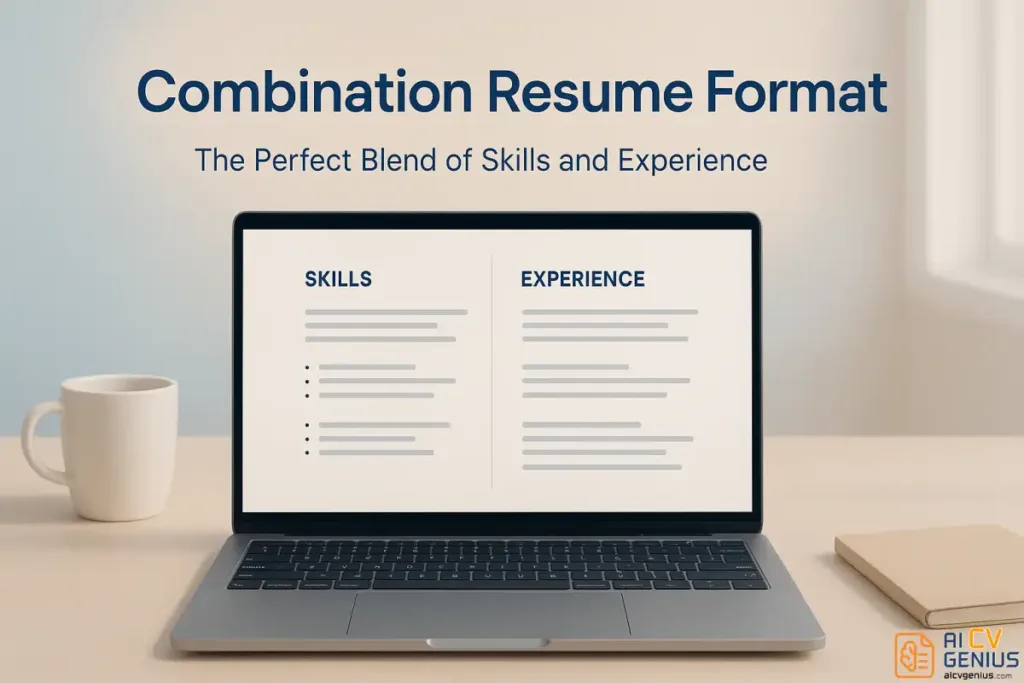
- The combination resume format (hybrid) leads with skills and results first, then backs it up with a clear reverse-chronological work history so recruiters see value before they scan dates.
- It’s strongest for non-linear paths: career changers, freelancers/consultants, return-to-work candidates, and mid-career pros whose job titles don’t fully explain their transferable skills.
- Build it in a clean order: header + summary, then 3-5 skill categories with specific tools and 1-2 quantified proof bullets each, then a tighter work history that adds context without repeating the same wins.
- Make it easy to skim and ATS-friendly: standard headings, consistent formatting, enough white space, and ruthless trimming so it stays readable and doesn’t feel cluttered.
- Tailor each application by reshaping the skill categories and top achievements to match the job description, while keeping the timeline stable and believable.
The Strategic Blend: Decoding the Combination Resume Format
In a career landscape that increasingly values adaptability over rigid linearity, the traditional resume formats sometimes fall short. Enter the combination resume format, often called the hybrid resume. This sophisticated structure artfully merges the skill-centric focus of a functional resume with the familiar timeline of a chronological one. It’s designed not just to list your history, but to strategically showcase your capabilities first, proving your value before delving into the when and where.
Imagine your resume as a conversation. The combination format starts by immediately highlighting your most relevant skills and impactful achievements – addressing the recruiter’s core question: “What can this person do for us?” Only after establishing this foundation of capability does it provide the chronological context of your work history. This balanced approach offers a powerful narrative, demonstrating both immediate value (skills) and proven experience (history). It’s particularly potent for professionals whose career paths aren’t perfectly linear but whose skill sets are strong and transferable.
This guide offers a deep dive into the combination resume format. We’ll explore its strategic advantages, identify who benefits most from its structure, provide a detailed breakdown of its components, offer actionable tips for optimization, and address common pitfalls – transforming your resume from a simple record into a compelling argument for your candidacy.
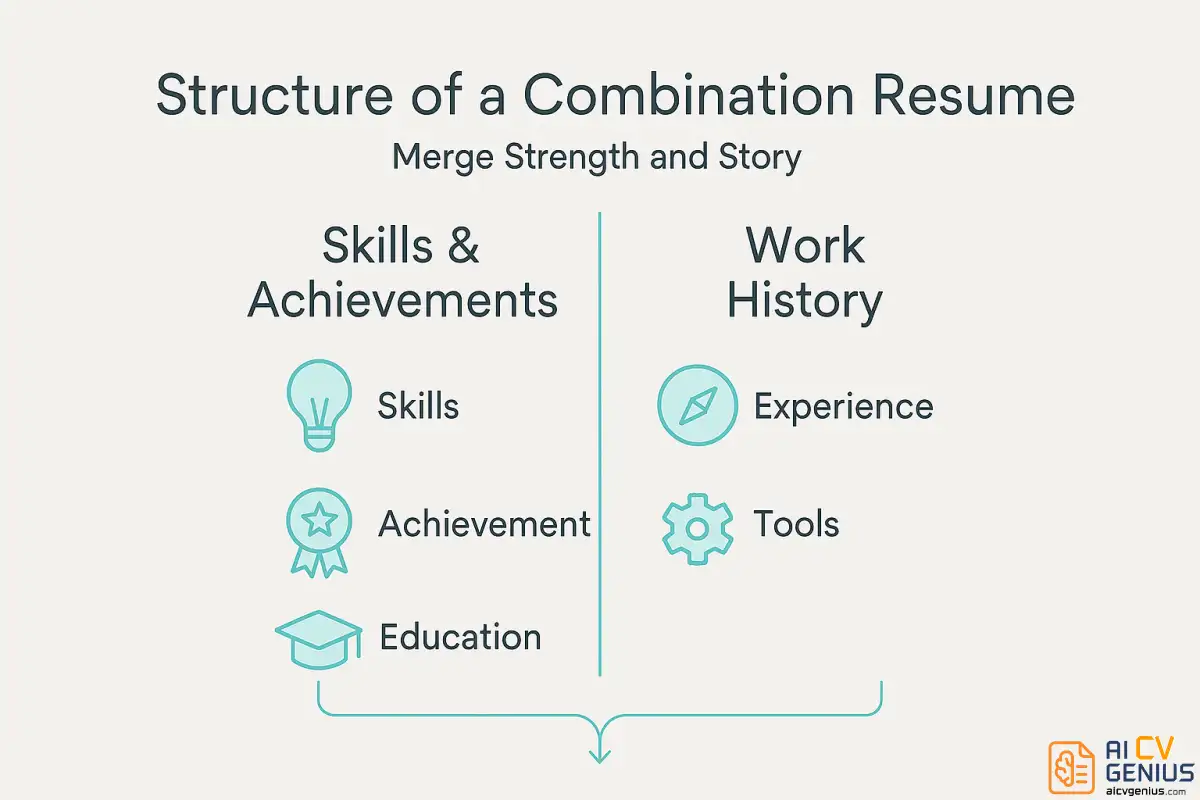
Why, Who, and How: The Strategy of the Combination Format
The Strategic Edge: Why the Combination Format Resonates
Traditional chronological resumes excel at showing steady progression within a field. Functional resumes highlight skills but can sometimes raise recruiter suspicion by obscuring work history. The modern career, however, often involves pivots, project-based work, skill accumulation outside of formal titles, and non-linear growth. The combination resume format uniquely acknowledges and leverages this reality.
Its effectiveness stems from several key factors:
- ✅ Highlights Transferable Skills Prominently: By placing a detailed skills/achievements section near the top, it immediately showcases your core competencies, especially crucial for career changers or those targeting roles slightly different from their past titles. Recruiters see relevance upfront.
- ✅ Maintains Recruiter Familiarity: While leading with skills, it still includes the reverse-chronological work history section that recruiters expect and often prefer for verifying experience and stability. This blend reduces potential skepticism associated with purely functional formats.
- ✅ Optimizes for Skimmability: Recruiters scan resumes quickly. The combination format allows them to grasp your key qualifications (skills, quantifiable results) in the top third of the page, making a faster, stronger initial impression.
- ✅ Ideal for Showcasing Diverse Experience: It adeptly handles varied backgrounds – freelancing, consulting, multiple part-time roles, significant volunteer work – by consolidating related skills and achievements thematically before listing the individual engagements.
- ✅ Downplays Potential Weaknesses (Subtly): While still providing a timeline, the emphasis on skills can subtly de-emphasize minor employment gaps or less relevant job titles, focusing the reader’s attention on capability first.
However, it requires careful execution:
- ❌ Requires Thoughtful Curation: Selecting and categorizing skills effectively takes more effort than simply listing job duties chronologically. Poor organization can lead to confusion.
- ❌ Can Become Lengthy if Not Edited: Balancing a detailed skills section with a full work history can push the resume beyond the preferred one-to-two-page limit if not concise.
- ❌ Less Intuitive for Entry-Level Candidates: Without significant achievements or a diverse skill set built over time, this format can feel forced or thin compared to a straightforward chronological approach focused on education and internships.
Ultimately, the combination format works because it aligns with how recruiters evaluate talent in dynamic fields: they prioritize demonstrable skills and impact first, then verify the historical context. It’s a strategic choice for telling a more nuanced and persuasive career story.
Target Audience: Who Benefits Most from a Combination Resume?
This format isn’t a universal solution, but it’s exceptionally powerful for specific professional profiles where a simple timeline doesn’t capture the full picture. Consider using a combination resume if you identify with one or more of these scenarios:
- ✅ Career Changers: This is arguably the prime audience. When moving from teaching to corporate training, or from hospitality management to project management, your past job titles might seem irrelevant. The combination format lets you lead with transferable skills like “Instructional Design,” “Stakeholder Communication,” or “Process Optimization,” demonstrating capability before the recruiter even sees your previous roles. It builds the bridge between where you’ve been and where you want to go.
- ✅ Seasoned Professionals with Diverse Skill Sets: If you’ve held roles spanning multiple functions (e.g., marketing and product development, or engineering and team leadership), this format allows you to thematically group your expertise (“Product Lifecycle Management,” “Agile Team Leadership,” “Go-to-Market Strategy”) rather than scattering related achievements across different job entries.
- ✅ Freelancers, Consultants, and Gig Workers: When your work history consists of numerous short-term projects for various clients, a chronological list can appear fragmented or unstable. The combination format allows you to consolidate achievements under skill categories (“Client Relationship Management,” “Digital Content Creation,” “Technical Project Delivery”) showcasing the breadth and depth of your expertise cohesively, followed by a summarized client/project list.
- ✅ Individuals Returning to the Workforce: After a significant break (e.g., parental leave, sabbatical, caregiving), leading with a strong skills section reminds recruiters of your capabilities and can subtly downplay the time gap, focusing attention on retained or newly acquired competencies.
- ✅ Mid-Career Professionals Seeking Advancement or Specialization: If you’re aiming for a promotion or a more specialized role that leverages skills honed across different positions, this format helps you consolidate and emphasize that specific expertise (e.g., highlighting “Data Visualization & Reporting” skills drawn from analyst, specialist, and team lead roles).
- ✅ Those with Significant Volunteer or Side Project Experience: If key skills or impressive achievements come from outside your formal employment (e.g., leading a non-profit initiative, developing a popular open-source tool), the skills section provides a natural place to integrate and highlight this valuable experience.
Example Scenario: Marketing Analyst to UX Designer Transition
A marketing analyst pivoting to UX design can use the top “Skills & Achievements” section to highlight:
- User Research & Persona Development (leveraging market research skills)
- Data Analysis for User Behavior Insights (re-framing analytics experience)
- A/B Testing & Iteration (connecting campaign optimization to product design)
- Wireframing & Prototyping (showcasing new skills from courses/projects)
This immediately signals relevant UX competencies, even though the subsequent “Work Experience” section lists “Marketing Analyst” roles. The format controls the narrative, emphasizing potential grounded in transferable abilities.
The Career Changer’s Secret Weapon: A Deeper Look
For individuals transitioning between fields, the combination resume acts as a translation tool. Recruiters unfamiliar with your previous industry might struggle to see the relevance of your past roles. The prominent skills section bridges this gap by explicitly mapping your transferable abilities to the requirements of the new field.
Consider the teacher moving into corporate training:
- Old Role (Teacher): Developed lesson plans, managed classroom dynamics, assessed student progress, communicated with parents.
- New Target Role (Corporate Trainer): Requires curriculum design, facilitation skills, performance evaluation, stakeholder communication.
A combination resume allows the candidate to create skill categories like:
- Instructional Design & Curriculum Development: Highlighting lesson planning, adapting content for diverse learners, creating assessment tools. Achievement: Developed a new science curriculum adopted district-wide, improving student engagement scores by 15%.
- Facilitation & Communication: Showcasing classroom management, presenting complex topics clearly, parent-teacher communication, conflict resolution. Achievement: Led professional development workshops for 20+ colleagues on new teaching technologies.
- Performance Assessment & Feedback: Detailing methods for tracking student progress, providing constructive feedback, reporting on outcomes. Achievement: Implemented a new feedback system that correlated with a 10% increase in standardized test scores.
By framing past experiences using the language and priorities of the target industry (“curriculum design,” “facilitation,” “stakeholder communication”), the resume immediately establishes relevance and competence, overcoming potential biases associated with the “Teacher” job title listed later in the experience section. It proactively answers the question, “How does your background fit here?”
Architecting Your Story: Structure & Execution
The Detailed Structure of a Combination Resume
Crafting an effective combination resume requires careful organization. While flexible, a standard, highly readable structure typically includes these key components in order:
- ✅ Contact Information & Header: Positioned at the very top. Include your Full Name (professional font, slightly larger), Target Job Title or Professional Headline (e.g., “Senior Project Manager | Agile & Scrum Expert”), Phone Number, Professional Email Address, City & State, and crucial links (updated LinkedIn profile, Portfolio URL if applicable).
- ✅ Professional Summary: A concise (3-5 sentences) and impactful paragraph immediately following the header. This is your high-level pitch, synthesizing your years of experience, core expertise, key transferable skills, and a significant quantifiable achievement. Crucially, tailor this summary to align directly with the target job description.
- ✅ Skills Summary / Key Competencies / Areas of Expertise: This is the defining feature of the combination format. It’s a detailed section showcasing your most relevant skills, grouped thematically. Structure it strategically:
- Use 3-5 Skill Categories: Choose broad themes directly related to the target role (e.g., “Project Management & Delivery,” “Team Leadership & Mentoring,” “Data Analysis & Reporting,” “Client Relationship Management”).
- Under Each Category, List Specific Skills/Tools: Be precise (e.g., under “Project Management,” list “Agile Methodologies,” “Risk Mitigation,” “Budget Management,” “Jira,” “Asana”).
- Include 1-2 Bullet Points with Quantifiable Achievements Under Each Category (Optional but Powerful): Directly link skills to results. E.g., under “Team Leadership,” add: “Mentored and coached a team of 5 junior developers, resulting in a 30% improvement in code quality metrics.” This transforms the skills list into an achievements showcase.
- ✅ Professional Experience / Work History: Present your employment history in reverse chronological order (most recent first). For each role, include:
- Job Title
- Company Name & Location (City, State)
- Dates of Employment (Month, Year – Month, Year or Present)
- Briefly list 1-3 key responsibilities or achievements, focusing on aspects not already covered in detail in the Skills section or that provide essential context. Avoid redundancy. The heavy lifting on achievements should happen in the Skills section above.
- ✅ Education: List degrees in reverse chronological order (Degree Name, University, Location, Graduation Year). Include relevant honors, minors, or theses.
- ✅ Certifications & Professional Development: List relevant industry certifications (PMP, CSM, Google Analytics IQ), licenses, or significant training courses.
- ✅ Optional Sections: Include only if they add significant value and are relevant: Technical Proficiencies (if not fully covered in Skills), Languages, Volunteer Experience, Publications/Presentations.
Critical Design Principle: Visual Hierarchy and Balance. The Skills section should be visually prominent but not overwhelmingly dense. Ensure clear headings, consistent formatting (bolding, bullets, indentation), and ample white space throughout. The goal is a document that feels balanced, professional, and easy for a recruiter to navigate quickly, guiding their eye from broad competencies to specific historical context.
Example Layout: Deconstructing a Combination Resume Section
Let’s expand on the brief example provided earlier for a Digital Marketer, showing more detail in the Skills section:
Jane Doe
Digital Marketing Strategist | Content & SEO Specialist
(555) 123-4567 | jane.doe@email.com | San Francisco, CA | linkedin.com/in/janedoe | janedoeportfolio.comProfessional Summary
Creative and data-driven Digital Marketing Strategist with 8+ years of experience developing and executing integrated content and SEO campaigns that significantly increase organic visibility and user engagement. Proven ability to lead cross-functional teams, leverage analytics for actionable insights, and consistently exceed lead generation targets. Seeking to apply expertise in B2B SaaS marketing to drive growth at [Target Company Name].Key Skills & Achievements
Content Strategy & SEO Optimization
- Expertise in keyword research (SEMrush, Ahrefs), on-page/off-page SEO, technical audits, and content calendar management.
- Developed and implemented a pillar content strategy that resulted in a 150% increase in organic traffic and ranking for 20+ high-intent keywords within 12 months.
- Managed freelance writers and designers to produce high-quality blog posts, case studies, and infographics aligned with SEO goals.
Digital Campaign Management & Analytics
- Proficient in Google Analytics, Google Ads, LinkedIn Ads, HubSpot, and Marketo.
- Managed a $500K annual digital advertising budget, optimizing campaigns to achieve a 25% reduction in cost-per-lead (CPL) while increasing MQL volume by 40%.
- Created custom performance dashboards in Tableau, providing stakeholders with real-time insights into campaign effectiveness and ROI.
Cross-Functional Leadership & Communication
- Collaborated effectively with Sales, Product, and Design teams to ensure marketing initiatives aligned with overall business objectives.
- Presented campaign results and strategic recommendations to executive leadership quarterly.
- Mentored two junior marketing coordinators, enhancing team productivity and skill development.
Professional Experience
Marketing Manager | Horizon Media | San Francisco, CA | January 2019 – Present
- Led development of integrated digital campaigns, focusing on SEO and content marketing initiatives previously detailed.
- Managed marketing budget and vendor relationships.
- Reported on campaign performance and provided strategic recommendations to senior management.
Content Specialist | Bright Studio | Oakland, CA | June 2015 – December 2018
- Created data-informed blog posts, guides, and website copy that contributed to a 120% increase in site traffic over two years.
- Collaborated with design team to ensure visual and brand consistency across all content assets.
- Managed company social media channels, growing follower base by 50%.
Education
Bachelor of Arts in Communications | University of California, Berkeley | Berkeley, CA | May 2015
Minor in Data ScienceCertifications
Google Analytics Certified Professional | HubSpot Content Marketing Certified
This structure allows Jane to immediately showcase her core strengths (Content Strategy, Campaign Management, Leadership) with quantified proof, making her relevant even before the recruiter reads the specific job titles.
Optimization, Final Review & FAQs
Weighing the Hybrid Approach: Pros and Cons Revisited
Choosing the right format is a strategic decision. Let’s re-evaluate the combination format’s strengths and weaknesses in more detail:
| ✅Pros | ❌Cons |
|---|---|
| Strategic Emphasis on Skills: Allows you to control the narrative by highlighting your most relevant qualifications upfront, ideal for complex or non-linear careers. Instantly showcases value. | Potential for Redundancy: Requires careful writing to avoid repeating the same achievements in both the skills and experience sections. Can feel repetitive if not executed well. |
| Excellent for Transferable Skills: The best format for career changers to explicitly demonstrate how abilities from previous roles apply to a new field. Builds a clear bridge. | Can Obscure Chronology (If Poorly Done): Some recruiters prefer seeing the timeline immediately. If the skills section is too long or disorganized, it might frustrate readers looking for quick historical context. |
| Highlights Diverse Expertise: Effectively showcases multi-skilled professionals (e.g., tech lead + people manager) or those with significant project/freelance work by grouping related achievements thematically. | Requires More Upfront Effort: Identifying, categorizing, and articulating skills with achievements demands more thought and writing time than simply listing chronological job duties. |
| Modern & Adaptable: Reflects the reality of contemporary careers where skills are often acquired across various roles and projects, not just through linear promotions. | Less Suitable for Traditional/Conservative Fields: In industries like law or academia where a detailed chronological CV is the strict norm, a combination format might be perceived as unconventional. |
| ATS Compatibility (If Structured Well): When using standard headings and clear formatting, combination resumes are generally well-parsed by Applicant Tracking Systems. | Risk of Looking Cluttered: Balancing two major content sections (Skills & Experience) requires strong visual design and concise writing to maintain readability, especially on a single page. |
Design & Content Tips for a Polished Combination Resume
Executing a combination resume effectively relies on both content strategy and visual presentation:
- ✅ Clear Section Headings: Use distinct and standard headings (e.g., “Professional Summary,” “Areas of Expertise” or “Key Skills & Achievements,” “Professional Experience,” “Education”). Consistency is key.
- ✅ Strategic Skill Categorization: Group skills logically under 3-5 thematic headings that directly align with the target role’s requirements. Use keywords from the job description in these headings if possible.
- ✅ Quantify Achievements in BOTH Sections (Carefully): While the Skills section carries the heavier achievement load, ensure key metrics also appear concisely under relevant roles in the Experience section for context and reinforcement. Avoid direct copy-pasting; rephrase slightly.
- ✅ Prioritize ruthlessly: Limit the Skills section to your most impactful and relevant competencies. Don’t list every skill you possess. Focus on the top 5–7 abilities crucial for the target job.
- ✅ Maintain Visual Balance: Ensure neither the Skills nor the Experience section visually dominates the page disproportionately. Use consistent formatting (fonts, bullet points, spacing) throughout. Ample white space enhances readability.
- ✅ Concise Language: Use strong action verbs and brief, results-oriented bullet points. Avoid long paragraphs or dense blocks of text.
- ✅ Save as PDF: Always submit your resume as a PDF to preserve formatting across different devices and operating systems. Ensure the text is selectable (not an image) for ATS compatibility.
- ✅ Tailor Each Submission: Revisit the Skills categories and highlighted achievements for every application, aligning them with the specific requirements and keywords of that particular job description.
Visual clarity reinforces the message of organization and strategic thinking. A cluttered or confusing layout undermines the format’s strengths. Explore professionally designed, ATS-friendly templates specifically built for combination formats to ensure a polished look.
Common Mistakes to Avoid (And How to Fix Them)
Even well-intentioned combination resumes can fall flat due to common errors:
| ❌ Mistake | ✅ Fix |
|---|---|
| Redundant Information Overload – repeating the same achievements in both Skills and Experience. | Feature the detailed achievement under the relevant Skill category. In Experience, use a brief, contextual bullet: “Applied expertise in [Skill Area] to achieve X result (see Skills).” |
| Vague or Generic Skill Labels – “Teamwork,” “Communication,” “Problem Solving” without proof. | Use specific, action-oriented phrasing (e.g., “Cross-Functional Collaboration,” “Stakeholder Communication & Presentations,” “Analytical Problem Solving & Process Improvement”) and back each with results-driven bullets. |
| Disconnected Skills and Experience – skills don’t map to roles/projects listed. | Ensure each highlighted skill clearly ties to your experience, projects, or education/certifications. If gained via volunteering/side project, note that context briefly. |
| Inconsistent Tense Usage – mixing past/present tense incorrectly. | Use past tense for completed roles/achievements. In the current role, use present tense for ongoing responsibilities and past tense for completed wins. |
| Poor Visual Hierarchy or Clutter – dense blocks, inconsistent formatting, little white space. | Prioritize readability: clear headings, consistent bullet styles, balanced columns (if two-column), and adequate spacing/margins. Get a second set of eyes for scan-ability. |
The Recruiter’s Lens: How They View Combination Resumes
The Recruiter’s Lens: How They View Combination Resumes
Most recruiters appreciate well-executed combination resumes, particularly for roles requiring diverse skill sets or when evaluating career changers. Here’s what goes through their mind:
- Efficiency Boost: “Okay, I can immediately see their core skills and biggest wins related to this specific job right at the top. Saves me time.”
- Relevance Check: “They’ve clearly tailored this skills section to match our requirements. They understand what we need.”
- Context Verification: “The skills look strong; now let me quickly scan the work history to see where and when they applied these abilities. Good, it lines up.”
- Transferability Assessment (for Career Changers): “Interesting background. They’ve explicitly shown how their [Previous Field] experience translates to [New Field] skills. Makes sense.”
- Potential Red Flag (If Poorly Done): “Why is this skills section so long and vague? Are they trying to hide something in their work history? This feels disorganized.”
When done right, the combination format builds credibility quickly by presenting capability first, then context. It demonstrates strategic thinking – you’ve organized your story for their benefit. However, a poorly structured or generic combination resume can achieve the opposite, appearing confusing or evasive. Execution is everything.
Tailoring the Combination Resume: Strategic Adaptation
The true power of the combination format lies in its adaptability. Unlike a rigid chronological resume, the prominent skills section acts as a modular component that can be easily reframed for different applications without altering the core work history.
The Process:
- Analyze the Target Job Description: Identify the top 3-5 essential skills, competencies, and desired outcomes. Note specific keywords and industry jargon.
- Select Relevant Skill Categories: Choose 3-5 thematic categories for your Skills section that directly mirror the job’s priorities. Reorder or rename existing categories as needed.
- Curate Skills & Achievements: Under each chosen category, list the specific skills and tools most relevant to this job. Select the 1-2 most impactful achievement bullet points (from your master list) that best demonstrate proficiency in that skill area in the context of the target role.
- Update the Professional Summary: Rewrite your summary to align with the target job title and emphasize the specific skills and value proposition most relevant to this employer. Incorporate 1-2 key requirements from the job description.
- Review Work History (Minor Adjustments): While the core history remains stable, you might slightly rephrase a bullet point under a past role to better highlight an experience relevant to the current application, ensuring consistency with the skills section.
Example: Adapting for Leadership vs. Technical Focus
Imagine a candidate with experience in both software development and team leadership.
- Applying for a Senior Developer Role: They might structure the Skills section with categories like “Backend Development (Python, Java),” “Cloud Architecture (AWS),” and “Database Optimization,” featuring achievements related to code efficiency, system scaling, and bug reduction.
- Applying for a Tech Lead Role: They would reframe the Skills section with categories like “Agile Team Leadership & Mentoring,” “Project Delivery & Roadmapping,” and “Technical Architecture & Code Review,” highlighting achievements related to team velocity, project completion rates, and mentoring junior engineers.
The underlying experience is the same, but the strategic emphasis shifts based on the target role’s priorities. The combination format facilitates this targeted storytelling effortlessly.
Final Thoughts: The Resume as a Strategic Narrative
The combination resume format is more than just a layout choice; it’s a strategic decision about how to tell your professional story. It empowers you to lead with your strengths, bridge career transitions, and present a holistic picture of your capabilities – balancing demonstrable skills with verified experience. It reflects the dynamic nature of modern careers, acknowledging that value is built through diverse experiences, not just linear progression.
When crafted with clarity, tailored with intention, and designed for readability, the combination resume transforms from a historical document into a persuasive argument. It allows you to present the most compelling version of your professional self, proving not just where you’ve been, but showcasing the full scope of what you can achieve next. It’s the format for those whose careers are defined by evolution, adaptability, and multifaceted expertise.