
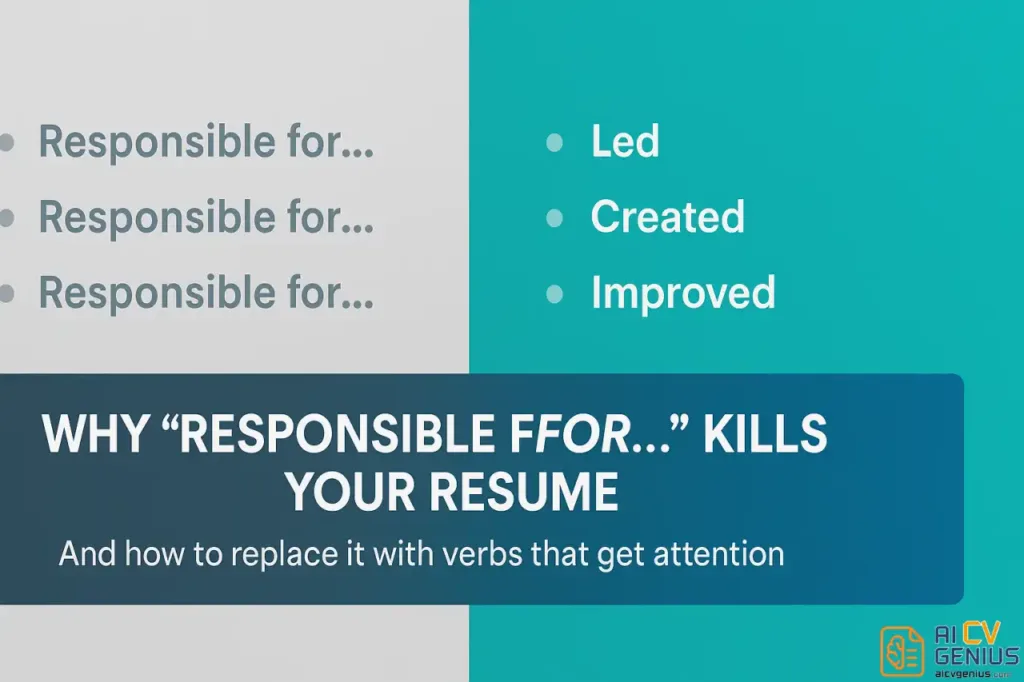
- The phrase “Responsible for” weakens your resume because it lists duties, not outcomes: Recruiters want evidence of impact, not a copy of your job description.
- Recruiters scan bullet points looking for proof fast: Starting with strong action verbs plus a measurable result communicates value immediately.
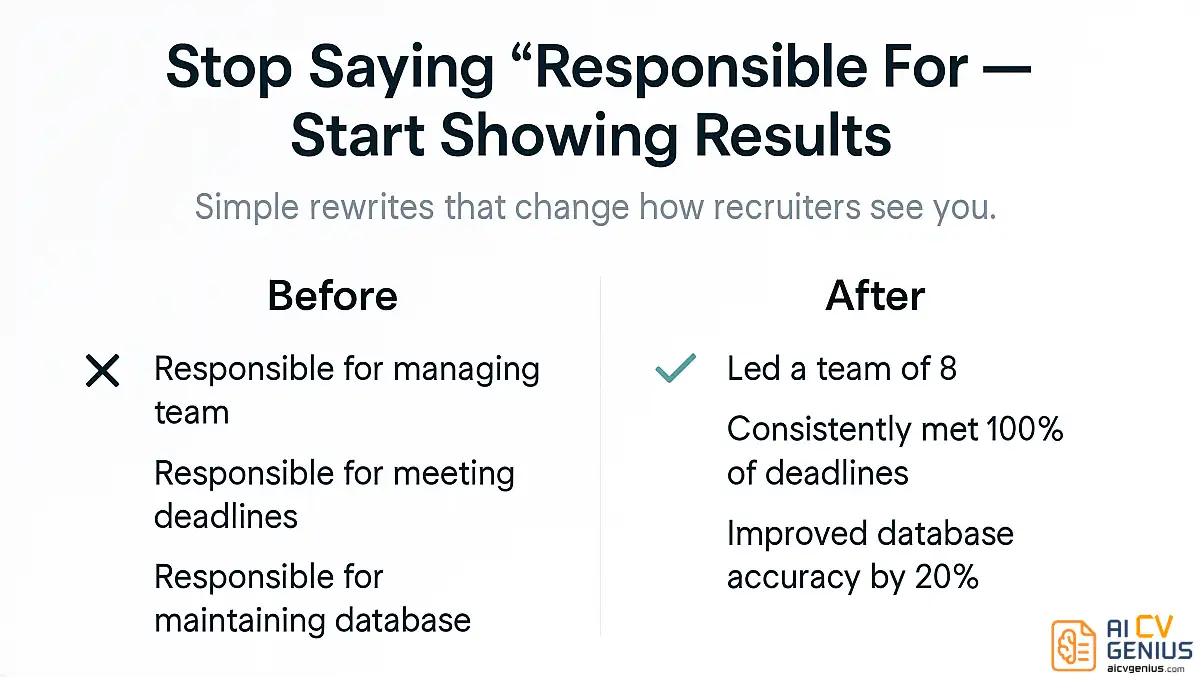
- The before and after rewrites show the pattern clearly: Swap passive duty lines for Action Verb + Context + Metric, so scope and results are obvious.
- The article gives a 4-step method to remove “Responsible for” systematically: Choose the real verb, add scope, add a result, then cut filler to keep bullets tight.
- Using “Responsible for” is only acceptable in rare cases: High-level accountability or when followed instantly by a strong outcome, otherwise vary verbs and quantify to avoid repetition and “pattern fatigue.”
It’s lurking innocuously on countless resumes, perhaps even yours: the seemingly harmless phrase, “Responsible for.” You might have added it without a second thought, believing it clearly outlines your duties. But here’s the stark reality: every time you lean on this phrase, you inadvertently sabotage your professional narrative. It drains the energy from your accomplishments, obscures your true impact, and ultimately contributes to the frustrating silence following your applications. Understanding why “responsible for” kills your resume is the first critical step toward transforming how you communicate your value.
Recruiters don’t dismiss the phrase because it’s grammatically incorrect. They bypass it because it’s devoid of substance. “Responsible for” merely states what you were assigned, not what you actually achieved. It lists obligations, not tangible outcomes. And in a fiercely competitive job market where recruiters scan hundreds of resumes under immense time pressure, obligations fade into the background. Concrete results command attention.
The Illusion of Effort vs. The Evidence of Impact
When your resume states, “Responsible for managing a team,” the recruiter is left guessing: Did you inspire them? Did the team exceed its targets? Did you navigate complex challenges, drive innovation, or simply ensure tasks were completed? Without explicit proof of impact, the assumption defaults to the minimum required effort. This passive phrasing creates ambiguity, forcing the reader to do the interpretive work – work they simply don’t have time for. And herein lies the silent tragedy: capable candidates are frequently overlooked because their resumes read like generic job descriptions rather than compelling narratives of success.
Let’s meticulously dissect why this seemingly innocuous phrase undermines your momentum and explore powerful alternatives that instantly convey credibility, initiative, and the hireable qualities employers actively seek.
How Recruiters Actually Read Your Bullet Points
The Scanning Mindset: Hunting for Proof
When recruiters open your resume (as detailed in What Really Happens When a Recruiter Opens Your Resume), they aren’t leisurely reading prose; they are executing a rapid, targeted scan for evidence. Their subconscious filter constantly asks: “Did this candidate demonstrably make things better? Did they solve problems? Did they achieve results?” If your bullet points don’t provide affirmative answers within the first few seconds, your resume risks being relegated to the “no” pile.
“Responsible for” forces them to infer or guess the answer. In contrast, starting with dynamic action verbs like “Led,” “Improved,” “Increased,” or “Reduced” delivers the answer directly and immediately. That is the fundamental power of strategic verb choice.
How Verbs Shape Perception and Convey Energy
Language is inherently persuasive; word choice significantly shapes emotional and cognitive responses. “Responsible for managing sales” sounds bureaucratic, passive, and routine. “Grew regional sales by 24% in FY2024” sounds dynamic, active, and impactful. Both might technically describe aspects of the same role – one focuses on assigned duty, the other highlights achieved proof. Recruiters instinctively gravitate towards, and vividly remember, proof.
Here’s a core principle to internalize: recruiters don’t primarily reward described effort – they reward demonstrated impact. Possessing identical experience to another candidate is irrelevant if their phrasing effectively communicates results while yours merely lists tasks. This linguistic difference often determines who secures the interview and who remains unheard.
Before and After: The Transformative Power of Rewriting
Witness the dramatic shift in clarity and impact:
| ❌ Before (Passive Duty: “Responsible for…”) | ✅ After (Active Achievement: Action Verb + Result) |
|---|---|
| Responsible for managing a project team of 5 engineers. | Led a cross-functional team of 5 engineers to successfully deliver the [Project Name] software module two weeks ahead of the scheduled deadline. |
| Responsible for creating social media posts for campaigns. | Created and scheduled engaging social media content (images, videos, copy) across 3 platforms that boosted average post engagement by 35% within Q3. |
| Responsible for handling customer service inquiries. | Resolved an average of 40+ weekly client technical support issues via email and phone, consistently maintaining a 98% customer satisfaction rating based on post-interaction surveys. |
| Responsible for filing monthly performance reports. | Streamlined the monthly performance reporting process using Excel automation (macros, pivot tables), reducing manual data compilation time by approximately 20% (saving 8 hours/month). |
| Responsible for training new staff members. | Developed and implemented a comprehensive 4-week onboarding and training program for new hires, which was subsequently adopted as the standard company-wide process. |
Observe the consistent pattern: one column describes assigned obligations; the other column provides compelling evidence of impact and initiative. The strategic use of strong verbs injects momentum – it portrays you as an individual who actively drives outcomes, not merely someone who was assigned tasks.
What Recruiters Actually Think When They See “Responsible For”
Understanding the subconscious signals this phrase sends is crucial:
Assumption #1: It’s Likely Copied from a Job Description
Most recruiters are intimately familiar with standard job descriptions. When they encounter “Responsible for…” repeated numerous times throughout a resume, it often signals that the candidate simply lifted generic text from their old JD or an online template. This lack of personalization tells the recruiter nothing unique or compelling about your specific contributions. Even rewriting a single key bullet point to focus on results can dramatically shift this perception from passive recipient to proactive achiever.
Assumption #2: It Lacks Necessary Context and Scope
Consider the phrase “Responsible for events.” This is frustratingly ambiguous. What kind of events? Corporate conferences, small workshops, fundraising galas? How many attendees? What was the budget managed? What were the key success metrics (attendance, revenue generated, satisfaction scores)? Vague language forces recruiters to make assumptions or fill in critical blanks – a task they rarely have time for amidst hundreds of other applications. Specificity builds credibility.
Assumption #3: It Signals a Lack of Ownership or Initiative
While perhaps unintentional, repeatedly using “Responsible for” can subtly imply that you merely executed assigned tasks rather than taking genuine ownership or proactively seeking improvements. In contrast, action verbs like “Led,” “Developed,” “Optimized,” or “Solved” inherently convey initiative, problem-solving, and a focus on driving positive change – qualities highly sought after in almost any role.
Result: Pattern Fatigue and Diminished Engagement
The human brain naturally tunes out excessive repetition. If every bullet point begins with the identical passive phrase, the recruiter’s attention inevitably wanes. Utilizing a variety of strong, relevant action verbs – “Created,” “Improved,” “Designed,” “Analyzed,” “Negotiated” – not only makes your resume more engaging and dynamic but also showcases a broader range of skills and contributions.
How to Systematically Eliminate “Responsible For” in 4 Steps
Transform your passive descriptions into powerful achievement statements:
Step 1: Identify the Core Action Verb
Analyze the underlying task. What specific action did you actually perform? Replace vague phrases like “responsible for managing” with precise, active verbs such as “Led,” “Coordinated,” “Supervised,” or “Directed.” Choosing the right verb immediately places you in control of the narrative.
Step 2: Add Specific Context and Scope
Provide necessary details to illustrate the scale and nature of your work. Numbers are incredibly effective here. “Managed projects” is weak. “Managed 12 concurrent client software implementation projects with budgets up to $50K each” instantly conveys scope and complexity.
Step 3: Articulate the Measurable Result or Outcome
Crucially, answer the “So what?” question. How did your action positively impact the team, department, or organization? Whenever possible, quantify this impact using percentages (%), time saved (hours/days), costs reduced ($), revenue generated ($), clients served (#), or efficiency gained. Recruiters’ eyes are naturally drawn to digits – they represent concrete proof. (For data supporting this, see the analysis in Improve Your CV.) If precise numbers aren’t available, describe a specific positive qualitative outcome (e.g., “resulting in improved team morale,” “leading to adoption as a best practice”).
Step 4: Trim Excess Words and Filler Phrases
Eliminate weak, redundant, or unnecessary phrases like “on a daily basis,” “as needed,” “when required,” or “assisted with efforts related to.” These add length but subtract value and dilute impact. Strive for concise, powerful statements. Each bullet point should ideally convey its core message clearly and completely in one or two lines maximum.
The Subtle Psychology Behind Strong Action Verbs
The impact extends beyond mere grammar:
Verbs Create Narrative Momentum
Strong action verbs inject energy and imply forward movement. Recruiters subconsciously associate verbs like “Developed,” “Launched,” “Transformed,” or “Spearheaded” with qualities like leadership, initiative, and ownership. Passive phrasing, conversely, suggests stagnation or simply following instructions.
Verbs Imply Confidence and Ownership
Consider the subtle difference: “Responsible for creating monthly reports” sounds like fulfilling an obligation, possibly requiring permission or oversight. “Created automated monthly reports using [Tool]” sounds like proactive ownership and competence. This psychological shift significantly influences how recruiters perceive your seniority, autonomy, and initiative.
Verbs Enhance Memorability
During interviews and subsequent discussions, hiring teams recall candidates who sound like they actively achieve results. They don’t typically remember lists of mundane tasks; they remember compelling stories of transformation and impact. Action verbs help create vivid mental visuals – and visuals are inherently more memorable than abstract concepts.
Checklist: Transforming Your Resume Language from Passive to Powerful
Apply these checks rigorously to every bullet point:
- ✅ Systematically replace nearly every instance of “Responsible for” with strong, specific action verbs (e.g., Led, Created, Implemented, Delivered, Managed, Analyzed, Increased, Reduced, Optimized).
- ✅ Strive to begin each bullet point describing your experience with a unique and impactful action verb relevant to the achievement described.
- ✅ Incorporate at least one quantifiable metric (%, $, #, time saved) or specific positive outcome for each significant role or project listed.
- ✅ Ensure verb tense consistency: use present tense for your current role(s) and past tense for all previous positions.
- ✅ Ruthlessly eliminate filler words and phrases (“on a regular basis,” “assisted with,” “helped to,” “involved in”) that dilute impact and add unnecessary length.
- ✅ Keep sentences concise and focused, ideally under two lines each, enhancing scannability and immediate comprehension.
- ✅ Verify that your chosen layout utilizes ample white space and clear visual hierarchy (e.g., consistent use of bolding for titles/metrics) to maximize readability.
Real Example: The Tangible Impact of Rewriting
The Candidate’s Situation
A marketing coordinator who had applied to 25 relevant positions over two months with zero interview invitations. Her original resume was heavily reliant on “Responsible for” statements. After a targeted rewrite focusing solely on replacing passive phrasing with action verbs and quantifiable results, she landed two interviews within one week using the revised version.
| Old Resume (Passive Duties) | Rewritten Resume (Active Achievements) |
|---|---|
| Responsible for managing company email marketing campaigns. | Launched 5 targeted, automated email nurture campaigns using [Platform, e.g., HubSpot] reaching 12K+ subscribers, resulting in an average Click-Through Rate (CTR) increase of 19% compared to previous manual sends. |
| Responsible for daily social media updates across platforms. | Produced and scheduled engaging weekly content (posts, stories, short videos) for Instagram and LinkedIn that grew overall audience engagement metrics by 42% and organically added 3K+ new, relevant followers over six months. |
| Responsible for reporting campaign results to management weekly. | Delivered comprehensive monthly performance dashboards using Google Analytics and Excel, providing data-driven insights that directly guided the strategic allocation of $50K+ in quarterly digital advertising spend. |
The underlying experience remained identical. Only the narrative – the story told through strategic language – changed. Recruiters don’t necessarily need more information; they desperately need more clarity regarding your impact.
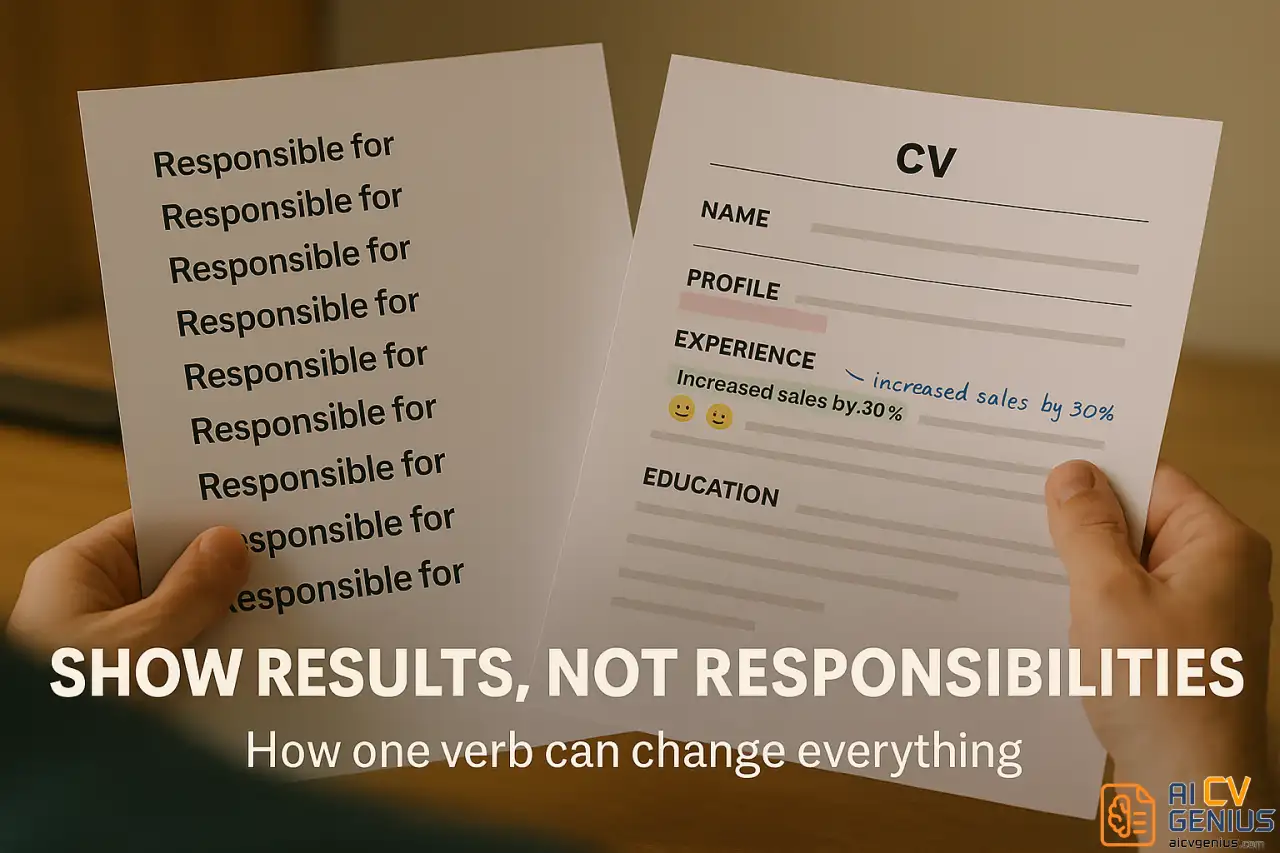
When Can You Still Use “Responsible For”? (Use Sparingly)
While generally weak, the phrase isn’t entirely forbidden if used strategically and infrequently:
1. When Describing High-Level Accountability or Oversight
If the word “responsible” specifically highlights ultimate accountability, ethical duty, or regulatory oversight (e.g., “Held ultimate P&L responsibility for the $10M European division,” or “Directly responsible for ensuring adherence to all SOX compliance regulations”), it can sometimes carry appropriate weight. However, even in these cases, reframing with active verbs and results is often stronger if possible: “Ensured 100% compliance with SOX regulations across 4 key departments through rigorous internal audits and process improvements.”
2. When Immediately Followed by a Strong Outcome
You can occasionally retain the phrase if it serves purely as a brief setup immediately followed by a powerful, quantifiable result: “Responsible for training all new customer service hires (approx. 15 per quarter), resulting in a documented 20% reduction in average onboarding time and improved first-call resolution rates.” Here, the strong result effectively mitigates the weakness of the initial phrasing.
3. For Extreme Brevity (Very Rare Cases)
If resume space is exceptionally tight and you need to convey a complex area of oversight very concisely, using “Responsible for [Broad Area]” once might be acceptable. However, avoid this crutch. Variety in sentence structure demonstrates better writing skills and keeps the reader engaged. Repetition signals laziness or lack of substantive achievements to highlight.
A Thesaurus of Power: Strong Verbs to Replace “Responsible For”
Keep this list handy during your resume rewrite:
| Category of Action | Impactful Verbs to Use |
|---|---|
| Leadership & Management | Led, Directed, Supervised, Mentored, Coached, Coordinated, Oversaw, Governed, Spearheaded, Orchestrated |
| Strategy & Creation | Developed, Designed, Implemented, Executed, Launched, Created, Produced, Conceptualized, Built, Architected, Founded, Established, Formulated |
| Improvement & Results | Increased, Grew, Expanded, Improved, Enhanced, Optimized, Streamlined, Reduced, Decreased, Saved, Consolidated, Achieved, Delivered, Generated, Secured |
| Communication & Collaboration | Presented, Negotiated, Persuaded, Collaborated, Partnered, Wrote, Authored, Advised, Facilitated, Liaised |
| Analysis & Research | Analyzed, Measured, Assessed, Evaluated, Researched, Investigated, Forecasted, Modeled, Audited, Identified |
| Problem-Solving & Resolution | Solved, Resolved, Addressed, Mitigated, Overcame, Diagnosed, Troubleshot |
These verbs inject dynamism and specificity into your experience. Use them thoughtfully and accurately; your resume will immediately feel more energetic and credible without resorting to exaggeration.
FAQ: Eliminating “Responsible For” Effectively
Final Thought: Owning Your Impact
Ultimately, your resume isn’t just a neutral listing of responsibilities – it’s your strategic highlight reel showcasing results achieved. Systematically replacing the passive, ubiquitous phrase “Responsible for” isn’t merely about adhering to grammatical preferences; it’s about fundamentally reclaiming ownership of your professional narrative. It shifts your story’s focus from passively fulfilling assigned duties to proactively driving purposeful outcomes, transforming your perceived value from invisible to irresistible in the eyes of recruiters. That’s the profound reason why “responsible for” kills your resume – it obscures the very impact employers are searching for.
Begin today by rewriting just one “Responsible for” bullet point on your current resume using a strong action verb and a specific result. Experience firsthand how this small linguistic shift immediately elevates the energy and credibility of your statement. You’ll likely be surprised by how quickly both you and potential employers notice the powerful difference. And when you’re ready to ensure your entire presentation consistently reflects this impact-driven approach, explore the professionally designed layouts in the Resume Templates Finder – templates specifically engineered to let your powerful verbs, and consequently your true value, shine through clearly.