
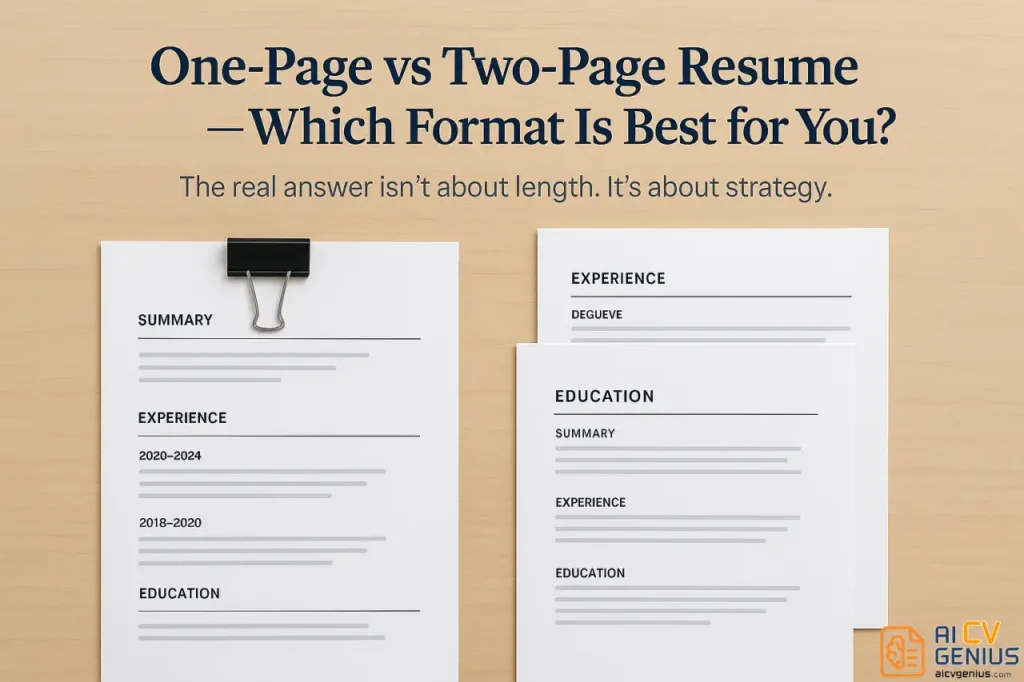
- Main takeaway: Resume length is a strategy choice about clarity and storytelling, not an old “one page rule”.
- 7-second scan reality: Recruiters scan for relevance, titles, skills, recent fit, and measurable wins, not page count.
- One-page is best when: You are early-career, under about 7 to 10 years, changing careers, or in fields that reward brevity.
- Two-page is best when: You have 10+ years, technical or academic depth, project-heavy work, or lots of certifications that need space.
- Non-negotiable execution: Page 1 must carry the strongest proof, avoid cramped formatting, keep ATS-friendly structure, and never add fluff just to fill space.
Introduction: The One-Page vs. Two-Page Debate
It is the oldest debate in career advice: “Should my resume be one page or two pages?” For decades, the answer was a rigid, unwavering “one page, no exceptions.” That advice is now dangerously outdated. In a digital hiring world, context matters more than conformity, and clarity matters more than page count.
Choosing between a one page vs two page resume is not about following an arbitrary rule. It is a strategic choice about storytelling. Are you telling a story of focused potential, or a story of deep, proven experience? Your career stage, industry, and the complexity of your achievements all dictate the right format.
This guide will dismantle the one-page myth, explore the psychology of the recruiter’s 7-second scan, and provide clear, actionable rules for when to use each format. We will replace dogma with strategy, so you can choose the length that best sells your unique value.
The Psychology of the 7-Second Scan
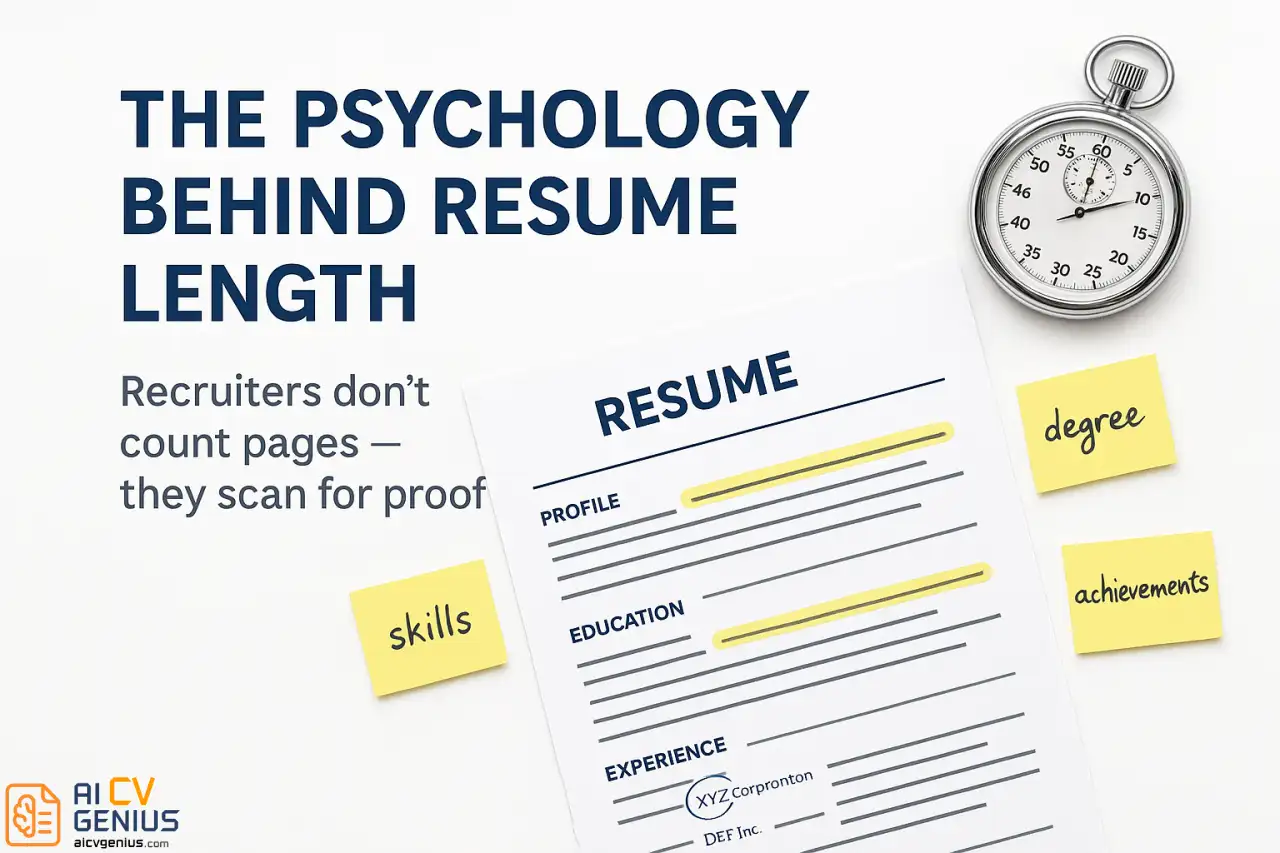
Recruiters do not “read” resumes initially. They scan. Studies show you have about 7 seconds to make an impression. During this scan, they are not counting pages; they are hunting for proof of relevance. Their internal monologue sounds like this:
- “Does this person have the right job title?”
- “Do their skills match the job description?”
- “Is their recent experience relevant?”
- “Are there any quantifiable achievements?”
Resume length matters because it affects the “density” of this information.
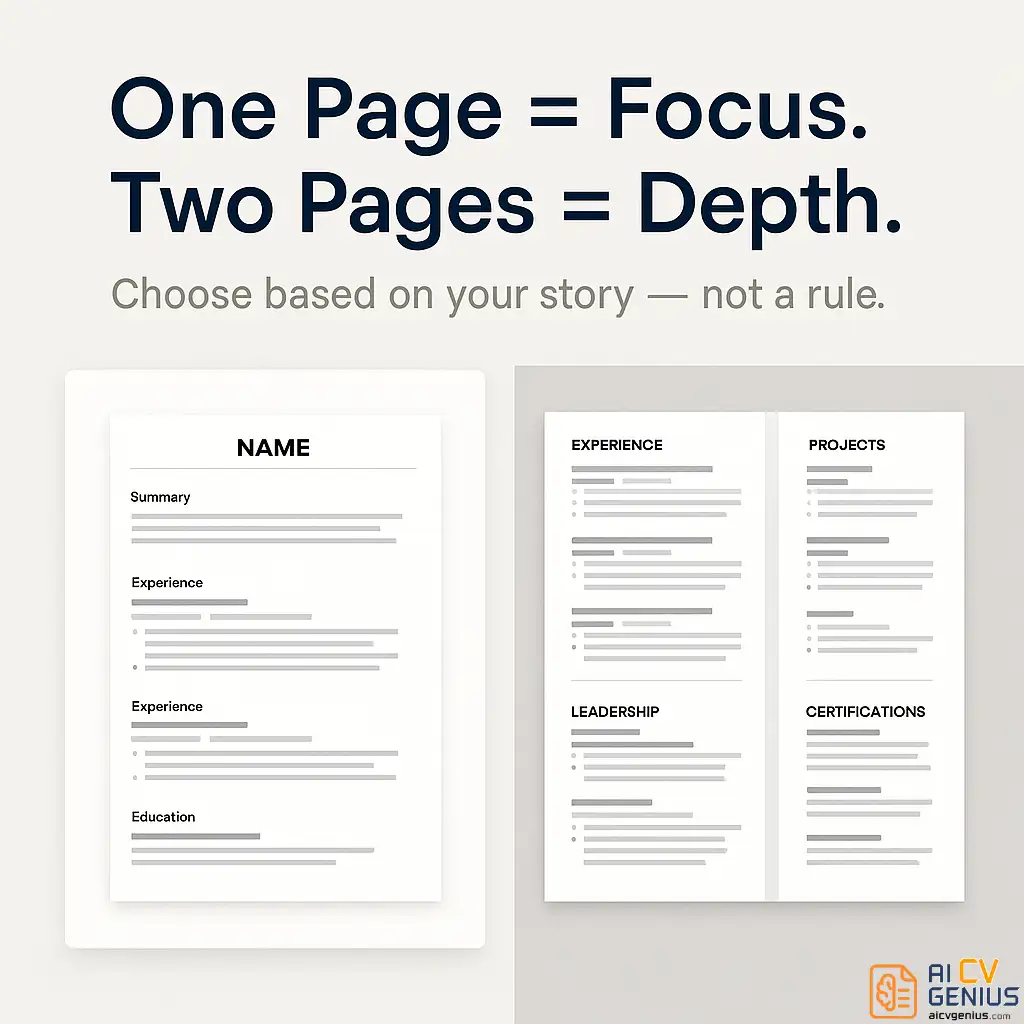
- A one-page resume is dense and impactful. It forces you to be ruthless, making every word count. It is perfect for telling a story of “potential and focus.”
- A two-page resume is comprehensive and detailed. It allows for context, nuance, and a deeper dive into projects and outcomes. It tells a story of “experience and depth.”
Choosing the wrong format creates friction. A two-page resume for an entry-level candidate feels padded and full of fluff. A one-page resume for a 20-year executive feels shallow and incomplete. Your choice signals your level of professional self-awareness.
The Case for the One-Page Resume
When to Use a One-Page Resume: Clarity and Focus
A one-page resume is your sharpest tool when your story is about focused potential rather than a long history. It is the standard for a reason: it respects the recruiter’s time and is inherently ATS-friendly.
You should absolutely use a one-page resume if:
- ✅ You Are a Student or Recent Graduate: Your experience (internships, projects, coursework) is relevant but not extensive. One page shows you can be concise and professional.
- ✅ You Have Less Than 7-10 Years of Experience: For most professionals in the first decade of their career, one page is sufficient to highlight key achievements without resorting to filler.
- ✅ You Are Making a Significant Career Change: A one-page resume forces you to highlight only your transferable skills and new certifications, rather than dwelling on a long, irrelevant past.
- ✅ You Are in a Field That Values Brevity: In fields like marketing, advertising, or design, the ability to communicate with impact and brevity is, itself, a required skill.
Best Practices for One-Page Perfection
- Prioritize Ruthlessly: If a bullet point does not support your case for this specific job, cut it. Remove jobs from over 10 years ago unless they are critical.
- Quantify Everything: Use numbers to show impact, not just words. “Increased engagement by 25%” is stronger than “Managed social media accounts.”
- Master White Space: Do not shrink margins to 0.2 inches or use a 7pt font. A crowded one-page resume is harder to read than a clean two-page resume. White space is your friend; it guides the eye.
- Use Strong Action Verbs: Start every bullet with a powerful verb: “Led,” “Managed,” “Developed,” “Streamlined,” “Negotiated.”
The Case for the Two-Page Resume
When to Use a Two-Page Resume: Depth and Context
For experienced professionals, forcing 15+ years of achievements onto one page is an act of self-sabotage. You are not “trimming the fat”; you are “cutting muscle.” A two-page resume is not a sign of rambling; it is a sign of seniority.
A two-page resume is the right choice if:
- ✅ You Have 10+ Years of Relevant Experience: You are a mid-level, senior, or executive professional. You need space to detail leadership, scope of responsibility (e.g., P&L, team size), and career progression.
- ✅ You Are in a Technical or Academic Field: Fields like IT, engineering, science, or academia require lists of projects, publications, patents, or technical skills that simply will not fit on one page.
- ✅ You Are a Project-Based Professional: Consultants, project managers, or freelancers need space to detail the “Problem, Action, and Result” of several key engagements.
- ✅ You Have Extensive Certifications or Licenses: Professionals in fields like finance (CPA, CFA), project management (PMP), or healthcare (RN, MD) need room for these critical credentials.
Best Practices for Two-Page Impact
- Make Page One Count: The 7-second scan still applies. Page one must contain your most critical information: your summary, key skills, and most recent/relevant roles. Assume page two might only be skimmed.
- Put Your Name on Both Pages: Add your name and “Page 2” to the header of the second page. Pages can get separated, digitally or physically.
- Do Not “Split” Entries: Never split a job description between page one and page two. Ensure each role and its bullet points are contained on a single page.
- Avoid the “Half-Page” Fail: A resume that is 1.25 pages long looks unfinished. If you go onto a second page, ensure you fill at least half of it with relevant content (like a “Key Projects” or “Certifications” section). If you cannot, stick to one page.
Analysis, Comparison, and Case Studies
Pros and Cons: A Head-to-Head Comparison
Your choice has direct consequences. Here is a simple breakdown of the trade-offs you are making.
One Page Resume
| Format | ✅ Pros | ❌ Cons |
|---|---|---|
| One Page Resume |
|
|
| Two Page Resume |
|
|
Decision Matrix: One Page vs Two Page Resume
Use this table as a quick reference guide. Find your profile and see the recommended format.
| Your Profile | One Page Resume | Two Page Resume |
|---|---|---|
| Student / Recent Graduate | ✔ Recommended | (Only if in a highly technical/academic field with extensive research) |
| Entry-Level (0-5 years) | ✔ Recommended | (Avoid unless you have critical, relevant projects) |
| Mid-Level (6-10 years) | ✔ Recommended (If you can be concise) | ✔ Also Acceptable (If you have complex roles) |
| Senior / Executive (10+ years) | (Avoid, looks inexperienced) | ✔ Recommended |
| Career Changer | ✔ Recommended (Focuses on transferable skills) | (Only if new career builds directly on old one, e.g., PM) |
| Academic / Scientist / MD | (Not sufficient) | ✔ Recommended (Or a multi-page CV) |
| IT / Engineer / Developer | (Good for entry-level) | ✔ Recommended (For listing projects & tech stacks) |
Case Study 1: The Graduate (Emma)
Emma just graduated with a degree in communications. She had two internships, one volunteer role, and a campus leadership position. She correctly chose a one-page resume. This forced her to translate her internship duties into achievements. Instead of “Posted on social media,” she wrote, “Managed 3 social media accounts during internship, boosting engagement by 25%.” Her concise, impactful format helped her land a PR assistant job within weeks.
Case Study 2: The Senior Engineer (Michael)
Michael had 15 years of experience in mechanical engineering, multiple patents, and leadership roles in several large-scale projects. His one-page attempt was a cramped, unreadable mess. He switched to a two-page format. Page one held his summary, skills, and his last two senior roles. Page two detailed his earlier experience, a “Key Projects” section, and his list of patents. This allowed him to showcase his depth and won him a senior engineering manager role.
Comparison: Weak vs Strong Resume Bullets (For Any Length)
The effectiveness of your resume is not just its length, but the power of its content. Weak bullets are passive and describe duties. Strong bullets are active and prove achievements.
| Weak (Duty-Focused) | Strong (Achievement-Focused) |
|---|---|
| “Responsible for managing projects.” | “Managed 5 concurrent projects remotely, delivering all on time and 10% under budget.” |
| “Worked with customers.” | “Handled 50+ weekly customer inquiries, resolving 95% on first contact and achieving a 95% satisfaction rate.” |
| “Involved in content creation.” | “Developed a content strategy that grew blog traffic by 150% in 6 months.” |
FAQ and Final Thoughts
In-Depth FAQ: One Page vs Two Page Resume
Final Thoughts: Storytelling Over Rules
Stop agonizing over the one page vs two page resume debate. Instead, ask yourself a better question: “What is my story, and what is the best way to tell it?”
Your goal is to present the right amount of detail for your specific career stage and the job you are targeting. For graduates and early professionals, brevity wins. For seasoned leaders and technical experts, depth and context matter more.
Focus on clarity, strong action verbs, and measurable achievements. Whether it takes one page or two, a resume that is clear, relevant, and filled with proof of your accomplishments will always impress recruiters. Trust your professional judgment, not an outdated rule.