
- What this guide solves: How to use a teacher resume template to show both human warmth and measurable classroom impact in a fast scan.
- Best structure choice: Use a Combination format to put key skills up top while keeping a clear reverse-chronological work history.
- How to write experience: Replace duty lists with Challenge, Action, Result bullets and quantify outcomes using observable proof like growth, engagement, attendance, referrals, or club participation.
- What to highlight for credibility: Put licenses, endorsements, and high-value certifications in a separate section and build an ATS-friendly skills list across pedagogy, tech tools, and leadership.
- Final polish that wins interviews: Tailor keywords to each school type, avoid generic templates and overloaded design, run a pre-flight checklist, and adjust your story by experience level.
A teacher’s resume is one of the most challenging documents to write. Why? Because it’s more than a list of schools and degrees – it’s an attempt to capture your patience, your passion, and your purpose on a single piece of paper. When you build your resume using a strong teacher resume template, you’re not just proving you can manage a classroom; you’re showing a principal how you inspire learning, spark curiosity, and create a safe, engaging community for students, day in and day out.
The truth is, hiring principals aren’t just looking for a “Subject Matter Expert.” They’re looking for a mentor, a collaborator, and a pillar of the school’s culture. They can find someone who knows an subject anywhere. They want someone who can teach it, live it, and inspire it in others.
Whether you are a new graduate eager to land your first classroom, a veteran educator seeking a new challenge, or a specialist in primary, secondary, or adult education, this guide will move beyond the basics. We will explore how to write, format, and polish a teacher resume that feels as deeply human as it is profoundly professional. This is how you tell your unique story.
Why Your Resume Matters & How to Structure It
Let’s be honest. The hiring process in education can feel impersonal. Hiring principals, HR coordinators, and district education boards are inundated with hundreds of applications for a single opening. What truly makes one stand out in that digital pile? It’s not just qualifications – it’s the immediate sense of warmth, clarity, and evidence of impact.
Many resumes are scanned by an Applicant Tracking System (ATS) before a human ever sees them. After that, you’re subject to the infamous 6-second resume rule, where a principal makes a snap judgment. Your resume doesn’t just need to be good; it needs to be immediately compelling.
The best teacher resumes strike a difficult balance between structure and soul. They show measurable results without losing the heart that makes you a great educator. They demonstrate a command of pedagogy while also hinting at the person who will stay late to help a struggling student. Let’s break down how to write one that earns you both respect and, most importantly, the interview.
Before we write, we must plan. A disorganized resume implies a disorganized classroom. A clean, logical, and professional format is non-negotiable. It shows respect for the reviewer’s time and makes it easy for them to find what they need – fast.
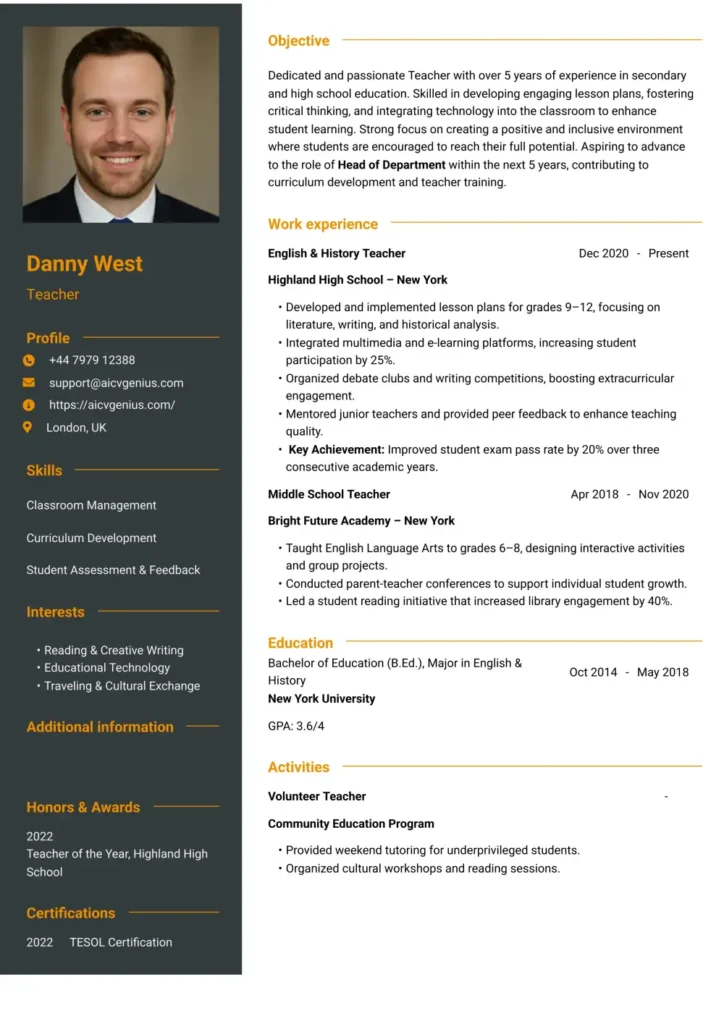
Step 1: Choose Your Narrative Framework (The Format)
Teachers come from varied backgrounds. Some have a linear, consistent teaching history; others are re-entering the field or changing specializations. Your format choice tells a story.
- Reverse-Chronological: This is the gold standard for education. You list your most recent teaching position first and work backward. It’s best for teachers with a consistent, strong history. Principals prefer this format because it clearly shows your career progression.
- Combination (or Hybrid): This format is increasingly popular and highly effective. It starts with a powerful “Skills” or “Areas of Expertise” section at the top, followed by your chronological work history. This is perfect for balancing hands-on classroom experience with specific, high-demand skills like curriculum design, technology integration, or special needs certification.
- Functional: Use with caution. This format focuses almost entirely on skills and downplays work history. It can be useful if you are making a dramatic career change into teaching, but it often raises red flags for principals who want to see where and when you acquired your experience.
Our expert recommendation: Stick with the Combination format. It gives you the best of both worlds. It showcases your immediate value “above the fold” while still providing the clear, chronological history that administrators expect.
As for length, keep it to one page if you have less than 10 years of experience. A two-page resume is acceptable only if you are a senior educator, administrator, or have a deep list of publications, presentations, and research to include. Brevity is a sign of confidence.
Step 2: Craft a Warm, Confident “Teaching Philosophy” Summary
The professional summary is your “first hello.” In education, this section is your chance to convey your teaching philosophy in 3-4 powerful lines. It must share who you are as a teacher, the specific value you bring, and the passion that drives you. Avoid generic, fluffy statements like “Passionate teacher who loves kids.” Get specific.
Weak Summary (What to avoid):
“Dedicated elementary teacher with 6+ years of experience. Skilled in teaching and classroom management. Looking for a new role in a good school.”
Strong Summary (What to aim for):
“Compassionate and data-driven Elementary Teacher with 6+ years of experience fostering inclusive, inquiry-based learning environments. Proven expertise in differentiating instruction for diverse learners and integrating new educational technology to boost student engagement. Committed to helping each child discover their unique strengths and develop a lifelong love of learning.”
Tip: Let your personality peek through. Use strong adjectives. Are you “data-driven,” “compassionate,” “inquiry-based,” “student-centered,” or “community-focused”? Pick one or two that truly define you and weave them in. Schools hire people, not just a list of skills.
Step 3: From ‘Duties’ to ‘Impact’ – Detailing Your Teaching Experience
This is the heart of your resume. Most teachers make a critical mistake here: they list their duties, not their achievements.
A principal knows what a teacher is “responsible for.” They know you plan lessons, grade papers, and manage a classroom. Listing these things wastes valuable space. You must shift your mindset from “What did I do all day?” to “What was the result of my work?”
Instead of passive phrases like “Responsible for teaching…”, use dynamic action verbs. This isn’t just a style choice; it’s a psychological shift from “what I was told to do” to “what I achieved.” If your resume is full of passive language, it’s time for an upgrade. Learn more about why ‘responsible for’ kills your resume.
Use the Challenge -> Action -> Result (CAR) framework for your bullet points.
Standard (Weak):
- Taught 9th-grade English.
- Used smartboard technology.
- Managed classroom behavior.
Impact-Driven (Strong):
English Teacher, Riverside High School | 2018–Present
- Designed and implemented a project-based learning curriculum for 9th-grade English, resulting in a 15% improvement in standardized test scores.
- Pioneered the use of interactive smartboard technology and collaborative apps, boosting classroom engagement and participation by over 35%.
- Mentored three new teachers in positive classroom management techniques, contributing to a 20% school-wide decrease in disciplinary referrals.
How to Quantify the “Unquantifiable”
This is the biggest hurdle for educators. “How do I put a number on ‘curiosity’ or ’empathy’?” You get creative and focus on observable outcomes. Data speaks volumes, even in education.
| Instead of (Weak) | Try (Strong) |
|---|---|
| “Helped struggling readers.” | “Piloted a peer-tutoring reading initiative that advanced 85% of participating students by at least one full reading level.” |
| “Good at parent communication.” | “Instituted a monthly digital newsletter and ‘office hours’ for parents, increasing parent-teacher conference attendance by 40%.” |
| “Led the science club.” | “Grew the after-school STEM club from 10 to 45 students by securing a local grant and organizing the school’s first-ever robotics fair.” |
| “Taught social-emotional learning.” | “Integrated a daily mindfulness and ‘check-in’ circle, leading to a measurable 30% reduction in classroom disruptions and fostering a more empathetic class culture.” |
Even if you don’t have hard numbers, you can show initiative. “Selected by the principal to lead professional development workshops on…” or “Redesigned the 5th-grade science curriculum to better align with new state standards…”
Step 4: Beyond the Degree – Showcasing Your Credentials
Education is your foundation. This section must be clear, precise, and easy to scan. Don’t just list your degrees; include credentials that strengthen your authority and relevance in a modern classroom.
List your degree, university, and graduation year. Your GPA is only relevant if you are a brand-new graduate (and it’s over 3.5). After your first 2-3 years of teaching, your experience is far more important, and the GPA should be removed.
Crucially, create a separate sub-section for “Certifications and Endorsements.” This is where you shine. List your state teaching license first, ensuring it’s current. Then, add other high-value credentials.
Example:
Education
Master of Arts in Teaching (M.A.T.) – Greenfield University, 2017
Bachelor of Arts in English Literature – State College, 2015
Certifications & Professional Development
• State of [Your State] Teaching License, Secondary English (Grades 7-12), Expires 2028
• TESOL Certification (120-hour) – 2019
• Google Certified Educator, Level 1 – 2021
• Special Education (SPED) Endorsement – 2022
• Mental Health First Aid for Youth Certification – 2023
Certifications in high-demand areas like SPED, ESL/TESOL, IB, Montessori, or Educational Technology (like Google Certified Educator or Apple Teacher) make you an incredibly attractive candidate.
Step 5: The Modern Educator’s Skillset (ATS-Friendly)
Teachers wear countless hats – you are an educator, counselor, organizer, tech wizard, and chief communicator, all before lunch. Your skills section must reflect this diversity. Ditch the simple “Hard Skills” and “Soft Skills” divide. Instead, categorize your skills to show your professional depth. This strategy is also highly effective for passing through ATS-friendly resume scanners.
Many schools use Applicant Tracking Systems (ATS) to filter applications. Your resume must include keywords from the job description. If the job description asks for “differentiated instruction,” “curriculum design,” and “parent communication,” those exact phrases should appear in your skills or experience sections.
Consider these categories:
- Pedagogical Skills: Differentiated Instruction, Lesson Planning, Assessment Design (Formative & Summative), Inquiry-Based Learning, Project-Based Learning, Social-Emotional Learning (SEL), Classroom Management, Student-Centered Learning.
- Digital & Technical Skills: Google Classroom, Canvas, Seesaw, Smartboard Technology, Microsoft 365 (inc. Teams), Zoom, Student Information Systems (SIS), Video Editing (e.g., WeVideo).
- Interpersonal & Leadership: Parent & Community Engagement, Faculty Collaboration, Student Mentorship, Conflict Resolution, Empathy, Adaptability, Public Speaking, Curriculum Development.
By balancing all three, you show that you understand the science of teaching, the tools of the modern classroom, and the heart of building relationships.
Teacher Resume Examples (By Experience Level)
A resume is not one-size-fits-all. The story you tell as a new graduate is very different from that of a department head. Here’s how to adapt your summary and experience.
The Entry-Level Teacher (New Graduate)
Your Goal: To prove that your potential, passion, and training outweigh your lack of full-time experience. You must heavily feature your student teaching.
Summary Example:
Enthusiastic and creative Education graduate from [Your University], passionate about creating inclusive and engaging learning spaces for 3rd-grade students. Skilled in modern classroom technology (Seesaw, Google Classroom) and group facilitation. Eager to bring fresh energy and collaborative strategies to a student-focused school environment.
Experience Section:
Treat your student teaching exactly like a professional job. Get specific and use impact statements.
Student Teacher, [School Name], [City, State] | [Dates]
- Co-taught a 4th-grade class of 28 students, developing and delivering 10+ lesson plans in math and science under the guidance of a mentor teacher.
- Integrated game-based learning tools (Kahoot!, Blooket) to review material, resulting in a 25% increase in quiz scores.
- Managed all parent communication for a 5-student reading group, providing weekly progress updates.
The Mid-Level Teacher (5-10 Years)
Your Goal: To demonstrate growth, expertise, and leadership potential. You’re not just a teacher; you’re a mentor and a resource for your colleagues.
Summary Example:
Results-oriented secondary History Teacher with 7+ years of experience in curriculum design and student mentorship. Proven record of improving AP exam pass rates by 22% through inquiry-based learning and critical thinking workshops. Seeking to contribute to a collaborative department focused on academic excellence.
The Senior / Head of Department (10+ Years)
Your Goal: To showcase high-level leadership, strategic vision, and school-wide impact. Your focus shifts from your classroom to the entire faculty’s success.
Summary Example:
Proactive and data-informed Science Department Head with 12 years of teaching and instructional leadership experience. Expertise in faculty training, NGSS curriculum implementation, and fostering school-wide professional learning communities (PLCs). Committed to building a culture of innovation and academic rigor.
The Complete Teacher Resume Example (Putting It All Together)
Theory is one thing; practice is another. Let’s apply every strategy we’ve discussed to build a complete resume for a fictional candidate, Emily Vance, a mid-level elementary teacher.
EMILY VANCE
Elementary School Teacher | STEM Integration Specialist
Austin, TX 78701 | (555) 123-4567 | emily.vance.edu@email.com | linkedin.com/in/emilyvance
PROFESSIONAL SUMMARY
Compassionate and data-driven Elementary Teacher with 6+ years of experience fostering inclusive, inquiry-based learning environments for grades 3-5. Proven expertise in differentiating instruction for diverse learners (including ELL and SPED) and integrating Google Classroom technology to boost student engagement by 35%. Committed to helping each child discover their unique strengths and develop a lifelong love of learning.
CORE COMPETENCIES
|
|
|
PROFESSIONAL EXPERIENCE
4th Grade Teacher | Austin Independent School District | Austin, TX (2018 – Present)
- Designed and implemented a project-based learning curriculum for 28 students, resulting in a 15% improvement in standardized test scores for math and science.
- Integrated a daily mindfulness and ‘check-in’ circle, leading to a measurable 30% reduction in classroom disruptions and fostering a more empathetic class culture.
- Instituted a monthly digital newsletter for parents, increasing parent-teacher conference attendance by 40% and improving at-home assignment completion.
- Pioneered the use of Google Classroom and Seesaw to differentiate instruction, boosting classroom engagement and participation by over 35%.
3rd Grade Teacher | Round Rock ISD | Round Rock, TX (2016 – 2018)
- Piloted a peer-tutoring reading initiative that advanced 85% of participating students by at least one full reading level within the school year.
- Collaborated with the 3rd-grade team to develop a unified set of formative assessments, improving data consistency across the grade level.
- Managed a classroom of 25 students, including 5 ELL students, by creating tailored lesson plans and visual aids.
EDUCATION & CERTIFICATIONS
- Texas Teaching License, Elementary (EC-6) (Active, Expires 2028)
- Special Education (SPED) Endorsement (2020)
- Google Certified Educator, Level 1 (2019)
- Master of Arts in Teaching (M.A.T.) | University of Texas at Austin (2016)
- Bachelor of Arts in English | Southwestern University (2014)
Final Polish: Templates, Mistakes, & FAQs
A teacher resume template can be a lifesaver, but it’s a tool, not a solution. How you use it matters.
Pros & Cons of Using a Teacher Resume Template
| Pros | Cons |
|---|---|
| ✅ Professionalism & Speed: Instantly saves time and ensures a clean, professional layout that administrators appreciate. | ❌ Generic Feel: Can look generic or “cookie-cutter” if not customized with your personal brand and keywords. |
| ✅ ATS-Friendly Structure: Good templates are designed to be easily read by Applicant Tracking Systems, ensuring you pass the first filter. | ❌ Design Overload: Overly “creative” templates with too many colors, columns, or icons can distract from your content and confuse ATS bots. |
| ✅ Organization: Helps you neatly organize diverse experiences, certifications, and skills without a cluttered feel. | ❌ Rigidity: A strict template may not fit your unique career story, especially if you have gaps or are changing careers. |
| ✅ Confidence: Knowing your format is solid allows you to focus 100% on what matters: writing powerful, impactful content. | ❌ Commonality: If you use a very common free template, your resume might look identical to 10 others in the stack. |
Common (But Avoidable) Mistakes on Teacher Resumes
We see the same well-intentioned mistakes time and again. A quick review can save your application from the “no” pile.
- ❌ The “Duties” List: As mentioned, writing “responsible for…” instead of using powerful action verbs and showing results.
- ❌ One-Size-Fits-All Applications: Sending the exact same resume to a tech-focused charter school and a traditional, arts-focused private school. Tailor your keywords and summary every time.
- ❌ Forgetting Soft Skills: Highlighting your knowledge of “Curriculum Design” but forgetting to include “Empathy,” “Collaboration,” and “Adaptability.” Schools want colleagues, not just instructors.
- ❌ Outdated Formatting: Using Times New Roman, objective statements, or a resume that’s 3 pages long. These signal you aren’t current with professional norms.
- ❌ Ignoring the “Why”: Your resume shows what you did. Your summary and achievements should also hint at why you did it – your passion for student success.
Your Final Pre-Flight Checklist
Before you click “send,” review your resume against this checklist.
- ✅ Philosophy First: Does your summary reflect your unique teaching philosophy and value?
- ✅ Impact-Driven: Is every bullet point in your “Experience” section starting with a strong action verb?
- ✅ Quantified: Have you added at least 3-5 numbers, percentages, or specific outcomes to prove your impact?
- ✅ Tailored: Does your resume include keywords from the specific job description you’re applying for?
- ✅ Current: Are all your certifications and licenses up-to-date and clearly listed?
- ✅ Flawless: Have you proofread it twice? (Then, have someone else proofread it again).
- ✅ Properly Saved: Is it saved as a PDF (never a .docx) with a professional file name? (e.g.,
JaneDoe_TeacherResume_2025.pdf).
Frequently Asked Questions (FAQs)
- Public School: They are often focused on state standards, data, test scores, and managing large, diverse classrooms. Emphasize: Differentiated instruction, data-driven results, classroom management, and experience with state-mandated testing.
- Private School: They often focus on a “whole-child” approach, extracurricular involvement, and parent community. Emphasize: Your mentorship roles (e.g., “Coached the debate team”), parent communication, and commitment to the school’s specific values (e.g., arts-integration, religious values, etc.).
- Charter School: They are often mission-driven, innovative, and fast-paced. Emphasize: Your adaptability, experience with new technology, project-based learning, and your enthusiasm for their specific mission (e.g., “STEM-focused,” “bilingual immersion,” etc.).
Final Thoughts: Your Resume is a Story, Not Just a List
Teaching is more than a job – it’s a calling. It’s one of the few professions that fundamentally shapes the future. Your resume should reflect that weight and that passion. When written well, it becomes a quiet but powerful statement of who you are, what you believe about learning, and the incredible value you bring to a school community.
Start with a professional layout, but don’t let it stamp out your warmth. Use numbers to prove your results, but use powerful, empathetic language to prove your value. A great teacher resume balances both, beautifully.
Ready to build yours? Explore our gallery of best resume templates for layouts designed for educators. And if you feel your entire CV needs a fresh perspective, start with these strategies to improve your CV today.
Your next classroom is waiting. This document is the key to opening that door.