

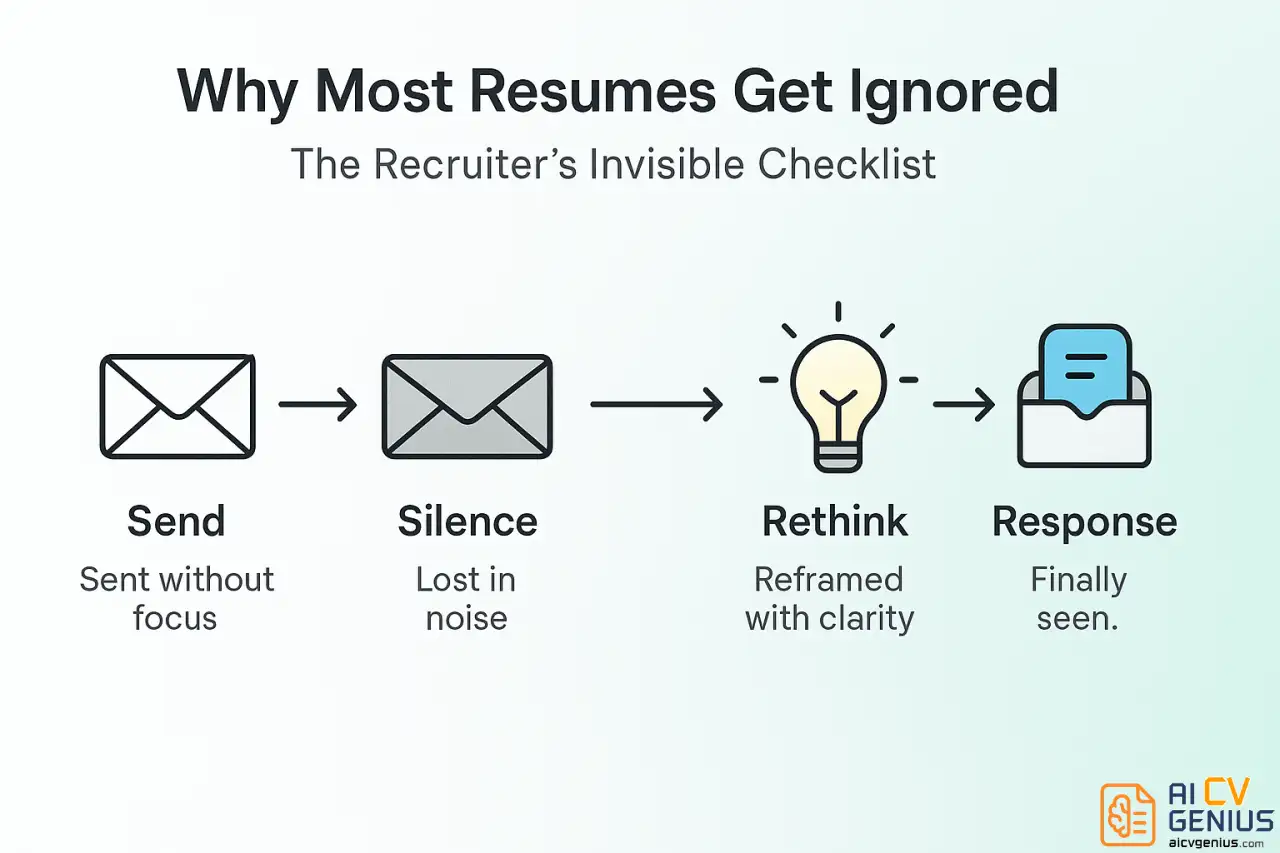
- The story starts with thirty-seven tailored applications and zero replies, then reframes the problem as visibility: Recruiters likely saw the resume, but did not see clear value fast enough.
- The core mistake is duty-first writing: Phrases like “Responsible for” make you blend in, because they document effort, not outcomes.
- The fix is a simple rewrite formula: Action verb + Specific task or context + Quantifiable result, turning each bullet into a mini story of impact.
- Structure and layout matter because of scanning behavior and ATS: Single-column clarity, strong summary first, and skills placed where recruiters naturally look improves comprehension.
- The proof shows up quickly: One revised application triggers a response, followed by interviews, reinforcing the takeaway that clarity plus evidence beats more volume.
The Long Silence After Thirty-Seven Resumes
I still remember the ritual: waking up, grabbing coffee, and staring hopefully at my inbox, searching for a single subject line that didn’t begin with “Thank you for applying…” It never materialized. Thirty-seven targeted applications, meticulously crafted cover letters, zero meaningful responses. The silence wasn’t just deafening; it started to feel deeply personal, as if the entire job market had collectively decided I was invisible.
Initially, my frustration pointed outwards – blaming complex algorithms, overworked recruiters, sheer bad luck. But a persistent feeling lingered: there had to be something fundamental about me, or more accurately, the way I was presenting myself on paper, that rendered my efforts ineffective. That realization, though difficult, was the turning point. It marked the day I finally began to understand why my resume gets no response.
When Effort Doesn’t Equal Visibility
Each application represented significant effort. I composed thoughtful cover letters, carefully tailored job titles to match postings, and even experimented with different formatting styles. By all conventional measures, I believed I was doing everything correctly. Yet, the outcome remained stubbornly consistent: nothing. Sending dozens of resumes into the void feels like shouting into a black hole. But the sobering truth emerged later: recruiters likely saw my resume; they just didn’t truly see the value I offered within their brief scanning window.
The Moment That Changed Everything
One evening, fueled by frustration after another generic rejection email, I tried a different approach. I printed my resume, sat back, and forced myself to view it not as its author, but through the critical, time-constrained lens of a recruiter reviewing fifty similar documents in under an hour. Would I stop and take a closer look at this one? Would I genuinely care about the story it told? The honest answer struck me hard: probably not.
My resume wasn’t fundamentally wrong; it was simply forgettable. It dutifully listed responsibilities using phrases like “Responsible for…,” “Worked on…,” “Helped with…” It chronicled effort expended, not impact achieved. And in a professional world saturated with competent candidates presenting similar backgrounds, effort alone is insufficient – it becomes invisible. That single insight – the need to shift from describing duties to demonstrating results – was the catalyst for change.
The One Change That Made All the Difference: Shifting from Duties to Impact
Switching from History Log to Compelling Story
My old resume functioned like a historical log – a chronological listing of dates, job titles, and assigned tasks. It documented where I had been, but failed to articulate what I had actually accomplished. The pivotal change was transforming this log into a focused narrative. I committed to rewriting each bullet point not as a description of responsibility, but as a mini-story demonstrating cause and effect, adhering rigorously to a simple yet potent formula:
- Instead of: “Responsible for managing social media campaigns.”
Became: “Led three targeted digital campaigns across Facebook and Instagram that increased average customer engagement by 47% and generated 200+ qualified leads within six months.” - Instead of: “Created weekly performance reports.”
Became: “Developed and automated weekly performance reports using Excel macros, saving approximately 10 hours of manual data entry per week for the analytics team and improving report accuracy.”
This transformation – from merely stating duties to showcasing verifiable impact – infused the resume with energy and credibility. Recruiters aren’t primarily interested in what you were assigned to do; they urgently need to understand what positive results occurred because you did it.
Writing for the Reader (the Recruiter), Not Myself
I consciously abandoned the mindset of a job seeker desperately trying to impress with exhaustive detail. Instead, I adopted the perspective of a busy recruiter operating under intense time pressure. They lack the time or inclination to decipher dense jargon, connect disparate dots, or guess why a particular accomplishment matters. Consequently, I prioritized plain, direct language – using strong action verbs that convey momentum and specific nouns that anchor meaning. No empty buzzwords. Just relentless clarity.
Furthermore, I strategically reordered the entire document. Professional Experience became the primary focus, positioned immediately after a concise summary. Key Skills followed, with Education placed last (reflecting several years post-graduation). This structure aligns directly with established recruiter scanning patterns, ensuring they encounter the most compelling evidence (your impact) early in their review. This insight, reinforced by resources like Resume Templates Guides which analyze recruiter behavior, proved crucial. Once the information flow mirrored their natural scanning path, comprehension improved dramatically.
Quantifying Without Exaggerating: The Power of Metrics
Incorporating numbers initially felt intimidating; I worried it might sound arrogant or overly assertive. However, I realized that metrics aren’t about bragging – they’re about providing objective evidence and establishing credibility. I didn’t invent or inflate figures; I simply took the time to measure or reasonably estimate the impact of work I had genuinely performed but previously failed to highlight. Data replaced subjective adjectives. Instead of claiming “excellent communication skills,” I provided concrete proof: “Presented monthly campaign performance reports, including key metrics and strategic recommendations, to an audience of 12 cross-functional team members and senior stakeholders.” That specificity constitutes real evidence of communication ability.
The New Tone: Confidence Through Clarity
The revised resume stopped sounding like a tentative list of hopes and started reading like a confident assertion of proven capabilities. It wasn’t a confession of what I aspired to become; it was verifiable evidence of who I already was professionally. Recruiters aren’t repelled by genuine confidence – they are repelled by ambiguity and unsubstantiated claims. Achieving clarity was the heart of the tonal shift.
The First Email After Months of Silence: Proof of Concept
Sending Out the New Version with Apprehension
I distinctly remember the feeling – a mix of hope and apprehension – as I clicked “Send” on application number thirty-eight, targeting a similar role at a comparable company. Same industry, same essential qualifications presented. But this time, the framing felt fundamentally different. The next morning, amidst the usual promotional emails, one subject line stood out: “Next steps regarding your application for [Job Title].” It was concise, professional, and utterly transformative after months of silence.
That single reply validated a crucial hypothesis: the primary obstacle hadn’t been my underlying qualifications, but rather the ineffective way I had been communicating them. Recruiters hadn’t actively ignored me; they simply hadn’t been able to quickly grasp the value I offered amidst the noise. Once the resume told a clear, compelling, results-oriented story, they finally started listening.
The Recruiter’s Revealing Feedback
Later, during the initial phone screen, I cautiously inquired what specifically prompted them to reach out this time. The recruiter’s response was direct and insightful: “Your updated resume immediately caught my eye because it focused clearly on quantifiable impact. It felt like you understood exactly what results you achieved and took ownership of them. That made us curious to learn more.” That single word – curiosity – resonated deeply. A resume’s first job isn’t to secure the offer; it’s to spark enough curiosity to secure the conversation.
Lessons Learned (And What You Can Apply Right Now)
This experience yielded several critical insights applicable to nearly any job seeker:
The Power of Strategic Positioning
Previously, my resume implicitly positioned me as a candidate passively asking for an opportunity based on past responsibilities. The rewrite strategically repositioned me as a proactive professional offering tangible solutions and value based on proven impact. This fundamental shift in mindset permeates every sentence you write. Job hunting is inherently a marketing endeavor – your resume functions as your primary product description page. The clearer and more compelling your value proposition, the faster recruiters understand why they should engage.
Making Every Bullet Point Tell a Mini-Story
Each revised bullet point became a concise narrative arc: situation implied, action taken, result delivered. Starting every line with a dynamic action verb, followed immediately by concrete evidence or context, creates a natural rhythm that guides the reader’s eye and reinforces momentum. This structure mirrors effective storytelling principles used across various media: establish context → describe action → reveal resolution/impact. When you adopt this storytelling framework, your writing naturally differentiates itself from generic lists of duties.
Clarity Over Cluttered Creativity
At one earlier stage, I experimented with making my resume visually “stand out” using elaborate color schemes, icons, and multi-column sidebars sourced online. None of these cosmetic changes generated positive results, and likely hindered ATS parsing. Recruiters, especially during initial screening, prioritize rapid comprehension over aesthetic novelty. When I ultimately switched to a clean, professionally designed, single-column layout from Resume Templates Finder, the positive response was almost immediate. Functionality and clarity trump unnecessary visual complexity every time.
Understanding and Leveraging Human Scanning Patterns
Recruiters predominantly scan resumes following an “F-shape” pattern – horizontally across the top (summary), then down the left margin (job titles/dates), with occasional horizontal darts across lines containing compelling keywords or numbers. Your most critical information (strong summary, impactful achievements under recent roles) absolutely must reside along this primary visual path. Understanding this ergonomic reality, as detailed with examples in the Career Resources section, allows you to strategically place your strongest evidence where it’s most likely to be seen within those crucial first few seconds.
Breaking Down the Mistake (and the Fix): A Comparative View
The core transformation involved shifting focus from activity to outcome:
| Before (Ineffective Approach) | After (Effective Approach) |
|---|---|
| Listed assigned tasks: e.g., “Managed social media campaigns daily.” | Showcased achieved outcomes: e.g., “Increased social media engagement by 47% through targeted multi-channel campaigns.” |
| Used vague, subjective language: e.g., “Possess good communication skills.” | Provided concrete proof: e.g., “Presented monthly campaign metrics and strategic recommendations to 12 cross-team members and stakeholders.” |
| Focused primarily on duties performed. | Focused intently on results delivered. |
| Talked broadly about responsibilities held. | Told specific mini-stories about impact generated. |
| Formatted primarily for perceived visual design appeal. | Formatted rigorously for optimal readability and ATS compatibility. |
What this table truly illustrates
The crucial difference between being consistently ignored and finally getting noticed often isn’t a matter of luck or needing drastically different qualifications – it’s fundamentally about achieving strategic clarity. Most candidates mistakenly believe they need to add more information to their resume. Frequently, the most effective strategy is actually to remove the noise and ambiguity so their inherent value can finally be perceived clearly.
What Happens When You Finally Get a Reply: The Ripple Effect
The Crucial Psychological Shift
Receiving that first positive response after prolonged silence does far more than simply open a potential door – it fundamentally resets your confidence and perspective. Suddenly, the lack of replies wasn’t irrefutable proof of personal inadequacy; it was merely actionable feedback indicating an ineffective communication strategy. This emotional transformation is powerful, often fueling more confident interviews and stronger self-presentation moving forward.
The Momentum of Small Wins
After securing that initial interview invitation, others began to follow. Within approximately one month of consistently using the revised, impact-focused resume, I had landed three interviews and ultimately received two compelling job offers. Importantly, I hadn’t changed industries, acquired significant new skills overnight, or obtained additional certifications during that brief period. The core change was learning how to effectively frame and communicate the value I already possessed. That underscores the profound power of targeted, meaningful edits.
What most job seekers get wrong
Common pitfalls preventing positive responses often include:
- ❌ Passively waiting for luck or external factors to change instead of proactively adjusting their core message and presentation.
- ❌ Writing primarily for themselves (documenting history) rather than strategically writing for the recruiter’s specific needs and time constraints.
- ❌ Prioritizing elaborate visual design elements over fundamental structural clarity and ATS compatibility.
- ✅ Failing to recognize that unambiguous clarity, backed by evidence, is inherently magnetic and persuasive.
The Psychology Behind Recruiter Responses: Empathy is Key
Why recruiters often ignore technically “perfect” resumes
Many job applicants meticulously chase superficial perfection – obsessing over every comma, exact font choice, and precise line spacing. However, recruiters aren’t primarily functioning as copy editors during initial screening. They operate as rapid pattern recognizers, scanning swiftly for clear signals of relevance and potential fit, not for artistic expression or flawless grammar (though basic errors are detrimental). When faced with dozens of resumes that appear polished but substantively generic or devoid of measurable impact, the one that feels authentic, concise, and demonstrably results-oriented inevitably stands out.
Bridging the Empathy Gap
I previously envisioned recruiters primarily as adversarial gatekeepers actively seeking reasons to reject candidates. My perspective shifted when I began to see them as overwhelmed professionals simply trying to make fast, reasonably fair decisions under significant pressure. Once you cultivate that empathy – understanding their need for rapid triage and clear signals – you naturally start writing differently. You instinctively highlight the information that helps them justify saying “yes” to an interview faster and with greater confidence.
Checklist: Actionable Steps to Make Recruiters Reply
Apply these principles rigorously to transform your resume:
- ✅ Clearly demonstrate cause and effect (Action → Result) within every significant bullet point describing your experience.
- ✅ Quantify at least one key achievement under each relevant role using specific numbers, percentages, or dollar values whenever possible.
- ✅ Keep your professional summary concise (under 4 lines), sharply focused on your core value proposition and key expertise, avoiding generic adjectives.
- ✅ Utilize a clean, simple, predominantly single-column layout proven to be compatible with Applicant Tracking Systems (ATS).
- ✅ Ensure the section order aligns logically with recruiter scanning patterns: typically Summary → Experience → Skills → Education for most professionals.
- ✅ Read your resume aloud – does it sound like concrete proof of capability or merely wishful thinking and listed duties? Refine phrasing for impact.
- ✅ Track your application responses systematically. If 10–15+ tailored applications yield consistent silence, it strongly indicates something fundamental in your resume’s message or presentation needs significant revision.
Why This Works: The Power of Perspective Shift
The crucial “one thing” I ultimately changed wasn’t a specific font, a clever design element, or a secret keyword hack. It was fundamentally shifting my perspective. The moment I stopped writing my resume primarily for myself – as a personal record – and started writing it strategically for someone else’s specific needs and limited attention span, everything began to align. It’s arguably the simplest yet most challenging lesson in effective professional communication: you are not the primary audience. The recruiter (and the ATS) is.
This shift also explains why so many job seekers struggle to see results. They continually polish aspects of their resume that already appear satisfactory (like formatting minutiae) instead of addressing the core, often invisible, weakness: the lack of a clear, compelling narrative demonstrating tangible impact. Once you truly understand why my resume gets no response – often due to vagueness or lack of focus – you cease sending out hopeful but ineffective applications and begin transmitting clear, powerful signals of value that demand attention.
FAQ: Addressing Resume Response Issues
Final Thought: Transforming Silence into Opportunity
Sometimes, the most potent form of rejection isn’t a “no,” but prolonged silence. It can be deeply discouraging, yet it also contains valuable feedback. If you consistently face that silence in your job search, resist the urge to take it solely personally. Instead, view it strategically as an indicator that your professional message isn’t resonating effectively. Reframe your narrative, shift your focus from describing responsibilities to demonstrating impact, prioritize clarity above all else, and then confidently send your revised story out once more.