
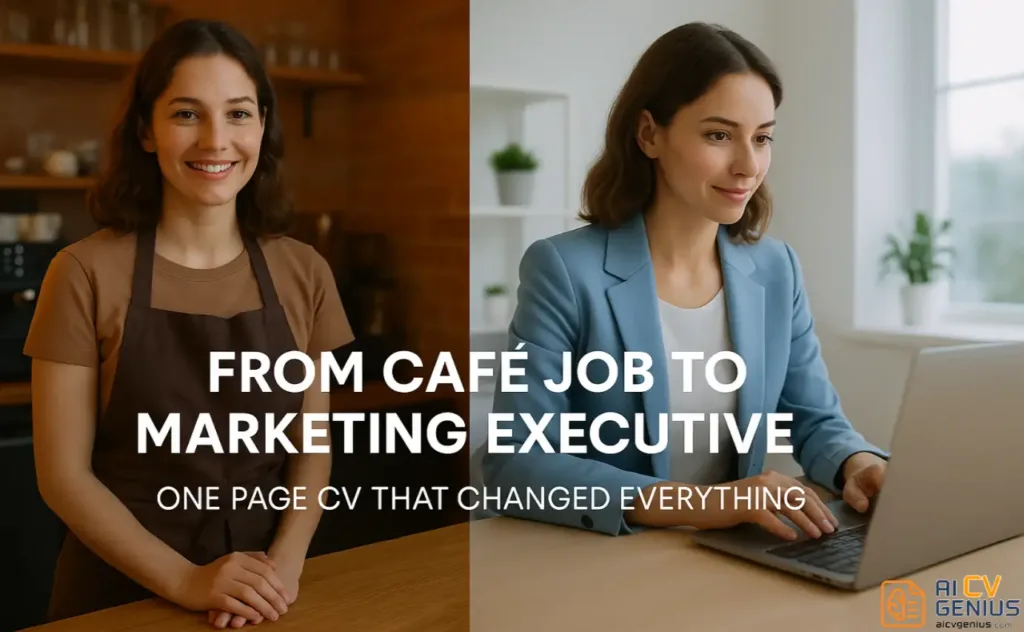
- Maya kept getting silence with a three-page, duty-heavy resume, so she rebuilt it into a focused one-page CV aimed at marketing roles.
- The real shift was clarity first: She defined what must land in six seconds, then cut anything that did not support that message.
- She made it easy to scan and easy for ATS: A clean single-column layout, one professional font, strong spacing, and a short summary that states the target role.
- Her bullets stopped describing tasks and started proving impact: Action verb, specific context, measurable result, kept to a few high-signal bullets per role.
- The result was fast traction and a job offer, and the lesson is simple: One page is a screening advantage for most roles, while exceptions still require page one to work as a standalone summary.
It started with spilled coffee and tired eyes. Maya had been working behind the counter of a small café for almost four years. Her dream was to move into marketing – to create campaigns, not cappuccinos. But every time she applied, silence followed. Until one day, she decided to throw out her old, rambling resume and build something focused, something powerful – a one page CV that changed everything.
What happened next wasn’t magic. It was the strategic application of clarity, honesty, and design thinking to personal storytelling. This is the real story of how a single, well-crafted page helped Maya leap from service industry burnout to a full-time marketing executive role at a growing agency, proving that brevity often conveys more strength than volume.
The Job That Didn’t Define Her: Recognizing the Flaws
Maya’s original resume mirrored many first attempts – crammed, unfocused, and apologetic. Spanning three pages, it was filled with vague descriptions, passive language, and roles she felt didn’t represent her true capabilities. “Cashier at Bean & Brew Café, 2019–2023.” “Responsible for customer service excellence.” “Assisted with inventory management.” Reading it felt like a chore, even to her.
When she critically compared it against actual job descriptions for marketing roles, the disconnect was stark. Recruiters weren’t explicitly seeking baristas; they sought evidence of storytelling ability, communication skills, and the capacity to generate engagement. Maya realized she possessed these skills, honed daily in customer interactions and promotional efforts, but her resume failed to translate them into the language marketing professionals valued.
That crucial realization sparked the transformation.
The Turning Point: Embracing the Blank Page
Starting from Zero: Defining the Core Message
One evening, determined, she opened a blank document. No pre-filled templates, just a clean slate. The initial emptiness felt daunting. To break through, she asked herself a single, guiding question: “What absolute essentials do I need a recruiter to remember about me after just six seconds?”
She immediately recognized her old resume functioned like a historical diary, chronicling tasks performed. The new one needed to operate like a strategic pitch deck, highlighting potential value delivered. This meant prioritizing impact over mere activity. She began brainstorming connections between her café role and core marketing competencies: managing the café’s fledgling Instagram presence, designing eye-catching chalkboard promotions, effectively training new hires (communication & leadership), implementing small changes that improved customer retention (customer relationship management). The job title remained unchanged, but the narrative began to shift dramatically.
Distillation: Boiling It Down to One Powerful Page
Maya recalled advice suggesting recruiters rarely delve beyond the first page, especially during initial screening. Shorter, she reasoned, often meant sharper, more focused. The real challenge became strategic subtraction: deciding what not to include. Out went irrelevant high school accolades, generic skills lacking context (“teamwork”), and nearly half her previous employment history. What remained were carefully selected achievements and experiences that directly reflected the skills and potential relevant to the marketing roles she aspired to.
When she finished, the document felt different. It had breathing room – strategic white space. It projected clarity. It conveyed confidence. It wasn’t overloaded with information; every element felt intentional. For the first time, Maya felt her resume told the truth – not just about the tasks she had performed, but about the capable, adaptable professional she truly was.
Designing for Simplicity and Impact
Choosing a Clean, Scannable Layout
Wisely avoiding overly complex templates or the common trap of two-column layouts (often problematic for Applicant Tracking Systems – ATS), Maya selected a clean, professional, single-column design from the Resume Templates Finder. She adhered to a simple visual hierarchy: one clear, professional font, consistent sizing for headings and body text, and generous spacing between sections. The goal was to allow the recruiter’s eyes to glide effortlessly through the information, not struggle against clutter.
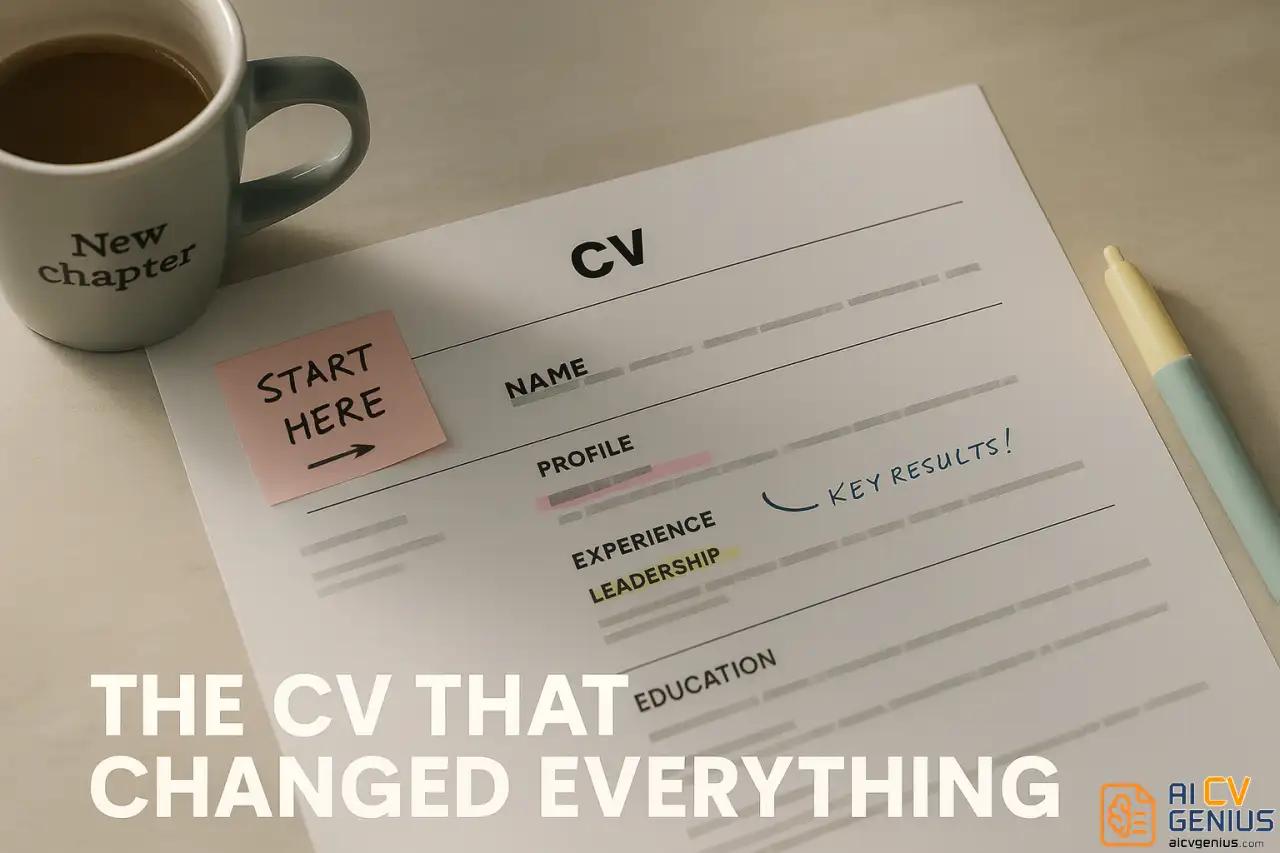
Her header contained only essential, easily scannable details: full name, professional contact information, and a concise, forward-looking title – “Aspiring Marketing Assistant | Proven Communicator & Content Creator.” Below it, a three-line professional summary crafted in her authentic voice:
“Creative communicator with four years of front-line experience transforming casual customer interactions into opportunities for brand loyalty and engagement. Seeking to apply demonstrated skills in visual storytelling (social media, promotions) and team training to contribute effectively to digital marketing campaigns that genuinely connect with audiences.”
This summary wasn’t filled with corporate jargon; it was conversational yet professional. It didn’t merely list past duties; it clearly signaled future potential and relevant transferable skills. That carefully chosen tone made a significant difference.
Writing Bullets That Breathe: Action + Impact
Each experience section was ruthlessly trimmed to its most impactful essentials – typically three bullet points per relevant role, each meticulously crafted to start with a strong action verb and conclude with tangible evidence or a measurable result. She rigorously followed the “Action Verb + Specific Task/Context + Quantifiable Result/Outcome” structure recommended on resources like Improve Your CV:
- ✅ “Grew local café Instagram following organically from 200 to over 2,000 followers within 18 months through consistent posting of original photo content and customer engagement initiatives.”
- ✅ “Designed and executed seasonal chalkboard promotional campaigns that demonstrably increased average weekly sales of featured items by approximately 18%.”
- ✅ “Trained and onboarded 5+ new team members, introducing simplified visual service workflow diagrams that reduced average order preparation time by 10% during peak hours.”
For the first time, her bullet points sounded concrete and measurable – not vaguely “helped with promotions,” but clearly “drove specific, quantifiable results.”
Using Space as a Design Element
Strategic white space isn’t merely empty area; it’s crucial breathing room that enhances readability and directs focus. Maya ensured every section had sufficient margins and spacing to prevent a cluttered appearance and allow the eye to rest. Recruiters often spend only about six seconds on their initial glance, a reality detailed in What Really Happens When a Recruiter Opens Your Resume. She deliberately designed her one-page CV to make those critical six seconds feel effortless and informative for the reader.
When Clarity Meets Confidence: The Outcome
Hitting “Send” with Renewed Purpose
When Maya finally submitted her newly crafted one-page CV, it marked the 29th time she had applied for a marketing position – but it was the very first time she felt genuinely proud and confident about the document representing her. Within just two days, she received her first personalized email response from an agency recruiter. They didn’t inquire about missing experience. Instead, they stated: “Your concise CV caught my attention with its clear focus on results. Let’s schedule a call to discuss your background further.”
That moment crystallized the realization: simplicity doesn’t equate to insignificance – strategic simplicity signifies sharpness and focus.
The Interview That Validated the Approach
During her subsequent interview, the hiring manager specifically referenced the café stories highlighted on her resume – particularly the initiative shown in redesigning the chalkboard ads to boost sales. “You already demonstrate a marketer’s mindset,” he commented. “You were optimizing for conversion, just using a different medium.” Two weeks later, Maya accepted her first offer letter for a full-time marketing executive role.
The Emotional Aftermath: Proof of Potential
Securing the job brought immense relief and validation. More than just excitement about the new role, Maya felt profound proof that individuals like her – without traditional linear career paths or prestigious corporate backgrounds – could successfully rewrite their professional narrative and achieve their goals. All it required was translating existing potential into a clear, compelling, single-page story.
The Strategic Power of the One-Page Resume
Why Shorter Often Works Better in Initial Screening
Recruiters face immense time pressure, reviewing potentially hundreds of applications daily. A concise resume is inherently easier and faster to digest during the crucial initial screening phase. A rigorously crafted one-page resume forces clarity and prioritization – it compels the applicant to distill their most relevant qualifications and impactful achievements, eliminating fluff and amplifying core value. Think of it as effective communication: one clear, compelling story consistently outperforms ten vague, rambling ones.
Breaking the Myth: Length Does Not Equal Experience or Value
Lengthy resumes often inadvertently signal insecurity or a lack of focus. When candidates are unsure what truly matters, they tend to include everything, hoping something resonates. Conversely, a focused one-page format demonstrates confidence and strategic thinking. It implicitly tells the recruiter, “I understand what’s important for this role, and here is the direct evidence.” That perceived confidence and clarity subconsciously build trust and make a stronger positive impression.
When to Consider Going Beyond One Page
Naturally, strict adherence to one page isn’t universally applicable. Certain contexts warrant longer formats:
- Senior Executive Roles: Often require two pages to adequately detail extensive leadership scope, strategic impact, and significant career achievements.
- Academic CVs (Curriculum Vitae): Used in academia, research, or medicine, these are comprehensive documents detailing publications, presentations, grants, and teaching experience, often running many pages.
- Highly Technical Roles with Extensive Project Lists: Some specialized engineering or scientific roles may necessitate a second page to detail numerous relevant projects or publications.
However, even in these cases, the first page must function as a powerful standalone summary, compelling the reader to want to delve into the second page. The principle of concise impact remains paramount.
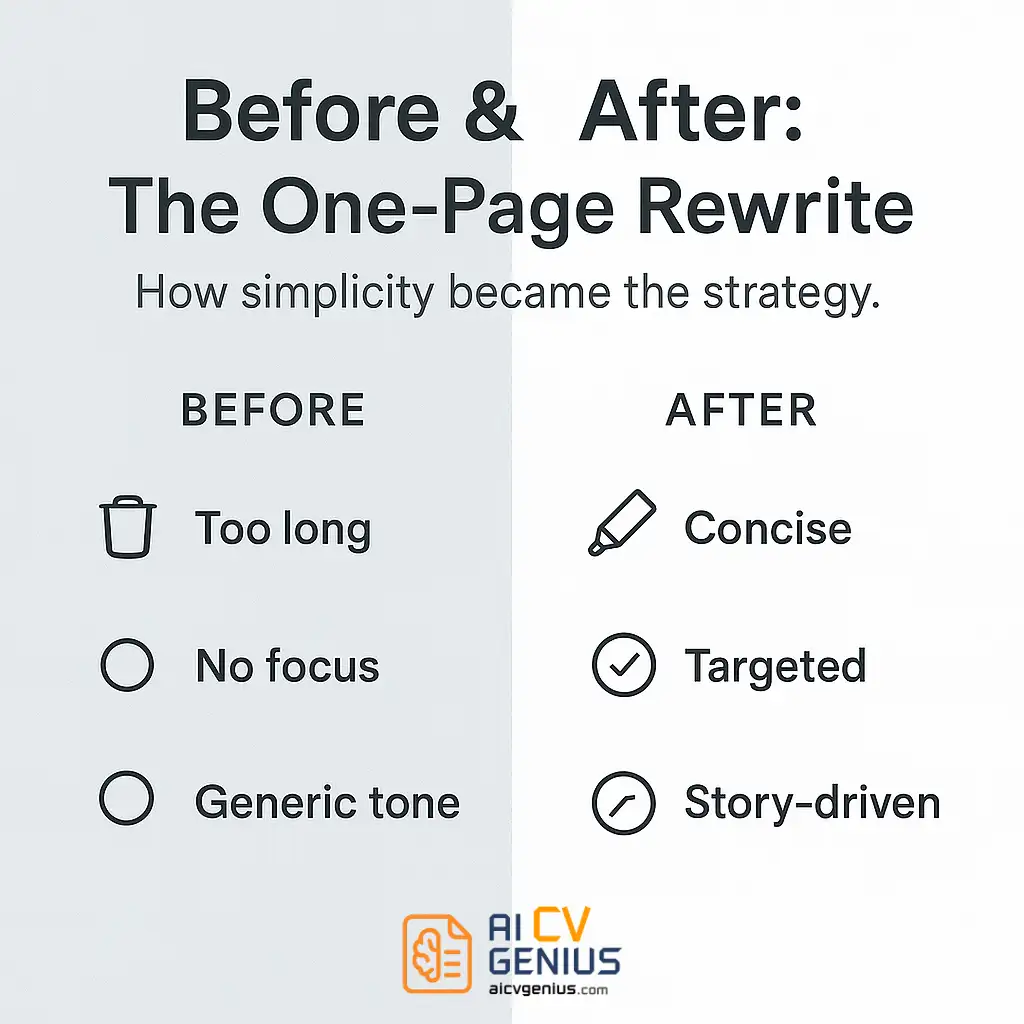
Key Transformations: Before vs. After
The strategic shift in presentation dramatically altered the perception of Maya’s qualifications:
| Section | Old Version (Ineffective) | New Version (Impactful One-Page) |
|---|---|---|
| Length & Focus | Three pages, cluttered, unfocused list of duties. | One page, clean, focused on transferable skills & potential. |
| Summary | Generic objective statement about being hardworking and seeking opportunity. | Concise professional summary stating marketing intent, highlighting communication skills & customer engagement experience. |
| Experience Bullets | Passive descriptions of responsibilities (e.g., “Responsible for inventory”). | Active descriptions focusing on measurable outcomes (e.g., “Grew Instagram following…”, “Increased weekly sales by 18%…”). |
| Skills | Vague soft skills (“Communication, teamwork”). | Specific, relevant skills (Canva, Instagram Insights, Customer Retention Strategies, Team Training). |
| Layout & Design | Potentially complex, multi-column, distracting elements. | Clean, single-column, ample white space, professional font hierarchy. ATS-friendly. |
| Overall Tone | Passive, apologetic for lack of direct experience. | Confident, proactive, forward-looking, emphasizing value. |
This comparison starkly illustrates how strategic adjustments in layout, language, and focus fundamentally shift the perception – not of the underlying experience itself, but of the candidate’s professional value and potential.
Checklist: Building Your Own High-Impact One-Page CV
Ready to craft your own concise powerhouse? Follow these essential steps:
- ✅ Define Your Target & Headline First: Clearly state the type of role you are seeking (e.g., in your summary or header) – focus on where you want to go, not just where you’ve been.
- ✅ Prioritize Ruthlessly: Include only the most relevant experiences and achievements from the last ~5-7 years (unless earlier experience is exceptionally pertinent). Cut anything that doesn’t directly support your target role.
- ✅ Master the Action + Impact Bullet Formula: Ensure every bullet point under relevant experience starts with a strong action verb and ideally ends with a measurable result or specific outcome. Aim for 3–4 powerful bullets per key role/project.
- ✅ Focus on Transferable Skills: Explicitly highlight skills gained (even in non-traditional roles) that directly map to requirements in your target field (e.g., communication, problem-solving, project coordination, data handling, customer engagement).
- ✅ Optimize Layout for Scannability: Choose a clean, single-column, ATS-friendly template. Use consistent professional fonts, ample margins (at least 0.5 inches), strategic white space, and clear section headings.
- ✅ Craft a Compelling Summary: Write a concise (3-4 line) professional summary at the top that immediately conveys your core value proposition and career focus.
- ✅ Save and Submit as PDF: Always save your final version as a PDF to preserve layout integrity across all devices and prevent formatting errors during submission.
- ✅ Conduct the Six-Second Test: Glance at your completed one-page CV for just six seconds. Can you instantly identify your name, target role/field, key skills, and most recent impactful experience? If not, refine the visual hierarchy further.
Why This Story Matters: Beyond One Person’s Success
Maya’s journey resonates because it reflects a common, often underestimated, truth: valuable professional skills are developed in diverse environments, not just within traditional corporate structures. Her success wasn’t due to luck or embellishment; it resulted from gaining self-awareness and learning to strategically translate her existing transferable skills (communication, customer engagement, visual promotion, training) into the specific language and context valued by her target industry (marketing). She didn’t fake a career shift; she effectively reframed her narrative by focusing on demonstrable impact.
This principle applies broadly. Whether your background is in retail, hospitality, education, customer service, or another field seemingly unrelated to your desired career path, your daily experiences likely cultivate crucial competencies like problem-solving, collaboration, project management, and empathy. The critical step is learning to identify these skills, articulate them using industry-relevant terminology, and present them concisely within a structure that recruiters can easily digest. The concept of the one page CV that changed everything isn’t about finding a magic document; it’s about adopting a mindset of strategic self-presentation and recognizing the inherent power of clarity.
FAQ: The One-Page CV Strategy
Final Thought: Clarity Creates Opportunity
The strategic constraint of the one-page resume isn’t about limitation – it’s about forcing potent clarity. It compels honesty about what truly matters in your professional story. It trains you to identify and articulate your most impactful contributions concisely. And often, achieving that level of sharp focus is precisely what unlocks doors previously thought closed.
Like Maya discovered, the perceived gap between seemingly disparate roles often isn’t a chasm of talent – it’s merely a bridge of translation waiting to be built. Once you learn to tell your unique story effectively, using the language your target audience understands, the professional world genuinely starts listening.
Need assistance shaping your own impactful one-page narrative? Explore the resources and templates available through the Resume Templates Finder to begin constructing a layout that strategically highlights your future potential, not just your past history.