

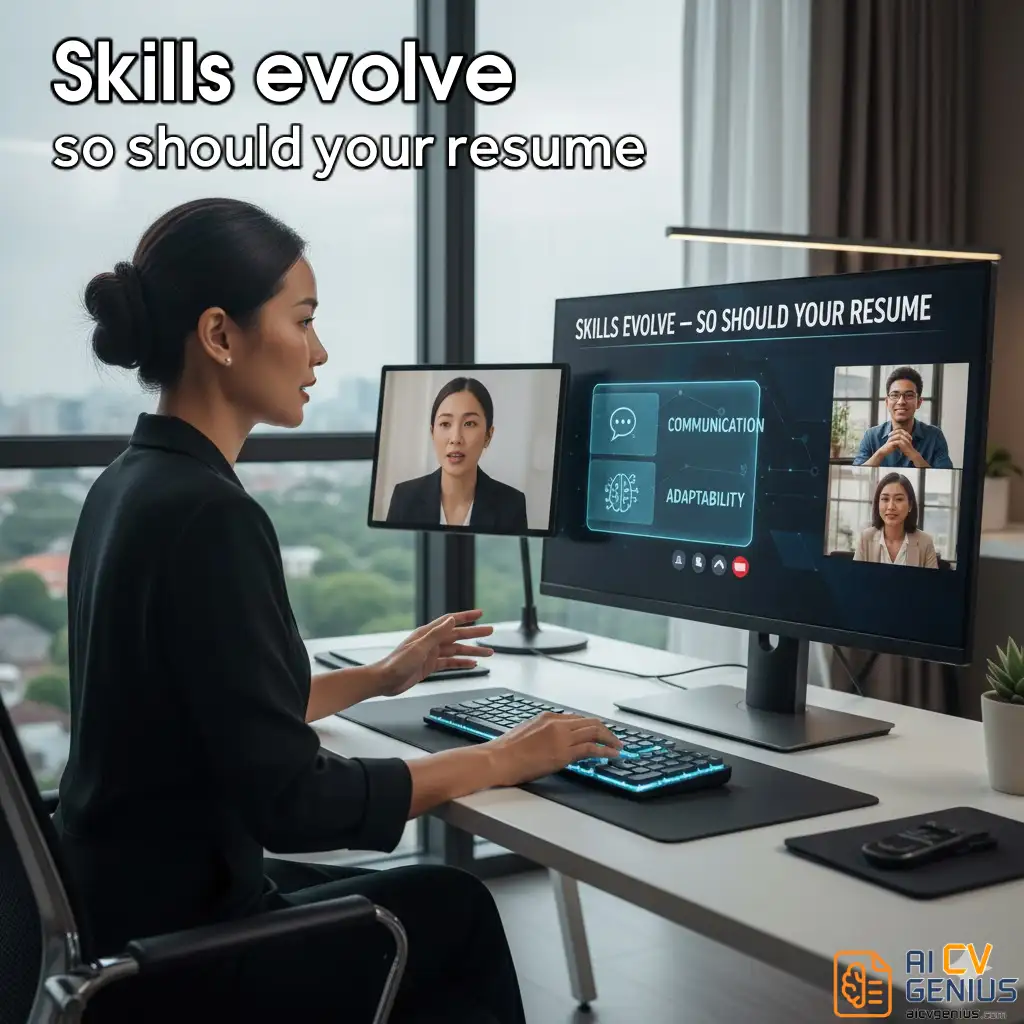
- Top skills employers want in 2026 are framed as an adaptability test: The message is that skills are already shifting, and resumes need to prove you evolve with them.
- Three hiring shifts define the new baseline: AI and automation literacy, adaptability and growth mindset, and human skills that keep teams functional in digital work.
- Skill categories are organized into a simple map: Digital and AI literacy, communication, adaptability, problem-solving, and leadership and collaboration, with examples like prompt writing, automation, async clarity, and data-driven decisions.
- The “human edge” and “hybrid skills” sections argue for a blend: Empathy, accountability, and curiosity paired with data storytelling, AI-enhanced creativity, digital leadership, and strategic communication.
- Skills must be shown, not listed: Use metrics, combine hard plus soft skills in one bullet, separate “Core Skills” from “Emerging Tools,” and refresh your resume every six months based on job descriptions and industry trends.
The Skills Revolution Has Already Begun
Forget “five years from now” – the future of work is already here. By 2026, over 40% of core skills across industries will have changed, according to the World Economic Forum. The question isn’t if your skills are evolving – it’s whether your resume shows that evolution clearly.
“The strongest resumes in 2026 won’t belong to the smartest people – but to the most adaptable ones.”
In this guide, we’ll break down the top skills employers want in 2026 – what they mean, why they matter, and how to present them strategically on your resume to look future-ready, not outdated.
The Core Skill Categories Employers Want in 2026
The Shift in Hiring Priorities
Employers today are less interested in long job titles and more focused on transferable value. In 2026, three major hiring shifts define what recruiters look for:
- ✅ AI & Automation Literacy – using tools, not fearing them.
- ✅ Adaptability & Growth Mindset – continuous learners win.
- ✅ Human Skills in a Digital World – communication, empathy, and creativity remain priceless.
If your resume still lists “MS Word” under skills, it’s time for a reboot.
Core Categories Overview
| Skill Category | Examples | Why It Matters in 2026 |
|---|---|---|
| Digital & AI Literacy | Prompt writing, automation tools, data visualization | Shows you can integrate AI into daily workflows. |
| Communication | Asynchronous messaging, cross-cultural clarity | Essential for remote and hybrid collaboration. |
| Adaptability | Upskilling, learning agility | Signals resilience during constant change. |
| Problem-Solving | Data-driven decisions, creative ideation | Demonstrates value beyond tasks – strategic thinking. |
| Leadership & Collaboration | Coaching peers, project coordination | Human leadership still drives digital teams. |
Digital Skills Dominating the Decade
Technology is no longer a department – it’s the language of work. Here’s what employers expect you to know by 2026:
- AI Literacy: Writing prompts, verifying outputs, and integrating tools like ChatGPT, Midjourney, or Notion AI.
- Data Fluency: Understanding dashboards, not just reading them.
- Workflow Automation: Zapier, Make, or native automations within productivity suites.
- Cyber Awareness: Knowing how to work securely from any device.
These aren’t “tech jobs” – they’re life skills for every modern professional.
The Human Edge: Soft Skills in the AI Era
Ironically, the more automation grows, the more human qualities matter. In 2026, emotional intelligence and empathy are not “nice to have” – they’re the glue that holds distributed teams together.
| Soft Skill | Application |
|---|---|
| Empathy | Understanding context and tone in async communication. |
| Adaptability | Responding to change without losing focus or morale. |
| Curiosity | Asking questions that lead to innovation, not just answers. |
| Accountability | Following through in self-managed teams. |
Soft skills are what make tech-driven work human again.
The Rise of Hybrid Skills
The most employable candidates blend technical fluency with human creativity – something machines can’t replicate.
| Hybrid Skill | What It Looks Like |
|---|---|
| Data Storytelling | Explaining insights in human terms – not charts. |
| AI-Enhanced Creativity | Using tools like DALL·E or Canva AI to ideate faster. |
| Digital Leadership | Leading hybrid teams across cultures and time zones. |
| Strategic Communication | Crafting written clarity that replaces meetings. |
Hybrid skills are your differentiator – they turn you from replaceable to remarkable.
How to Show Future-Ready Skills on Your Resume
Listing skills isn’t enough – presentation is everything. Use structure, metrics, and proof:
- ✅ Incorporate metrics: “Automated weekly reporting – saved 6 hours/week.”
- ✅ Blend hard & soft skills: “Coordinated cross-timezone AI project with empathy and precision.”
- ✅ Separate sections: Use “Core Skills” and “Emerging Tools.”
Remember: recruiters scan resumes in under 8 seconds. Formatting and clarity matter as much as the content.
Example Resume Excerpt (Future-Ready Style)
“Integrated AI tools to automate marketing reports, cutting turnaround time by 60%. Led a cross-functional team of 8 across 4 time zones using Asana and Notion – improved project completion by 35%.”
It’s not about listing skills – it’s about proving them in context.
Real Example: The Resume That Got the Interview
“Instead of writing ‘Excellent communicator,’ I added: ‘Facilitated async cross-team updates across 5 countries using Loom videos and Notion dashboards – reduced project confusion by 40%.’ That one bullet alone got me 3 recruiter callbacks.”
How to Identify Your Skill Gaps
Ask yourself three questions:
- What skills are rising in my industry?
- Which ones appear repeatedly in job descriptions?
- What can I learn quickly to stay ahead?
Then align your resume updates with those answers – and revisit every 6 months. Careers are living documents now.
Final Analysis, Resources & FAQs
Pros & Cons of Future-Focused Resumes
| Pros ✅ | Cons ❌ |
|---|---|
| Positions you as adaptable and forward-thinking. | Requires constant updating to stay relevant. |
| Appeals to modern employers and startups alike. | Can feel buzzword-heavy if not balanced. |
| Helps your resume stand out in AI screening systems. | Harder to keep concise and focused. |
Checklist: Is Your Resume Future-Proof?
- ✅ Includes both hard and soft skills (technical + human).
- ✅ Mentions AI, data, or automation literacy.
- ✅ Shows measurable results tied to new tools.
- ✅ Uses modern verbs (“optimized,” “streamlined,” “orchestrated”).
- ✅ Updated in the last 6 months.
Emerging Skills to Watch Beyond 2026
| Skill | Why It’s Rising |
|---|---|
| Ethical AI & Governance | Companies seek people who can balance innovation with integrity. |
| Virtual Collaboration Design | Making remote work smoother through systems thinking. |
| Green & Sustainable Practices | ESG policies affect hiring at all levels. |
| Neurodiversity Awareness | Inclusive teams drive creativity and retention. |
FAQ – Skill Trends & Resume Tips
Internal Resources
Explore our Resume Templates Finder for modern layouts, or visit the Career Resources page for upskilling tools and AI resume builders. You can also pair this with our Future-Proof Cover Letter guide.
Final Thoughts
The future of work doesn’t belong to the most qualified – it belongs to the most curious.
Your resume isn’t just a record of what you’ve done; it’s proof that you’re still growing.
When you weave adaptability, digital fluency, and empathy into every section, your application says: “I don’t just fit the future – I’m already there.”
“The best skill you can have in 2026 is learning how to learn.”