

- Core framing and mindset: A career change resume is a translation bridge, not a confession. Lead with purpose, not apology, and rewrite your story so recruiters hear relevance and confidence instead of “I do not have direct experience.”
- Choose the right structure: Use a Combination (Hybrid) format for most pivots because it highlights transferable skills up top while keeping a clear work timeline. Use Functional only for major pivots or messy timelines, and use Reverse-Chronological only when the shift is minor and your titles already look relevant.
- Translate skills into the new industry’s language: Identify universal skills (Communication, Leadership, Problem-Solving, Adaptability, Project Management) and rephrase old tasks using target-role keywords. Rebuild Experience bullets as “What you changed + Why it mattered,” and add metrics that travel across industries (Time saved, Error reduction, Volume handled, Satisfaction lift), even if estimated.
- Build the resume section by section for a pivot: Summary or Objective must explicitly name the target role and your transferable value, then a categorized Skills section becomes your “toolkit” with proof lines. Add a “Relevant Projects / Recent Training” block to show initiative (Certs, volunteer work, side projects, portfolio links) so you look active in the new field, not just interested.
- Finish with credibility and polish: Add a one-sentence transition context only if needed, place relevant certifications strategically, keep tone empowering, and run the final checklist (Tailored keywords, ATS-safe formatting, numbers, clear sections, no old-industry jargon, no generic templates, no typos). The article also includes a full worked example resume plus FAQs on length, explaining the change, and which older jobs to keep.
New Path, Same Strengths: Crafting a Resume That Bridges Your Past and Future
Whether you’ve spent a decade mastering one field or you’re finally ready to pursue a long-held dream, the decision to switch careers requires immense courage. It’s a step into the unknown, often accompanied by self-doubt and the fear of starting over. Your resume for career change becomes more than just a document; it transforms into a vital bridge connecting the value of your past experiences to the potential of your future aspirations. The primary challenge isn’t necessarily a lack of experience in the new field, but rather the art of translation – making your existing, hard-earned skills resonate in a new professional language.
You already possess a wealth of valuable competencies: problem-solving abilities honed over years, communication skills sharpened through countless interactions, leadership potential demonstrated in past projects, and adaptability proven by the very act of considering this change. The task now is to frame these universal strengths in a way that speaks directly to the needs and priorities of your target industry. This guide will show you how.
“Changing careers isn’t a sign of failure or inconsistency – it’s powerful proof that you’ve outgrown your old limits and are ready for the next stage of growth.”
The Core Strategy: Reframing Your Narrative
Step 1: Start With Purpose, Not Apology – Frame Your Narrative Confidently
One of the most common pitfalls for career changers is beginning their resume or cover letter with apologetic language. Phrases like, “Although I lack direct experience in marketing…” or “While my background is primarily in education…” immediately undermine your position. Employers aren’t looking for excuses or justifications; they are searching for relevance, potential, and confidence. They need to see how your unique journey makes you a valuable, albeit different, candidate.
Instead of highlighting what you don’t have, focus on what you do bring. Reframe your opening statement to emphasize transferable skills and a clear intention. Consider this shift:
❌ Weak Opening:
“Although I’ve never worked directly in project management, I am eager to learn…”
✅ Strong Opening:
“Leveraging five years of experience leading cross-functional client initiatives and streamlining operational workflows, I am now seeking to apply proven project coordination and stakeholder management skills within a dedicated project management role.”
This subtle but crucial shift in mindset transforms the entire energy of your application. It moves the narrative from one of uncertainty (“Will they give me a chance?”) to one of confidence (“Here’s how my unique background benefits you.”). Your resume should radiate purpose, showing that this career change is a deliberate, strategic move, not a desperate leap.
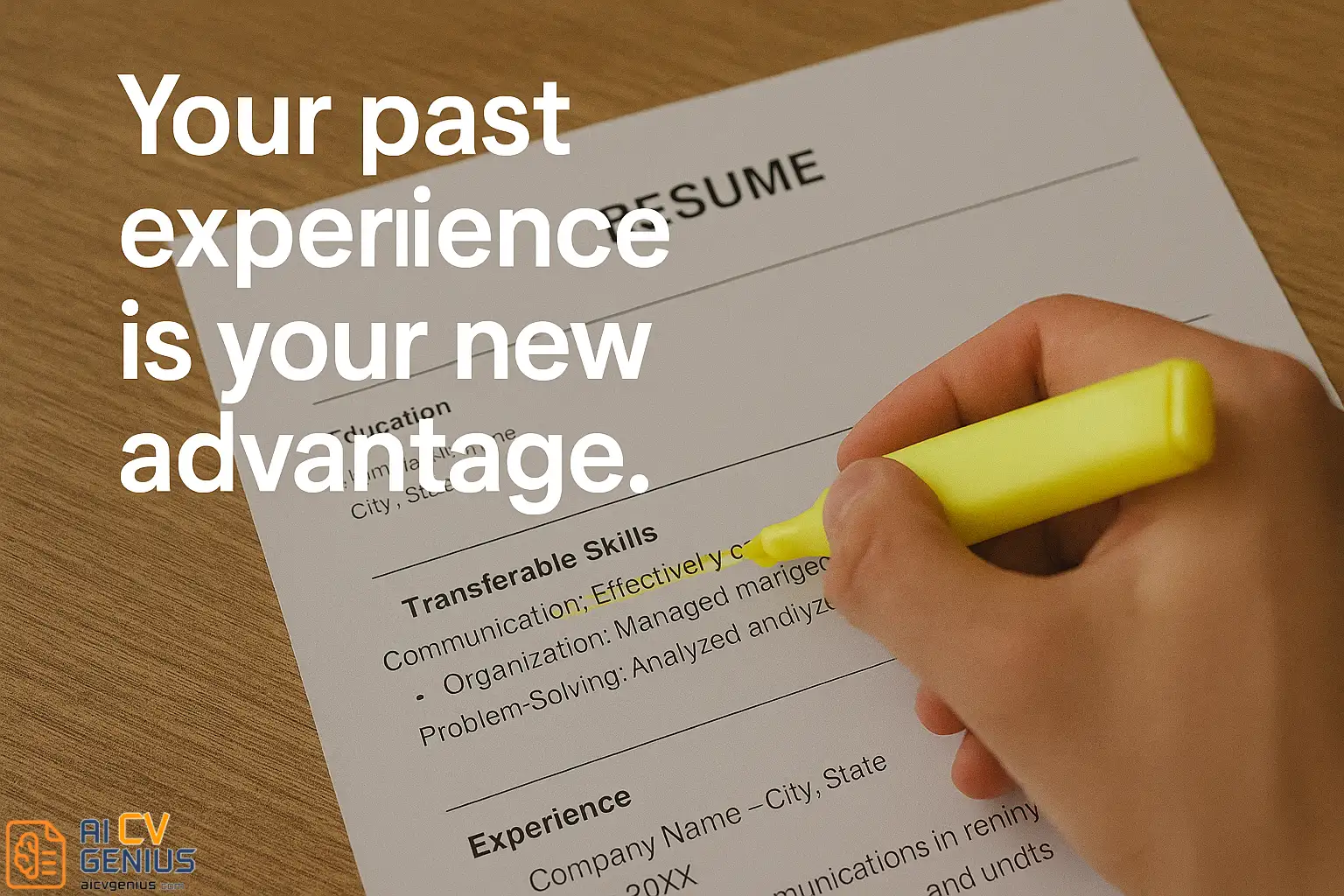
Step 2: Choose the Right Format – Functional or Hybrid Over Chronological
If you’re making a significant industry shift, the traditional reverse-chronological resume format (listing jobs from newest to oldest) can sometimes work against you. It emphasizes job titles and timelines, potentially highlighting a lack of direct experience in the target field. Instead, consider formats that prioritize skills and achievements over strict chronology.
The functional and combination (hybrid) resume formats are often more effective for career changers because they allow you to group your accomplishments by relevant skill sets, drawing attention to your capabilities rather than your job history sequence.
| Format Type | Best For | Why It Works | ️Key Feature |
|---|---|---|---|
| Functional | Significant career pivots (e.g., teacher to software developer); individuals with employment gaps or extensive freelance work. | Emphasizes transferable skills and achievements prominently at the top, minimizing focus on job titles and dates. Allows grouping accomplishments under skill-based headings (e.g., “Project Management,” “Client Relations”). | Detailed skill sections precede a brief work history list. |
| Combination (Hybrid) | Career changers with some overlapping experience or skills; those wanting to balance skills showcase with demonstrating career progression. | Blends elements of both functional and chronological formats. Typically starts with a strong summary and detailed skills section, followed by a reverse-chronological work history, but with achievements framed to highlight transferable skills. | Robust skills/summary section followed by optimized chronological experience. |
| Reverse-Chronological | Minor industry shifts (e.g., moving from corporate finance to non-profit finance); roles where clear career progression is highly valued. | Standard format, easily understood by recruiters and ATS. Still effective if previous roles clearly demonstrate transferable leadership or technical skills relevant to the new field. | Work history listed newest to oldest, achievements detailed under each role. |
Recommendation for Most Career Changers: The Combination (Hybrid) format often strikes the best balance. It allows you to prominently feature your most relevant transferable skills near the top while still providing the chronological context that many recruiters prefer. A purely functional resume can sometimes raise red flags, making recruiters wonder what you might be hiding regarding your work history.
Step 3: Identify and Translate Your Transferable Skills – The Art of Reinterpretation
This is the core task of crafting a career change resume. Transferable skills are competencies and abilities acquired through education, work, or life experiences that are applicable across different roles and industries. Even if your past industry seems vastly different from your target field, the underlying skills often remain remarkably consistent: communication, critical thinking, problem-solving, leadership, teamwork, adaptability, and project management are universal assets.
The key is not just identifying these skills but reframing them using the language and context of your desired industry. Think like a translator converting one language to another. Ask yourself: “How did the tasks I performed in my previous role demonstrate skills valued in my target role?”
Here’s a deeper dive into translating common experiences:
| Old Role & Task | Core Skill Demonstrated | New Skill Translation (Example Target: Project Management) |
|---|---|---|
| Teacher: Designing lesson plans, managing classroom behavior, communicating with parents. | Planning, organization, conflict resolution, stakeholder communication, mentorship. | “Developed and executed project plans (lesson plans) for diverse groups, managed stakeholder expectations (parent communication), and mentored junior members (students).” |
| Sales Representative: Identifying leads, presenting products, negotiating contracts, meeting quotas. | Client relationship management, persuasive communication, negotiation, data analysis (sales figures), goal orientation. | “Managed key client accounts, presented solutions tailored to stakeholder needs (product demos), negotiated deliverables (contracts), and consistently exceeded performance targets (quotas).” |
| Engineer: Analyzing technical problems, designing solutions, collaborating with cross-functional teams, documenting processes. | Analytical thinking, problem-solving, precision, cross-team collaboration, technical documentation, systems thinking. | “Applied analytical frameworks to diagnose root causes (technical problems), designed and implemented process improvements (solutions), coordinated with multiple departments (cross-functional teams), and maintained detailed project documentation.” |
| Graphic Designer: Interpreting client briefs, developing visual concepts, managing project timelines, presenting designs. | Creative direction, branding strategy, visual communication, project management, client presentation skills, attention to detail. | “Translated stakeholder requirements (client briefs) into actionable project deliverables (visual concepts), managed project schedules and resources, and presented progress updates to key stakeholders.” |
| HR Specialist: Mediating employee disputes, developing training programs, ensuring policy compliance, managing recruitment cycles. | Conflict resolution, talent development, risk management, process optimization, stakeholder communication, project management (recruitment). | “Facilitated cross-departmental communication to resolve issues (disputes), designed and implemented performance improvement plans (training), ensured adherence to project guidelines (compliance), and managed end-to-end project lifecycles (recruitment).” |
Your goal is not to erase or diminish your past experiences but to reinterpret their value through the lens of your future career. By consciously translating your skills, you make it easy for recruiters to see your potential fit, even without direct industry experience.
Building Your Career Change Resume: Section-by-Section
Step 4: Lead With a Compelling Summary or Objective – Your Strategic Intent
The top section of your resume (typically a Professional Summary or Career Objective) is prime real estate. For a career changer, this section must immediately convey your intention, highlight key transferable skills, and express confidence in your transition. It sets the narrative for the rest of the document.
- A Career Objective is often better for those making a significant pivot or with limited experience. It focuses on your future goals and how you plan to contribute.
- A Professional Summary works well if you have substantial experience and can clearly articulate how your past skills align with the new role. It focuses more on your existing value proposition.
Examples for Career Changers:
- Objective (Teacher transitioning to Corporate Training): “
Highly motivated educator with 8+ years of experience designing engaging curriculum and facilitating adult learning. Seeking to leverage expertise in instructional design, communication, and performance assessment to develop impactful corporate training programs at [Target Company Name].”
- Summary (Marketing Manager transitioning to Product Management):
“Strategic marketing leader with 7+ years of experience launching successful products and driving user adoption through data-driven campaigns. Now transitioning into Product Management, combining deep customer empathy, market analysis skills, and cross-functional team leadership to build user-centric digital products.”
- Summary (Customer Service Lead transitioning to UX Design):
“Customer-focused professional transitioning into UX Design, leveraging 5+ years of experience understanding user needs, analyzing feedback patterns, and collaborating with development teams to improve service delivery. Eager to apply empathy-driven design thinking and recent UX/UI certification to create intuitive and engaging digital experiences.”
Notice how each example explicitly mentions the transition but frames it positively, emphasizing relevant skills and a clear target role. This isn’t just a title change; it’s a strategic declaration in one or two powerful sentences.
Step 5: Create a Dedicated Skills Section – Your Transferable Toolkit
In a functional or hybrid resume, the Skills section takes on greater importance. It allows you to group your core competencies prominently, showcasing relevance before diving into potentially less-related job titles. Organize this section using categories that align with the requirements of your target industry.
Instead of a generic list, use 3–4 key categories relevant to your new direction. Under each category, list specific skills and perhaps include a brief, powerful achievement that demonstrates that skill in action, even if it’s from a previous role.
Example Skills Section (Retail Manager transitioning to Operations Analyst):
Key Skills
- ✅ Process Improvement & Efficiency:
- Streamlined inventory management procedures, reducing stock discrepancies by 15%.
- Developed new staff scheduling system, cutting overtime costs by 10%.
- Workflow analysis, bottleneck identification, SOP development.
- ✅ Data Analysis & Reporting:
- Analyzed daily sales data using Excel (Pivot Tables, VLOOKUP) to identify purchasing trends and inform merchandising decisions.
- Prepared weekly performance reports for regional management, highlighting KPIs and areas for improvement.
- Proficient in Microsoft Excel, Google Analytics (Basic).
- ✅ Team Leadership & Training:
- Managed and trained a team of 10+ retail associates, improving team performance metrics by 20%.
- Developed onboarding materials for new hires.
- Performance management, conflict resolution, coaching.
- ✅ Project Coordination & Execution:
- Successfully coordinated store remodeling project, ensuring completion on time and under budget.
- Managed rollout of new POS system across the store.
- Resource allocation, timeline management, vendor coordination.
This structure allows recruiters to quickly see your relevant capabilities, supported by concrete examples, regardless of the job title under which you gained them.
Step 6: Add a “Relevant Projects” or “Recent Training” Section – Demonstrating Initiative
Even if you lack direct, paid job experience in your target field, showcasing relevant personal projects, volunteer work, freelance gigs, or recently completed certifications can significantly bolster your resume. This demonstrates proactive effort, genuine interest, and a commitment to acquiring the necessary skills.
Create a short, dedicated section titled “Relevant Projects,” “Portfolio,” or “Professional Development.”
Relevant Projects & Professional Development
- Designed and launched a social media marketing strategy for a local animal shelter (Volunteer), resulting in a 250% increase in online engagement and a 50% rise in adoption inquiries over 3 months.
- Completed Google UX Design Professional Certificate (Coursera, 2024), culminating in the development of a high-fidelity prototype for a mobile wellness application using Figma. (Link to Portfolio: [Your Portfolio URL])
- Volunteered to redesign and migrate a family business website using WordPress and Elementor, improving site navigation and reducing bounce rate by 30%.
- Developed a personal Python script to automate analysis of public transportation data, identifying optimal commute times. (Link to GitHub: [Your GitHub URL])
This section transforms you from someone merely interested in the field to someone actively involved in it. It shows passion and initiative, qualities highly valued by employers, especially when evaluating candidates without traditional experience.
Step 7: Reframe Past Job Descriptions – Speak Their Language
When detailing your previous roles in the “Professional Experience” section (especially in a hybrid or chronological format), avoid simply listing the responsibilities relevant to that old job. Instead, selectively highlight and rephrase duties and achievements using keywords and concepts pertinent to your new target industry. This requires careful translation.
Think about the underlying function or skill demonstrated by each task, then describe it using terminology common in your target field.
Example (Administrative Assistant transitioning to Event Coordinator):
Old Description:
“Scheduled meetings, managed calendars, and booked travel arrangements for executives.”
Reframed Description:
“Coordinated complex logistics for executive schedules, including multi-stakeholder meeting planning, calendar synchronization across time zones, and end-to-end travel management, ensuring seamless operations.”
(Keywords: Coordinated logistics, stakeholder planning, end-to-end management)
Example (Librarian transitioning to Data Management Specialist):
Old Description:
“Cataloged new books and managed library database.”
Reframed Description:
“Managed and maintained a database of over 50,000 assets, ensuring data integrity, accuracy, and adherence to metadata standards through meticulous cataloging and classification protocols.”
(Keywords: Managed database, data integrity, metadata standards, cataloging protocols)
You are not rewriting history; you are strategically highlighting the aspects of your past work that directly map onto the requirements of your future role. This translation makes your experience feel relevant, even if the job titles are different.
Step 8: Use Numbers to Build Credibility – Metrics Speak Every Language
Quantifiable achievements provide concrete evidence of your impact and are universally understood, regardless of industry. Numbers build trust and make your contributions tangible. Even if your previous role wasn’t data-heavy, look for opportunities to quantify your accomplishments.
Consider metrics related to:
- Efficiency Improvements: Time saved, processes streamlined, errors reduced (e.g., “Automated weekly reporting process, saving an estimated 10 hours of manual work per month.”)
- Client/Customer Impact: Retention rates improved, satisfaction scores increased, complaints resolved (e.g., “Implemented new client follow-up program, resulting in a 15% increase in repeat business within one year.”)
- Team/Training Impact: Number of people trained, performance improvements, reduced onboarding time (e.g., “Trained and mentored 20 new team members on customer service protocols, contributing to a 30% improvement in average customer feedback scores.”)
- Scale or Volume: Budgets managed, number of users supported, volume of tasks handled (e.g., “Managed social media accounts with a combined following of 50,000+, creating and scheduling 15+ posts per week.”)
Even estimates (“approximately,” “over X%”) are better than vague statements. Numbers make your achievements specific, believable, and memorable.
Step 9 (Optional): Include a Brief Career Change Context Statement
Sometimes, adding a very short (one-sentence) contextual statement just before your “Professional Experience” section can help bridge the gap for recruiters, explicitly stating your transition.
“Transitioning from 8 years in operations management, the following experience highlights my transferable skills in process optimization, data analysis, and team leadership relevant to a career in data analytics.”
This preemptively addresses potential confusion and guides the recruiter on how to interpret your work history through the lens of your new career goal. Use this judiciously; your summary/objective should already set the stage.
Step 10: Highlight Relevant Education & Certifications Strategically
Your “Education” and “Certifications” sections gain importance during a career change. They demonstrate your commitment to acquiring knowledge and skills relevant to the new field. List any recent courses, bootcamps, workshops, or certifications prominently.
Order this section strategically. If your recent certifications are more relevant than an older degree, consider placing the “Certifications” or “Professional Development” section before the “Education” section.
| Certification / Course | Institution / Platform | Completion Year / Status |
|---|---|---|
| Google Project Management Professional Certificate | Coursera | 2024 |
| Certified Associate in Project Management (CAPM) | Project Management Institute (PMI) | 2024 |
| UX Design Fundamentals Nanodegree | Udacity | 2023 |
| Financial Modeling & Valuation Analyst (FMVA) | Corporate Finance Institute (CFI) | In Progress (Expected 2025) |
| Bachelor of Arts in English Literature | [University Name] | [Year Graduated] |
Including “In Progress” courses shows ongoing commitment and learning agility.
Step 11: Keep the Tone Empowering and Confident
Career change often comes with feelings of vulnerability or inadequacy (“imposter syndrome”). It’s crucial that your resume reflects confidence, not fear. Avoid language that sounds hesitant or apologetic. Own your journey and frame your transition as a positive evolution driven by purpose and growth.
Use strong action verbs. Focus on achievements. Highlight learning agility. Remember, every recruiter values curiosity, courage, adaptability, and initiative – traits inherent in anyone undertaking a significant career change.
Instead of viewing your background as a limitation, present it as a unique asset that brings fresh perspective and diverse experience to the role.
“I’m not starting over from scratch – I’m leveraging a decade of experience to evolve with purpose into this new challenge.”
Simple. Confident. Believable. That’s the energy your resume should convey.

The Complete Career Change Resume Example (Putting It All Together)
Theory is one thing; practice is another. Let’s apply every strategy we’ve discussed to build a complete resume for our fictional candidate, Sarah Jenkins, a teacher transitioning into project management, as discussed in the guide.
SARAH JENKINS, CAPM
Project Coordinator | Aspiring Project Manager
Philadelphia, PA 19103 | (555) 321-9876 | sarah.jenkins.pm@email.com | linkedin.com/in/sarahjenkins
PROFESSIONAL SUMMARY
Highly motivated professional with 6+ years of experience in education, now transitioning into Project Management. Proven ability to manage complex projects, coordinate cross-functional teams, and communicate with diverse stakeholders to achieve set objectives. Eager to apply newly acquired CAPM certification and expertise in planning, execution, and risk mitigation to a challenging Project Coordinator role.
CORE COMPETENCIES
|
|
|
PROFESSIONAL EXPERIENCE
Senior English Teacher (Department Lead) | Philadelphia School District | Philadelphia, PA (2018 – Present)
- Project Leadership: Led a 4-person team to develop and execute a new district-wide digital literacy curriculum, delivering the project on time for 1,500+ students.
- Stakeholder Management: Coordinated with 50+ parents, 10 administrators, and 3 external vendors to manage educational goals and resource allocation, resulting in a 15% increase in standardized test scores.
- Training & Onboarding: Designed and delivered 5 professional development workshops for 20+ junior teachers, improving adoption of new educational software by 40%.
- Risk & Resource Management: Managed a $15,000 annual department budget, optimizing resource allocation to reduce material waste by 10%. Identified and resolved 3 major scheduling conflicts to prevent program disruption.
Shift Supervisor | Starbucks | Philadelphia, PA (2016 – 2018)
- Process Improvement: Supervised a team of 8 baristas; implemented a new inventory tracking system that reduced weekly waste by 20%.
- Conflict Resolution: De-escalated 100+ customer complaints, resolving issues effectively to maintain a 95% positive customer satisfaction rating.
CERTIFICATIONS & EDUCATION
- Certified Associate in Project Management (CAPM) | Project Management Institute (PMI) (2024)
- Google Project Management Professional Certificate | Coursera (2024)
- Master of Arts in Education | Temple University, Philadelphia, PA (2018)
- Bachelor of Arts in English | Penn State University, University Park, PA (2016)
Final Review, Resources & FAQs
Common Mistakes to Avoid on a Career Change Resume
Steer clear of these frequent missteps:
- ❌ Using a Template Designed for Your Old Career: Choose a format (functional or hybrid) and style appropriate for your target industry.
- ❌ Over-Explaining the Reason for Change on the Resume: Save the detailed “why” for your cover letter or interview. The resume should focus on relevance and skills.
- ❌ Forgetting to Update Your LinkedIn Profile: Ensure your LinkedIn headline, summary, and skills sections align with your new career direction. Consistency builds credibility.
- ❌ Ignoring the Value of Soft Skills: Career changers often have strong soft skills like adaptability, resilience, communication, and empathy developed over years. Highlight them!
- ❌ Using Industry Jargon from Your Old Field: Translate terminology to match the language of your target industry.
- ❌ Failing to Tailor Each Application: Generic resumes rarely work, especially for career changers. Customize your summary, skills, and highlighted achievements for each specific job description.
Pros & Cons of a Strategically Crafted Career Change Resume
Understanding the strengths and potential challenges helps you navigate the process effectively.
| Pros ✅ | Cons ❌ |
|---|---|
| Showcases personal growth, adaptability, and courage. | Requires more effort in reframing and translating past experience compared to a standard resume. |
| Demonstrates a proactive, lifelong learning mindset attractive to modern employers. | May confuse Applicant Tracking Systems (ATS) if keywords from the new industry are weak or formatting is overly complex (especially with purely functional formats). |
| Highlights valuable transferable strengths over potentially irrelevant job titles. | Needs a strong accompanying cover letter and interview narrative to fully connect the dots between past experience and future potential. |
| Allows you to position diverse experience as a unique asset bringing fresh perspectives. | Some traditional recruiters may still prefer linear career paths, requiring extra effort to overcome potential biases. |
Final Checklist Before Submitting Your Career Change Resume
Before you hit “Apply,” review your resume against this checklist:
- ✅ Format Chosen Strategically: Selected a functional or hybrid format appropriate for the degree of career change.
- ✅ Strong Opening Statement: Includes a compelling summary or objective that clearly states the transition and highlights key transferable skills.
- ✅ Skills Translated: Past job duties and achievements are reframed using the language and keywords of the target industry.
- ✅ Quantifiable Results: Includes 1–2 measurable results (using numbers, percentages, or scale) for key achievements, even if estimated.
- ✅ Relevant Skills Section: Features a dedicated skills section organized by categories relevant to the new role.
- ✅ Projects/Training Included: Added a section for relevant personal projects, volunteer work, or recent certifications/courses.
- ✅ Tone is Confident: Language is positive, proactive, and avoids apologetic phrasing.
- ✅ Tailored to the Job: Keywords and highlighted skills align specifically with the target job description.
- ✅ ATS-Friendly: Uses standard headings, clear formatting, and avoids graphics or tables that hinder parsing.
- ✅ Proofread Meticulously: Free of typos, grammatical errors, and formatting inconsistencies.
FAQs About Career Change Resumes
Leverage Additional Resources for Your Transition
Successfully navigating a career change requires a cohesive application package and strong self-presentation skills. Pair your newly crafted resume with professional templates and further guidance:
- Find ATS-friendly and visually appealing layouts in the Resume Templates Finder.
- Explore in-depth guides on identifying transferable skills, networking, and interviewing strategies in our Career Resources hub.
- Review effective Cover Letter examples specifically designed for career changers to help you tell your story compellingly.
Final Thoughts: Your Career Change Resume as Proof of Evolution
Your resume for career change is powerful evidence that you’re not afraid to learn, adapt, and grow. It’s inherently less about documenting what you’ve done and far more about strategically showcasing what you’re capable of doing next. When you approach it with clarity, confidence, and a focus on translation, your career change doesn’t look like a risky leap to employers – it looks like a natural, intentional evolution.
Embrace your unique journey. Highlight the universal skills you’ve mastered. Frame your transition with purpose. Your past experience is not a liability; it’s the foundation upon which you’re building your future.
“You don’t need to start your career over from zero – you just need to start from where you are now, leveraging everything you’ve learned along the way.”