
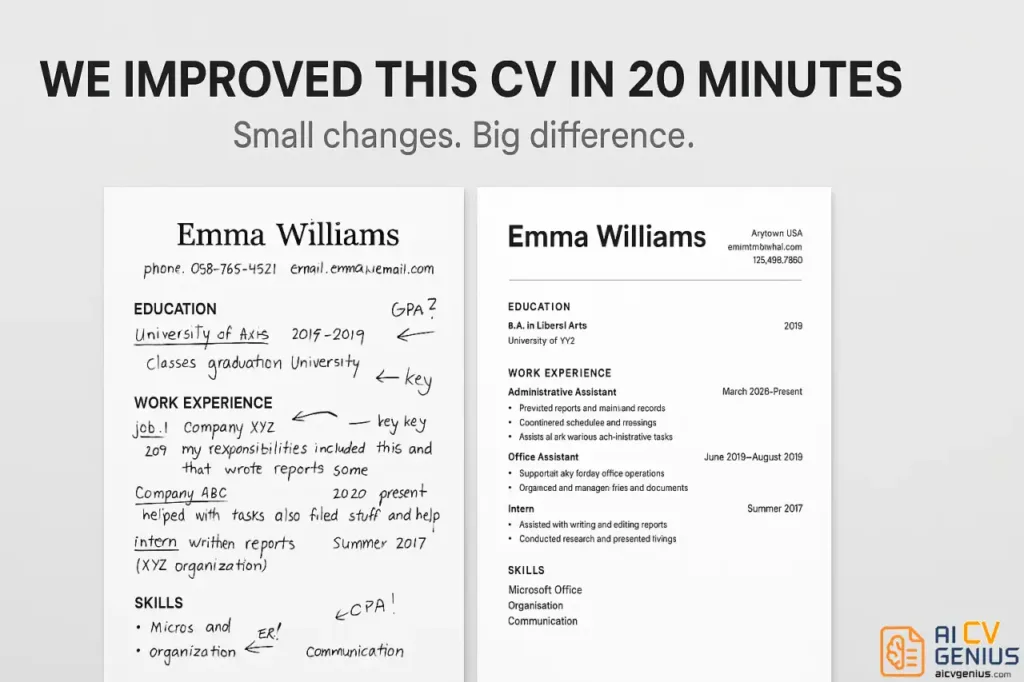
- The piece follows Sarah, a marketing assistant whose “fine” resume got 37 applications worth of silence because it was readable but effectively invisible during fast recruiter scans.
- It argues the fastest wins come from scannability first: Delete clutter, elevate metrics, and stop writing duties so your value shows up in seconds.
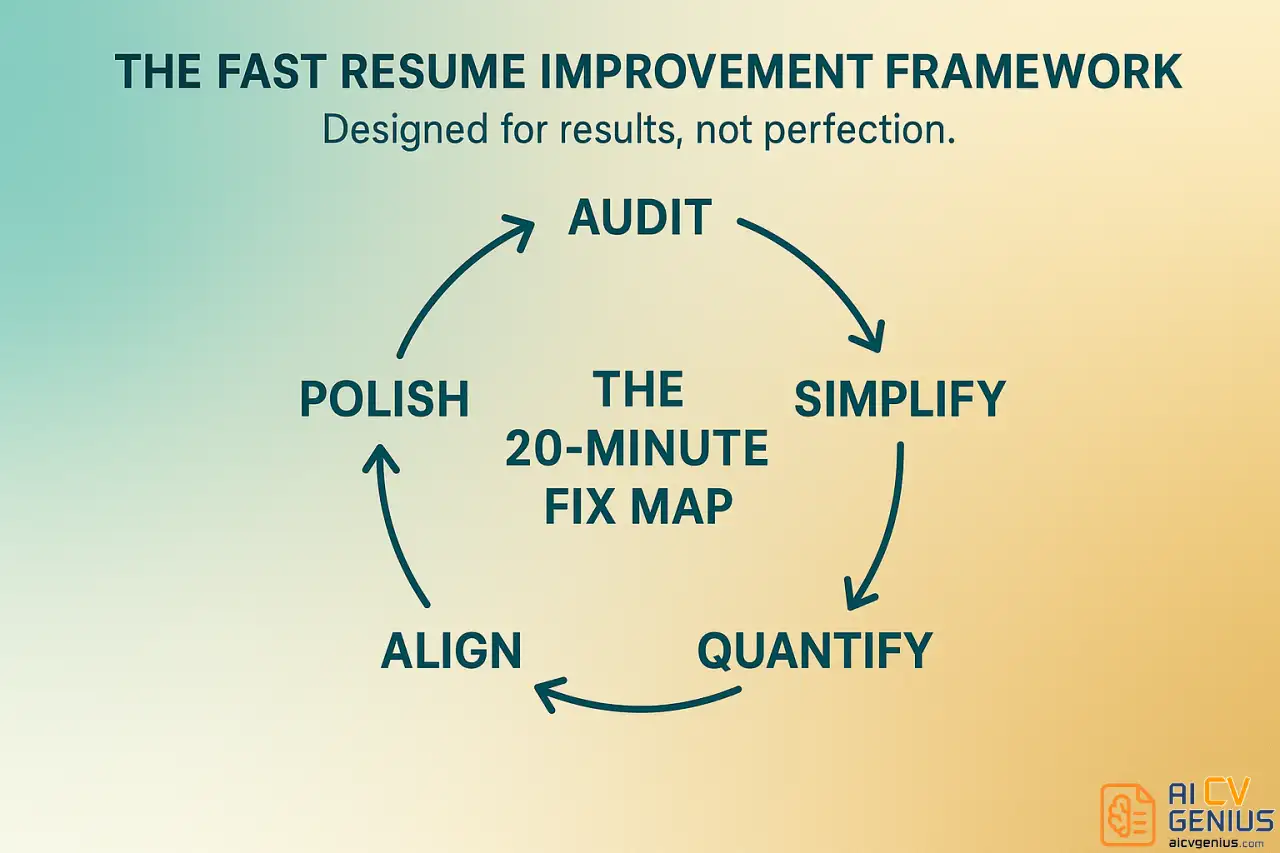
- The “20-Minute Fix” is a sprint with four moves: Audit and reorder sections, rewrite bullets into results (Verb + Task + Metric), simplify into a single-column ATS-safe layout, then rebuild the summary as a tight story hook.
- After submitting the revised version, Sarah gets a quick callback, and the recruiter feedback points to one change: The resume finally reads like ownership and impact instead of assignments.
- The article ends with a copyable framework plus a reality check: Quick fixes work best when experience is solid but buried, while major transitions or thin experience usually need a deeper rewrite.
The 20-Minute Experiment That Changed Everything
It started as a casual experiment on a quiet Tuesday afternoon. Could we really turn a mediocre resume into something recruiters would actually respond to – in just twenty minutes? The idea sounded improbable, perhaps even overly simplistic. But that’s exactly what we attempted. This isn’t abstract theory; it’s a real story about focused transformation, detailed minute by minute. It demonstrates the kind of 20-minute CV improvement anyone can replicate if they understand how recruiters prioritize information and what truly captures attention on paper.
Most people don’t realize how effectively a resume can obscure potential. Behind cluttered layouts or passive phrasing often lies a capable individual whose value proposition was never clearly presented. This story focuses on one such professional – a marketing assistant named Sarah – and how a targeted adjustment in clarity dramatically altered her job search trajectory.
The problem with “good enough” resumes
Sarah wasn’t careless. Her resume appeared clean, utilized standard bullet points, and contained no obvious typos. She had diligently followed common advice from numerous “how to write a resume” articles found online. Yet after submitting thirty-seven targeted applications, the result was disheartening: absolute silence. No interview requests. Not even automated rejections.
When she shared her CV, the core issue became immediately apparent – a common reason for lack of response. It wasn’t objectively bad – it was simply invisible. It represented the kind of document that might pass basic ATS filters due to keyword presence but ultimately failed to establish a meaningful connection with a human reviewer. It lacked clear visual hierarchy, quantifiable achievements, and a compelling narrative thread. Everything carried seemingly equal weight – meaning nothing truly stood out during a rapid scan.
What we decided to test
Instead of undertaking a lengthy, comprehensive overhaul, we aimed to determine what substantive changes could be achieved through a highly focused, time-constrained method – a structured sprint. We termed it “The 20-Minute Fix.” The guiding principle: implement only changes that demonstrably increase scannability, convey professional energy, or foster an immediate connection with the reader’s priorities. No complete redesigns. No exhaustive rewrites. Just twenty minutes dedicated to strategic refinement.
Understanding How Recruiters Actually Read Resumes
Before modifying a single word, it’s crucial to understand the recruiter’s reality. Eye-tracking research confirms recruiters don’t read linearly, top to bottom; their gaze typically follows predictable patterns, often resembling an ‘F’ or ‘Z’ shape – scanning horizontally across the top (name, title, summary), jumping down to scan job titles and company names along the left margin, and darting across lines containing numbers or specific keywords. They are not reading for nuance; they are pattern-hunting for relevance signals in under 10 seconds. This insight dictates that subtle formatting choices and prominently placed, quantifiable metrics often matter more initially than detailed paragraphs of self-description.
Therefore, instead of merely making Sarah’s resume aesthetically prettier, our focus shifted entirely to making it more strategically scannable and immediately impactful. Less visual clutter, more informational contrast. Fewer passive adjectives, more dynamic action verbs tied to results. The objective was to ensure every critical piece of information communicated clear, demonstrable “impact.”
Where clarity begins: The power of subtraction
The initial, and perhaps most impactful, fix was psychological and subtractive: we deleted aggressively. We removed an outdated high school internship, generic filler hobbies (“reading,” “travel”), and condensed her lengthy, objective-focused summary into a concise, value-driven professional profile. Within the first three minutes, her resume already felt significantly lighter, more focused, and easier to navigate. The strategic use of white space began working its subtle magic. Recruiters don’t reward clutter; they subconsciously appreciate clarity and control.
Turning duties into quantifiable results
Sarah’s original bullet points predominantly began with passive phrases like “Responsible for…” or “Duties included…” These constructions are among the least effective in job search communication. They state assigned tasks, not achieved outcomes. We systematically rewrote these lines adhering to a simple, powerful formula: Action Verb + Specific Task + Quantifiable Result/Outcome. Examples:
- ✅ “Responsible for managing social media campaigns” → “Led 3 targeted social media campaigns (Facebook, Instagram) that grew average post engagement by 58% and generated 200+ qualified leads.”
- ✅ “Created content for new product launch” → “Produced 20+ pieces of launch content (blog posts, email sequences, social graphics) that contributed to reaching 120K+ target users and exceeding initial adoption goals by 15%.”
- ✅ “Assisted marketing manager with various projects” → “Supported cross-functional project teams (Marketing, Sales, Design) contributing to initiatives that resulted in a documented 12% increase in quarterly departmental goal attainment.”
Each specific number and measurable outcome transformed her from appearing as simply an employee fulfilling duties into a professional delivering demonstrable value. That crucial distinction separates resumes that get briefly skimmed from those that get saved for further review.
When design choices hinder accessibility
Sarah’s original template featured prominent color blocks and was structured into two narrow columns. While potentially perceived as “creative” by some, it failed multiple ATS compatibility tests we ran. The parsing software misinterpreted the column structure, jumbling contact information with skills and work history sections randomly. A human recruiter might never even have seen the correctly formatted version due to this initial technical failure.
We replaced it with a clean, single-column layout emphasizing white space, sourced from Resume Templates Finder. The text immediately felt more breathable. The informational flow became intuitive and logical. Suddenly, her carefully rewritten achievements became the clear focal point, rather than being overshadowed by distracting formatting. Remember: effective resume design prioritizes strategic communication and accessibility over mere aesthetics. Minimalism isn’t just a style – it’s often a strategic necessity.
The 20-Minute Process, Broken Down
With the timer started, the singular goal remained: structure the resume to make a compelling case within the typical six-second initial recruiter scan. Here’s the minute-by-minute breakdown of the focused editing session.
Minute 0–5: Audit ruthlessly – Prioritize and Purge
We scanned specifically for low-impact or irrelevant sections. Her generic “Objective” paragraph offered no unique value proposition. Removed. Her Education section was positioned first, despite five years of relevant work history. Moved to follow Experience. We then reordered the main sections to align with how recruiters typically prioritize information: Contact Header → Summary → Work Experience → Key Skills → Education. This ensures the most critical information appears earliest in the scanning path.
Minute 6–10: Rewrite bullets with energy and evidence
We transformed six vague, duty-focused bullet points under her most recent role into four powerful, achievement-oriented statements. Every revised line now contained a strong action verb and concrete evidence of impact (often quantified). We replaced bland corporate jargon (“Supported cross-department initiatives to enhance synergy”) with clearer, more direct language (“Partnered with Product Design and Data Analytics teams to successfully launch integrated marketing campaigns viewed by over 90K target users”). Recruiters subconsciously respond to textual momentum – this revision provided it.
Minute 11–15: Simplify visuals – Enhance hierarchy
We eliminated decorative borders, unnecessary icons, and distracting background gradients. Instead, we relied on strategic use of subtle font weight variations (bolding for job titles, company names, key metrics) and consistent vertical spacing between sections and bullet points to establish a clear visual hierarchy. When we compared printed before-and-after versions, the difference was palpable – the new version appeared calmer, more organized, and intentionally structured. Effective design psychology guides the eye effortlessly.
Minute 16–20: Rewrite the summary as a compelling story hook
Her newly crafted professional summary read:
“Results-driven Marketing professional with 5 years of hands-on experience developing and executing digital strategy and compelling brand storytelling. Proven ability in transforming underperforming campaigns into high-engagement success stories, achieving measurable growth (e.g., 58% engagement increase). Passionate about leveraging data-driven creativity to build genuine connection between brands and their target audiences.”
This was no longer a generic wish list or statement of responsibility. It functioned as a concise, high-impact trailer, allowing the recruiter to instantly grasp her core strengths and potential value. Clarity, when combined with evidence, becomes charisma on paper.
The Transformation – and the Silence That Broke
Submitting the new version
With renewed confidence, Sarah submitted the updated, strategically refined resume to the very same company that had ignored her previous application a month earlier. The result was almost immediate. Two days later, she received a personalized email: “We reviewed your updated profile and would love to speak with you further about your background and potential fit for our Marketing Specialist role.” The only substantive change between the two applications was the presentation and framing of her existing qualifications.
Recruiter reaction and feedback
During the subsequent interview process, Sarah inquired about what made this version of her resume stand out compared to the previous one. The hiring manager’s feedback was illuminating: “This version read like someone who understands impact and takes ownership of results, not just someone describing assigned tasks. The clarity and focus on metrics made it easy to see your potential contribution quickly.” That single comment perfectly encapsulated the experiment’s success. The revised resume didn’t alter who Sarah was – it simply revealed her capabilities more effectively within the recruiter’s limited timeframe.
What stayed the same – Honesty and Authenticity
Crucially, we didn’t inflate achievements, fabricate numbers, or misrepresent her experience in any way. We didn’t need to. Most candidates already possess the core qualifications and experiences recruiters seek; often, this value is merely obscured by ineffective presentation or buried under irrelevant noise. The 20-minute method primarily focuses on removing that noise and sharpening the focus. It emphasizes strategic precision, not unattainable perfection.
The Framework You Can Copy Today
Core steps of the quick resume fix
This focused approach can be broken down into repeatable phases:
| Phase | Focus | Key Action | Desired Outcome |
|---|---|---|---|
| Audit (Minutes 0-5) | Clarity & Relevance | Remove low-value content (fluff, outdated info), reorder sections logically (Experience first for non-grads). | Cleaner flow, improved focus on critical information. |
| Rewrite (Minutes 6-10) | Evidence & Impact | Transform passive duty descriptions into active, measurable achievements (Verb + Metric + Outcome). Prioritize strongest results. | Enhanced credibility, clear demonstration of value. |
| Design (Minutes 11-15) | Readability & ATS Compatibility | Adopt clean, single-column layout. Use consistent fonts, spacing, and subtle hierarchy (bolding). Maximize white space. | Improved scannability, accessibility for software and humans. |
| Summary (Minutes 16-18) | Storytelling & Branding | Craft a concise (3-line) professional summary highlighting key expertise and value proposition, tailored to target roles. | Increased memorability, immediate positive impression. |
| Polish (Minutes 19-20) | Professionalism & Accuracy | Final check for consistency (formatting, dates), grammar, spelling. Ensure all links work. | Error-free presentation, conveys attention to detail. |
When quick fixes are most effective
Short, focused editing sprints like this are highly effective when your underlying experience is strong, but your presentation is hindering its visibility. They are ideal for refining an existing resume that feels cluttered, passive, or fails to highlight key achievements adequately. Think of it as essential maintenance or optimization – small, targeted adjustments that significantly improve performance without requiring a complete rebuild.
When a deeper rewrite is necessary
If you are undergoing a significant career transition (changing industries), targeting executive-level roles requiring a different strategic focus, or if your existing resume lacks substantive content (e.g., very early career), a twenty-minute fix alone likely won’t suffice. These situations demand a more comprehensive approach involving in-depth content development, strategic repositioning, and potentially more personalized layout choices.
For guidance on these deeper transformations, explore resources like Resume Templates Guides which offer frameworks specifically designed around career transition and demonstrating senior-level strategic impact.
The Ripple Effect of Confidence
New tone, new energy in interviews
After her successful first interview using the revised resume, Sarah shared a subtle yet powerful observation: “I sounded different in the interview because I felt different about how I was presenting myself.” The improved resume didn’t just get her noticed by recruiters; it fundamentally helped her internalize and articulate her own professional story more effectively. When asked about her experience, she naturally used the same quantified achievements and impactful verbs we had integrated. The narrative became genuinely hers, not just words borrowed from generic job descriptions.
Recruiter empathy and connection
What proved most insightful was how recruiters seemed to respond not just to the improved design or clearer metrics, but to the perceived energy and self-awareness conveyed by the document. They could sense a level of professional pride and intentionality behind the words. That’s a key function of every truly great resume – it transfers a sense of competence and confidence from the candidate to the reader.
The broader lesson: Focus drives speed
Writing an effective resume isn’t primarily about pleasing a complex algorithm (though ATS compatibility is crucial). It’s fundamentally about shaping human perception of your impact and potential within an extremely limited timeframe. Fast editing doesn’t equate to carelessness; it necessitates intense focus on what truly matters. That’s why this time-constrained approach often yields significant results – it forces clarity by imposing deadlines.
Checklist for Your Own 20-Minute Resume Sprint
Ready to try it yourself? Set a timer and focus intensely on these high-impact actions:
- ✅ Start by Deleting (Aggressively): Immediately cut approximately 15% of the text that adds the least measurable value (e.g., generic objectives, irrelevant hobbies, redundant phrases). Be ruthless.
- ✅ Reorder Sections Strategically: Ensure Work Experience comes before Education (unless you’re a recent grad). Place the most critical sections (Summary, Experience, Skills) within the top half/two-thirds of the page.
- ✅ Transform Passive Bullets: Systematically replace every instance of “Responsible for…” or similar passive phrasing with strong action verbs directly linked to quantifiable metrics or specific outcomes. Aim for 3-5 high-impact bullets per role.
- ✅ Verify Layout & ATS Compatibility: Confirm the layout is predominantly single-column and uses standard, readable fonts. Copy-paste content into a plain text editor to check parsing order.
- ✅ Refine the Summary for Impact: Rewrite your summary into a concise (3-line maximum) statement that immediately sells your core value proposition and key expertise, tailored to target roles. Focus on impact, not just intention.
- ✅ Conduct the Print Test: Print the resume. If it feels visually crowded, dense, or difficult to scan quickly, it needs more white space or better hierarchy. Adjust spacing and font sizes slightly if needed.
- ✅ Perform the Read-Aloud Test: Read key sections (summary, bullet points) out loud. If you stumble over awkward phrasing or overly long sentences, recruiters likely will too. Simplify language for clarity.
- ✅ Get Quick External Feedback: Send it to one trusted friend or mentor with a single question: “What’s the very first thing that jumps out at you?” Their immediate impression is valuable data.
- ✅ Implement One Key Feedback Point: Address the single most critical piece of feedback received.
- ✅ Stop Editing After 20 Minutes: Resist the urge to endlessly tweak. The goal is significant improvement through focused effort, not unattainable perfection. Clarity often benefits from deadlines.
Pros & Cons of the 20-Minute Method
This approach offers distinct advantages but also has limitations:
| ✅ Pros | ❌ Cons |
|---|---|
| Delivers rapid, visible improvements that can build job search momentum and confidence. | May lack sufficient depth for addressing complex career transitions or repositioning for significantly higher-level roles. |
| Forces prioritization and focus on high-impact changes, combating analysis paralysis. | Can potentially overlook subtle but important issues related to overall narrative tone or strategic positioning if not careful. |
| Instantly improves recruiter readability and scannability, increasing chances of passing the initial 6-second review. | Does not replace the need for comprehensive content updates if experience itself is outdated or lacks substance. It primarily refines presentation. |
| Highly effective for optimizing existing resumes that are fundamentally sound but poorly presented. | Less effective for resumes requiring foundational content creation (e.g., first-time resume writers with minimal experience). |
Final Reflection: Distillation Over Detail
The most effective resumes are often not the most exhaustively detailed – they are the most strategically distilled. Sarah’s story serves as a powerful reminder that the primary barrier to securing interviews frequently isn’t a lack of qualifications, but rather a lack of clarity in communicating those qualifications. When you cease chasing elusive perfection and instead concentrate intensely on achieving impactful clarity, significant progress often happens remarkably quickly. Sometimes, that focused refinement is precisely what’s needed to fundamentally change the trajectory of your job search.
If you wish to replicate this approach, begin with your current resume draft and allocate exactly twenty minutes to implement these high-impact changes. You might be genuinely surprised by how much improves when you finally view your own professional experience through the critical, time-constrained lens of a recruiter.
For practical tools, ATS-friendly layouts, and further real-world examples illustrating these principles, explore our Career Resources section – it’s filled with recruiter insights, before-and-after transformations, and templates specifically designed to help you articulate your value more effectively and advance your career faster.
Ready to initiate your own 20-minute sprint towards a more impactful resume? Browse our curated Resume Templates Finder to select a layout optimized for clarity and scannability, and begin transforming your career story today.