

- What “Why this job?” really tests: Motivation, role fit, and whether you will stick around long enough to be worth the hire.
- Fastest ways to fail: Compensation-first answers, desperation or negativity, and generic flattery that could fit any company.
- Winning structure: Use a 3-part “Value Triangle” that connects Why them, why this role, and why you can deliver.
- How to sound specific: Reference a real product, project, or recent move, then tie it to work you actually want to do.
- Prep that makes it natural: Do a 30-minute research sprint, then build a tight 60 to 90 second story you can repeat under pressure.
The interview is going well. You’ve built rapport. You’ve detailed your experience. Then, the interviewer leans in and asks, “So, how to answer ‘why do you want this job‘?” This is not small talk. This is not a filler question. This is, quite possibly, the most important question of the entire interview. It’s a pivot point that reveals whether you are a thoughtful, motivated candidate who has done their homework, or just another applicant mass-applying for any paycheck. Get it wrong, and the rapport you’ve built evaporates. Get it right, and you position yourself as the only logical choice.
Most candidates stumble here because they fundamentally misunderstand what the interviewer really wants to know. They fall into the trap of talking about themselves – their career goals, their need for growth, their desire to learn, or how the commute is convenient. But here’s the cold, hard truth: the interviewer doesn’t primarily care about your personal development. They have a problem. They have a budget to solve that problem. They care about one thing: Are you the best, most reliable solution to their problem?
This guide will deconstruct the psychology behind this critical question. We will provide a powerful, three-part formula that works in every scenario, four complete, word-for-word example answers for different career situations, and a breakdown of the three responses that instantly disqualify you. Whether you are switching careers, just entering the workforce, or gunning for a senior leadership role, this approach will ensure your answer lands with confidence and clarity.
What Recruiters Actually Hear When They Ask This Question
The question sounds simple, but it’s a sophisticated diagnostic tool. It’s a single probe designed to get answers to a dozen underlying concerns that hiring managers have about every candidate. Your answer tells them everything about your motivation, your preparation, and your professionalism.
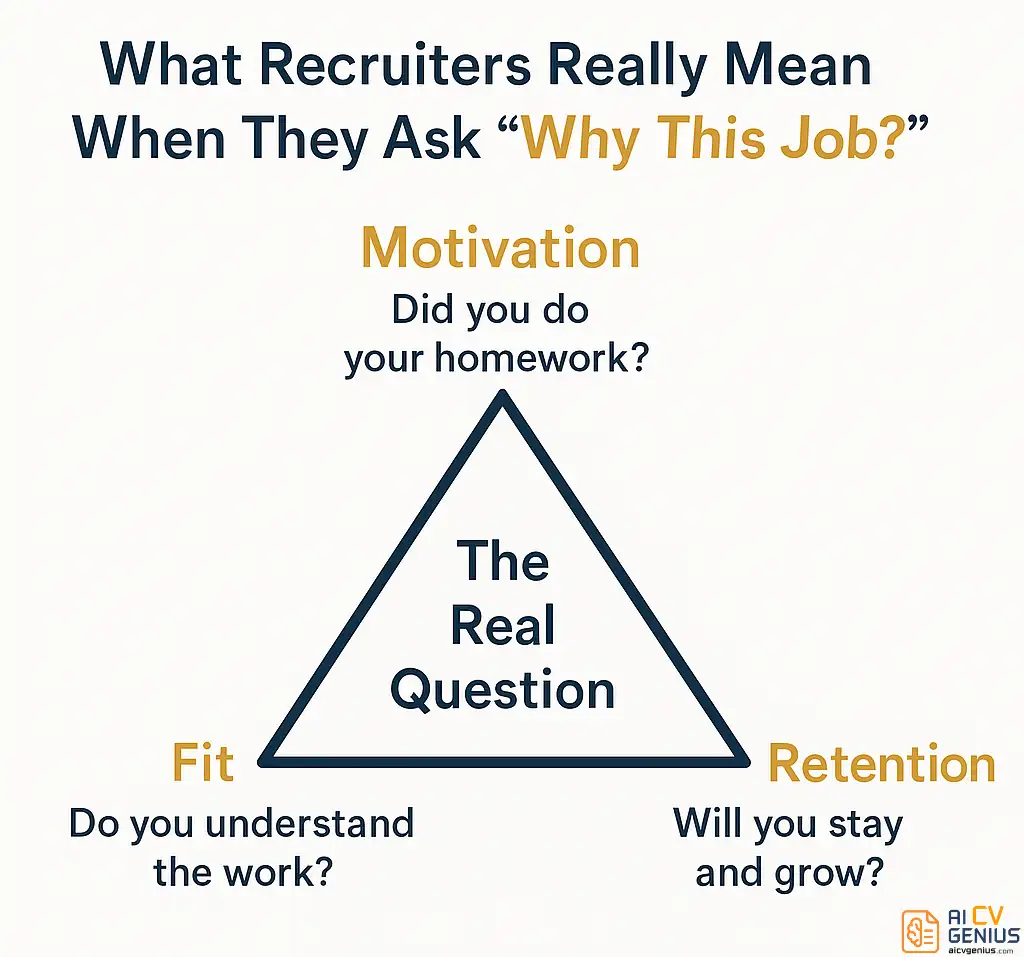
The Three Hidden Questions Behind the Question
When someone asks “Why this job?” they are almost always asking three things simultaneously:
- Did you do your homework? (The “Motivation” Test)Have you done more than just read the job title? Do you know what our company actually does? Do you know who our competitors are? Or are you just mass-applying to 50 jobs a day? Companies waste thousands of dollars on bad hires. If you can’t articulate what makes this specific organization compelling, you signal that you’re a flight risk who will leave the moment a slightly better offer appears.
- Do you understand what this job actually is? (The “Fit” Test)Many candidates apply for the idea of a job, not the reality of it. They love the idea of being a “data scientist” but hate the reality of cleaning data 80% of the time. Hiring managers need to know you’ve read the job description, you understand the day-to-day work (even the boring parts), and you still want it.
- Are you going to be a good long-term investment? (The “Retention” Test)Training a new employee is incredibly expensive and time-consuming. The real question underneath it all is: are you going to stay, or will we be doing this entire hiring process again in six months? They are listening for genuine enthusiasm that suggests you’ll be engaged, motivated, and committed enough to push through the inevitable tough days.
Research from LinkedIn and other HR analytics firms consistently shows that “cultural fit” and “motivation” are as important as hard skills. This question is the primary tool for testing both. Your answer is a direct window into your level of preparation and genuine interest.
What They Absolutely Do Not Want to Hear (The Traps)
Before we build the perfect answer, let’s look at the common responses that immediately kill your chances. These answers are all focused on “me,” not “you” (the company).
- ❌ The Money/Perks Answer: “Honestly, the salary range was very attractive, and I’ve heard your benefits are great.”(What they hear: “I am a mercenary. I will leave this job for a 10% raise.”)
- ❌ The “Career Growth” Answer: “This seems like a great next step for my career and a wonderful opportunity for me to learn and grow.”(What they hear: “I am a student, not an employee. I want you to invest in me. I’m focused on what I can get, not what I can give.”)
- ❌ The Generic Flattery Answer: “Well, [Company Name] is a well-known industry leader and I’ve always admired your brand.”(What they hear: “I did zero research. This answer could apply to any of your competitors. I’m just telling you what I think you want to hear.”)
- ❌ The “Escape” Answer: “My current boss is a micromanager and the culture is toxic. I just need to get out of there.”(What they hear: “I am unprofessional, I badmouth my employers, and I might be the actual problem.”)
- ❌ The “Convenience” Answer: “It’s only a 10-minute commute from my house, and the hybrid schedule really works for me.”(What they hear: “I am settling for this job because it’s easy, not because I’m passionate about the work. I have no real commitment to the role.”)
These responses get you eliminated not because they aren’t true, but because they fail to demonstrate that you are the best person to solve their problem.
The Winning Formula: The 3-Part “Value Triangle” Answer
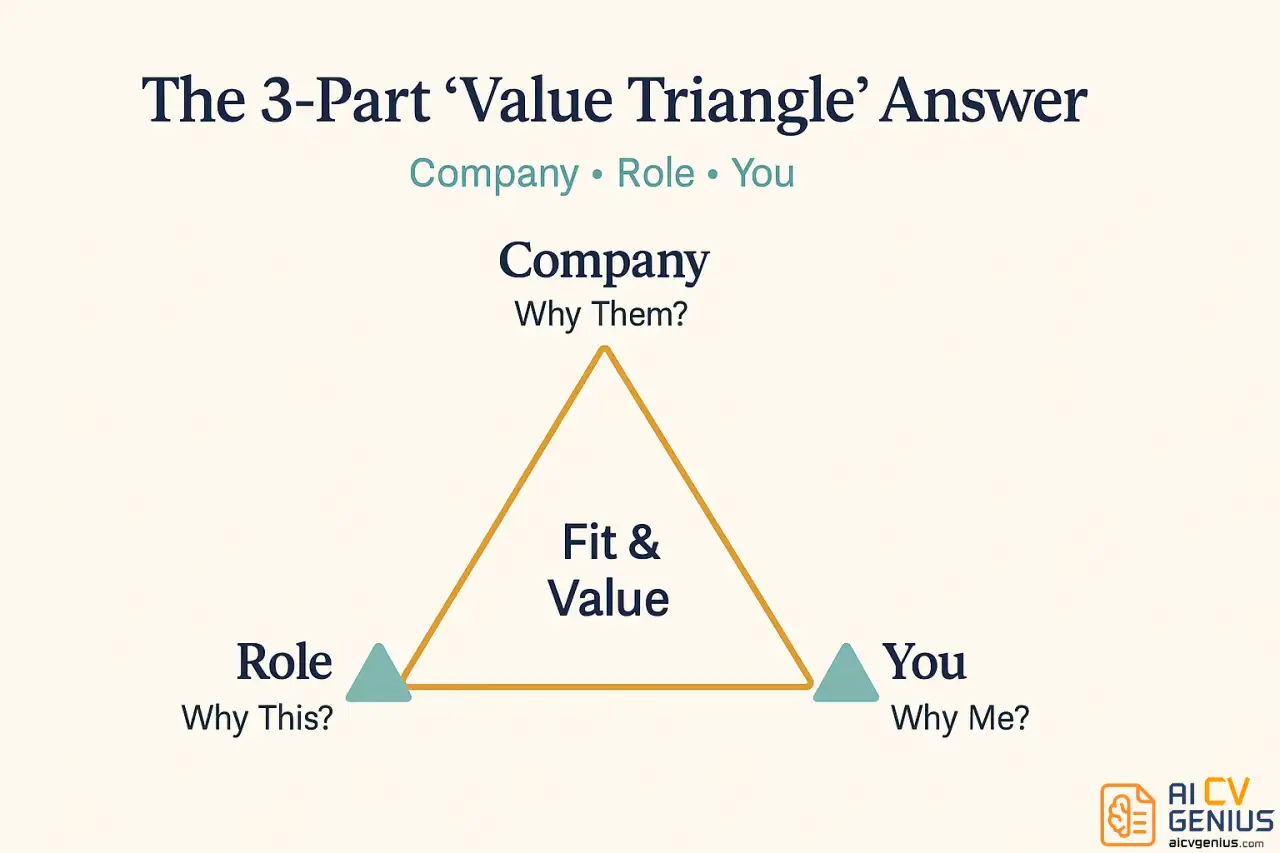
The most effective, persuasive, and memorable answers follow a simple, three-part structure. We call it the “Value Triangle” because it connects the company, the role, and your unique value into one cohesive, undeniable argument.
Your answer should be a 60-90 second narrative that weaves together these three points:
- Part 1: The Company (Why Them?) – “I’m impressed by you.”
- Part 2: The Role (Why This?) – “I’m drawn to this specific work.”
- Part 3: The Value (Why Me?) – “I’m equipped to deliver.”
You can change the order, but a great answer contains all three.
Part One: Why This Company? (Demonstrate Your Research)
You must start by proving you’re not just applying everywhere. You chose them for a specific, intelligent reason. This immediately builds rapport and respect.
What it should sound like:
• Reference a specific product, project, or recent news: “I’ve been following your work on the ‘Atlas’ project for the past year…”
• Mention a company value or mission statement: “I read your company value of ‘moving with purpose,’ and that really resonated with me because…”
• Highlight their specific approach or market position: “What really interests me is how [Company Name] is tackling [Industry Problem] differently than your competitors, specifically by focusing on…”
Example (In-Depth):
“I’ve actually been following [Company Name]’s work for a while, ever since I read your whitepaper on sustainable supply chains last year. As someone who’s worked in traditional logistics, I’ve seen firsthand how much waste the industry generates. Your company’s pragmatic approach to solving that problem – focusing on retrofitting existing systems rather than just proposing expensive new ones – strikes me as genuinely innovative and, frankly, the only approach that will actually work at scale.”
This answer is powerful because it’s specific (“sustainable supply chains,” “retrofitting existing systems”), shows genuine industry knowledge, and offers a thoughtful opinion. It’s an answer that could only be given to this one company. Many candidates struggle with this step when switching industries, but understanding how to position career transitions can help you frame your unique background as an asset, not a liability.
Part Two: Why This Role? (Demonstrate Your Understanding)
Next, prove you’ve read the job description and understand what the day-to-day work actually involves. This reassures them that you won’t be surprised or disappointed six weeks into the job.
What it should sound like:
• Reference 1-2 specific responsibilities from the job description.
• Explain why those tasks appeal to you (e.g., they align with your strengths, or they are the logical next step in your skillset).
Example (In-Depth):
“What particularly excites me about this specific Project Coordinator role is the blend of high-level stakeholder management and in-the-weeds operational execution. In my current job, I often handle one or the other, but rarely both on the same project. The job description mentions ‘managing client communications from kickoff to delivery’ while also ‘owning the project timeline and resource allocation.’ That blend is exactly what I’ve been seeking as my next step, as I really enjoy both the people-facing and the analytical sides of project management.”
This answer demonstrates that you’ve read the job description line by line, you understand the nuances of the role, and you are consciously choosing this blend of responsibilities.
Part Three: Why You? (Demonstrate Your Value)
Finally, you close the loop. You’ve shown you like them and you like the job. Now you must show them why they should like you. This shifts the answer from “Here’s what I want” to “Here’s what I can deliver.”
What it should sound like:
• Highlight a key skill or experience that directly maps to their biggest need.
• Use a specific, quantifiable example (a mini-STAR method story) that proves you can deliver.
• Show how your unique background is the perfect solution to their problem.
Example (In-Depth):
“This all comes together because my background is a perfect fit. My three years coordinating product launches for a fully distributed team means I’ve lived the challenges this role requires. I’ve managed complex timelines across five different time zones, I’ve been the single point of contact for engineers in one country and marketers in another, and I’ve learned how to anticipate communication breakdowns before they derail a project. That experience in building systems for remote-first alignment isn’t something I’d have to learn; it’s the expertise I’d be bringing on day one.”
This final piece completes the argument:
(Company): You’re doing innovative work I admire.
(Role): The job itself is the perfect blend of tasks for me.
(You): My unique experience means I can solve your specific problems immediately.
This three-part answer is irrefutable. It’s not a plea; it’s a business case.
Four Complete Example Answers for Different Situations
The “Value Triangle” formula adapts to any scenario. Here are four complete, word-for-word responses that demonstrate how to structure your answer based on your specific circumstances.
Example One: For Career Changers
Situation: Switching from 7 years in K-12 Teaching to a Corporate Training (Learning & Development) role.
“Thank you for asking. My interest in this role is actually the result of a very deliberate career journey. For seven years, I’ve been a high school English teacher, and while I love the act of teaching, I found my greatest passion was in developing curriculum for adults – specifically, running the professional development workshops for new teachers at my school. That’s when I realized I wanted to move into a corporate L&D space, and I began my [Certification Name].
What specifically drew me to [Company Name] was your reputation for this. I read two of your case studies on your blog – one about how you redesigned the sales onboarding program and another on your new manager training. The focus on experiential, long-term learning instead of one-off ‘training days’ aligns perfectly with my own teaching philosophy. It’s clear you build for retention, not just for checking a box.
Finally, I believe my classroom experience is my biggest asset for this role. I’m not a theorist; I’m a practitioner. I have 7 years of real-world data on what makes people ‘tune in’ versus ‘tune out.’ I’ve managed a room of 30 ‘stakeholders’ with different learning styles every single day. I’ve designed curriculum, measured outcomes, and adapted my lesson plans on the fly. I’m excited to bring that hands-on experience in pedagogy and engagement to your team.”
Why this works: It addresses the career change head-on, not as a weakness, but as a logical “origin story.” It proves deep research (case studies, blog) and connects it to a personal philosophy. It masterfully reframes “teaching” as “stakeholder management” and “curriculum design,” showing they are a L&D professional already, just in a different context.
Example Two: For Experienced Professionals (Moving Up)
Situation: A Senior Marketing Manager applying for a Director of Marketing role at a growing startup.
“I’ve been following [Company Name]’s growth trajectory since your Series B round was announced. What’s impressed me most is how you’ve managed to scale revenue so quickly without, from the outside at least, losing your authentic brand voice. A lot of SaaS companies in hyper-growth default to generic, ‘enterprise’ messaging. Your content strategy, however, shows you understand that educating your users is what builds a loyal community and prevents churn. That’s a philosophy I share.
This specific Director role is exactly what I’m looking for because it’s at this critical inflection point. I’ve spent five years building and leading marketing teams, but often at larger corporations where strategy and execution are heavily siloed. This role requires someone who can build the high-level, 12-month strategic plan and has the hands-on experience to roll up their sleeves and build the initial systems with the team. That’s the exact blend of leadership and execution I thrive on.
In my last role, I navigated this exact transition. I inherited a team of three generalists and scaled it to a 15-person specialized team. I implemented the company’s first marketing automation platform (HubSpot) and built the reporting dashboards that aligned our team’s efforts with the sales org’s revenue goals. You’re at the point where marketing needs to professionalize without losing its agility, and I’ve done that before.”
Why this works: It shows deep business and industry knowledge (“Series B,” “SaaS hyper-growth,” “inflection point”). It correctly identifies the company’s core challenge (scaling without losing agility) and positions the candidate as the specific solution. It demonstrates clear understanding of what makes a top candidate at a senior level: strategic vision paired with proven execution.
Example Three: For Entry-Level Candidates (Recent Graduate)
Situation: A recent graduate applying for their first full-time Marketing Coordinator position.
“I first discovered [Company Name] through your ‘Accessible Design’ campaign last year – specifically the video series that featured users with disabilities testing your product. As a marketing student, we talked a lot about ‘authenticity,’ but that campaign was one of the few times I’d seen a tech company actually do it well, by centering the users’ voices instead of their own. It showed me this is a team that cares about doing the work, not just the “look” of the work.
This Marketing Coordinator role is exciting to me for that very reason. I want my first job to be at a place where I can learn the fundamentals from a team that operates with that level of integrity. The job description mentions supporting everything from email campaigns to event coordination, and that variety is a huge plus. I’m eager to contribute across all those channels while learning the ropes.
Even though I’m a recent graduate, I’m not coming in with just classroom theory. As the marketing intern for a local nonprofit, I managed their social media, grew their Instagram following by 40% in six months, and single-handedly coordinated a fundraising event for 200 people. I’m ready to bring that same hustle and hands-on execution to your team while I learn from your experts.”
Why this works: It proves genuine, specific research on a past campaign. It’s honest about being entry-level but reframes it as a positive (“eager to learn”). Most importantly, it uses a concrete internship example (40% growth, 200-person event) to prove they are a “doer” who can contribute immediately, not just a “learner.”
Example Four: For Same-Field Transitions (Lateral Move)
Situation: A Software Engineer moving from one mid-size company to another.
“I’ve been a backend engineer in the fintech space for three years, but I’ve been following [Company Name]’s engineering blog for a while. Your open-source contributions to the GraphQL ecosystem first caught my eye, and I was particularly impressed by the post about your team’s migration from a REST monolith to microservices. The focus on developer experience and well-documented, pragmatic decisions really stood out.
What excites me about this specific role is the opportunity to work on infrastructure that operates at a truly massive scale. In my current role, our systems handle about 10,000 transactions per hour, which has been a great challenge. But I know your systems handle 10 or 20 times that. The specific problems that emerge at that level – around distributed systems, caching strategies, and observability – are exactly the problems I’m most passionate about solving at this stage of my career.
My experience is a direct match. I recently redesigned our core retry logic, which reduced failed transactions by 30%. I also led the implementation of circuit breakers that improved system stability during high-load periods. I understand the reliability and precision required when handling financial data, and I’m ready to apply that experience to the challenges of your scale.”
Why this works: It’s a masterclass in “speaking their language.” It shows genuine technical engagement (engineering blog, open-source) beyond just the job hunt. It clearly articulates why this “lateral” move is actually a step up (the challenge of “scale”). It proves capability with highly relevant, specific examples (retry logic, circuit breakers). For more on preparing for these technical discussions, check out our comprehensive interview strategies.
Three Answers That Instantly Disqualify You (Avoid at All Costs)
Even a highly qualified candidate can be instantly eliminated by giving one of these common, low-effort answers. Avoid them, no matter how honest they feel in the moment.
Mistake One: Leading With Compensation or Benefits
️The Answer: “To be honest, the salary range you posted was really attractive, and I know your company has great benefits. I’m looking to increase my income, and this seemed like a good opportunity.”
❓Why it Fails: This is the “mercenary” answer. Even though compensation is a key part of any job, leading with it makes you seem purely transactional. The interviewer hears, “I have no loyalty to your company or mission. I will leave the second someone offers me $5,000 more.” It signals you are a flight risk with no intrinsic motivation.
The Fix: Never, ever mention salary or benefits as a reason for wanting the job. That is a negotiation topic, not a motivation topic. Focus 100% on the work, the company, and the value you can add.
Mistake Two: Revealing Desperation or Negativity
️The Answer: “My current job is a nightmare. My boss is a toxic micromanager, and I just need to get out of there as soon as possible.” or “I’ve been unemployed for six months, and I really just need to find a position, any position.”
❓Why it Fails: This is the “red flag” answer. Complaining about a former employer is the #1 rule of what not to do in an interview. It makes you sound unprofessional, negative, and like you might be the common denominator in the problem. The desperation answer is just as bad; it signals you will take any job, which means you haven’t chosen this one for any good reason. It makes them question why 50 other companies have already passed on you.
The Fix: If you’re leaving a bad situation, frame it positively. Don’t talk about what you’re running from; talk about what you’re running to. “I’m looking for a more collaborative environment where I can be part of a team, which is what drew me to your company’s culture.”
Mistake Three: Generic Flattery That Applies to Any Company
️The Answer: “Well, [Company Name] is a real industry leader with a great reputation. I’ve always admired your brand, and I’d be proud to work for such a successful company.”
❓Why it Fails: This is the “empty calorie” answer. It’s 100% generic flattery that could be (and is) said to any company. It demonstrates zero research and zero specific interest. It’s the verbal equivalent of a form letter. Recruiters hear this ten times a day, and it immediately tells them you didn’t prepare.
The Fix: Replace every generic compliment with a specific fact. Instead of “you’re an industry leader,” say, “Your new ‘Atlas’ product is the first I’ve seen to successfully integrate [X] and [Y], which sets you apart from competitors.” Specificity proves preparation. This is why understanding how confidence impacts hiring decisions is key; confidence comes from this deep preparation.
How to Prepare This Answer Before the Interview (A 30-Minute Plan)
You cannot improvise a strong response to this question in the moment. The best, most natural-sounding answers are the result of meticulous preparation.
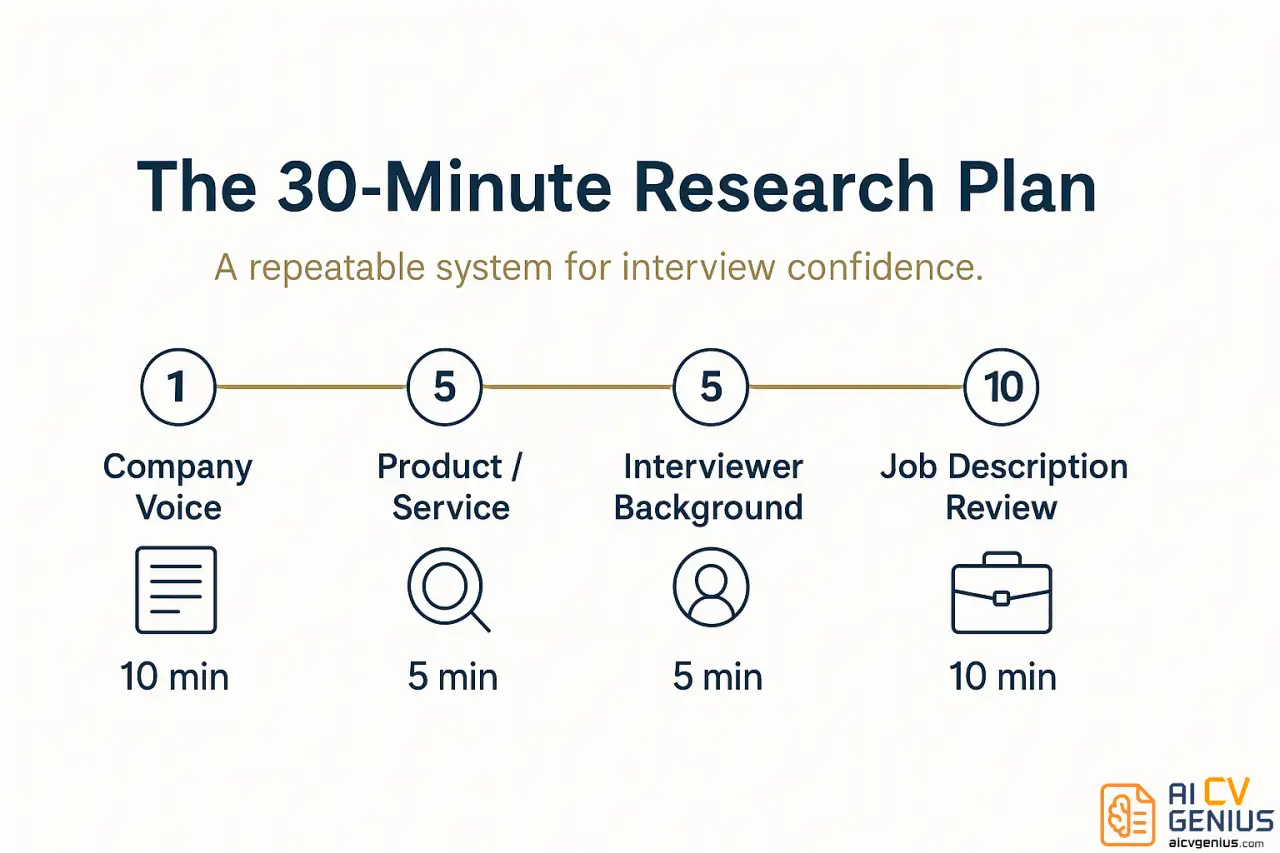
The 30-Minute Research Process That Guarantees a Good Answer
Spend 30-45 minutes researching before every single interview. Focus on finding specific, current, and interesting facts you can reference.
- (10 min) The Company’s “Voice”: Read the company’s “About” page, “Mission” page, and their last 5-10 blog posts or press releases. What words do they use? What are they proud of? (This is for Part 1: Why Them?).
- (5 min) The Product/Service: Use their product if you can. If not, read 3-5 user reviews (on G2, Capterra, or app store). What do real users love or hate? (This provides deeper insight for Part 1).
- (5 min) The Interviewer: Look up your interviewer(s) on LinkedIn. What’s their background? Did they write any articles? (This helps you build rapport).
- (10 min) The Job Description (Again): Re-read the job description multiple times. Highlight the top 3 responsibilities. Your answer must address these. (This is for Part 2: Why This Role?).
The goal is to find 2-3 specific, tangible things (a product launch, a company value, a recent award, a specific responsibility) that you can genuinely connect with.
Practice Out Loud, Do Not Memorize
Once you have your 3-part answer, you must practice speaking it. There is a huge difference between what sounds good in your head and what sounds good when you say it out loud.
- Write bullet points, not a script. Memorizing a script sounds robotic. Memorizing your 3-5 key bullet points (e.g., “1. Mention ‘Atlas’ project. 2. Connect to ‘stakeholder’ part of JD. 3. My ‘remote-first’ experience.”) allows you to be natural and conversational.
- Use a voice recorder. Record yourself answering the question on your phone. Listen back. Do you sound confident? Are you rambling? Are you using “um” or “like” too much? This is painful but incredibly effective.
- Time yourself. Your answer should be between 60 and 90 seconds. If it’s 3 minutes long, it’s too long. Cut it down.
The point is not to memorize a speech. The point is to internalize the structure of your argument so you can deliver it smoothly and confidently under pressure. This is a core part of understanding how recruiters evaluate candidates – they are listening for polished, prepared confidence.
Advanced FAQ: Answering “Why This Job?” in Tricky Situations
Prepare This Answer Like It Determines the Interview Outcome (Because It Does)
Understanding how to answer “why do you want this job” is not about memorizing a script. It’s about understanding the psychology of the hiring process. This question, more than any other, reveals your preparation, your genuine interest, and your ability to connect your personal narrative to the company’s needs.
The three-part “Value Triangle” formula is your framework for success because it addresses every hidden concern the hiring manager has:
1. Company: You’ve done your research.
2. Role: You understand the job.
3. You: You can deliver the value they need.
Avoid the three fatal mistakes – leading with money, revealing desperation, or offering generic praise – at all costs. These errors signal you are a high-risk, low-motivation candidate, and they can disqualify you even if your resume is perfect.
Do the 30 minutes of research. Find genuine, specific reasons this opportunity excites you. Practice your bullet points out loud until they sound natural and confident. This is not the time to “wing it.” This is the moment you prove you are not just a candidate, but the candidate.
For more strategies on positioning yourself effectively throughout the job search process, explore our complete guide to career resources that covers everything from application materials to interview preparation.