
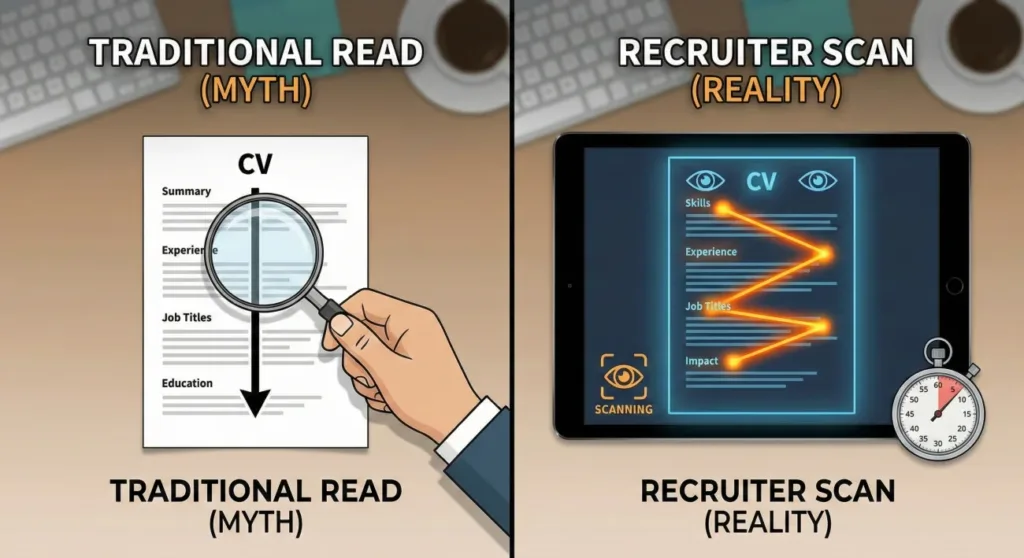
- Recruiters triage fast: They scan diagonally for relevance signals like matching titles, recognizable employers, critical keywords, and visible numbers.
- The first two seconds are visual: Clarity, white space, consistent fonts, and an easy structure win because anything cluttered feels harder to process.
- The top third decides momentum: A specific headline and a concrete summary that proves fit beats vague clichés and keeps the reader moving.
- Seconds four to six hit recent experience: Your current role and the first one to two bullets must show impact with metrics and action verbs, not passive “Responsible for” duties.
- Submit only after a quick checklist: Confirm scannable layout, natural keyword alignment, quantified impact near the top, targeted headline, clean file name, proofread, and a stable PDF unless DOCX is requested.
We’ve all wondered it – that critical moment right after you hit “Submit.” What truly unfolds on the other side of the screen? What does a recruiter actually see, and how do they see it, when your meticulously crafted resume lands in their inbox or applicant tracking system? Understanding what happens when a recruiter opens your resume isn’t just about satisfying curiosity; it fundamentally changes how you should write, design, and strategically position your career narrative for maximum impact.
For years, job seekers have operated under the assumption of a careful, line-by-line review – imagining someone diligently studying every sentence. The reality, shaped by high volume and tight deadlines, is far more mechanical in its initial stages, yet ultimately more human in its final judgment than most realize. Let’s step behind the hiring curtain to witness the rapid-fire evaluation process that unfolds in those crucial first seconds – seconds that determine whether your story gets a closer look or vanishes into the digital ether.
The Myth of the Deep Read: Reality is Faster
Most applicants cling to the belief that recruiters dedicate minutes to carefully analyzing each resume. The stark truth is far different: recruiters scan first, read later – if at all. The initial pass to determine basic viability takes mere seconds. Seminal eye-tracking research from TheLadders confirmed that recruiters spend an average of only 6–8 seconds making the critical initial decision: continue reading or move on. This isn’t born of carelessness; it’s a necessary survival mechanism when facing potentially hundreds of applications for a single open position.
When that resume file opens, recruiters’ eyes don’t methodically traverse top to bottom. Instead, they execute rapid, often diagonal scans, instinctively hunting for signals of relevance – specific job titles matching the role, recognizable company names within the industry, crucial keywords indicating required skills, and quantifiable metrics demonstrating impact. It’s not personal judgment at this stage; it’s high-speed pattern recognition optimized for efficiency.
Inside the Recruiter’s Mind: The Triage Process
The First Impression (Seconds 1-2): Layout, Clarity, and Professionalism
The absolute first judgment is purely visual, occurring before a single word is truly processed. Does the document look professional and easy to navigate? Is there sufficient white space, or is it a dense wall of text? Are the fonts clean and readable? Does the overall structure feel organized? Cluttered formatting, inconsistent fonts, or overly elaborate designs immediately trigger cognitive friction – a subconscious signal that processing this resume will require extra effort. Given their time constraints, recruiters instinctively favor documents that feel effortless to scan.
That’s precisely why utilizing a clean, balanced, and structurally sound layout, like those offered in the Resume Templates Finder, can immediately create a positive initial impression. A well-organized resume implicitly signals attention to detail and professionalism before the content is even evaluated.
Section One (Seconds 2-3): Headline, Summary, and Initial Positioning
Once the recruiter confirms basic readability (“This looks like a professional document”), their eyes almost invariably jump to the top third of the page – your name, contact information, professional headline or target role, and the crucial opening summary or objective statement. This is where the most significant initial make-or-break decision often occurs. If your summary is vague, filled with clichés (“Results-driven professional with a passion for success”), or fails to immediately convey relevance to the target role, their attention often wavers, and they may move on. Conversely, if it’s concrete, keyword-rich, and directly addresses the core requirements (“Senior Marketing Manager with 5+ years leading digital growth campaigns that consistently doubled user engagement metrics”), it compels them to continue scanning.
The key principle: open with tangible proof and clear positioning, not generic adjectives. At this stage, they aren’t assessing nuanced potential; they’re rapidly filtering for basic relevance and clarity.
Section Two (Seconds 4-6): Recent Experience & Quantifiable Impact
Next, their gaze typically jumps directly to your most recent (or current) role. The underlying logic is straightforward: recent performance is often the strongest predictor of future success. Your current job title and employer name act as immediate credibility filters – do they align with the industry and seniority level required? Then come the critical first one or two bullet points under that role. Recruiters scan these specifically for evidence of impact. If these initial bullets effectively communicate concrete outcomes, incorporate relevant keywords, and ideally include quantifiable metrics (%, $, #), they are significantly more likely to invest more time reading further down. If, however, they encounter passive descriptions heavy with phrases like “Responsible for managing…,” their engagement often drops precipitously. You risk losing their attention right there.
Indeed, one of our earlier practical tests – the rapid 20-minute rewrite detailed in Improve Your CV – demonstrated how simply transforming passive duty descriptions into active, quantified achievements could dramatically increase the time recruiters spent engaging with the resume before making a shortlist decision. Focus on results is paramount.
The Six-Second Scan: A Moment-by-Moment Breakdown
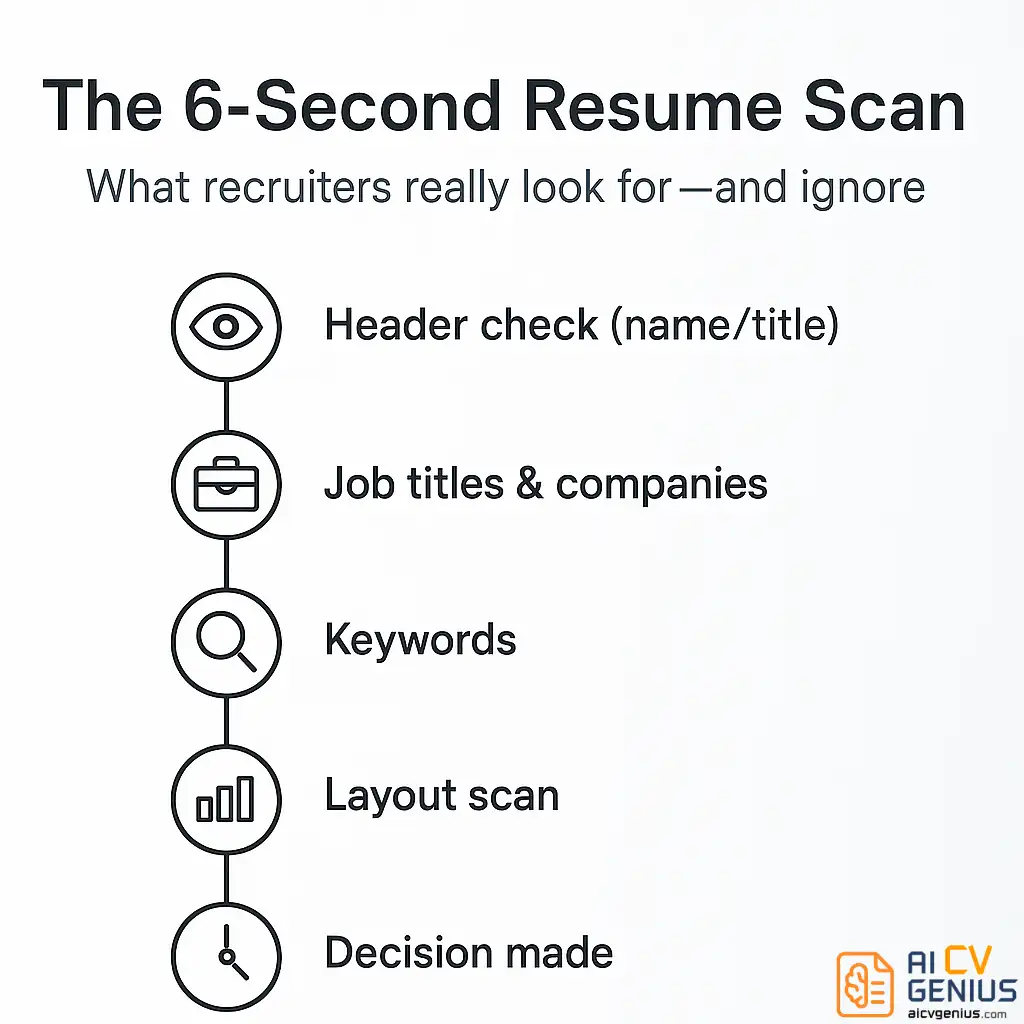
Synthesizing insights from eye-tracking data and real-world recruiter feedback, here’s a typical trajectory of those critical initial seconds:
| Second(s) | Focus Area | What Recruiters Typically Notice / Assess |
|---|---|---|
| 1 | Overall Visual Structure | Is it clean, professional, and easy to scan? (Whitespace, margins, consistent font) |
| 2 | Header & Top Section | Name clearly visible? Professional title/headline relevant? Location match (if applicable)? |
| 3 | Current/Most Recent Role | Job title alignment with target role? Recognizable company name? Dates consistent? |
| 4 | First 1-2 Bullet Points (Recent Role) | Action verbs used? Evidence of quantifiable impact (%, $, #)? Key responsibilities match? |
| 5 | Keywords & Skills Scan | Quick vertical scan (often down left side) for critical keywords, specific technologies, or required certifications mentioned in the job description. |
| 6 | Initial Decision Point | Does this warrant further review? (Shortlist / Maybe Pile) Or is it clearly not a fit? (Skip / Reject Pile) |
That rapid sequence underscores the immense pressure on your resume to communicate relevance and impact almost instantaneously. Every design choice and every word matters.
The Follow-Up Read (If You Pass the Scan)
Crucially, if your resume successfully passes this initial six-to-eight-second scan by signaling strong potential relevance, then the recruiter transitions into a more detailed review. They might read your professional summary more carefully, delve into bullet points under previous roles, cross-reference your skills section, or even click on your LinkedIn profile link. But remember: this deeper engagement is entirely contingent upon surviving that crucial first visual and contextual impression. Everything that follows depends on making those initial seconds count.
Why Some Resumes Trigger Instant Interest: The Science of Signals
Pattern Recognition vs. Deep Storytelling (Initially)
Recruiters, through sheer repetition, become highly adept pattern recognizers. They are subconsciously trained to quickly spot signals of reliability and fit. That’s why conventional career progression (“Assistant → Specialist → Manager”), consistent industry experience, and clear alignment between past titles and the target role often trigger positive initial responses. Conversely, unexplained career gaps, frequent short-term job hopping, or seemingly random industry shifts can raise red flags and cause them to pause or skip.
However, a brief, strategically placed contextual sentence can often mitigate these concerns. For example: “Successfully transitioned from a decade in hospitality management into the technology sector after completing intensive UX Design certification and portfolio development.” That single line restores narrative logic and addresses potential questions proactively.
The Magnetic Pull of Numbers Over Narratives
Recruiters instinctively gravitate towards quantitative data because numbers offer objective evidence and remove subjective guesswork. They transform vague claims like “improved communication” into concrete proof like “Presented technical findings to audiences of 20+ non-technical stakeholders monthly, resulting in improved cross-departmental understanding.”
They turn generic statements like “led marketing campaigns” into compelling evidence like “Directed multi-channel digital marketing campaigns that grew qualified lead generation by 46% year-over-year.” Metrics simplify evaluation – they provide instant, verifiable evidence of impact. Eye-tracking studies consistently show visual hot spots wherever digits appear on the page, demonstrating their power to capture and hold attention.
ATS Filters and Strategic Keyword Alignment
Before a human recruiter even performs their rapid scan, your resume likely first encounters an Applicant Tracking System (ATS). This software primarily functions by scanning for specific keyword matches between your resume content and the predefined requirements entered from the job description. If your document lacks a sufficient density or relevance of these critical keywords (skills, tools, certifications, industry terms), it risks being automatically filtered out, regardless of your qualifications. Therefore, understanding how both recruiters and algorithms process information is key. Strategically incorporating relevant keywords naturally within your achievement statements ensures you pass the initial software gate while simultaneously providing compelling evidence for the human reviewer. You can explore nuanced strategies for optimizing keywords without resorting to stuffing in our detailed Resume Templates Guides.
Common Mistakes That Immediately Break Recruiter Attention
Avoid these frequent pitfalls that cause recruiters to quickly lose interest:
Overly Complex or Unprofessional Design
Highly stylized templates featuring excessive colors, unusual fonts, distracting icons, graphics, photos, or complex multi-column layouts might seem creative but often hinder readability and professionalism. More critically, many corporate ATS systems struggle to parse non-standard formats, potentially scrambling your information or rendering it unreadable. Simplicity, clarity, and adherence to professional norms are almost always the safer and more effective strategy.
Keyword Stuffing and Lack of Authenticity
Trying to game the ATS by excessively repeating keywords copied directly from the job description, often out of context, is easily detectable by both modern software and human reviewers. It appears unnatural, desperate, and ultimately undermines your credibility. Instead, integrate keywords organically within meaningful achievement statements, using synonyms and variations where appropriate. Recruiters reward demonstrated comprehension and genuine alignment, not mere repetition.
Unclear Chronology or Confusing Structure
Mixing freelance projects, short-term contract gigs, academic work, and full-time employment within a single chronological stream without clear labeling or dates can create significant confusion for recruiters trying to quickly understand your career trajectory. Label each entry transparently (e.g., “Freelance Consultant,” “Contract Project Manager,” “Full-Time Analyst”) and ensure dates are accurate and consistent. Honesty and clarity are always respected more than attempts to obscure potentially complex work histories.
Inducing Cognitive Fatigue
Recruiters review hundreds, sometimes thousands, of resumes weekly. Anything that makes their job harder – dense paragraphs requiring deep concentration, excessive use of clichés and buzzwords (“synergy,” “go-getter”), inconsistent formatting, or an unclear narrative flow – drains their limited cognitive energy and attention span. Your primary goal in resume design and writing should be to reduce friction and make comprehension as effortless as possible, not necessarily to add excessive flair or exhaustive detail.
How to Make Recruiters Want to Read Your Resume Deeper
Shift from just submitting information to strategically guiding attention:
Start with Impeccable Structure and Readability
Your resume should feel inherently navigable, like a well-designed website landing page – fast, clear, intuitive, and scannable. Every element, from section headings to bullet point indentation, should serve the primary goal of rapid comprehension. Use clear, standard headings (“Work Experience,” “Skills,” “Education”), maintain consistent bullet lengths where possible, and employ concise, action-oriented sentences.
Write Explicitly for Scanners, Not Leisurely Readers
Accept the reality: recruiters initially skim for proof, not nuance. This means your most compelling quantifiable results and impactful action verbs should ideally appear near the beginning of bullet points and along the left margin – aligning with their natural eye path. Structure your bullets to begin immediately with strong verbs and conclude swiftly with measurable metrics or clear outcomes. Examples that grab attention:
- ✅ “Increased organic website traffic by 82% within 12 months through implementing comprehensive on-page and off-page SEO strategies.”
- ✅ “Reduced average employee onboarding time from 5 days to 3 days (a 40% improvement) by developing and implementing a streamlined digital training module.”
Front-Load Relevance and Keywords Strategically
Imagine you’re a recruiter searching specifically for a “Senior Project Manager with SaaS experience.” If those exact (or very similar) phrases appear prominently within the first few lines of a candidate’s resume (e.g., in their professional headline or summary), it creates an immediate sense of alignment and relaxes the recruiter’s filtering mechanism – they’ve found a potential match. Ensure your professional headline, summary, and recent job titles directly reflect the keywords and seniority level of your desired role.
Leave Subtle Curiosity Cues (Sparingly)
While most bullets should focus on clear results, occasionally leaving a hint of a larger story can pique interest and make your resume more memorable. Instead of exhaustively detailing every aspect of a major initiative, sometimes a slightly more evocative bullet can be effective: “Pioneered a new customer feedback collection initiative using [Method] that was subsequently adopted as the standard process company-wide.” This naturally invites the reader (interviewer) to inquire, “Tell me more about that initiative and its impact.” Use this technique sparingly, focusing mostly on direct results.
Checklist: Final Review Before You Submit
Conduct this rapid check to ensure your resume is optimized for recruiter attention:
- ✅ Layout Clean & Scannable? Primarily single-column, ample white space, consistent professional fonts, clear section headings.
- ✅ Keywords Aligned? Naturally incorporates key terms (skills, tools, qualifications) from the specific job description without stuffing.
- ✅ Impact Quantified? At least the first bullet point under recent roles includes a number (%, $, #) or clear, tangible impact.
- ✅ Headline/Summary Targeted? Clearly defines your professional identity and relevance to the specific role sought.
- ✅ File Naming Convention Professional? Includes your name and target position (e.g., “JaneDoe_SeniorProjectManager_Resume.pdf”).
- ✅ Meticulously Proofread? Checked multiple times (ideally by another person too) for any grammar, spelling, or consistency errors.
- ✅ Saved as PDF? Ensures formatting is preserved across all devices (unless DOCX is specifically requested by the application system).
Why Understanding the Recruiter’s Process Changes Everything
Once you truly internalize what happens when a recruiter opens your resume – the speed, the scanning patterns, the relentless hunt for relevance signals – your entire approach to job hunting shifts from hopeful guessing to strategic design. You cease writing resumes primarily for yourself (as a comprehensive historical record) and begin crafting them explicitly for their specific workflow and cognitive constraints. That fundamental empathy – understanding how they read, how they filter, and how they make rapid decisions under pressure – becomes your most potent competitive advantage.
The objective isn’t about deceiving anyone or gaming the system. It’s about achieving effective communication faster, demonstrating clarity amidst complexity, and projecting confidence through precision. When your resume successfully achieves that alignment, recruiters don’t just passively scan your document – they actively engage with it, recognize your potential value, and remember your name.
FAQ: Recruiter Resume Review Process
Final Thought: Designing for Decision
Recruiters aren’t enigmatic gatekeepers employing secret criteria – they are typically overworked professionals making rapid decisions based on limited information under significant time pressure. When you design your resume with genuine empathy for their process – prioritizing clarity, highlighting relevance, quantifying impact, and ensuring technical compatibility – you align directly with their needs. That strategic alignment is precisely when the hiring process begins to feel less like a random lottery and more like a professional conversation you’ve earned the right to join.
And if you’re ready to proactively refine your own career story for that critical six-second evaluation, consider starting with a modern, recruiter-approved layout from the Resume Templates Finder – templates meticulously built to help your resume successfully pass the scrutiny of both human eyes and automated systems.