
- Why it matters: Your headline gets clicks, your summary earns messages, recruiters scan fast and skip blank or generic About sections.
- The winning structure: Hook, Value, Proof, CTA, write what you do, why it matters, and back it with numbers or concrete context.
- Hooks that work: Lead with a problem you solve, a clear niche statement, or a specific win, not “Dedicated professional” filler.
- Mistakes that kill reach: Third person writing, empty buzzwords, and long About sections that force scrolling.
- Fast way to write it: Use a 3 sentence template, then customize the role, proof, and what you want so it reads human and specific.
Why Your LinkedIn Summary Matters More Than You Think
Your LinkedIn headline gets people to click on your profile. Your summary is what makes them reach out.
Recruiters spend about 30 seconds scanning a LinkedIn profile. If your About section is blank, generic, or boring, they move on. If it communicates clear value in those 30 seconds, they send a message.
The best summaries follow a simple formula: Hook → Value → Proof → Call-to-Action. This structure works across industries and experience levels. The examples below show exactly how to apply it.
The 4-Part Formula That Works
Every effective LinkedIn summary follows this pattern: Hook + Value + Proof + CTA
1. Hook (First 1-2 Sentences)
Start with something that makes recruiters want to keep reading. Not “I am a dedicated professional with 10 years of experience.” That’s boring and everyone says it.
Better hooks:
- Start with a specific problem you solve
- Lead with a surprising stat or achievement
- Open with what you’re passionate about
2. Value (What You Do and Why It Matters)
Explain your core skills and who you help. Be specific. “Marketing professional” is vague. “I help B2B SaaS companies grow organic traffic through SEO and content strategy” is clear.
3. Proof (Credibility and Results)
Back up your claims with concrete evidence: metrics, recognizable companies, certifications, or specific projects. Numbers matter. “Increased revenue” is weak. “Grew revenue by 40% in 18 months” is strong.
4. Call-to-Action (What You Want)
End with what you’re looking for or how people can work with you. “Open to new opportunities in product management” or “Let’s connect if you’re building fintech products” or “Message me about speaking engagements.”
For foundational profile optimization, see our complete resume and LinkedIn guide.
10 LinkedIn Summary Examples by Industry
Example 1: Software Engineer
I build backend systems that don’t break when traffic spikes. Over the past 6 years, I’ve designed and scaled APIs serving 10M+ daily requests for companies like [Company A] and [Company B].
My focus: Python, AWS, microservices architecture, and making distributed systems reliable under stress. I’ve reduced server costs by 35% through optimization and led migrations to cloud infrastructure that cut deployment time from hours to minutes.
Currently exploring opportunities with teams building infrastructure for high-growth products. Let’s connect if you’re solving scaling challenges.
Why it works: Opens with a specific problem (traffic spikes), includes concrete metrics (10M requests, 35% cost reduction), and clearly states what they’re looking for.
Example 2: Digital Marketer
I help SaaS companies grow without paid ads. In the past 3 years, I’ve built organic acquisition channels that generated 500K+ monthly visitors for B2B tech companies.
My approach combines SEO, content strategy, and conversion optimization. Recent wins: grew organic traffic 300% in 8 months for a marketing automation platform, and built an email nurture sequence that converted 18% of free users to paid.
Currently seeking senior marketing roles at early-stage B2B SaaS companies. If you’re growing fast and need sustainable acquisition channels, let’s talk.
Why it works: Immediately states the value prop (growth without ads), backs it with specific results, targets exact type of company they want.
Example 3: Student / Recent Graduate
Computer Science student graduating May 2026. I spend most of my time building things – most recently, a web app that helps students find study groups, used by 2,000+ students on campus.
Skills: JavaScript, React, Node.js, SQL. I’ve completed 3 internships (fintech, edtech, e-commerce) where I shipped features used by thousands of users. Comfortable working across the full stack but strongest on frontend.
Looking for new grad software engineering roles starting Summer 2026, particularly at companies building consumer products. Open to relocating.
Why it works: Leads with action (building things), proves capability with real project, clear about timeline and preferences.
Example 4: Sales Professional
I close enterprise deals in competitive markets. Over 7 years in B2B sales, I’ve brought in $12M+ in revenue selling SaaS solutions to Fortune 500 companies.
My strength is complex, multi-stakeholder sales cycles. I’ve closed deals ranging from $100K to $2M ARR, with an average sales cycle of 6 months. Top performer in my region for 3 consecutive years.
Exploring roles at high-growth SaaS companies selling into enterprise. If you need someone who can navigate procurement, legal, and C-suite buying committees, let’s connect.
Why it works: Opens with results ($12M revenue), includes deal size and cycle length (proves they handle complexity), targets specific company type.
Example 5: Career Changer (Teacher → Tech)
After 8 years teaching high school biology, I’m transitioning into technical writing and documentation. Turns out explaining complex concepts to confused teenagers is excellent training for making software documentation actually readable.
I’ve completed Google’s Technical Writing course and built sample docs for open-source projects. My background: breaking down complicated topics, working with diverse audiences, and iterating based on feedback.
Looking for technical writing roles at software companies, particularly in healthcare tech or edtech where my science background adds value. Open to contract or full-time.
Why it works: Acknowledges career change upfront, frames teaching skills as relevant transferable skills, shows initiative (courses completed, samples created).
Example 6: Product Manager
I build products people actually use. As a PM at [Company], I led a mobile app redesign that increased retention by 35% and launched features used by 500K+ users monthly.
My focus: consumer mobile apps, growth experimentation, and data-driven product decisions. I run A/B tests constantly, ship fast, and kill features that don’t work. Comfortable working with engineering, design, and data teams.
Currently exploring PM roles at consumer tech companies in fintech or health/wellness. Let’s talk if you’re building products that improve daily life.
Why it works: Hook grabs attention (products people use), specific metrics validate claims, clear about product focus and target industry.
Example 7: UX Designer
I design interfaces that make complex tasks feel simple. Over 5 years, I’ve worked on B2B dashboards, mobile apps, and design systems for companies like [Company A] and [Company B].
My process: user research, rapid prototyping, testing with real users, iterating based on data. Recent project: redesigned a 15-year-old enterprise dashboard, reducing task completion time by 40% and support tickets by 25%.
Looking for senior UX roles at companies solving hard problems – fintech, healthcare, logistics. Portfolio: [link]
Why it works: Clear value prop (complex → simple), includes process and results, portfolio link makes it easy to see work.
Example 8: Data Analyst
I turn messy data into clear decisions. At [Company], I built dashboards and reports that helped executives make faster, better choices about where to invest resources.
Tools: SQL, Python, Tableau, Excel. I specialize in taking ambiguous business questions and translating them into analysis that actually drives action. Most proud of: building a customer segmentation model that identified $2M in upsell opportunities.
Open to data analyst roles at companies 50-500 employees where one person can make an impact. Particularly interested in e-commerce, SaaS, or marketplace businesses.
Why it works: Focuses on business impact (not just technical skills), specific result ($2M opportunities), clear about ideal company size.
Example 9: Executive / Senior Leader
I build and scale operations teams. Over 15 years, I’ve led ops for three companies through hypergrowth – from 20 to 200+ employees, from $5M to $50M+ ARR.
My expertise: hiring and developing high-performing teams, implementing systems that scale, and building operations infrastructure before it becomes a bottleneck. I’ve opened new markets, led post-merger integrations, and turned around underperforming divisions.
Currently advising early-stage B2B companies and open to COO/VP Operations roles at Series B-C startups.
Why it works: Immediately establishes seniority and scope, focuses on business outcomes (ARR growth, scaling), clear about level and stage they’re targeting.
Example 10: Freelancer / Consultant
I help small businesses stop wasting money on ads that don’t work. As a freelance marketing consultant, I’ve worked with 30+ local businesses to build profitable Google and Facebook ad campaigns.
Typical results: 3-5x ROAS within 90 days. I handle strategy, setup, creative testing, and ongoing optimization. Industries I work with: home services, professional services, e-commerce.
Taking on 2-3 new clients per quarter. Message me if you’re spending $2K+/month on ads and not seeing returns.
Why it works: Clear niche (small business ads), quantified results (3-5x ROAS), specific client criteria (spending level).
For more profile examples and optimization strategies, explore our resume builder guide with LinkedIn templates.
3 Mistakes That Kill LinkedIn Summaries

1. Writing in Third Person
Don’t write: “John is a dedicated marketing professional with extensive experience…”
Write: “I help companies grow through content marketing…”
LinkedIn is social media. Writing in third person sounds stiff and corporate. Use first person (“I”) unless you’re a CEO with a brand team writing your profile.
2. Using Empty Buzzwords
Avoid:
- “Results-driven professional”
- “Passionate about excellence”
- “Strategic thinker”
- “Team player with strong communication skills”
These phrases mean nothing. Everyone claims them. Use specific skills and concrete results instead.
3. Making It Too Long
LinkedIn allows 2,600 characters. Don’t use all of them. Aim for 150-250 words (about what fits on a mobile screen without scrolling).
If recruiters have to scroll to see your key points, they won’t. Keep it tight.
3-Sentence Template You Can Use Right Now
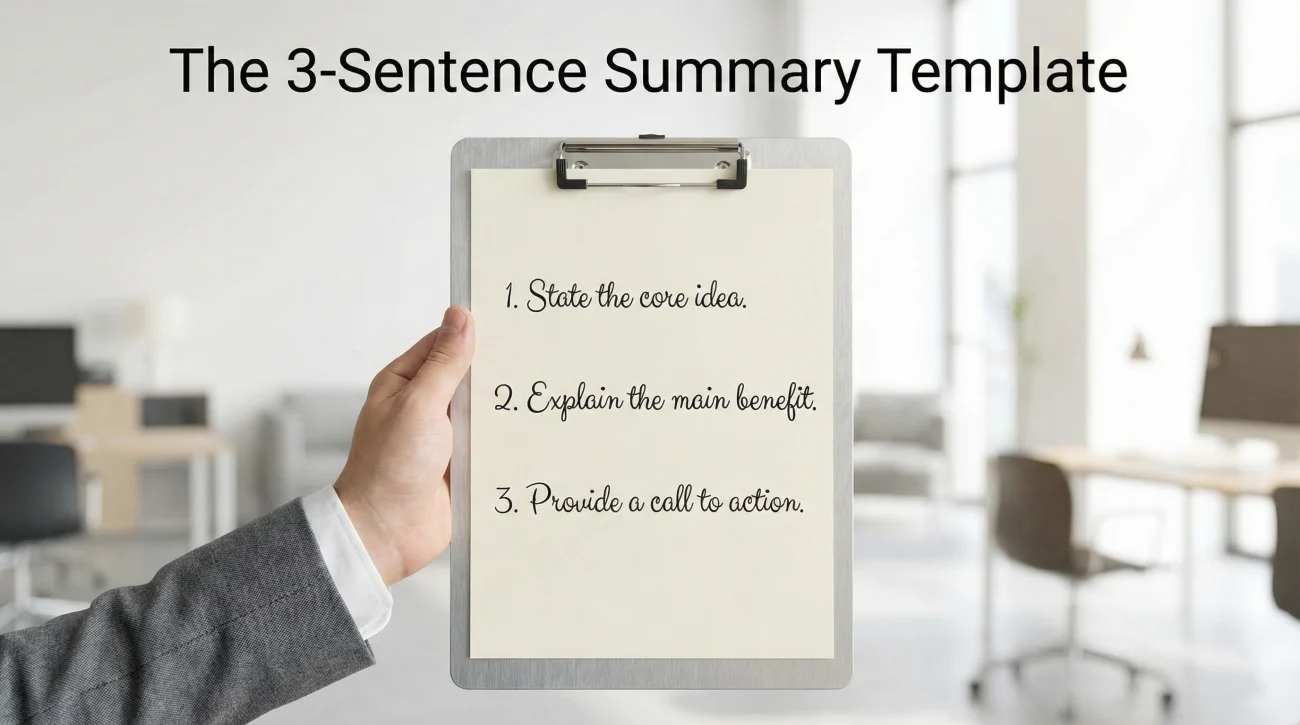
If you’re stuck, start with this basic structure:
Sentence 1 (Hook): I [do specific thing] for [specific people/companies].
Sentence 2 (Value + Proof): Over [X years/time period], I’ve [specific achievement with numbers] at [companies or contexts].
Sentence 3 (CTA): Currently [what you’re looking for]. Let’s connect if [specific scenario or interest].
Example filled in:
I build mobile apps for early-stage startups. Over 4 years, I’ve shipped iOS apps for 6 companies that collectively reached 1M+ downloads. Currently looking for senior mobile dev roles at consumer tech companies. Let’s connect if you’re building products that improve daily life.
This template takes 5 minutes to customize and is 10x better than a blank About section.
FAQ
Your Summary Is Your Elevator Pitch
The LinkedIn About section is where recruiters decide whether to message you or move on. A blank section means they move on. A generic “passionate professional seeking opportunities” means they move on.
An effective summary follows the Hook + Value + Proof + CTA formula: start with something interesting, explain what you do and why it matters, back it up with evidence, and end with what you want.
The 10 examples above show how this works across industries and experience levels. Pick the one closest to your situation, adapt the structure to your background, and you’ll have a summary that actually gets recruiters to reach out.
Or use the 3-sentence template and finish it in 5 minutes. Either way, fill in that About section. It’s the difference between being visible and being ignored.
For additional LinkedIn and resume optimization resources, check out our comprehensive career guide.
Next, tighten your first impression: use these LinkedIn headline examples and formulas to rewrite your headline into a clear, keyword-rich value statement.