

- Main shift: Stop using LinkedIn like a feed and use it as proof of activity, expertise, and momentum.
- Post idea 1: Do one “Open to Work” post that is specific about role, niche, and target companies, not desperate or vague.
- Post ideas 2 to 3: Share what you are learning and one past win using STAR so you show skills with real outcomes.
- Post ideas 4 to 5: Stay visible with smart comments and occasional industry news plus your take, not empty praise or link drops.
- Consistency rule: Aim for 1 to 2 posts per month, 3 to 5 thoughtful comments per week, and prioritize quality over volume.
Don’t Just Scroll – Create Content
Most job seekers use LinkedIn passively. They scroll through their feed, like a few posts, maybe comment occasionally. Their profile sits dormant while they apply to jobs through job boards.
This is a wasted opportunity. Active LinkedIn users – people who post regularly and engage meaningfully – get far more recruiter attention than passive scrollers.
Posting on LinkedIn when you’re job searching serves three purposes: it signals you’re active and current in your field, it increases your visibility in recruiter searches, and it demonstrates expertise that can lead to inbound opportunities.
But what should you actually post? The five ideas below work across industries and don’t require you to be an influencer or thought leader.
Idea 1: The “Open to Work” Post (Do This Once)
At some point in your job search, you may want to publicly announce you’re looking. This can work – but only if you do it right.
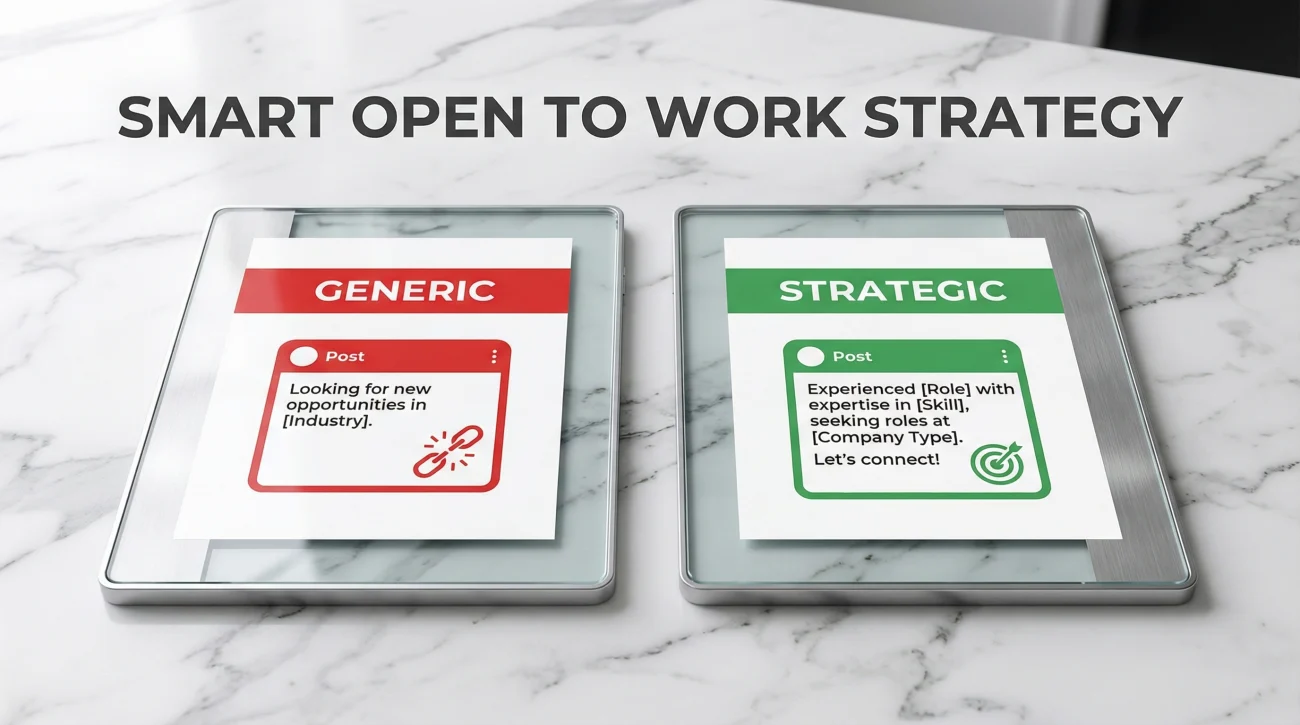
What NOT to Post
Don’t write desperate, generic announcements:
“I’m currently seeking new opportunities. Please reach out if you know of any openings. Open to anything!”
This signals desperation and lacks specificity. Recruiters ignore these posts because “open to anything” means you don’t know what you want.
What Works Better
Frame it as moving toward something, not running from something:
After 5 years in digital marketing, I’m exploring my next role focused on growth marketing for B2B SaaS companies.
What I’m looking for: a senior marketing role where I can apply my experience scaling organic acquisition channels (SEO + content). Particularly interested in companies at Series A-B stage.
If you know teams building great products and looking for marketing leadership, I’d love to connect.
Why it works:
- Specific about what you want (not “open to anything”)
- Demonstrates expertise (scaling acquisition channels)
- Targets specific company stage (Series A-B)
- Professional tone (not desperate)
Post this once. Don’t repost weekly. One clear signal is enough.
For comprehensive job search strategies, see our complete career guide.
Job searching often involves skill development – taking courses, learning new tools, or studying your industry. Share this progress publicly.

Simple Format That Works
Just finished [Course/Book/Tutorial] on [Topic].
Three things I learned:
1. [Specific insight] 2. [Specific insight] 3. [Specific insight]Already applying [specific thing] to [project or context].
Real Example
Completed Google’s Data Analytics Certificate this week.
Three takeaways I’m already using:
1. SQL window functions made my queries 10x more efficient
2. Tableau dashboards beat static reports for stakeholder updates
3. Starting with questions (not data) leads to better analysisBuilding a portfolio project analyzing local restaurant health inspection data. More to share soon.
Why this works:
- Shows continuous learning (attractive to employers)
- Demonstrates you’re staying current
- Provides value to your network (they learn too)
- Keywords help recruiters find you (SQL, Tableau, data analytics)
Post these 1-2 times per month as you complete courses or learn new skills.
Don’t wait for a new job to share accomplishments. Highlight past successes using the STAR framework: Situation, Task, Action, Result.

Post Structure
Situation: Brief context of the challenge
Task: What you needed to accomplish
Action: What you did specifically
Result: The measurable outcome
Real Example
One of my proudest moments at [Previous Company]:
Our customer support team was drowning in repetitive tickets – response times had ballooned to 48+ hours.
I built a knowledge base with 50 self-service articles covering our top support questions. Then trained the team to link articles instead of rewriting answers.
Result: Response time dropped from 48 hours to 8 hours. Support ticket volume decreased 30%. Team morale improved because they could focus on complex issues.
Sometimes the best solution isn’t hiring more people – it’s removing repetitive work.
Why this works:
- Demonstrates problem-solving skills
- Includes concrete metrics (48 hrs → 8 hrs, 30% reduction)
- Shows leadership and initiative
- Ends with a lesson (makes it valuable, not braggy)
Mine your past 2-3 roles for stories like this. Post one every 2-3 weeks.
Idea 4: Engage Through Smart Comments
You don’t always need to post original content. Thoughtful comments on others’ posts increase your visibility and demonstrate expertise.

Bad Comments
- “Great post!”
- “Thanks for sharing!”
- “Agree 100%”
These add nothing. They’re noise.
Good Comments Add Value
Effective comments do one of three things:
- Add a relevant example: “This matches what I saw at [Company]. We implemented [similar approach] and reduced [metric] by [amount].”
- Ask a thoughtful question: “Interesting point about [topic]. How did you handle [specific challenge]?”
- Offer a counterpoint: “Great framework. I’d add that in [specific context], [alternative approach] works better because [reason].”
Example of a Strong Comment
Original post about remote work challenges:
This resonates. At my last company, we struggled with async communication too.
What worked: daily recorded video updates (5 min max) instead of synchronous standups. Team could watch on their schedule, and we maintained alignment across 3 time zones.
The trick was keeping them short and focused on blockers, not status reports.
Why this works:
- Shares specific solution (video updates)
- Includes context (3 time zones)
- Provides actionable detail (5 min, focus on blockers)
- Shows you’ve dealt with real problems
Comment thoughtfully on 3-5 posts per week. This keeps you visible without requiring original content daily.
For more networking and engagement strategies, explore our networking guide.
The Most Important Thing: Be Consistent
Posting once and disappearing doesn’t work. Visibility requires consistency.
Realistic Posting Schedule
You don’t need to post daily. A sustainable cadence looks like:
- 1-2 original posts per month (learning updates, past wins, industry takes)
- 3-5 thoughtful comments per week (easier than posting, still keeps you visible)
- 1 “Open to Work” announcement (optional, do once if you want)
This totals 15-20 pieces of content per month – enough to stay visible without overwhelming your schedule.
Quality Over Quantity
One well-written post about a real accomplishment beats ten generic “motivational quotes” posts. LinkedIn’s algorithm rewards engagement. Posts that spark comments and discussion get more visibility.
Focus on providing value: share actual insights, real examples, or useful perspectives. Skip the fluff.
FAQ
Visibility Requires Activity
Job seeking on LinkedIn isn’t a passive activity. You can’t just set your profile to “Open to Work” and wait for recruiters to find you. You need to be visible, and visibility requires consistent engagement.
The five content ideas above – open to work announcement, learning updates, past wins, smart comments, industry news – give you a repeatable framework. You don’t need to be creative or influential. You just need to be consistent and genuine.
Post 2-3 times per month. Comment thoughtfully on others’ content 3-5 times per week. Share real insights, not motivational quotes. Demonstrate expertise through examples, not claims.
Do this consistently for 2-3 months and your profile visibility will increase. Recruiters will start finding you. Your network will grow. Opportunities will appear that wouldn’t have if you’d just scrolled passively.
Start this week. Pick one of the five ideas and post it. Then commit to showing up consistently. That’s how LinkedIn becomes a job-search tool instead of just another time sink.
For additional job search and LinkedIn resources, check out our comprehensive career guide.