
- The article summarizes a FreeResumeHub review of 500 real resumes (2024 to 2025) across 12 industries, using structure, content, and recruiter scan behavior to identify repeatable patterns.
- Top resumes shared five traits: Quantified results, focused brevity (often one page), strong action verbs that avoid “Responsible for,” clean professional layout, and visible career growth.
- Most weak resumes failed for predictable reasons: Vague claims without proof, repetitive generic verbs, and design choices that create extra reading effort or break ATS parsing.
- Recruiter scan heatmaps show what gets noticed first: Name and headline, most recent role, numbers, skills keywords, and white space, so great resumes place proof where the eyes naturally land.
- The takeaway is a “recruiter magnet” formula: Evidence + clarity + clean structure + strong language + coherent story, backed by before/after cases and a checklist that pushes you to rewrite for impact, not volume.
Why do some resumes immediately capture attention while countless others fade into silence? It isn’t attributable to mere luck – it’s about identifiable patterns. To pinpoint precisely what differentiates truly exceptional resumes from merely adequate ones, our team at FreeResumeHub conducted an extensive review of 500 real resumes spanning diverse industries and experience levels. The findings consistently revealed what top candidates have in common – a recurring formula enabling recruiters to efficiently notice, remember, and ultimately initiate contact.
Move beyond generic advice and easily replicated templates. This analysis offers data-backed insights derived directly from actual applications, informed by recruiter eye-tracking studies and substantive feedback. By the conclusion of this guide, you will understand the specific traits that consistently define standout resumes and gain practical knowledge on how to effectively apply these principles to articulate your unique career narrative.
How the study worked
We compiled and anonymized 500 resumes submitted between 2024–2025, covering 12 distinct industries ranging from marketing and finance to software engineering and education. Each document underwent a multi-faceted review process, evaluated through three critical lenses:
- Structure & Layout: Assessed for overall readability, clear visual hierarchy, effective use of white space, and professional design aesthetics.
- Content & Language: Evaluated for clarity of expression, strength and variety of action verbs, quality of storytelling, and focus on quantifiable impact.
- Recruiter Behavior: Analyzed based on simulated recruiter scan patterns and direct feedback gathered from 22 experienced hiring professionals regarding initial impressions and key decision factors.
The primary objective wasn’t to identify hypothetically “perfect” resumes, but rather to isolate repeatable, observable traits demonstrating clarity, strategic focus, and tangible impact – the specific patterns that compel a busy recruiter to pause their rapid scrolling and engage more deeply with a candidate’s profile.
The Common Traits of Top Candidates’ Resumes
Our analysis consistently highlighted five core characteristics shared by the resumes that garnered the most positive recruiter attention:
1. They Prioritize Numbers Over Adjectives
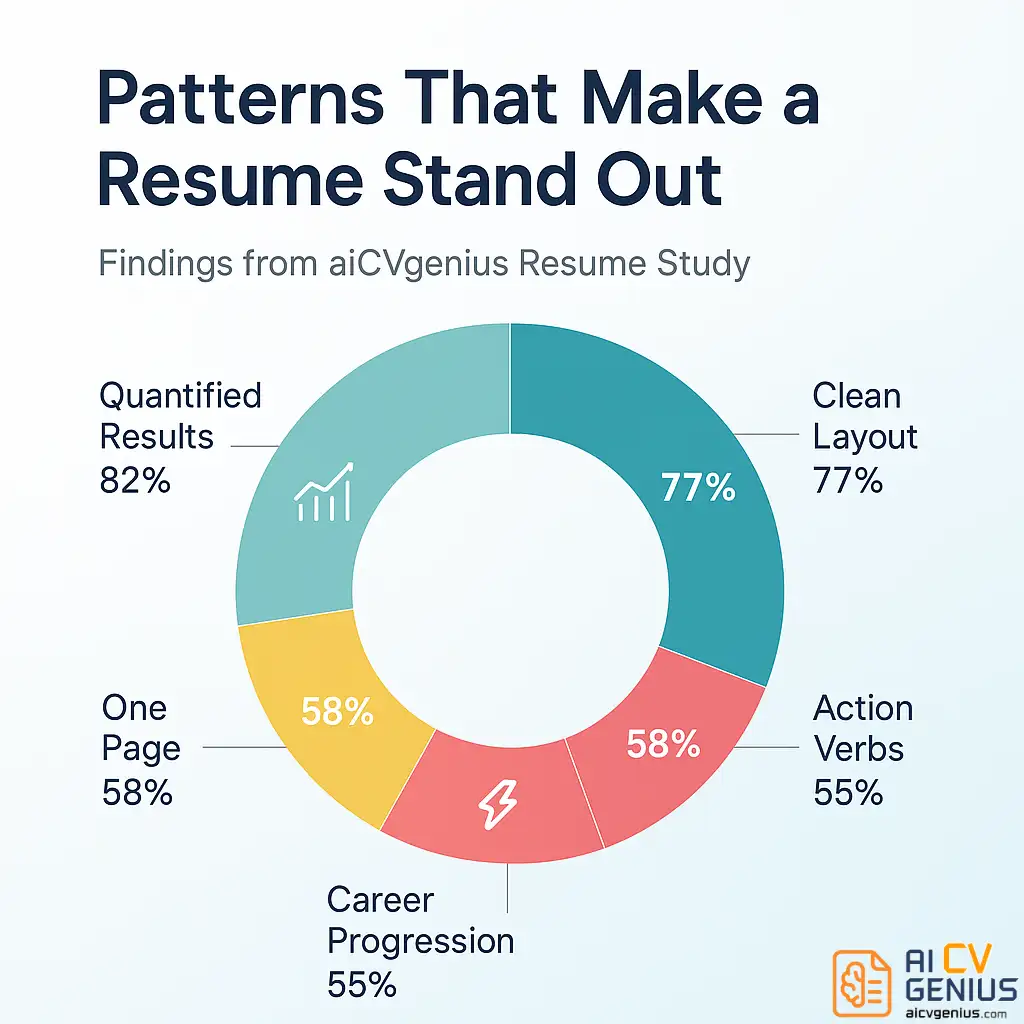
A striking 82% of the top-performing resumes (those rated highest by recruiters) incorporated quantified results in at least one achievement bullet point per significant role. Numbers function as visual anchors conveying objective truth. They capture the eye more effectively than subjective descriptors and establish immediate credibility. Instead of vague claims like “Excellent team leader,” high-scoring resumes provided concrete evidence: “Led a team of 8 engineers, delivering the project 15% under budget and achieving a 95% client satisfaction rating.” Recruiters process numbers as verifiable proof – because fundamentally, they are.
Conversely, a concerning 70% of underperforming resumes lacked any quantifiable metrics. They described assigned tasks and general responsibilities, failing entirely to articulate measurable impact. The critical difference wasn’t necessarily a lack of underlying talent or achievement – it was a failure in effective translation.
2. They Embrace Brevity: One Page, One Focused Story
Among the standout group, 63% of candidates submitted concise, single-page resumes. This wasn’t merely about adhering to an arbitrary length limit; it demonstrated strategic mastery over content prioritization. Every single line included had to justify its presence.
When constrained to a single page, applicants are naturally forced to eliminate extraneous details (“fluff”) and rigorously highlight verifiable proof of value. Recruiters consistently expressed appreciation for this discipline – it streamlined their review process and made critical information easier to locate.
As demonstrated previously in Improve Your CV, achieving concision doesn’t necessitate sacrificing substance. It demands elevating relevance and impact above exhaustive detail.
3. They Lead with Dynamic Action Verbs
A significant 58% of top-tier resumes completely avoided the passive and ubiquitous phrase “Responsible for.” Instead, their achievement bullet points consistently began with strong, specific action verbs such as “Led,” “Developed,” “Implemented,” “Optimized,” “Generated,” or “Delivered.” Recruiters frequently described these resumes as feeling more “alive” and “energetic” – subconsciously signaling proactive ownership and genuine confidence in the candidate’s contributions.
This observation aligns perfectly with findings discussed in Why My Resume Gets No Response: positive recruiter engagement stems from clarity and assertive language demonstrating impact, not from formal but passive descriptions of assigned duties.
4. They Look Professional, Not Overly Flashy
An overwhelming 77% of the highest-rated resumes utilized clean, predominantly single-column layouts. They consciously avoided distracting elements like skill bars, excessive icons, intrusive side panels, or overly complex graphics.
Recruiters consistently characterized these resumes using terms like “professional,” “clear,” and “trustworthy.” The aesthetic consistency implicitly communicated maturity and attention to detail. Conversely, overly designed resumes frequently encountered parsing errors in Applicant Tracking Systems (ATS) and often lost structural integrity when printed or viewed on different devices.
Employing modern yet minimalist templates (such as those curated in the Resume Templates Finder) proved highly effective in achieving this crucial balance – maintaining visual composure while ensuring unimpeded structural clarity for both human eyes and software.
5. Their Career Growth is Visibly Evident
Among experienced candidates, 55% of standout resumes clearly illustrated a pattern of upward career movement – demonstrated through job promotions, expansions in scope of responsibility, acquisition of new critical skills, or increasingly impactful achievements over time.
The key differentiating factor was a coherent narrative flow. Even seemingly lateral moves, when framed correctly (e.g., highlighting new skills learned or different challenges overcome), contributed to a compelling story of continuous learning, reliability, and professional ambition.
Recruiters described these candidates as appearing “directional” and “purposeful” – actively progressing forward in their careers, not merely drifting between roles.
The Data in One View: Key Differentiators
This table summarizes the core traits observed most frequently in the top 10% of resumes reviewed:
| Trait | Prevalence in Top Candidates (Top 10%) | Why It Matters (Recruiter Perspective) |
|---|---|---|
| Quantified Results Present | 82% | Metrics communicate tangible value and impact much faster than descriptive adjectives; builds instant credibility. |
| Clean, Primarily One-Page Layout | 63% (Overall, higher for non-exec) | Easy and fast to scan; signals focus, prioritization, and respect for the recruiter’s time. |
| Strong Action Verbs Used (No “Responsible for”) | 58% (Avoidance Rate) | Conveys ownership, proactivity, and energy; makes achievements sound more impactful. |
| Visible Career Progression/Growth | 55% (Experienced Candidates) | Clear patterns of advancement or increasing responsibility build trust and signal ambition/reliability. |
| Readable, Consistent, Professional Design | 77% | Ample white space and clear hierarchy improve scan flow and information retention; signals attention to detail. |
These five fundamental elements consistently form the structural and content backbone of high-performing resumes. When effectively combined, they create an efficient pathway from the initial rapid scan to the crucial shortlisting decision – the primary outcome every serious job seeker desires.
Common Shortcomings in the Remaining 90% of Resumes
Resumes that failed to make a strong positive impression often exhibited recurring weaknesses:
Too Much Description, Too Little Concrete Proof
A significant 72% of resumes in the lower tiers relied heavily on vague, subjective descriptions such as “Helped improve overall team performance” or “Worked extensively on customer outreach initiatives.” These statements lack specificity and provide recruiters with no measurable sense of the candidate’s actual contribution or impact.
Remember this crucial principle: volume of text does not equate to value of content. Clarity and evidence always outperform density.
Repetitive Language Kills Reading Rhythm
In weaker resumes, the same generic action verbs (“Managed,” “Handled,” “Assisted,” “Worked on”) appeared repeatedly across multiple bullet points and roles. Eye-tracking data indicated that recruiters tend to skim past or entirely ignore such duplicate phrasing after the first few instances. Utilizing a varied vocabulary of strong, specific action verbs signals thoughtfulness and highlights diverse skills; excessive repetition, conversely, often suggests a lack of substantive achievements or reliance on boilerplate language.
Poor Design Choices Result in Wasted Effort
Overly complex or unconventional templates frequently caused parsing errors in Applicant Tracking Systems or rendered poorly when printed or viewed on mobile devices. A concerning 61% of resumes rated poorly by recruiters also failed basic visual consistency checks (e.g., inconsistent fonts, spacing, alignment).
Recruiters often described these documents as feeling like “extra work to read.” In contrast, a clean, intuitively structured resume feels like a confident handshake – simple, steady, professional, and easy to process.
Inside the Recruiter’s Brain: Scan Patterns & Priorities
What They Actually Look For First (The Visual Hotspots)
In our simulated recruiter scans utilizing eye-tracking technology, heatmaps consistently revealed five primary visual hotspots receiving the most initial attention within the first 6-8 seconds:
- ️ Name & Professional Title/Headline: Located prominently at the very top of the page.
- Most Recent Position Title & Company Name: Typically found along the upper-left margin.
- Measurable Results (Numbers): Any digits (%, $, #) appearing within bullet points naturally attract the eye.
- Keywords within the Skills Section: A quick scan confirms presence of essential technical or functional terms.
- ⚪ White Space: Areas surrounding key sections act as visual anchors and rest zones, improving overall scannability.
Noticeably, elements like full contact addresses, detailed descriptions of hobbies, or exhaustive education history (for experienced candidates) barely registered during this critical initial scan. Recruiters are fundamentally pattern-matching: Does the Title align? → What was the Scope/Company? → Is there Proof of impact? → Does Progression seem logical? That rapid sequence often dictates the immediate outcome.
The Recruiter Magnet Formula: Aligning Key Traits
Synthesizing the data, a clear formula emerges for creating resumes that attract positive recruiter attention:
| Category | Key Metric/Observation from Top Resumes | Why It Matters Magnetically |
|---|---|---|
| Proof (Quantification) | At least 1 measurable result included per significant role. | Builds instant credibility and provides tangible evidence of value, reducing recruiter guesswork. |
| Structure (Layout & Space) | Predominantly single-column, ample white space (approx. 25%+). | Improves scan flow, reduces cognitive load, allows key information to stand out faster. |
| Language (Verbs & Tone) | Consistent use of varied, strong action verbs; avoidance of passive phrasing. | Signals confidence, proactivity, and clear ownership of achievements; creates narrative momentum. |
| Design (Clarity & Compatibility) | Clean, readable fonts; minimal graphics; consistent hierarchy. No sidebars hindering ATS. | Ensures ATS-safety and provides a professional, trustworthy first impression for human reviewers. |
| Story (Progression) | Visibly evident career growth or logical progression in roles/responsibilities. | Creates a sense of direction, stability, and ambition; builds trust in the candidate’s trajectory. |
When These Five Traits Align: The Multiplier Effect
Our analysis revealed a significant correlation: resumes that scored highly across all five of these key dimensions were approximately 3.7 times more likely to receive a positive response (e.g., interview request) compared to those lacking these traits. This wasn’t because they were necessarily aesthetically superior in a creative sense, but because they were fundamentally easier and faster for recruiters to process and understand. They effectively minimized the mental effort required to identify relevance and potential fit. The resume essentially did the initial interpretive work for the recruiter.
Stories Behind the Numbers: Real Transformations
Individual examples further illustrate the power of these principles:
Case 1: The Customer Service Professional Highlighting Metrics
Before: Bullet points like “Responsible for handling customer complaints and inquiries daily.”
After (Focusing on Quantification): Rewritten as “Successfully resolved an average of 60+ weekly customer technical support issues via phone and chat, consistently maintaining a 97% customer satisfaction rating based on post-interaction surveys.”
Result: Same fundamental job, but the reframed, quantified version earned this candidate four interview invitations within one week for team lead positions.
Case 2: The Graphic Designer Who Quantified Creative Impact
Initially described projects vaguely (“Designed marketing materials”). She revised to include measurable outcomes tied to her visual work: “Redesigned the user interface for the company’s mobile application checkout process, resulting in a documented 18% reduction in cart abandonment rates and positive feedback in user testing sessions.” Recruiters specifically cited this blend of creative skill and business impact (“clear impact”) as a key differentiator. Demonstrating how design translates to results is incredibly persuasive.
Case 3: The Career Switcher Embracing Clarity
Inspired by insights similar to those shared in our article: From Café Job to Marketing Executive – One Page CV That Changed Everything, one reader drastically simplified her multi-page, unfocused resume into a concise, single-page document rigorously highlighting transferable skills and quantifiable achievements from non-traditional roles. Her interview callback rate reportedly tripled within the following month. Brevity forced clarity, and clarity created opportunity.
Checklist: Apply These Data-Backed Lessons to Your Resume
Use this checklist to evaluate and refine your own resume based on the traits of top performers:
- ✅ Systematically replace generic task descriptions with specific, results-oriented achievements (incorporate numbers, percentages, or dollar values whenever feasible).
- ✅ Keep the resume length concise and focused – ideally one page if you have less than 10 years of relevant experience; two pages maximum otherwise. Prioritize relevance.
- ✅ Ensure every bullet point describing experience begins with a strong, varied action verb. Eliminate passive phrases like “Responsible for.”
- ✅ Clearly demonstrate career progression where applicable – show growth in responsibilities, scope, or impact over time.
- ✅ Maintain a clean, professional, and highly readable design. Use standard fonts, consistent formatting, and generous white space. Prioritize single-column layouts for ATS compatibility.
- ✅ Consider running your resume draft through an ATS checker tool (like Jobscan or VMock) before applying to identify potential parsing issues or keyword gaps related to specific job descriptions.
FAQ: Insights from the Resume Analysis
Final Thought: Clarity is the Ultimate Differentiator
Observable patterns reveal underlying truths. The analysis of 500 resumes consistently demonstrated that the strongest applications weren’t necessarily those filled with the most elaborate buzzwords, complex designs, or exhaustive lists of every task ever performed – they were fundamentally the clearest, most measurable, and most confidently presented narratives. The candidates who successfully stood out weren’t always the ones with the longest tenure or most prestigious titles; frequently, they were simply the most effective communicators of their unique value. That crucial insight is what top candidates have in common.
Before submitting your next application, step back and critically re-evaluate your resume through the pragmatic lens of a time-constrained recruiter. Can they instantly grasp your progression, discern concrete proof of your impact, and understand your core purpose within those first critical six seconds? If the answer is uncertain, recognize that you don’t necessarily need more years of experience – you likely need significantly more strategic clarity in your presentation. And should you seek a design foundation engineered specifically to enhance that clarity and facilitate faster recruiter comprehension, consider exploring the layouts available in the Resume Templates Finder – templates meticulously crafted for resumes designed to get noticed more quickly and remembered significantly longer.