

- Salary negotiation matters because it sets your baseline: A higher starting point compounds into bigger raises, bonuses, and lifetime earnings.
- Use a simple 5-step flow: Research your market range, wait until you have a written offer, then counter with a justified range in a collaborative tone.
- If base pay is constrained, pivot to total compensation: Bonuses, equity, PTO, remote flexibility, and professional development can be easier to move than base salary.
- Your words and tactics change outcomes: Use data-backed phrasing, avoid ultimatums, pause with silence, anchor reasonably high, and know your walk-away point (BATNA).
- Follow the core rules and stay clean: Prepare, quantify value, keep it professional, get the final offer in writing, and counter around 5–15% only when it fits your researched range.
Imagine this: after weeks of applications and interviews, you finally receive a job offer. The relief is immense, but then you see the salary – it’s lower than you anticipated. Do you accept it immediately, grateful for the opportunity, or do you take a deep breath and negotiate? For many, the idea of salary negotiation feels inherently risky, fraught with the fear of appearing greedy or jeopardizing the offer entirely. However, the reality is starkly different: employers often expect negotiation as a standard part of the hiring process.
Understanding how to negotiate salary confidently and strategically is not just about securing a higher starting number; it’s about advocating for your value and ensuring you aren’t leaving significant long-term earnings on the table. Let’s dissect effective strategies, analyze real-world examples, and provide actionable tips so you can confidently secure the compensation you deserve without undermining the relationship with your potential new employer.
Why Salary Negotiation Matters More Than You Think
Dismissing negotiation as uncomfortable or unnecessary can have substantial long-term financial consequences. Consider these critical points:
- ✅ Sets Your Baseline: Your initial salary anchors all future compensation within that role – raises, bonuses, and subsequent promotions are often calculated as percentages of your base pay. A lower starting point compounds negatively over time.
- ✅ Significant Lifetime Impact: Research consistently shows that successfully negotiating even a modest increase (e.g., $5,000-$10,000) early in your career can translate into hundreds of thousands of dollars in additional lifetime earnings due to the compounding effect.
- ✅ Demonstrates Professional Value: Approaching negotiation professionally and respectfully signals confidence, self-awareness, and a clear understanding of your market worth – qualities highly valued by employers in any role. It shows you take your career seriously.
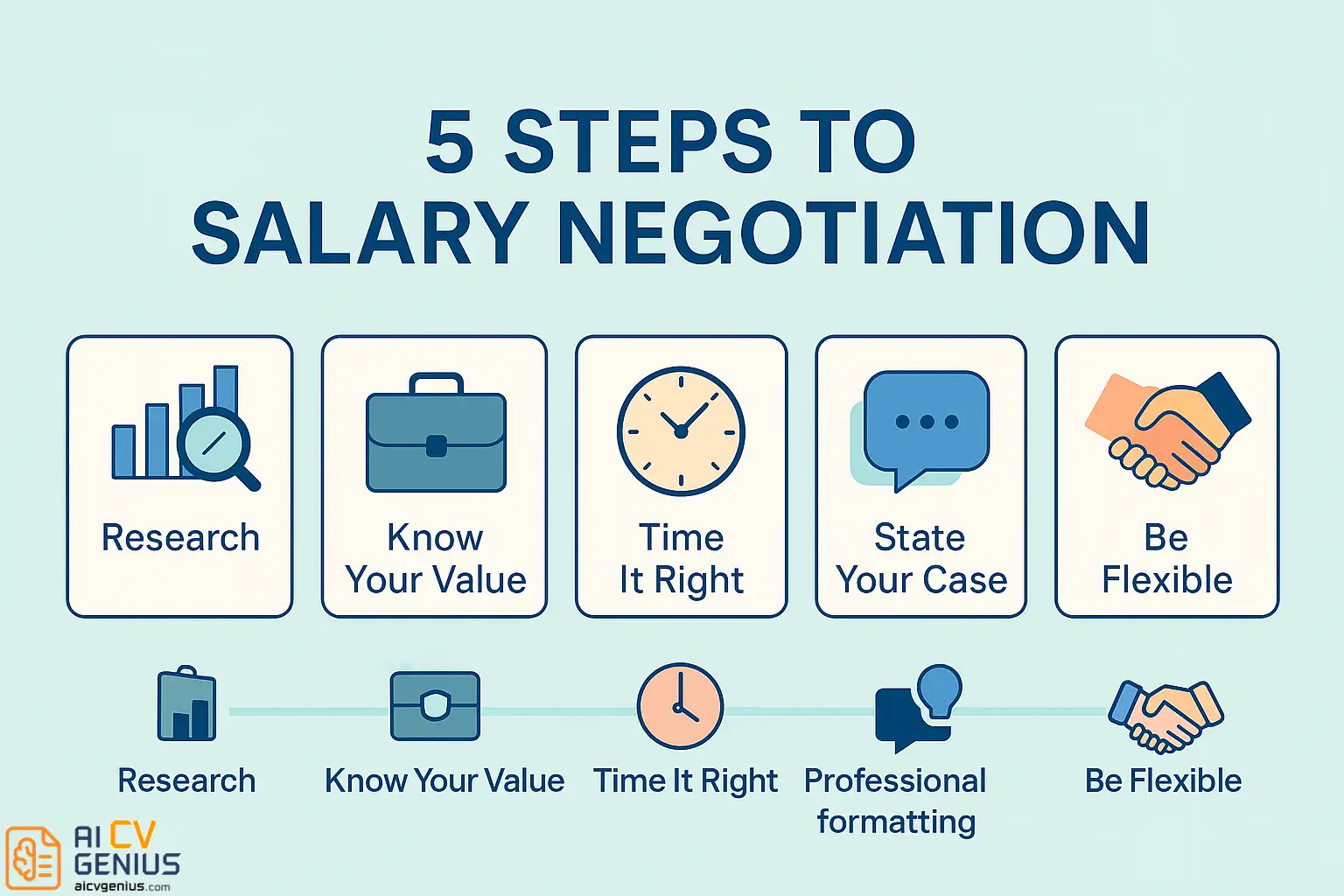
5 Strategic Steps to Effective Salary Negotiation
Successful negotiation isn’t about luck; it’s about preparation and strategy. Follow these steps:
Step 1: Conduct Thorough Market Research (Know Your Worth)
Entering a negotiation without data is like navigating without a map. Before any conversation, arm yourself with objective information:
- Research average salary ranges for your specific job title, industry, and geographic location. Utilize reputable sources like Glassdoor, Payscale, LinkedIn Salary, Salary.com, and industry-specific reports.
- Factor in your years of experience, specific skills (especially in-demand ones), educational background, and relevant certifications. These variables significantly influence your market value.
- Identify your unique value proposition: What specific skills, notable achievements (quantified if possible), or unique experiences do you possess that differentiate you from other candidates and directly benefit the employer?
Example:
A Marketing Manager with 5 years of experience in the SaaS industry in Austin, TX, discovers the typical salary range is $90K–$115K. If offered $85K, they possess concrete data demonstrating the offer is below market norms for their profile.
Step 2: Understand the Optimal Timing
Timing significantly influences your leverage and professionalism:
- For New Job Offers: The ideal time to negotiate is after you have received a formal, written job offer but before you have formally accepted it. This confirms their interest and provides a clear starting point for discussion. Avoid discussing specific salary numbers too early in the interview process.
- For Raises/Promotions: Initiate the conversation during scheduled performance reviews, after successfully completing a major project delivering significant results, or when taking on substantially increased responsibilities. Prepare a case demonstrating your increased value.
Initiating the discussion at the right moment shows strategic thinking and respect for the process.
Step 3: Frame Your Counteroffer Confidently and Collaboratively
How you communicate your request is as important as the request itself. Adopt a positive, professional, and collaborative tone. Avoid ultimatums or demands. Instead, justify your request based on your research and value proposition.
- Express enthusiasm for the role and company first.
- Clearly state your desired salary or range, grounding it in your research (“Based on market research for this role in [Location]…”) and your specific qualifications (“…and considering my [Number] years of experience in [Key Skill]…”).
- Frame it as a discussion, not a confrontation.
Example phrase:
“Thank you so much for the offer; I’m very excited about the opportunity to join [Company Name] and contribute to [Specific Goal/Team]. Based on my research into similar roles in [Location/Industry] and considering my demonstrated ability to [mention 1-2 key achievements/skills], I was targeting a salary closer to the range of $X–$Y. Is there flexibility within the compensation structure to potentially meet that range?”
Step 4: Be Prepared to Negotiate Beyond Base Salary (Total Compensation)
Sometimes, an employer’s budget for base salary is genuinely constrained. If they cannot meet your desired base pay, be prepared to explore and negotiate other valuable components of the total compensation package:
- Performance Bonuses: Signing bonus, annual performance bonus structure, commission rates.
- Equity: Stock options, Restricted Stock Units (RSUs), especially relevant in startups or tech companies.
- Work-Life Balance & Flexibility: More paid time off (vacation days), flexible working hours, guaranteed remote work days, compressed work weeks.
- Professional Development: Budget for conferences, certifications, further education, or specific training programs.
- Other Perks: Relocation assistance, enhanced health benefits, retirement plan matching contributions, transportation allowances.
Consider the overall value of the entire package, not just the base salary number.
Step 5: Practice Your Delivery
Negotiation is a skill that improves with practice. Rehearse your key talking points out loud:
- Practice with a trusted friend, mentor, or career coach.
- Anticipate potential responses from the employer (e.g., “That’s above our budget,” “Why do you believe you deserve that amount?”) and prepare thoughtful counter-responses.
- Practice maintaining a calm, confident, and professional demeanor, even if the conversation feels challenging.
Rehearsal builds confidence and helps you articulate your case more smoothly and effectively when the actual negotiation takes place.
Real-World Negotiation Scenarios & Outcomes
Let’s see these steps applied in common situations:
Case Study 1: Negotiating a New Job Offer
Scenario: Sarah receives a formal offer of $55,000 for a Marketing Coordinator role. Her research indicates the market average for her experience level and location is closer to $60,000-$65,000.
Her response (via email or phone):
“Thank you very much for offering me the Marketing Coordinator position. I’m genuinely excited about the opportunity to join the team and contribute to [mention specific campaign or goal]. Regarding the offered salary of $55,000, based on my research for similar roles in [City] requiring [mention 1-2 key skills she possesses, e.g., proficiency in HubSpot and SEO analytics], the typical range appears to be closer to $60,000-$65,000. Considering my [mention specific relevant achievement, e.g., experience managing campaigns that increased leads by 15%], would there be flexibility to adjust the starting salary towards the $62,000 mark?”
Result: After internal discussion, the employer countered with $60,000 base salary plus an additional week of paid vacation. Sarah accepted, feeling valued and fairly compensated.
Case Study 2: Requesting an Internal Raise
Scenario: Miguel has been an Accountant at his company for two years, consistently exceeding performance expectations and recently completing a major project that saved significant costs. His annual review is approaching.
His pitch (during the review):
“I appreciate the positive feedback on my performance over the past year. As we discussed, I successfully led the implementation of the new expense reporting system, which has resulted in an estimated $50K reduction in processing costs annually and improved compliance rates significantly. Additionally, I consistently completed month-end closing procedures 2 days ahead of schedule. Based on these contributions which exceed the standard expectations for my current role, and considering market benchmarks for accountants with [Number] years of experience and [mention specific skill/certification, e.g., CPA certification], I would like to request a salary review to adjust my compensation to approximately $X, reflecting this increased value and impact.”
Result: Recognizing his quantifiable contributions, Miguel secured a 12% salary increase.
Case Study 3: Negotiating Benefits When Salary is Firm
Scenario: Priya receives a job offer she’s excited about, but the company states the $70,000 salary offer is firm and at the top of their approved budget for the role. Her target was $75,000.
Her strategy: She responds positively but explores other areas: “Thank you for clarifying the salary structure; I understand the constraints. I remain very enthusiastic about this opportunity. Given that the base salary is fixed, would it be possible to discuss flexibility in other areas? Specifically, I’d value the option for two remote work days per week after the initial onboarding period, and perhaps an annual professional development budget of $2,000 to maintain my [mention relevant certification/skill] credentials?”
Result: The company agreed to the remote work arrangement and approved a $1,500 annual training budget. Priya accepted the offer, valuing the flexibility and growth opportunity alongside the base salary.
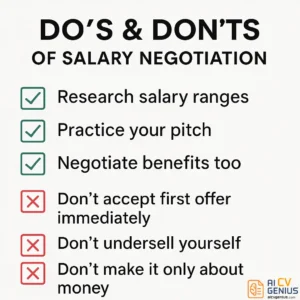
Checklist: Essential Do’s and Don’ts of Salary Negotiation
Navigate the process effectively by following these guidelines:
- ✅ DO conduct thorough research on salary ranges and your market value beforehand. Data is your strongest ally.
- ✅ DO clearly articulate your value proposition, highlighting specific, relevant achievements and skills (quantify impact whenever possible).
- ✅ DO maintain a positive, professional, and collaborative tone throughout the conversation. Express enthusiasm for the role.
- ✅ DO practice your key talking points to build confidence and ensure clarity.
- ✅ DO be prepared to discuss the entire compensation package (benefits, bonus, flexibility) if base salary is inflexible.
- ✅ DO get the final, agreed-upon offer in writing before formally accepting.
- ❌ DON’T accept the very first offer immediately without considering negotiation, especially if it’s below your researched range. Allow yourself time to evaluate.
- ❌ DON’T make the negotiation solely about money; consistently tie your request back to your skills, experience, and the value you will bring to the specific role and company.
- ❌ DON’T use aggressive language, ultimatums (“I won’t accept less than X”), or adversarial tactics. Negotiation should be a respectful dialogue.
- ❌ DON’T base your request solely on personal needs (e.g., “I need more money for my bills”). Focus on your professional market value.
- ❌ DON’T lie about your current salary or competing offers. Maintain honesty and integrity.
Table: Comparing Weak vs Strong Negotiation Language
The way you phrase your request significantly impacts its reception:
| Weak Language (Passive, Demanding, or Unjustified) | Strong Negotiation Language (Confident, Collaborative, Justified) |
|---|---|
| “Um, is this really the best salary you can offer me for this position?” | “Thank you for the offer. Based on market data for similar roles requiring [Skill X] and [Skill Y] in [Location], and considering my [Number] years of experience, I was anticipating a salary closer to the range of $X–$Y. Is there potential for adjustment within the compensation structure?” |
| “I feel like I need more money to take this job because my expenses are high.” | “I’m very excited about the responsibilities outlined for this role. To ensure the compensation accurately reflects the value and expertise I bring, particularly my track record in [mention specific achievement area, e.g., driving cost savings], I’d like to discuss if a salary of $X is achievable.” |
| “I absolutely cannot accept this offer unless the salary is at least $Y.” (Ultimatum) | “I’m highly enthusiastic about this opportunity and confident I can make significant contributions. However, the offered salary is somewhat below my expectations based on my research and current compensation level. I would feel much more comfortable accepting if we could reach a figure closer to $X. Would that be possible to explore?” |
Advanced Negotiation Strategies
Consider these tactics for more complex negotiations:
- Anchor High (Reasonably): When asked for your expectations first, or when making a counteroffer, start with a specific number towards the higher end of your well-researched, realistic range. This “anchors” the discussion and provides room for potential compromise while still landing within your acceptable zone.
- Leverage the Power of Silence: After clearly stating your well-reasoned request (e.g., your desired salary range and justification), pause and wait calmly for the employer’s response. Resist the urge to immediately fill the silence. This conveys confidence and often prompts the other party to respond thoughtfully or make a concession.
- Negotiate the Total Compensation Package Holistically: Frame the discussion around the entire value proposition, not just base salary. If base pay is constrained, pivot smoothly to negotiating other valuable elements like performance bonuses, equity, additional vacation time, professional development funds, or flexible work arrangements.
- Know Your Walk-Away Point (BATNA): Before entering the negotiation, determine your Best Alternative To a Negotiated Agreement (BATNA). What is your absolute minimum acceptable offer (considering the entire package)? Knowing your bottom line empowers you to negotiate confidently and, if necessary, respectfully decline an offer that significantly undervalues you.
Frequently Asked Questions About Salary Negotiation
Final Thoughts: Advocating for Your Value
Salary negotiation isn’t about engaging in conflict or being demanding – it’s fundamentally about clear, professional communication regarding your perceived market value and career worth. Employers generally respect candidates who approach this conversation with confidence, thorough preparation, and a collaborative mindset.
By diligently researching appropriate salary benchmarks, strategically timing your discussion, articulating your unique contributions with specific examples, and framing your request professionally, you significantly increase your likelihood of securing a compensation package that fairly reflects your skills and experience. Remember: every successful negotiation, even for seemingly small amounts, compounds positively over your entire career trajectory. Embrace the process as an opportunity to advocate for yourself and set a strong foundation for long-term financial growth and professional satisfaction.