
- The STAR Method is a structured way to answer behavioral questions: Situation, Task, Action, Result.
- Employers value it because it makes answers easier to follow and compare: It forces specific evidence of skills instead of vague claims.
- The strongest STAR delivery is weighted toward A and R: Keep S and T brief, use “I” to clarify your contribution, and quantify results when possible.
- The guide shows how to apply STAR across common questions: Teamwork, problem solving, and leadership, with detailed sample stories you can adapt.
- Preparation rules matter as much as structure: Do not memorize word-for-word, aim for about 1 to 2 minutes, and never end with a weak or missing Result.
You’re sitting in an interview, and the recruiter leans forward with the classic behavioral question: “Tell me about a time you faced a significant challenge at work and how you overcame it.” Your mind races. Do you launch into a lengthy narrative? Do you simply list the tasks involved? This critical moment is precisely where the STAR Method transforms your response from adequate to exceptional. It provides a simple yet powerful structure to articulate your experiences with clarity, focus, and demonstrable impact.
In this comprehensive guide, we’ll dissect exactly how to leverage the STAR Method effectively, complete with practical examples you can adapt and rehearse for your next interview, ensuring you communicate your value convincingly.
What Is the STAR Method? A Framework for Impactful Storytelling
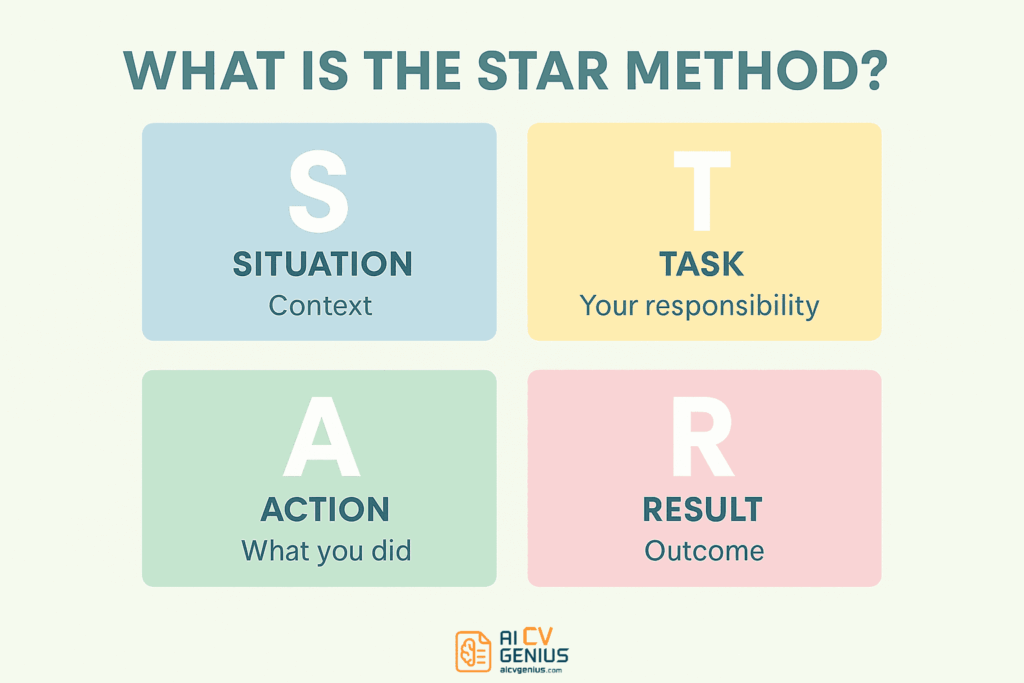
STAR is an acronym representing a structured approach to answering behavioral interview questions:
- ✅ S – Situation: Concisely set the scene. Provide necessary context about the circumstances or challenge you faced.
- ✅ T – Task: Clearly explain your specific role, responsibility, or the objective you were tasked with achieving within that situation.
- ✅ A – Action: Detail the specific, concrete steps you personally took to address the task or challenge. This is the core of your story, showcasing your skills and initiative.
- ✅ R – Result: Share the positive outcome(s) of your actions. Quantify the impact whenever possible and briefly mention key learnings if appropriate.
This structured formula works because it transforms potentially vague or anecdotal answers into concise, compelling narratives that vividly demonstrate your skills in action. Recruiters aren’t just interested in what tasks you performed; they are evaluating how you approach problems, collaborate, take initiative, and ultimately deliver tangible results.
Why Employers Value the STAR Method
Hiring managers and recruiters favor the STAR method for several key reasons:
- Structure & Comparability: It provides a consistent framework, making it easier to follow a candidate’s response and compare answers fairly across different applicants.
- Evidence of Competencies: It prompts candidates to provide specific examples, offering concrete evidence of essential competencies like problem-solving, teamwork, leadership, initiative, and conflict resolution in real-world scenarios.
- Focus & Relevance: It helps prevent candidates from rambling, going off-topic, or providing insufficient detail, ensuring the answer remains focused on the question asked.
- Insight into Self-Awareness: The “Result” component often reveals a candidate’s ability to recognize impact, learn from experiences, and understand the broader implications of their actions.
In essence, employing the STAR method makes you sound confident, articulate, results-oriented, and well-prepared – key attributes employers seek.
Breaking Down Each Step with Precision
Let’s delve deeper into crafting each component effectively:
Situation (S): Setting the Stage Concisely
Briefly provide the necessary background and context for your story. Focus only on the essential details needed to understand the subsequent Task and Action. Keep it concise – typically 1-2 sentences.
Example: “In my previous role as a Project Coordinator at ABC Corp, we were facing a critical deadline for a major client presentation, and a key team member unexpectedly went on medical leave just three days prior.”
Task (T): Defining Your Specific Role and Goal
Clearly articulate what your specific responsibility or objective was within that situation. What were you expected to achieve or address?
Example:
“As the coordinator, my task was to quickly redistribute the absent member’s workload, ensure all remaining presentation components were completed to a high standard, and guarantee we met the client deadline without compromising quality.”
Action (A): Detailing Your Specific Contributions
This is the most critical part. Describe the specific actions you took to handle the task. Use strong action verbs and focus on your individual contributions, even within a team context. Be detailed but relevant.
Example:
“I immediately convened a brief team meeting to assess the remaining tasks. I then reallocated specific sections based on team members’ current workloads and expertise. I personally took ownership of compiling the final slide deck and coordinating with the design team for graphics. Additionally, I set up twice-daily quick check-ins to monitor progress and address any roadblocks proactively.”
Result (R): Highlighting the Positive Outcome and Impact
Conclude by summarizing the positive results of your actions. Quantify the impact whenever possible (using numbers, percentages, or specific achievements). Briefly mentioning a key learning adds further value.
Example:
“As a result, the team successfully completed the presentation on time and received positive feedback from the client, specifically praising the report’s thoroughness. The project was secured, contributing to approximately $50K in follow-on business. This experience reinforced the importance of proactive communication and rapid BCP execution during unexpected challenges.”
Illustrative Case Studies: STAR Method in Action
Applying the framework across common behavioral questions:
Case Study 1: Demonstrating Teamwork
❓Question:
“Tell me about a time you had to work effectively as part of a team.”
STAR Answer:
- Situation: During my marketing internship last summer, our team of four interns was tasked with developing a social media campaign proposal for a new product launch under a tight two-week deadline.
- Task: My specific role involved conducting competitor analysis for social media strategies and collaborating with another intern responsible for content creation.
- Action: I researched competitor activities across three key platforms, identified gaps and opportunities, and presented findings to the team. I then worked closely with the content creator, providing data insights to inform messaging and visual concepts, ensuring our ideas were aligned and targeted. We held daily syncs to integrate feedback.
- Result: Our team delivered the proposal on schedule. The campaign concept we developed was highly praised by the Marketing Director for its data-backed approach and creativity, and several core ideas were later incorporated into the actual product launch campaign, contributing to a 25% higher initial engagement rate than projected.
Case Study 2: Showcasing Problem-Solving
❓Question:
“Describe a challenging situation you faced at work and how you resolved it.”
STAR Answer:
- Situation: While working part-time as a shift supervisor at a busy retail store, we experienced recurring issues with our primary point-of-sale (POS) system crashing during peak weekend hours, leading to long customer queues and frustration.
- Task: My responsibility was to minimize customer disruption, maintain transaction accuracy, and find a sustainable solution to mitigate the impact of the system failures.
- Action: I first implemented a clear protocol for quickly switching to backup manual transaction logs during outages. Simultaneously, I meticulously documented the specific error messages, times of occurrence, and transaction volumes preceding each crash over three weekends. I compiled this data into a concise report and escalated it to the IT department, providing concrete evidence of the issue’s pattern and severity. I also trained junior staff on the backup procedures.
- Result: Implementing the backup protocol immediately reduced average customer wait times during outages by approximately 5 minutes. The detailed report enabled IT to identify and resolve the underlying software conflict within one month, eliminating the crashes entirely. Customer complaints regarding checkout delays subsequently dropped by over 40%.
Case Study 3: Highlighting Leadership
❓Question:
“Give an example of a time you demonstrated leadership skills.”
STAR Answer:
- Situation: As president of the university debate club, we needed to organize our annual inter-collegiate tournament, but funding was cut by 20% compared to the previous year.
- Task: My primary task was to successfully plan and execute the tournament within the reduced budget while maintaining the quality of the event and securing participation from at least 10 visiting universities.
- Action: I led brainstorming sessions with the club officers to identify potential cost-saving measures, such as negotiating venue discounts and securing local sponsorships. I delegated specific responsibilities (logistics, outreach, sponsorship) to committee heads, created a detailed project plan with milestones using shared online tools, and held weekly progress meetings to ensure accountability and address challenges proactively. I personally secured three new local business sponsorships totaling $2,000.
- Result: We successfully hosted the tournament within the revised budget, attracted participation from 12 universities (exceeding our goal), and received positive feedback from 95% of attendees via post-event surveys. The event generated a small surplus, which helped fund club activities for the following semester, and the new sponsorship relationships were secured for future years.
Common Mistakes to Avoid When Using the STAR Method
While powerful, the STAR method can be ineffective if misused. Avoid these common pitfalls:
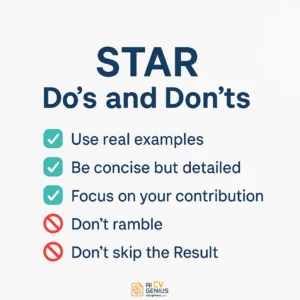
- ❌ Excessive Detail in Situation (S): Providing too much unnecessary background information, causing the interviewer to lose focus before you reach the core Action and Result. Keep the setup brief and relevant.
- ❌ Omitting or Downplaying the Result (R): Failing to clearly state the positive outcome or impact of your actions. This is arguably the most crucial part – always conclude with a strong result, quantified if possible.
- ❌ Focusing on “We” Instead of “I” in Action (A): While acknowledging teamwork is important, the interviewer needs to understand your specific contribution. Use “I” statements when describing the actions you personally took.
- ❌ Generic or Hypothetical Answers: Providing vague descriptions without specific details, concrete examples, or measurable outcomes. Base your stories on real experiences.
- ❌ Not Tailoring the Story to the Question: Using a pre-prepared story that doesn’t directly answer the specific behavioral competency the interviewer is probing (e.g., using a teamwork story for a leadership question).
Table: Transforming Weak Answers into Strong STAR Responses
Notice the difference in clarity, detail, and impact:
| Weak Answer (Vague/Incomplete) | Strong STAR Answer (Structured/Specific/Impactful) |
|---|---|
| “Yeah, I worked on a team project once, and it generally went pretty well despite some challenges. We managed to finish it.” | “(S) During my final-year marketing course project, our 4-person team faced a tight 3-week deadline to develop a comprehensive digital strategy for a local business. (T) My specific responsibility was to conduct the competitive analysis and keyword research. (A) I utilized tools like SEMrush and Google Keyword Planner, analyzed competitor backlink profiles, identified high-opportunity keywords, and presented my findings, which shaped our content plan. (R) Our team submitted the strategy on time, receiving an ‘A’ grade, and the local business adopted two of our core content recommendations, later reporting a 15% increase in website inquiries.” |
| “I’m pretty good at solving problems when they come up. Like, if something breaks, I usually figure out how to fix it.” | “(S) In my previous role as an IT support specialist, the company’s internal ticketing system frequently experienced slowdowns during peak hours, delaying issue resolution. (T) I was tasked with identifying the root cause and proposing a solution. (A) I monitored system performance logs, correlated slowdowns with specific query types, identified inefficient database indexing, and recommended specific index optimizations to the development team. (R) After implementing the suggested changes, average ticket processing time decreased by 30% during peak hours, significantly improving user satisfaction.” |
Advanced Tips for Achieving STAR Method Mastery
Elevate your STAR responses from good to outstanding:
- Develop a Portfolio of STAR Stories: Prepare 6–8 distinct, detailed STAR examples covering key competencies relevant to your field (e.g., teamwork, leadership, conflict resolution, problem-solving, initiative, handling failure, achieving success). Ensure variety in the situations and outcomes.
- Tailor Results to the Role’s Priorities: Customize the emphasis of your “Result” based on the specific job requirements. For sales roles, highlight revenue generated or targets exceeded. For operational roles, focus on efficiency gains or cost savings. For HR, emphasize improvements in employee engagement or retention.
- Quantify Outcomes Rigorously: Make quantification a priority. Use numbers, percentages, dollar amounts, or timeframes whenever possible to make your impact concrete and memorable (e.g., “Increased conversion rate by 15%,” “Reduced project completion time by 10 days,” “Managed a budget of $500K”). Even well-reasoned estimates are better than vague statements.
- Practice Delivery for Natural Flow: Rehearse your STAR stories out loud multiple times. Practice varying your tone and pace. The goal is to sound confident and conversational, not robotic or overly memorized. Use brief notes if needed, but avoid reading directly.
- Include a Brief Learning (Optional but Effective): Occasionally adding a concise reflection at the end of the Result (e.g., “…and I learned the critical importance of setting clear expectations upfront”) can demonstrate self-awareness and a growth mindset.
Story: A Graduate’s First Success with the STAR Method
Laura, a recent psychology graduate applying for research assistant positions, felt overwhelmed by behavioral interview questions, fearing her lack of extensive work experience. She diligently prepared several STAR stories based on her university research projects, volunteer work coordinating a peer support group, and even managing conflicting priorities during her final exams. In her first significant interview, she was asked about handling disagreements within a team.
Laura calmly deployed her prepared STAR example detailing a situation in her research group (S), her task to facilitate consensus on methodology (T), the specific communication and compromise steps she took (A), and the successful project completion with positive peer feedback (R). The interviewer visibly engaged, taking detailed notes. A week later, Laura received the job offer, citing her clear communication and problem-solving examples as key factors. The STAR Method provided the structure and confidence she needed to effectively translate her academic and extracurricular experiences into compelling professional competencies.
Her experience highlights a common challenge: connecting existing skills to perceived requirements. Often, the gap isn’t ability, but articulation – a problem frequently seen when job seekers wonder why their applications yield no response, as explored here: I Sent 37 Resumes and Got No Reply – Until I Changed One Thing.
FAQ: STAR Method Interviews
Final Thoughts: Mastering Your Interview Narrative
Interviews are fundamentally about effective storytelling – specifically, telling compelling stories that provide concrete evidence of your skills and suitability for the role. The STAR Method serves as your essential scriptwriting framework for these critical moments. By consistently structuring your responses around Situation, Task, Action, and Result, you empower recruiters and hiring managers to clearly understand not just what you’ve accomplished, but how you think strategically, act decisively, collaborate effectively, and ultimately deliver meaningful outcomes.
Whether you are a fresh graduate leveraging academic projects or a seasoned professional recounting significant career achievements, mastering the STAR method transforms interview anxiety into articulate confidence and transforms vague claims into undeniable proof of your competence. Practice it diligently, and you won’t just navigate behavioral interviews – you’ll excel in them, significantly increasing your chances of landing the offer.