
- A career objective is future-focused. It states your direction and the value you will bring, different from a summary (past wins) or a profile (skills list).
- Use an objective when your resume needs a “translator”, especially for students, fresh graduates, career changers, non-linear paths, or when targeting a very specific role.
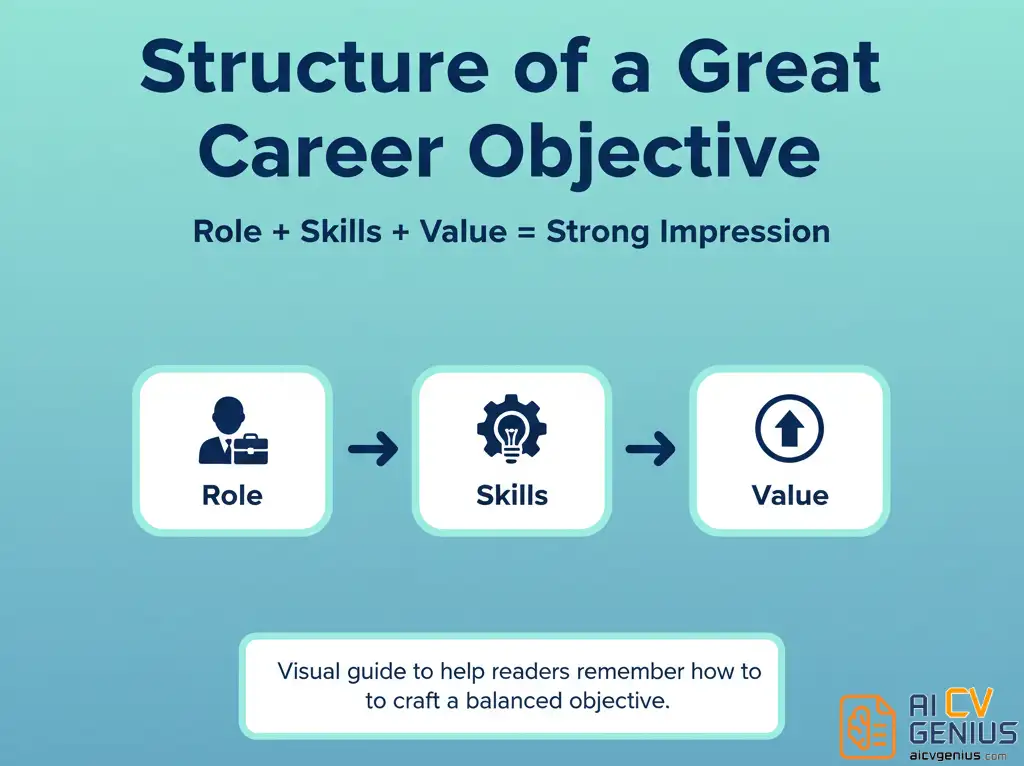
- A strong objective follows a simple formula: Who you are, what you offer (2 to 3 key skills), and why you are here (the employer-facing value).
- Tailor it every time by pulling 2 to 3 keywords from the job description and weaving them naturally, which also supports ATS scanning.
- Avoid the common failures: Self-centered wording, vague clichés, one-size-fits-all copy, paragraph-length objectives, and keyword stuffing that sounds robotic.
The Underrated Powerhouse: Why Your Career Objective Matters
Your resume is a story. The Career Objective is its opening line, its headline, its entire premise, all distilled into two or three powerful sentences. In a world where recruiters notoriously spend an average of six seconds scanning a resume, this short statement does an incredible amount of heavy lifting. It is the very first thing they read, and it has the power to frame the entire narrative that follows.
Think of it as your professional handshake. A weak, limp, or generic objective – “Seeking a challenging role” – is forgettable. A strong, confident, and specific objective, however, immediately answers the recruiter’s three unspoken questions: “Who are you, what can you do for me, and why are you here?”
Many guides will tell you the career objective is outdated, a relic from a bygone era. They are wrong. What is outdated is the selfish objective. The modern career objective has evolved: it is no longer about what you want; it is about the value you intend to bring. It is a strategic tool for controlling your narrative, especially when your resume does not speak for itself.
In this comprehensive guide, we will move far beyond generic templates. We will dissect the psychology of a compelling objective, explore its critical role for career changers and graduates, and provide dozens of powerful, real-world examples. This is how you write an objective that grabs attention and holds it.
Defining the Objective: What It Is & Why It Matters
Objective vs. Summary vs. Profile: A Critical Distinction
Before we write a single word, we must clear up the most common point of confusion. The top of your resume is prime real estate, and “Career Objective” is only one of three possible tenants. Choosing the right one is essential.
- Career Objective: A future-focused statement that defines your immediate career goals in the context of the value you will provide. It answers, “Where am I going and what can I do for you?”
- Career Summary (or Professional Summary): A past-focused statement that highlights your top 3-4 key achievements, skills, and years of experience. It answers, “What are my biggest accomplishments?”
- Professional Profile: A present-focused list of your core competencies, often presented as bullet points (e.g., “Languages: Python, Java,” “Certifications: PMP, AWS”). It answers, “What are my hard skills?”
Here is a simple breakdown of when to use each:
| Component | Primary Focus | Best For | Example |
|---|---|---|---|
| Career Objective | Future (Your Goals + Value) | Students, Fresh Graduates, Career Changers, or those targeting a very specific role. | “Recent honors graduate in Marketing seeking to apply data analysis and content strategy skills to help drive user acquisition at a mission-driven tech company.” |
| Career Summary | Past (Your Experience + Achievements) | Experienced professionals (3+ years) with a clear, linear career path and provable results. | “Senior Marketing Manager with 8+ years of experience in the SaaS industry. Proven track record of leading teams to grow MQLs by 300% and reducing CPL by 40%.” |
| Professional Profile | Present (Your Skills) | Highly technical or specialized roles (e.g., IT, Engineering, Healthcare) where specific skills are paramount. | “Skills: Python, C++, SQL, AWS Cloud Practitioner, Agile Methodologies. Projects: Deployed three full-stack applications serving 10k+ users.” |
For many professionals, a hybrid approach works best: a concise Career Summary followed by a Professional Profile. But for anyone whose resume needs a “translator,” the Career Objective is not just helpful – it is essential.
What Is a Career Objective? (The Deeper Definition)
A career objective is a concise, 2-3 sentence statement positioned at the top of your resume. Its primary function is to articulate your immediate career goals in the context of the value you intend to bring to an employer.
It must be sharp, targeted, and answer two questions at once:
- What you are seeking: This demonstrates your direction and focus. (e.g., “a software engineering position”)
- What you can contribute: This demonstrates your value and relevance. (e.g., “where I can apply my skills in Python to build scalable solutions”)
Let’s look at the anatomy of a weak objective versus a strong one:
- ❌ Weak Objective (Self-Centered): “To obtain a challenging and rewarding position in a dynamic company where I can learn new skills and grow my career.”(This says nothing specific and focuses only on what the candidate wants.)
- ✅ Strong Objective (Value-Driven): “To apply my data analysis skills in a fast-paced company where I can contribute to data-driven decision-making and help optimize business processes.”(This states the skill, the environment, and the specific value the candidate will add.)
The strong objective acts as a “thesis statement” for your entire resume. It tells the recruiter exactly how to read the document that follows.
Why the Career Objective Still Matters in 2025
In a market saturated with experienced candidates, a career objective has become a vital tool for specific groups. It is your chance to control the narrative when your resume alone does not tell the full story. It is a humanizing element that shows proactive thought – a trait recruiters will always value.
For Students or Fresh Graduates: Selling Potential Over Past
When you are a student, your “Experience” section is thin. You cannot compete on a 10-year track record. You must compete on potential, direction, and passion. An objective is the only tool that does this effectively. It shifts the recruiter’s focus from “What have you done?” (not much) to “What can you do for me?” (a lot).
It also shows you are focused and not just “spray and praying” – applying to every job you see. It demonstrates intentionality.
For Career Changers: Bridging the “Relevance Gap”
This is perhaps the most powerful use case. Imagine you are a teacher applying for a corporate training role. Without an objective, the recruiter sees “Teacher” and “Classroom” and might immediately discard your resume, thinking it is irrelevant. You have six seconds to stop them.
Your objective is the bridge.
- Without Objective: Recruiter sees “High School English Teacher” and thinks “irrelevant.”
- With Objective: “Former educator with 8+ years of experience in curriculum design and public speaking. Transitioning into corporate training to apply my expertise in adult learning and program development to enhance your employee engagement.”
Suddenly, “Teacher” becomes “Curriculum Designer” and “Public Speaker.” You have instantly translated your past skills into their future needs.
For Experienced Professionals: Providing Strategic Focus
While most senior professionals (10+ years) should use a Career Summary, an objective has a critical niche function. It is used when you are making a specific, strategic pivot that is not obvious from your job titles.
- Case 1: Pivoting to a new focus area. e.g., A “Senior Marketing Manager” (generalist) who now wants to specialize: “Senior Marketing Manager with 10+ years of experience seeking to leverage my expertise in market analytics to transition into a full-time ‘Marketing Analytics & Strategy’ leadership role.”
- Case 2: Moving from corporate to non-profit. e.g., “Fortune 500 executive seeking to apply two decades of experience in logistics and operations to drive efficiency and impact at a mission-driven non-profit organization.”
For Everyone: Optimizing for Applicant Tracking Systems (ATS)
Finally, there is the technical reason. Most large companies use Applicant Tracking Systems (ATS) to scan and rank resumes. This software looks for keywords from the job description. The career objective is the perfect, natural place to mirror those keywords right at the top of the page.
If the job description asks for “stakeholder communication” and “agile methodologies,” your objective can explicitly state your intent “to apply stakeholder communication skills within an agile methodology framework.” This ensures you pass the robot scan and get your resume in front of a human.
How to Write a Powerful Career Objective
The 3-Part Formula for a Powerful Career Objective
A powerful objective avoids clichés. It is a precise, three-part formula. Think of it as building with Lego blocks.
[Block 1: WHO You Are] + [Block 2: WHAT You Offer] + [Block 3: WHY You Are Here (Your Value)]
Let’s break down each block.
Block 1: The “Who” – Your Professional Identifier
This is your “hook.” Start with a strong adjective or your specific status. Avoid “I” or “My.”
Examples of Identifiers:
- “Driven and analytical…”
- “Recent honors graduate…”
- “Detail-oriented…”
- “Bilingual marketing professional…”
- “Former educator…” (for career changers)
- “Seasoned executive…”
- “Motivated Business Administration graduate…”
Block 2: The “What” – Your Top 2-3 Key Skills
This is where you must tailor your resume. Look at the job description and pull the top 2-3 required skills. These are your keywords.
Job Description Example: “Seeking a junior analyst with strong Excel modeling skills and experience in presenting data.”
Your “What” Block: “…with proven skills in Excel modeling and data presentation…”
Block 3: The “Why” – Your Value Proposition
This is the most important part. It connects your skills to their company and their goals. This is where you flip the script from “what I want” to “what I can do for you.”
- ❌ Bad (Selfish): “…seeking a role to grow my skills.”
- ✅ Good (Value-Driven): “…seeking to apply my skills to grow your user base.”
- ❌ Bad (Selfish): “…in a company where I can be challenged.”
- ✅ Good (Value-Driven): “…to help your team solve complex technical challenges.”
Putting It All Together (The Formula in Action)
[Block 1: Who] “Recent Marketing graduate…
[Block 2: What] …with strong analytical and content creation skills…
[Block 3: Why] …seeking to apply strategic thinking to help drive digital growth at an innovative company.”
This formula is effective because it is not generic. It clearly states who you are, what you do, and what you want to achieve for them.
The 5 Deadly Sins: Common Mistakes to Avoid
Writing a great objective is as much about avoiding errors as it is about including the right content. Here are the five mistakes that will get your resume ignored.
Mistake 1: The “It’s All About Me” Objective
This is the most common and most fatal error. The objective focuses entirely on what you want, what you need, and what you hope to get.
- ❌ The Mistake: “I am looking for a challenging role where I can grow my skills and learn from senior mentors in a fast-paced environment.”
- ✅ The Fix (The Value-Proposition Flip): Reframe every “I want” into a “I can give.”“Seeking a challenging role where I can apply my problem-solving skills to support senior mentors and contribute to a fast-paced team.”
Mistake 2: The “Vague Cliché” Objective
This objective is filled with empty “corporate-speak” that sounds impressive but means nothing. It is a wasted opportunity.
- ❌ The Mistake: “A highly motivated team player and go-getter seeking a position with a results-driven company.”
- ✅ The Fix (Use Concrete Skills): Replace every cliché with a specific skill or attribute.“A highly motivated professional with 3 years of project coordination experience seeking to apply my skills in Agile and stakeholder communication to a results-driven team.”
Mistake 3: The “One-Size-Fits-All” Objective
This is the generic, copy-pasted objective you send to every single job application. Recruiters can spot it a mile away. It signals low effort.
- ❌ The Mistake: “Seeking a good job at a good company.” (A slight exaggeration, but many are this vague).
- ✅ The Fix (The 5-Minute Tailor): You MUST tweak your objective for every application. Pull 2-3 keywords from the job description and insert them. This signals you wrote this for them.
Mistake 4: The “Too Long” Objective (The Paragraph)
The recruiter is scanning. If your objective is a dense, 5-line paragraph, their eyes will glaze over and skip it entirely. It has failed its one job.
- ❌ The Mistake: “I am a recent graduate who worked very hard on many projects in school and I believe my skills in teamwork and my passion for learning would make me a great fit for any department in your company…”
- ✅ The Fix (The Tweet Rule): Keep it to 2-3 lines, or about 280 characters. Shorter is sharper. Edit ruthlessly.
Mistake 5: The “Keyword Stuffing” Objective
This is an over-correction for the ATS. The objective is packed with so many keywords that it sounds like it was written by a robot.
- ❌ The Mistake: “Seeking a sales, marketing, and business development role with skills in SEO, SEM, PPC, B2B, B2C, and CRM.”
- ✅ The Fix (Weave Naturally): Pick the top two most important keywords and weave them into a natural sentence.“Dynamic sales professional seeking a role to apply my expertise in B2B SaaS and CRM management to grow your enterprise client base.”
Quick Tips for Writing and Refining
- ✅ Start strong: Begin with your role or a powerful adjective (e.g., “Driven graduate,” “Analytical marketer”).
- ✅ Mirror the Job Description: This is the most important tip. Use the exact language from the job posting. If they want a “collaborative team player,” use the word “collaborative.”
- ✅ Be Specific, Not Vague: “Increased sales” is vague. “Managed a $50k ad budget” is specific.
- ✅ Show Enthusiasm: Use words like “eager to,” “passionate about,” “seeking to apply,” “driven to contribute.”
- ✅ Ground it in Reality: Your objective must align with the rest of your resume. Do not claim skills you cannot back up.
- ✅ Read it Aloud: This is the best test. Does it sound like a confident human or a robot? If you stumble while reading it, it is too complex. Simplify.
40+ Career Objective Examples for Every Situation
A generic example is useless. Here are dozens of specific, tailored examples you can adapt for your unique situation. Notice how each one states a skill and links it to a contribution.
Examples by Experience Level
For Students or Fresh Graduates (Selling Potential)
“Motivated Business Administration graduate with a passion for data-driven decision-making. Eager to contribute analytical skills and a collaborative mindset to support your team’s business growth objectives while learning from industry leaders.”
“Recent Computer Science honors graduate with internship experience in front-end development. Seeking to apply my skills in JavaScript and React.js to help build responsive, user-centric applications.”
“Enthusiastic and creative English major with experience running a university blog (10k+ monthly visitors). Eager to contribute content creation and SEO skills to a fast-paced digital marketing team.”
“Resourceful Finance student seeking a summer internship. Aiming to apply my academic knowledge of financial modeling and valuation techniques to support your team with market research and analysis.”
“Sociology graduate with research experience in qualitative data analysis. Seeking an entry-level position in market research to apply my skills in survey design and user interviewing to generate actionable consumer insights.”
For Entry-Level Professionals (1-3 Years)
“Detail-oriented Administrative Assistant with 18 months of internship experience. Seeking to apply strong organizational and multitasking skills to ensure seamless office operations and improve efficiency at [Company Name].”
“Junior Graphic Designer with 2 years of agency experience. Seeking to apply my skills in UI/UX and brand identity to create compelling, user-focused designs that drive engagement.”
“Sales Development Representative with a 1-year track record of exceeding quota by 20%. Eager to apply my prospecting and lead-generation skills to help build a strong pipeline for a growing SaaS sales team.”
“Entry-level IT Support Specialist with CompTIA A+ certification. Seeking to leverage my problem-solving skills and customer service-oriented approach to provide excellent technical support to your internal team.”
For Mid-Level Professionals (Seeking Specialization or Leadership)
“Experienced Project Coordinator with a track record of managing projects on time and under budget. Seeking to leverage leadership and agile methodology skills to drive efficiency in your cross-functional development teams.”
“Digital Marketer with 5 years of experience in SEO/SEM. Aiming to transition from a generalist role to a dedicated SEO Strategist, using my deep knowledge of technical SEO to grow organic traffic.”
“Senior Accountant (CPA) with 7 years of public accounting experience. Seeking to move into a corporate finance role, applying my expertise in financial reporting and analysis to support strategic planning.”
“Human Resources Generalist (SHRM-CP) with 6 years of experience. Eager to take the next step into a leadership role as an HR Manager, focusing on developing and implementing employee retention and development programs.”
For Career Changers (The Most Critical)
“Former educator with 8+ years of experience in curriculum design and adult training. Transitioning into Human Resources, I aim to apply my expertise in mentoring and communication to enhance your employee engagement and training programs.”
“Registered Nurse with 5 years of clinical experience. Seeking to transition into a Healthcare IT role, applying my deep understanding of clinical workflows and patient data to help implement and optimize EMR systems.”
“Retail Store Manager with 7 years of experience in team leadership and P&L management. Seeking to pivot into a Sales Operations role, using my analytical and process-improvement skills to drive sales team efficiency.”
“Military veteran with 10 years of experience in logistics and operations management. Seeking a Project Manager position to apply my proven leadership and strategic planning skills to deliver complex projects on schedule.”
“Journalist with 6 years of experience in long-form storytelling and research. Eager to transition into a Content Marketing role, using my narrative skills to build brand authority and engage target audiences.”
For Senior Professionals (Strategic Pivots)
“Seasoned Marketing Manager with 10+ years of experience building brand visibility in the SaaS space. Seeking to contribute strategic insight and team leadership to help scale a growing creative department.”
“Director of Operations with 15+ years of experience in supply chain optimization. Seeking a senior leadership role at a sustainability-focused company to apply my expertise to building an efficient and ethical global supply chain.”
“Senior Software Engineer (Principal) with 12 years of experience. Eager to move into a formal People Manager role, applying my technical mentorship and architectural design skills to lead and grow a high-performing engineering team.”
More Examples by Industry
Here is a quick-reference table for common industries. Note how each one is specific and value-driven.
| Industry | Career Objective Example |
|---|---|
| Information Technology | “To obtain a software engineering position where I can apply my skills in Python and cloud architecture to build scalable and efficient digital solutions for your users.” |
| Marketing | “Creative professional seeking to leverage 5+ years of storytelling and content strategy experience to build a compelling brand narrative for a results-driven marketing team.” |
| Education | “Passionate secondary school teacher aiming to foster critical thinking and digital literacy, creating an inclusive classroom environment where all students can thrive.” |
| Finance | “Aspiring financial analyst with recent CFA Level 1 pass. Eager to apply quantitative reasoning and Excel modeling skills to support your team’s strategic investment decisions.” |
| Design | “Motivated graphic designer with a portfolio in UI/UX. Seeking to use my creativity and understanding of brand identity to deliver impactful, user-centric visual solutions.” |
| Healthcare | “Compassionate registered nurse with 3 years of emergency room experience. Aiming to provide quality, evidence-based care within a patient-focused medical environment.” |
| Sales | “Driven sales professional with 4 years of B2B experience. Seeking to apply my relationship-building and closing skills to help a high-growth tech company expand its enterprise accounts.” |
| Human Resources | “Organized and empathetic HR coordinator seeking to apply my experience in benefits administration and onboarding to create a positive and efficient employee experience at [Company Name].” |
| Operations | “Logistics specialist with 5 years of experience in warehouse management. Eager to apply my process-improvement and inventory-control skills to optimize your supply chain.” |
Advanced Concepts, Final Analysis & FAQs
Bonus: Beyond the Resume – Your Objective as a Personal Brand
A great career objective is not just text on a page; it is the core of your professional brand. It is your mission statement. Once you have perfected it, do not just leave it on your resume. Use it everywhere to build a consistent, memorable, and confident professional presence.
1. Your LinkedIn Headline
Your LinkedIn headline is your digital handshake. A weak headline is your job title (“Manager at Company”). A strong headline is your objective.
Objective:
“Former educator… seeking to apply my expertise in mentoring and communication to enhance employee engagement.”
LinkedIn Headline:
"Former Educator | Corporate Trainer | Enhancing Employee Engagement Through Communication & Mentoring"
2. Your LinkedIn “About” Section
The first two lines of your “About” section are all most people will read. Use your objective as the perfect opening hook to draw them in.
“I’m a seasoned marketer with 10+ years of experience, but my true passion is connecting strategic insight with team leadership to help scale growing creative departments. I thrive on…”
3. Your Cover Letter Opening
Never start a cover letter with “I am writing to apply for…” Start with your objective, tailored to them. It is far more powerful.
“As a recent computer science graduate with a passion for building user-centric applications, I was immediately drawn to [Company Name]’s mission to… My goal is to apply my skills in React.js to contribute to your innovative engineering team.”
4. Your Networking “Elevator Pitch”
When someone at a networking event asks, “So, what do you do?” you can use your objective as a script. It’s clear, confident, and forward-looking.
“I’m a project coordinator who loves driving efficiency. I’m currently seeking to leverage my leadership and agile skills to help a cross-functional dev team bring amazing products to market.”
When your objective aligns with your values and your story, it stops being a “resume section” and starts being your personal brand.
Pros & Cons of Using a Career Objective
Even a modern objective is a strategic choice. Here is a balanced look at the advantages and potential pitfalls.
| Pros | Cons |
|---|---|
| ✅ Instantly Clarifies Goals: Immediately tells the recruiter who you are and what you want. | ❌ Can Sound Generic: If copied from a template, it sounds low-effort and bland. |
| ✅ Controls the Narrative: Essential for students or career changers to bridge the “experience gap.” | ❌ Takes Up Valuable Space: For senior pros with extensive, relevant experience, a Summary is a better use of that space. |
| ✅ Primes the Recruiter: Tells the employer how to read your resume, framing your skills in a specific, favorable light. | ❌ Can Be Too Limiting: A very narrow objective (e.g., “Seeking only a front-end React role”) might get you passed over for a “Full-Stack” role you’d also love. |
| ✅ ATS Keyword Optimization: The perfect, natural place to include keywords from the job description. | ❌ Can Weaken First Impression: A poorly written one (vague, self-centered) does more harm than good. |
Final Thoughts: Your Objective as an Act of Clarity
Your career objective is a small section with a massive job. It is your first, best chance to tell the recruiter not just what you have done, but what you are capable of doing for them.
Writing a great objective is, at its core, an act of professional clarity. It forces you to stop and ask, “What value do I actually bring, and where do I want to bring it?”
When written thoughtfully, it shows insight, direction, and professionalism. It proves that you are not just a collection of past job titles, but a focused professional with a clear plan. Keep it short, personal, and relevant. Be specific enough to stand out, but flexible enough to show you are ready to grow.
For more resume-writing support, explore:
- Resume Templates Finder – explore professional resume layouts.
- Career Resources – guides for writing, interviewing, and growth.
- Blog – for mindset and productivity insights.
In-Depth FAQs About Career Objectives
This is one of the most confusing parts of resume writing. Here are detailed answers to the most common questions.
- You are a student or recent graduate with limited professional experience.
- You are a career changer, and your past experience is not obviously relevant to your new field.
- You are targeting a very specific niche or role, and you want to make that clear immediately.
- Your career path is not linear (e.g., you have gaps or have held many different types of roles).
If you are an experienced professional with a clear, linear career path (e.g., 10 years in sales), you should use a Career Summary instead, as it is more powerful for showcasing past achievements.
- Base: “Seeking a sales role to apply my communication skills.”
- Tailored: “Seeking a B2B SaaS sales role to apply my prospecting and CRM skills.”
A tailored objective shows you have done your research and are genuinely interested in this role, not just any role.
- Avoid: “I am a motivated professional seeking to…”
- Prefer: “Motivated professional seeking to…”
- Avoid: “My goal is to find a role…”
- Prefer: “Seeking a role…”
The best objectives focus on what you can give. Always frame your desire as a contribution.
- Selfish: “…where I can learn from a great team.”
- Value-Driven: “…where I can contribute to and learn from a great team.” (A simple, but critical, change).
- Objective: The most formal version, written in a full sentence for your resume. (e.g., “Driven analyst seeking to…”).
- Headline: The keyword-focused, punchy version for your LinkedIn profile. (e.g., “Data Analyst | SQL & Tableau | Turning Data into Insights”).
- Branding Statement: The conversational, first-person version you might use in an “About” section or a cover letter. (e.g., “I’m passionate about turning raw data into clear, actionable insights that drive business growth.”).
Think of them as 3 versions of the same core message, just tailored for different platforms.
- Resume 1 (Marketing): Has a marketing-focused objective and highlights marketing-related experience.
- Resume 2 (Sales): Has a sales-focused objective and re-frames your experience to highlight sales-related skills (e.g., “persuasion,” “client relationships”).
This is not dishonest; it is smart tailoring.
- Driven
- Analytical
- Detail-oriented
- Creative
- Strategic
- Organized
- Compassionate
- Resourceful
- Technical
- Bilingual
Verbs (The “Why”/Value):
- To apply…
- To contribute…
- To leverage…
- To drive…
- To optimize…
- To build…
- To enhance…
- To support…
- To deliver…
- To scale…