
- Main rule: Stop listing soft skills and start proving them with action, context, and results.
- Why lists fail: Recruiters and modern ATS ignore generic words like “Leadership” unless your bullets show evidence.
- How to show soft skills: Use strong verbs, name the people or teams involved, and add measurable outcomes wherever possible.
- Where to put them: Weave proof into your summary, experience bullets, and key achievements, not a standalone “Soft Skills” section.
- How to tailor fast: Pull the soft-skill signals from the job description, map them to your best proof bullets, then reorder for relevance.
Here is the single biggest mistake that lands 90% of resumes in the “no” pile: a section at the bottom titled “Skills” that lists the word “Leadership.” Or “Communication.” Or “Problem-Solving.” Every single candidate does this. As a result, these words have become meaningless. They are noise. What matters – what a hiring manager is desperately searching for – is not the claim of a skill, but the proof of its application. They don’t want to see “Leadership”; they want to see that you led a team of three to launch a product that generated $500K. That’s the profound difference between a resume that gets tossed and one that gets you called.
When you truly understand how to list soft skills on resume, you stop making generic claims and start providing compelling evidence. Soft skills are not abstract personality traits you can just list like items on a grocery list. They are demonstrable behaviors. They are the how behind every what you’ve accomplished. They are not checkboxes; they are the stories woven into the very fabric of your accomplishments, backed by context, actions, and results.
This guide is not a simple list of adjectives. It is a strategic framework. We will move beyond theory and give you 20+ practical, copy-and-paste examples that show you how to transform vague, invisible claims into the specific, powerful evidence that hiring managers and recruiters crave. This is how you stop being generic and start being the undeniable choice.
The Psychology of “Show, Don’t Tell”: Why Recruiters Ignore Your Skills List
Imagine you’re a hiring manager. You have a stack of 200 resumes on your desk (or, more likely, 200 PDFs on your screen). It’s 4:00 PM on a Friday. You have 30 minutes to find five people to interview. You start clicking. Every single resume – every single one – has a “Skills” section. And every single one lists:
“Skills: Strong communication, Teamwork, Leadership, Problem-solving, Detail-oriented.”
After the fifth resume, these words become invisible. They are filler. They are static. They tell you nothing about what the candidate can actually do. But then you see this bullet point under a candidate’s “Work Experience”:
“Coordinated a cross-functional team of 8 (from Engineering, Marketing, and Legal) to navigate a complex product launch, resulting in a delivery 3 weeks ahead of schedule and 15% under budget.”
You stop scrolling. This candidate didn’t tell you they have “Leadership,” “Teamwork,” and “Communication” skills. They proved it. In one sentence, they showed you they can manage a complex team, communicate across departments, and deliver results. This is evidence. This is what gets an interview.
Telling vs. Showing: The Core Difference That Defines Your Resume
This is the central principle you must adopt. “Telling” is passive and unconvincing. “Showing” is active and undeniable.
| Telling (Generic & Weak) | Showing (Specific & Powerful) | Also Demonstrates |
|---|---|---|
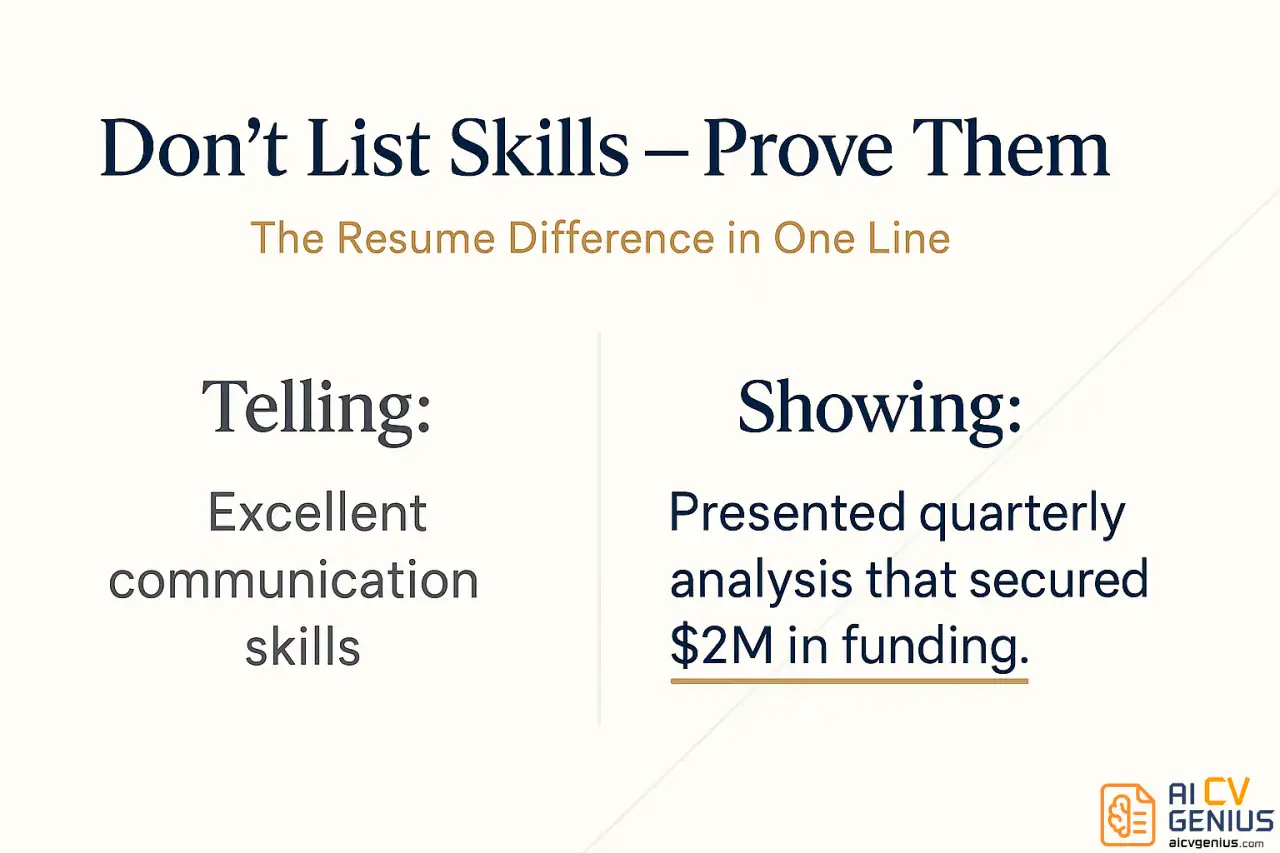
| “Excellent communication skills” | “Presented quarterly market analysis to C-suite executives, successfully securing a $2M budget increase for our department based on my data-driven recommendations.” | Analytical Skills; Persuasion; Strategic Thinking |
| “Strong leadership abilities” | “Mentored 3 junior developers on Python best practices and agile methodologies; 2 of the 3 were promoted to mid-level developer within 18 months.” | Coaching; Technical Expertise; Fostering Talent |
| “Great problem solver” | “Identified a critical bottleneck in the order processing system, designed and implemented an automated fix that reduced fulfillment errors by 40% and saved an estimated 20 hours of manual work per week.” | Analytical Skills; Initiative; Process Improvement |
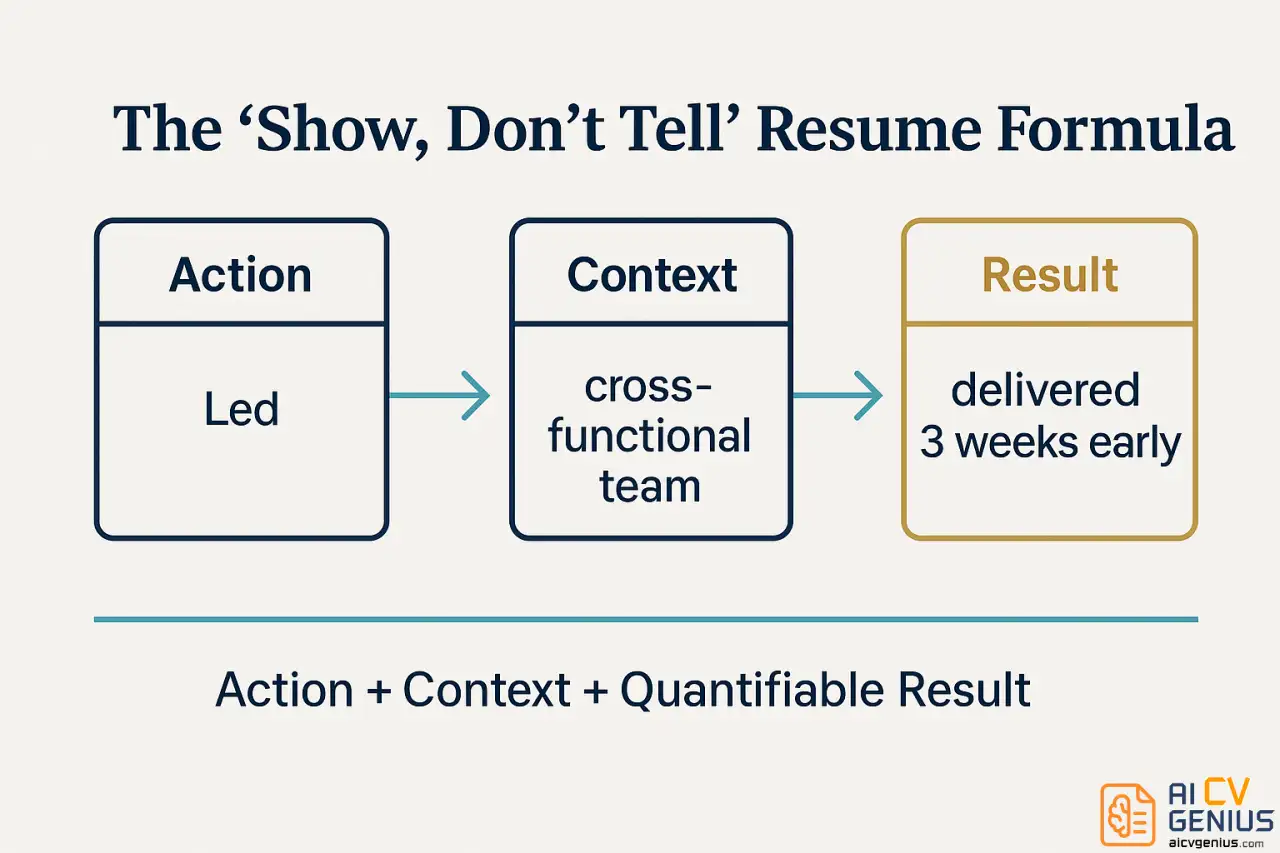
The pattern is simple but non-negotiable: Action + Context + Quantifiable Result. Showing always includes numbers, specific actions, and clear outcomes. Telling relies on empty adjectives.
Why Recruiters and AI Both Demand Evidence
According to groundbreaking research from Harvard, 85% of long-term job success comes from well-developed soft skills, with only 15% attributed to technical knowledge or hard skills. Recruiters and senior leaders know this. They know that technical skills can be taught, but a strong work ethic, intellectual curiosity, and good judgment are much harder to find.
They also know that anyone can type “teamwork” on their resume. It’s a meaningless claim. What they are looking for is evidence. When you provide specific, quantified examples of soft skills examples for resume, you are doing the hard work for the recruiter. You are spoon-feeding them the proof they need to justify bringing you in for an interview.
Furthermore, modern Applicant Tracking Systems (ATS) are evolving. Older systems just matched keywords. Newer, AI-driven systems are smart enough to look for context. They don’t just see the keyword “leadership.” They are being trained to find patterns like an action verb (“Led,” “Managed,” “Mentored”) followed by a team (“team of 8”) and a metric (“15% under budget”). A resume rich with these evidence-based bullet points will rank higher than a resume that just “keyword-stuffs” a generic skills list.
20+ Soft Skills Examples: The Ultimate “Show, Don’t Tell” Formula
Here is the practical, actionable part. For each of the most in-demand soft skills, you will see the wrong way (telling) and multiple right ways (showing). Use these formulas to craft your own experience bullet points.
1. Communication Skills (Written & Verbal)
This is the most common – and most abused – skill. Prove you can articulate complex ideas and persuade others.
❌ Telling:
- “Strong written and verbal communication skills”
✅ Showing:
- “Authored 15+ client-facing proposals and SOWs with a 90% acceptance rate, directly generating over $500K in new business.”
- “Presented monthly product demos to live audiences of 50+ potential clients, consistently receiving a 4.8/5 average satisfaction rating and contributing to a 20% increase in demo-to-trial conversions.”
- “Simplified complex technical documentation for a non-technical, 10,000-user customer base, resulting in a 35% reduction in related support tickets.”
- “Acted as the primary liaison between the development team and the executive steering committee, translating technical constraints into business implications to manage expectations and keep the project on track.”
Pro-Tip: Look for moments where your communication led to an action – a sale, a budget approval, a reduction in errors.
2. Leadership & Mentorship
Showcasing leadership skills on resume is vital, even if you’ve never had a “manager” title. Leadership is about influence, initiative, and developing others.
❌ Telling:
“Proven leadership skills” or “Natural leader”
✅ Showing (Managing):
“Led a team of 12 sales associates through a major company restructuring, maintaining 100% team retention and exceeding sales quotas by 10% during the 6-month transition.”
✅ Showing (Mentoring):
“Mentored 5 junior analysts in data visualization and Python; 3 of the 5 were promoted or given high-priority projects within 2 years.”
✅ Showing (Initiative):
“Initiated and led a new peer-review process for our code, which was adopted by the entire department and credited with improving code quality by 40% and reducing bugs in production.”
✅ Showing (Ownership):
“Volunteered to lead a failing project, re-scoped the timeline, motivated the team, and delivered the final product, turning a ‘red’ account into a $1M renewal.”
Pro-Tip: If you’re not a manager, focus on verbs like “Mentored,” “Trained,” “Initiated,” or “Coordinated” to show leadership without formal authority.
3. Problem-Solving & Analytical Skills
The best problem-solvers don’t just fix things; they identify the root cause and implement a lasting solution. Use the “Problem -> Action -> Result” formula.
❌ Telling:
- “Creative problem solver”
✅ Showing:
- “Diagnosed the root cause of a 20% customer churn rate by analyzing support tickets; designed and implemented a new onboarding flow that improved 90-day retention by 35%.”
- “Resolved persistent server outages by identifying a critical memory leak and implementing an automated monitoring system, reducing downtime from 8 hours/month to under 45 minutes/month.”
- “Identified a $50K annual inefficiency in our supply chain; sourced and negotiated with a new vendor, saving the company 30% on material costs while improving quality.”
Pro-Tip: Always frame the problem first. “Identified…” or “Diagnosed…” are powerful starters.
4. Teamwork & Collaboration
Everyone claims to be a “team player.” Prove it by showing how you worked with others to achieve a shared goal. Cross-functional work is the key here.
❌ Telling:
- “Excellent team player”
✅ Showing:
- “Collaborated with a cross-functional team of 8 (Design, Engineering, and Marketing) to launch the new mobile app 2 weeks ahead of schedule.”
- “Coordinated with 4 different departments (Legal, Finance, IT, and HR) to execute a seamless company-wide rebrand, completing the project on time and 10% under budget.”
- “Partnered with the sales team to create a new library of technical demo materials, directly contributing to an increase in the enterprise sales close rate from 18% to 27%.”
Pro-Tip: Name the other departments. It makes the collaboration feel real and significant.
5. Time Management & Organization
This is shown by proving you can juggle multiple priorities and meet deadlines. Volume, speed, and efficiency are your metrics.
❌ Telling:
- “Strong organizational skills” or “Great at time management”
✅ Showing:
- “Managed 15+ concurrent client projects, successfully delivering all milestones on or ahead of schedule with zero missed deadlines in 2024.”
- “Streamlined the team’s content intake process using Asana, reducing the average project kickoff time from 5 business days to 2.”
- “Balanced a full-time demanding role while concurrently completing an MBA, maintaining a 3.8 GPA and receiving a ‘Top Performer’ rating at work.”
Pro-Tip: “Zero missed deadlines” is a powerful (and quantifiable) statement if it’s true.
6. Adaptability & Flexibility
Companies pivot. Strategies change. Budgets get cut. Show how you thrive in chaos, not just how you follow a plan.
❌ Telling:
- “Highly adaptable and flexible”
✅ Showing:
- “Pivoted the entire Q4 marketing strategy in 48 hours when a key platform algorithm changed, reallocating budget and redesigning creative to maintain a 4:1 ROI.”
- “Successfully transitioned a 20-person team to a fully remote work model in 3 days during the pandemic, implementing new tools that maintained 98% productivity.”
- “Took over a failing project after a manager’s abrupt departure; learned the new system in 1 week, stabilized the client relationship, and successfully delivered the final phase.”
Pro-Tip: Frame the change or challenge first, then show your successful action.
7. Attention to Detail
This skill is proven by showing how your thoroughness prevented errors, saved money, or improved quality.
❌ Telling:
- “Detail-oriented professional”
✅ Showing:
- “Implemented a rigorous peer-review and QA process for all marketing copy, reducing published errors from an average of 3 per-week to 1 per-month.”
- “Audited quarterly financial reports for accuracy, identifying and correcting a $45,000 calculation error before submission to regulators.”
- “Maintained an error rate below 0.5% across 10,000+ monthly data entries in a high-volume, fast-paced environment.”
Pro-Tip: The best way to show attention to detail is to have a resume that is perfectly formatted and 100% free of typos.
8. Customer Service & Empathy
This is about retention, satisfaction, and de-escalation. How do customers feel after interacting with you?
❌ Telling:
- “Customer-focused mindset”
✅ Showing:
- “Resolved 95% of customer support issues on the first contact, consistently maintaining a 4.9/5 satisfaction (CSAT) score.”
- “Personally managed and de-escalated 10 high-stakes enterprise client complaints, saving an estimated $250K in at-risk annual accounts.”
- “Redesigned customer feedback loop, channeling insights to the product team that led to two new features and a 10% drop in complaints.”
Pro-Tip: CSAT scores, retention rates, and resolution times are your best friends here.
9. Critical Thinking & Strategic Planning
This is about why you did something, not just what you did. Show how you analyzed a situation and made a smart, data-driven decision.
❌ Telling:
- “Strong analytical and strategic abilities”
✅ Showing:
- “Analyzed sales data across 3 regions, identified the 2 lowest-performing territories, and developed a targeted retraining plan that increased regional revenue by 22%.”
- “Conducted a comprehensive 10-vendor cost-benefit analysis for new CRM software, presenting a final recommendation that saved $150K annually over the initially proposed solution.”
- “Conducted in-depth competitive research that informed a new pricing strategy, directly contributing to an 18% improvement in profit margins.”
Pro-Tip: Verbs like “Analyzed,” “Evaluated,” “Assessed,” and “Forecasted” are perfect for this.
10. Creativity & Innovation
On a resume, creativity isn’t about being “artsy.” It’s about finding new, novel approaches to old problems that lead to better outcomes.
❌ Telling:
- “Creative thinker” or “Out-of-the-box”
✅ Showing:
- “Designed and launched a new interactive email campaign that doubled click-through rates and generated a 30% increase in webinar signups compared to previous campaigns.”
- “Proposed and implemented a new employee recognition program (using a ‘gamified’ points system) that improved internal engagement scores by 15%.”
- “Created a ‘failed experiments’ report template to analyze unsuccessful marketing tests, fostering a team culture of innovation and learning from failure.”
Pro-Tip: “Proposed,” “Designed,” “Innovated,” or “Launched” are great verbs to signal that this was your new idea.
Where to Put Soft Skills on Your Resume (The Right Way)
Understanding where to put soft skills on resume is just as important as how you phrase them. You must integrate them. Do not just list them in a “junk drawer” skills section.
1. In Your Professional Summary
Your summary is the first thing a recruiter reads. It’s your 3-4 line elevator pitch. Weave 1-2 of your most powerful, role-relevant soft skills with their proof right here.
Standard Summary:
“Marketing Manager with 6 years of experience in digital marketing. Skilled in SEO, SEM, and content strategy. Looking for a new role in a fast-paced company.”
Evidence-Based Summary (Far Better):
“Data-driven Marketing Manager with 6 years of experience growing B2B SaaS companies. Led a cross-functional team to launch 15+ campaigns, achieving an average 5:1 ROI. Known for creative problem-solving and data-driven decision-making that increased the marketing-qualified pipeline by 40%.”
This summary doesn’t just claim “leadership” and “problem-solving” – it provides the data (15+ campaigns, 5:1 ROI, 40% pipeline) to prove it from the very first line.
2. In Your Work Experience Bullets (The Most Important Place)
This is where 90% of your soft skill demonstration should live. As shown in all the examples above, every bullet point under each job is a new opportunity to provide evidence of a soft skill through an accomplishment.
Structure: Action Verb (Signals the Skill) + Context (What you did) + Result (The quantifiable outcome)
- “Coordinated [Teamwork] with 4 department heads to execute a company rebrand…”
- “Mentored [Leadership] 3 junior analysts, 2 of whom were promoted…”
- “Analyzed [Critical Thinking] sales data to identify a market gap…”
- “Streamlined [Problem-Solving] the intake process, reducing kickoff time…”
- “Presented [Communication] monthly findings to executive stakeholders…”
Your verbs are doing the heavy lifting, signaling the soft skill without you ever having to name it.
3. In a “Key Achievements” or “Highlights” Section
If you are a senior professional or have many roles, you might use a “Key Achievements” section right below your summary. This is a fantastic place to put your 3-4 most impressive “showing” bullet points that combine multiple skills.
Key Achievements:
- Leadership & Turnaround: Took over a 10-person team with low morale; improved engagement scores by 30% and hit 110% of sales targets within 9 months.
- Strategic Negotiation: Led negotiations with 5 key vendors, consolidating contracts to save the company $200K annually while improving service levels.
- Process Innovation: Designed and implemented a new agile workflow for the marketing department, cutting average campaign delivery time from 8 weeks to 5.
The One Place NOT to Put Soft Skills
Do not create a standalone “Soft Skills” section. A list like this is the #1 sign of an amateur resume and will be completely ignored:
❌ AWFUL EXAMPLE:
Soft Skills: Leadership, Communication, Teamwork, Hard Worker, Problem-Solver, Punctual
This list is useless because it provides zero proof. It’s the resume equivalent of “trust me, bro.” Don’t do it. Weave them into your accomplishments instead. For more on structuring your resume, our guide on how to improve your CV is a great resource.
The Perfect Blend: Balancing Soft Skills vs. Hard Skills
A great resume is a symphony of both hard and soft skills. Understanding soft skills vs hard skills on resume helps you present a complete, compelling picture of your value.
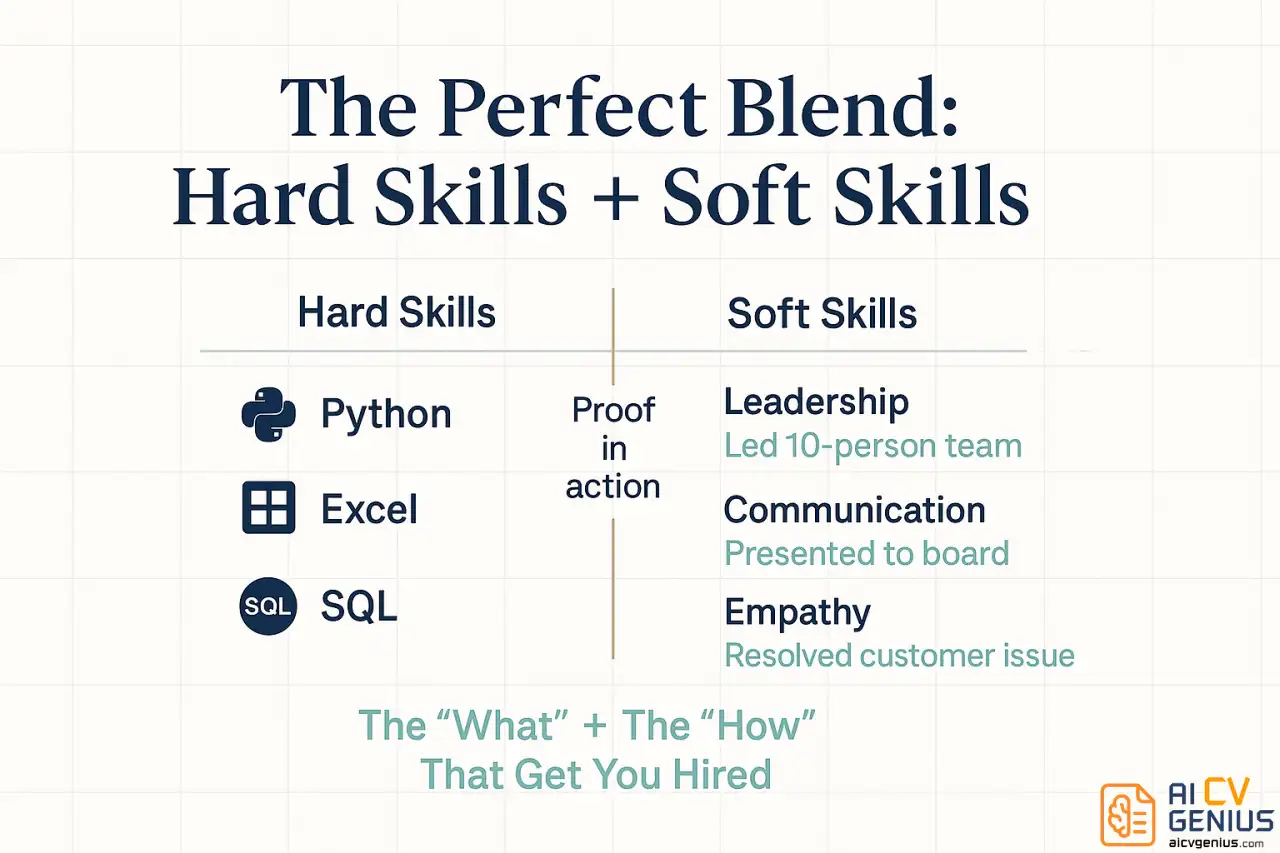
| Aspect | Hard Skills (The “What”) | Soft Skills (The “How”) |
|---|---|---|
| Definition | Teachable, technical, and quantifiable abilities. | Interpersonal, behavioral, and cognitive traits. |
| Examples | Python, SQL, SEO, Photoshop, French, Financial Modeling | Leadership, Communication, Empathy, Adaptability |
| How to Show | List directly in a dedicated “Technical Skills” section. | Demonstrate indirectly through achievement bullets. |
| Measurability | Easy to test and certify (e.g., a coding test, a certification). | Proven through outcomes, behaviors, and impact. |
| Transferability | Often specific to a role or industry. | Highly transferable across all roles and industries. |
The Synergy Strategy: Using One to Prove the Other
The most powerful resume bullet points showcase both at the same time. The hard skill is what you used. The soft skill is how you used it to create value.
Hard skills answer: “CAN you do the job?”
They get you past the initial technical screening.
Soft skills answer: “WILL you do the job WELL?”
They get you the interview and the offer.
Look at these examples of perfect balance:
Example (Analyst):
• “Analyzed [Critical Thinking] customer behavior data using Python and SQL [Hard Skills], presenting [Communication] findings to executives that informed a $2M product roadmap.”
Example (Marketing):
• “Launched [Initiative] a new content strategy based on Ahrefs & Google Analytics [Hard Skills] data, collaborating [Teamwork] with sales to create materials that boosted MQLs by 30%.”
Example (Sales):
• “Negotiated [Negotiation/Communication] 5-year, $3M+ enterprise contracts, using Salesforce [Hard Skill] to manage the 6-month sales cycle and coordinate [Teamwork] with legal and product teams.”
In each case, the hard skill is the tool, but the soft skill is what creates the result.
10 Common Soft Skills Mistakes That Will Kill Your Resume
Even if you understand the “show, don’t tell” concept, it’s easy to fall into these traps. Avoid them.
- The Buzzword Salad: “Results-oriented, go-getter, and dynamic professional with strong communication skills.” This is a string of meaningless buzzwords. Delete it.
- The Standalone List: Creating a “Soft Skills” section. (We’ve covered this, but it’s worth repeating: don’t.)
- Forgetting to Quantify: “Improved team morale” is vague and sounds made up. “Implemented a new feedback system that increased employee engagement scores from 68% to 84%” is specific and believable.
- Claiming Team Results as Your Own: “Grew company revenue by 50%.” Were you the CEO? No? Then be honest. “Contributed to a team effort that grew company revenue by 50% by personally securing $2M in new accounts.” Be specific about your contribution.
- Using Vague Verbs: “Responsible for…” or “Helped with…” or “Involved in…” These are weak, passive verbs. They signal you were a bystander, not a driver. Use strong action verbs (see below).
- Listing “Obvious” Skills: Don’t list things like “Hard worker” or “Punctual.” These are the bare minimum expectation of being an employee, not skills.
- Ignoring the Job Description: Highlighting your “creative innovation” when the job is a detail-oriented compliance role. Tailor your examples to the skills the job description prioritizes.
- Forgetting Context: “Led a team of 10” is better than “Leadership,” but it’s still incomplete. What did you lead them to do? “Led a team of 10 to exceed all quarterly targets by 25%” is the full, powerful story.
- Sounding Arrogant: There’s a fine line between confidence and arrogance. “Single-handedly saved the company” is arrogant. “Identified a critical flaw and led the team that implemented the fix, preventing an estimated $1M in losses” is confident.
- Mixing Hard & Soft Skills Randomly: “Skills: Python, Leadership, Excel, Teamwork, SQL.” This looks disorganized. Group your Technical Skills (Python, Excel, SQL) in one list. Weave your Soft Skills (Leadership, Teamwork) into your bullets.
Need help structuring this? Our resume templates and guides can help you organize everything effectively.
Power Verbs: Your Secret Weapon for Signaling Soft Skills
The verb you choose to start your bullet point is the signal for the soft skill you’re about to prove. Here is how to demonstrate soft skills on resume just by picking the right verb.
For Leadership & Management
- Led, Directed, Managed, Supervised, Mentored, Coached, Trained, Guided, Coordinated, Delegated, Governed, Inspired, Recruited, Hired, Fostered
For Communication & Persuasion
- Presented, Negotiated, Persuaded, Articulated, Authored, Conveyed, Facilitated, Collaborated, Translated, Advocated, Pitched, Wrote, Addressed, Mediated
For Problem-Solving & Critical Thinking
- Analyzed, Diagnosed, Resolved, Identified, Evaluated, Assessed, Investigated, Troubleshot, Optimized, Streamlined, Re-engineered, Solved, Discovered
For Teamwork & Collaboration
- Collaborated, Coordinated, Partnered, Contributed, Supported, Unified, Integrated, Cooperated, Assisted, Merged, Aligned
For Initiative & Adaptability
- Pioneered, Initiated, Adapted, Transformed, Innovated, Launched, Spearheaded, Revitalized, Redesigned, Modernized, Founded, Established, Overhauled
When you start your bullet with “Mentored 3 interns…” you’ve already proven leadership before the sentence is even over. The verb does the work.
How to Tailor Soft Skills for Every Job Application
A “one-size-fits-all” resume doesn’t work. The best candidates tailor their resume to show the specific soft skills the job description is begging for.
The 3-Step Tailoring Process
1️⃣Step 1: Dissect the Job Description. Copy the job description into a text editor. Highlight every soft skill they mention, either explicitly (“strong communicator”) or implicitly (“must work with cross-functional teams,” “fast-paced environment”).
2️⃣Step 2: Map Your Examples. Look at your master list of accomplishment bullets. For each highlighted skill from Step 1, find your best bullet point that proves you have that skill.
3️⃣Step 3: Prioritize & Reorder. Edit your resume. Put the bullet points that directly match their required skills at the top of each “Work Experience” section. Make your most relevant proof impossible to miss.
Example: Job Description for a Senior Project Manager
Key phrases: “coordinate complex, cross-functional teams,” “manage multiple competing priorities,” “communicate effectively with executive stakeholders,” “deliver on tight deadlines.”
Implied soft skills: Leadership, Time Management/Organization, Executive Communication.
Your TAILORED Bullets (Put these at the top):
- “Coordinated 5 cross-functional teams (Eng, Design, Legal) to launch a flagship product on schedule.” (Proves: Leadership, Org)
- “Presented bi-weekly project updates to C-level stakeholders, ensuring alignment and securing continued funding.” (Proves: Exec. Communication)
- “Managed 12 concurrent projects in a high-pressure environment, maintaining a 100% on-time delivery record for all critical-path milestones.” (Proves: Time Mgmt, Org)
This simple act of reordering your bullets to match their priorities makes you look like the perfect candidate. For more strategies, explore our career resources.
Advanced FAQ: Your Toughest Soft Skill Questions
Final Thoughts: Your Skills Are Your Story
The single biggest shift you can make to improve your resume is this: stop listing skills, and start proving them. Stop telling a hiring manager you are a leader and show them the team you led and the goal you achieved. Stop telling them you’re a problem-solver and show them the $50,000 problem you identified and solved. That is how to list soft skills on resume in a way that truly matters.
Remember, your resume is not a passive list of your responsibilities. It is an active, persuasive document designed to prove your value. Your soft skills are the narrative thread that connects all your accomplishments. They are the “how” and “why” behind your “what.”
Your technical hard skills might prove you’re qualified, but your demonstrated soft skills are what will separate you from every other qualified candidate. Make them impossible to ignore by backing every claim with specific, quantifiable, and compelling evidence. Use the formulas in this guide, and you will transform your resume from a generic list into an undeniable story of your success.
Ready to build a complete resume that showcases both your hard and soft skills? Check out our resume templates to find the perfect structure to tell your story.