
- Nurses benefit from specialized resume templates because healthcare hiring prioritizes credentials and patient care impact: These templates surface licenses, certifications, clinical rotations, and unit experience faster than generic layouts.
- A strong nurse resume follows a predictable structure: Contact details, a tailored summary or objective, prominent licenses and certifications, reverse-chron clinical experience, education, and a skills section that separates clinical skills from soft skills.
- Career stage changes what the template should emphasize: Students and new grads lead with education and rotations, RNs lead with unit experience and measurable outcomes, and advanced practice roles add leadership, research, publications, and teaching or precepting.
- Achievements matter more than duties: Use action verbs, quantify patient load and outcomes when possible, and convert vague lines into results using the STAR logic.
- The build and submit process has clear rules: Choose an ATS-friendly layout, add licenses early, tailor keywords from the job post, keep bullets tight, avoid clutter and excessive jargon, stay within one to two pages, then proofread and run a final checklist before submitting.
Nursing demands a unique blend of technical expertise, empathy, and resilience under pressure – qualities that must shine through on your resume. Condensing years of education, demanding clinical rotations, and impactful patient care onto one or two pages is a significant challenge. This is precisely where specialized nurse resume templates become invaluable. They provide a structured, professional framework tailored specifically for healthcare recruiters, ensuring your qualifications are presented clearly and effectively.
This guide explores the critical need for nursing-specific resumes, outlines the essential features of a strong template, and provides examples relevant to various career stages – from ambitious nursing students to experienced Registered Nurses. You’ll gain practical insights on crafting achievement-focused bullet points, optimizing your resume for Applicant Tracking Systems (ATS), and sidestepping common pitfalls.
Ultimately, you’ll be equipped to select the ideal template and populate it with compelling content that powerfully conveys both your clinical skills and unwavering commitment to patient well-being.
Why Nurses Need Specialized Resume Templates
The healthcare sector operates under unique standards. Recruiters and hospital administrators seek more than just technical proficiency; they prioritize candidates demonstrating compassion, reliability, and a consistent history of patient-centered care.
A generic resume template often fails to capture these nuanced qualities effectively. Nursing-specific templates are designed to strategically highlight crucial sections such as licenses, certifications, hands-on clinical experience, and specialized patient care skills, making them far more impactful in this field.
Key Differences: Generic vs. Nurse Resume
- Licenses & Certifications Emphasis: Nursing roles mandate specific credentials (RN, BSN, LPN, specialty certs). Nurse templates position these prominently for immediate visibility.
- Clinical Rotations Section: For students and new graduates, rotations represent critical hands-on experience. Nurse templates provide dedicated space for this, unlike generic formats.
- Focus on Patient-Care Achievements: Effective nurse resumes go beyond listing duties; they quantify impact – e.g., “Improved patient satisfaction scores by 10%” or “Reduced medication errors through diligent checks.”
- Dedicated Healthcare Skills Section: Essential competencies like wound care protocols, IV administration proficiency, or specific Electronic Health Record (EHR) system expertise require clear, dedicated sections.
Core Elements of an Effective Nurse Resume
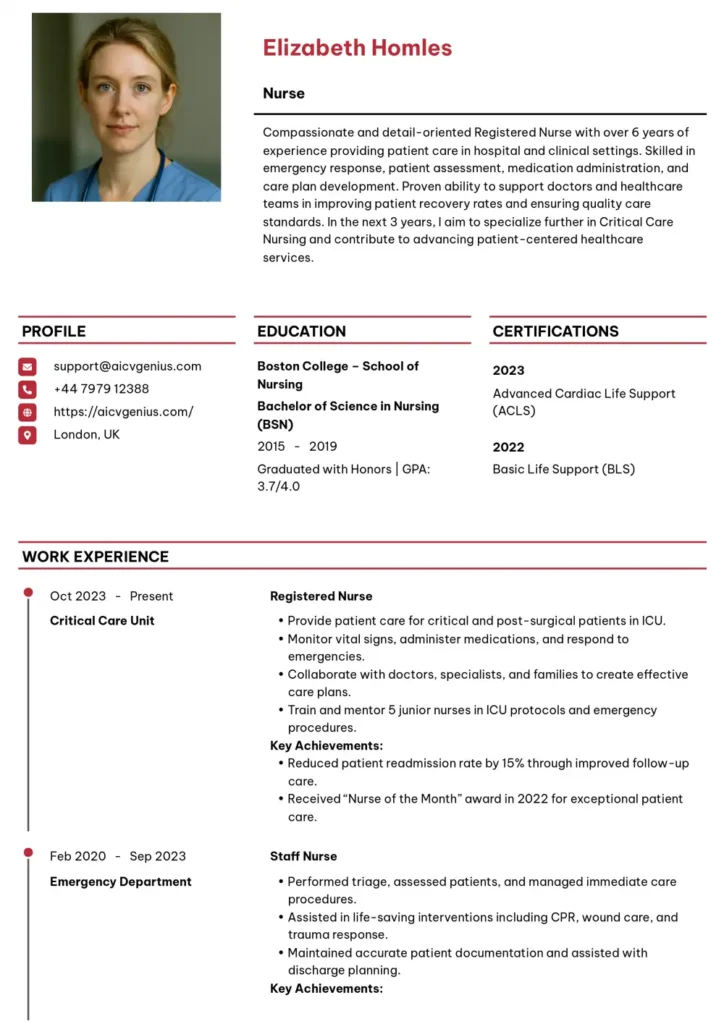
Regardless of your experience level, a compelling nurse resume must incorporate these fundamental components:
Contact Information
Include your full name, phone number, professional email address, and LinkedIn profile URL. Depending on the application requirements, adding your nursing license number here or in a separate section is often advisable.
Professional Summary or Objective
A concise (3-4 sentence) introduction tailored to the specific role. A Summary highlights years of experience, key specialties, and significant achievements for experienced nurses. An Objective focuses on career goals and relevant skills for students or new graduates. Example Summary:
“Dedicated Registered Nurse with 5+ years of experience in high-acuity emergency departments. Proven ability to provide exceptional patient care under pressure, proficient in EPIC and Cerner EHR systems, and committed to patient education and advocacy.”
Licenses and Certifications
List all relevant credentials clearly (e.g., Registered Nurse (RN), Bachelor of Science in Nursing (BSN), Advanced Cardiovascular Life Support (ACLS), Basic Life Support (BLS)). Include the issuing body and expiration dates if applicable. Position this section prominently, often directly below the summary.
Clinical Experience / Professional Experience
Use the reverse-chronological format. For each role, include your title, the facility name, location, and dates of employment. Employ action-oriented bullet points focusing on quantifiable achievements.
Examples:
“Managed comprehensive care for up to 12 diverse patients per shift in a fast-paced medical-surgical unit,” or “Successfully trained and mentored 3 newly hired nurses on updated EHR charting protocols, improving team efficiency.”
Education
Detail your nursing degree(s), the name of the institution, location, and graduation date(s). Include academic honors (e.g., Dean’s List, Sigma Theta Tau) or significant capstone projects, particularly for recent graduates.
Skills
Create distinct subsections if helpful:
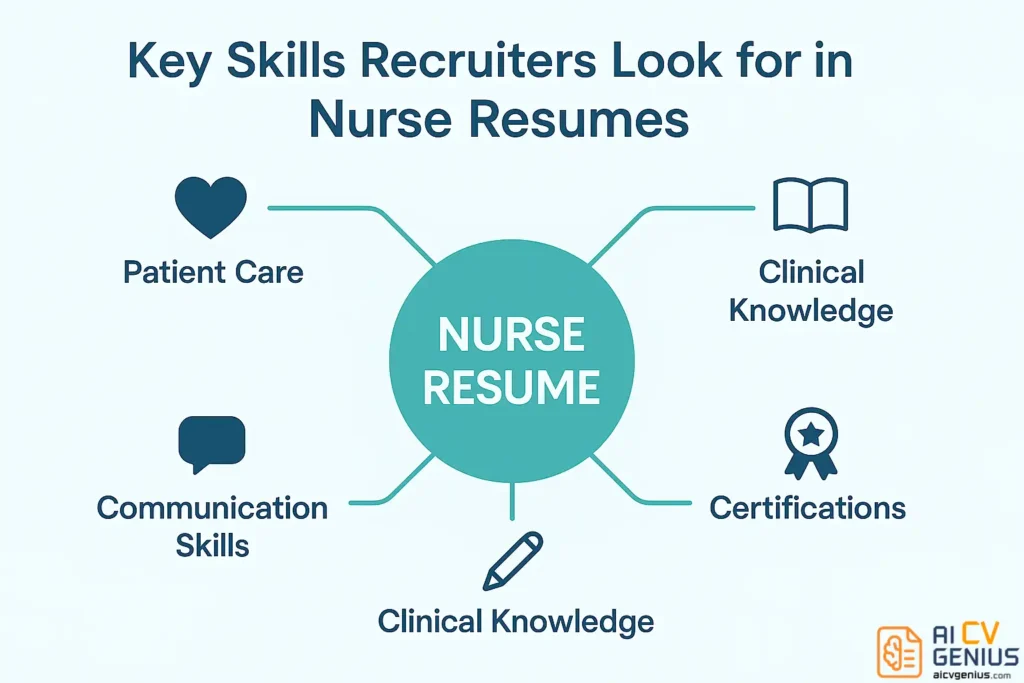
- Clinical Skills (Hard Skills): IV therapy, phlebotomy, wound care management, medication administration, specific EHR proficiency (e.g., EPIC, Cerner), patient assessment, vital signs monitoring.
- Soft Skills: Empathy, critical thinking, communication (patient/family/team), time management, problem-solving, collaboration, patient advocacy.
Tailoring Your Resume: Templates and Achievements by Career Stage
Types of Nurse Resume Templates Tailored to Career Stages
New Graduate Nurse Resume Template
Focuses heavily on education, detailed clinical rotations (mentioning specific units and skills learned), certifications (like BLS), volunteer work, and transferable soft skills. A strong objective statement is crucial here.
Registered Nurse (RN) Resume Template
Designed for licensed nurses with practical experience. This template emphasizes professional roles, specific unit experience (e.g., ICU, ER, Med-Surg), patient ratios managed, key responsibilities, and quantified achievements related to patient outcomes or process improvements.
Clinical Nurse Specialist (CNS) / Advanced Practice Nurse Resume Template
Requires a more comprehensive format, often extending to two pages. It highlights advanced certifications, specialized clinical expertise, research contributions, publications, presentations, leadership roles, and teaching or preceptorship experience.
Nursing Student Resume Template
Used while still enrolled in a nursing program, primarily for internships or volunteer positions. This template emphasizes current coursework, GPA (if strong), expected graduation date, relevant skills labs, any part-time work (even non-healthcare if it shows responsibility), and volunteer activities.
How to Write Compelling Achievements for a Nurse Resume
Shift from merely listing duties to demonstrating tangible impact. Use the STAR method (Situation, Task, Action, Result) implicitly. Compare:
| Vague Duty | Impactful Achievement |
|---|---|
| Responsible for administering medications. | Administered medications accurately to an average of 10 patients per shift, maintaining a 100% compliance rate with safety protocols over 2 years. |
| Involved in patient education. | Developed and delivered tailored discharge education plans for cardiac patients, contributing to a 15% reduction in preventable readmissions within 6 months. |
Quantify whenever possible (patient numbers, percentages, time saved, error reduction). If exact numbers aren’t available, describe specific positive outcomes or contributions: “Recognized by charge nurse for exceptional de-escalation skills during high-stress patient interactions.”
Complete Nurse Resume Example (Registered Nurse)
This full, ATS-friendly resume example applies the core principles discussed. It is structured for clarity, leads with credentials, and uses quantifiable achievements, making it ideal for a mid-career Registered Nurse.
JANE M. DOE, RN, BSN
(123) 456-7890 | jane.doe.rn@email.com | LinkedIn.com/in/janedoern
Professional Summary
Compassionate and detail-oriented Registered Nurse with 5+ years of experience in fast-paced Medical-Surgical units. Proven ability to manage complex patient loads, deliver high-quality patient-centered care, and collaborate effectively with interdisciplinary teams. Proficient in EPIC and Cerner EHR systems, with a strong commitment to patient education and safety protocols.
Licenses & Certifications
Registered Nurse (RN), State of [Your State] | License #1234567 | Expires: 05/2027
Advanced Cardiovascular Life Support (ACLS), American Heart Association | Expires: 06/2026
Basic Life Support (BLS), American Heart Association | Expires: 06/2026
Clinical Skills
Patient Care: Medical-Surgical Nursing, Patient Assessment, Wound Care & Dressing, IV Therapy & Phlebotomy, Medication Administration, Patient & Family Education, Discharge Planning
Technical & Soft Skills: EPIC, Cerner, Critical Thinking, Team Collaboration, Time Management, Patient Advocacy
Professional Experience
Registered Nurse, Medical-Surgical Unit | City General Hospital | [City, State] | June 2020 – Present
- Managed comprehensive care for a diverse patient load of 5-6 post-operative and acute-care patients per shift, ensuring timely medication administration and treatment plan adherence.
- Served as preceptor for 4 newly graduated nurses, providing training on unit protocols, EHR charting (EPIC), and patient care standards, resulting in their successful onboarding.
- Contributed to a unit-wide initiative to improve patient mobility, resulting in a 10% reduction in patient falls over a 12-month period.
- Collaborated with physicians, physical therapists, and case managers to develop and implement coordinated patient discharge plans, improving patient satisfaction scores by 15% on post-discharge surveys.
Graduate Nurse, Telemetry Unit | St. Jude’s Medical Center | [City, State] | July 2019 – June 2020
- Completed a 12-month nurse residency program, rotating through Telemetry, Med-Surg, and ER units.
- Monitored and interpreted cardiac rhythms for up to 10 patients, promptly reporting any significant changes to the charge nurse and physician.
- Assisted with patient admissions, transfers, and discharges, ensuring accurate documentation in Cerner.
Education
Bachelor of Science in Nursing (BSN)
[University Name], [City, State] | Graduated May 2019
Honors: Dean’s List (4 semesters), Member of Sigma Theta Tau International Honor Society of Nursing
Building Your Resume and Avoiding Common Pitfalls
Step-by-Step: Building Your Nurse Resume in Word or Google Docs
Step 1: Choose an ATS-Friendly Template
Select a clean, preferably single-column template specifically designed for nursing, ensuring clear sections for licenses and clinical details. Prioritize readability and structure.
Step 2: Add Contact Information and Licenses
Place your full name prominently at the top. Follow with your phone number, professional email, LinkedIn URL, and city/state. Include your key license (e.g., RN License #123456, State of [Your State]) directly below your name or in a dedicated section.
Step 3: Write a Targeted Summary or Objective
Tailor this 3-4 sentence section to the specific job. Highlight your most relevant experience, core nursing philosophy, and key skills mentioned in the job description.
Step 4: Detail Clinical / Professional Experience
List roles in reverse chronological order. Include your title, facility name, location, and employment dates. Use 3-5 concise bullet points per role, starting each with a strong action verb (e.g., Assessed, Administered, Collaborated, Educated, Managed, Advocated) and quantifying impact wherever possible.
Step 5: Outline Your Education
Include degree(s) (e.g., BSN, ADN), institution name, location, and graduation date(s). Add relevant honors or high GPA if recent graduate.
Step 6: List Licenses & Certifications Clearly
Create a distinct section if not placed at the top. List all relevant credentials (RN, LPN, BLS, ACLS, PALS, specialty certs) with issuing bodies and expiration dates if applicable.
Step 7: Integrate Keywords from the Job Description
Carefully review the job posting. Naturally weave required skills and qualifications (e.g., “critical care experience,” “triage protocols,” “patient advocacy,” “Cerner proficiency”) throughout your summary, experience, and skills sections to pass ATS filters.
Common Mistakes to Avoid in Nurse Resumes
- ❌ Omitting or Burying Licenses/Certifications: These are often non-negotiable requirements and must be easily visible.
- ❌ Generic Duty Descriptions: Failing to translate tasks into quantifiable achievements or specific contributions.
- ❌ Overuse of Complex Medical Jargon: While some technical terms are necessary, ensure the language is understandable to HR screeners, not just fellow clinicians.
- ❌ Poor Formatting or Length: Cluttered layouts, inconsistent fonts, or exceeding two pages (unless justified for highly experienced roles) can lead to rejection.
- ❌ Lack of Tailoring: Sending the same generic resume for different specialty roles (e.g., applying for an ICU role with a resume focused on pediatric experience).
Final Checklist Before Submitting Your Nurse Resume
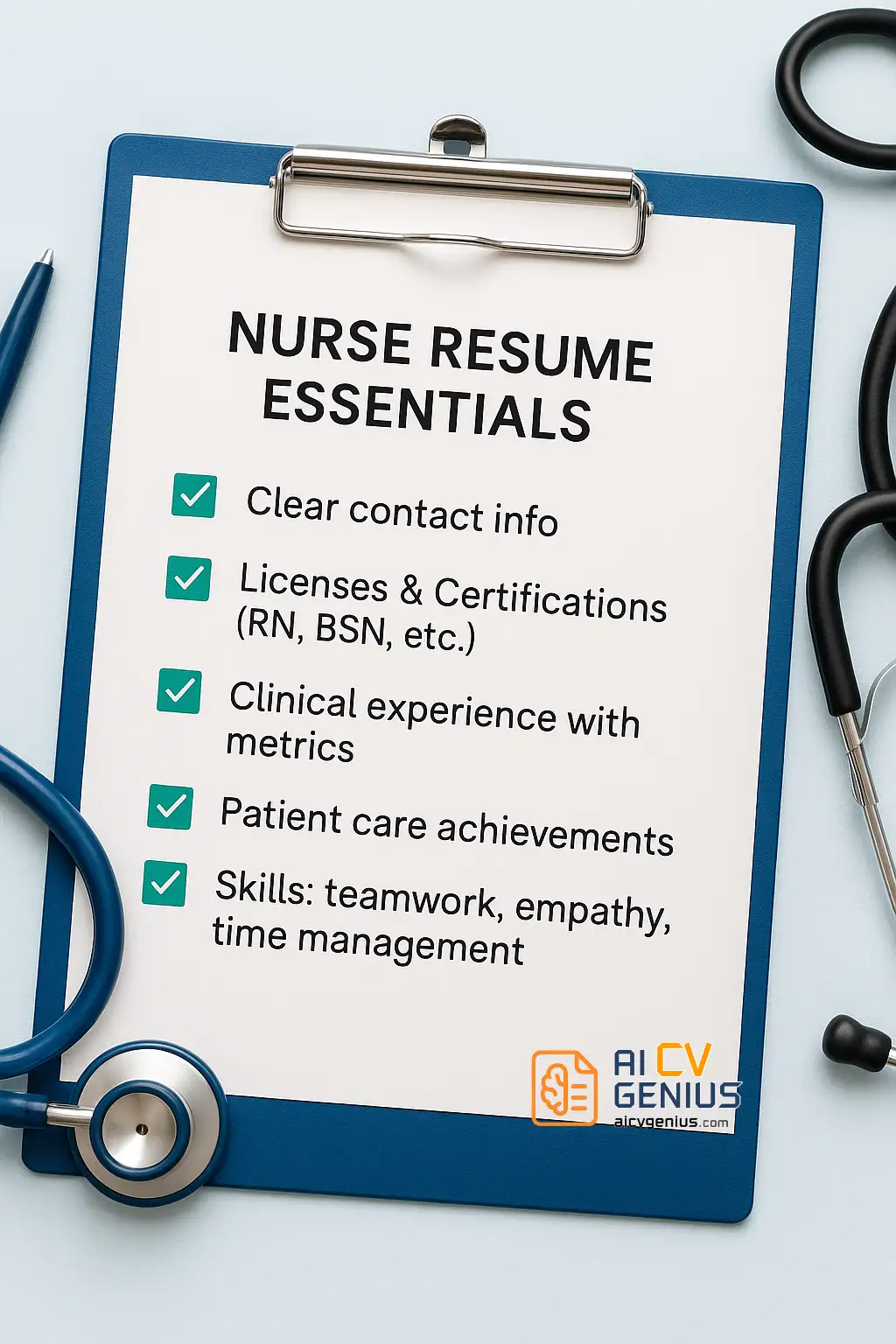
- ✅ Length: One page (students/new grads/early career) or maximum two pages (experienced RNs/specialists).
- ✅ Format: Clean, professional, ATS-friendly design (preferably single-column).
- ✅ Licenses & Certifications: Clearly listed, accurate, and prominently placed.
- ✅ Experience Section: Uses action verbs and includes quantifiable achievements or specific outcomes.
- ✅ Skills Section: Includes a mix of relevant hard (clinical) and soft (interpersonal) skills.
- ✅ Keywords: Tailored with terms directly from the target job description.
- ✅ Proofread: Meticulously checked for typos, grammatical errors, and inconsistencies.
FAQs About Nurse Resume Templates
Generally yes, especially if the job description asks for it or if applying directly to a hospital system. Place it clearly, often near your contact information or in the dedicated Licenses/Certifications section. Include the state of licensure.
One page is standard and preferred for nursing students, new graduates, and those with less than 5-7 years of experience. Two pages are acceptable and often necessary for experienced RNs, specialists, or those with extensive relevant history. Never exceed two pages unless applying for academic or high-level research positions requiring a CV format.
Yes, but sparingly and professionally. Subtle use of a single accent color (like navy blue or a muted green) for headings or section dividers is acceptable. Avoid bright colors, multiple colors, or graphic elements that could interfere with ATS readability.
Focus heavily on your clinical rotations (list units, key skills practiced, patient populations). Emphasize transferable skills gained from other jobs (customer service, teamwork, problem-solving). Highlight volunteer work, academic achievements, relevant projects, and certifications (like BLS/CPR).
Yes, many free templates are perfectly suitable, provided they are professional, well-structured, and ATS-friendly (check for single-column layouts). The quality of your content (achievements, skills) is far more important than whether the template was free or paid. Paid templates might offer more unique designs or built-in guidance.
Final Thoughts
A well-chosen nurse resume template serves as more than just an aesthetic choice – it’s a critical framework for communicating your unique value proposition in the competitive healthcare field.
Whether you are launching your nursing career as a student, transitioning as a new graduate, or advancing as an experienced RN or specialist, the right template ensures your essential skills, licenses, certifications, and dedication to patient care are immediately apparent. Opt for a clean, professional, and ATS-compatible design. Populate it with concise, achievement-oriented language, quantifying your impact whenever possible.
Remember, your resume is the primary evidence of your capability to care, heal, diagnose, and lead within a clinical setting. Use your template strategically to prove you are the right candidate to make a meaningful difference.