
- A strong social worker resume should translate complex advocacy work into a clear, professional story that shows both care and competence.
- Your resume needs to signal the core expectations fast: Compassion, system navigation, and professional communication.
- Open with a tailored Summary or Objective in 3 to 5 sentences that states your focus, setting, and the kind of impact you deliver.
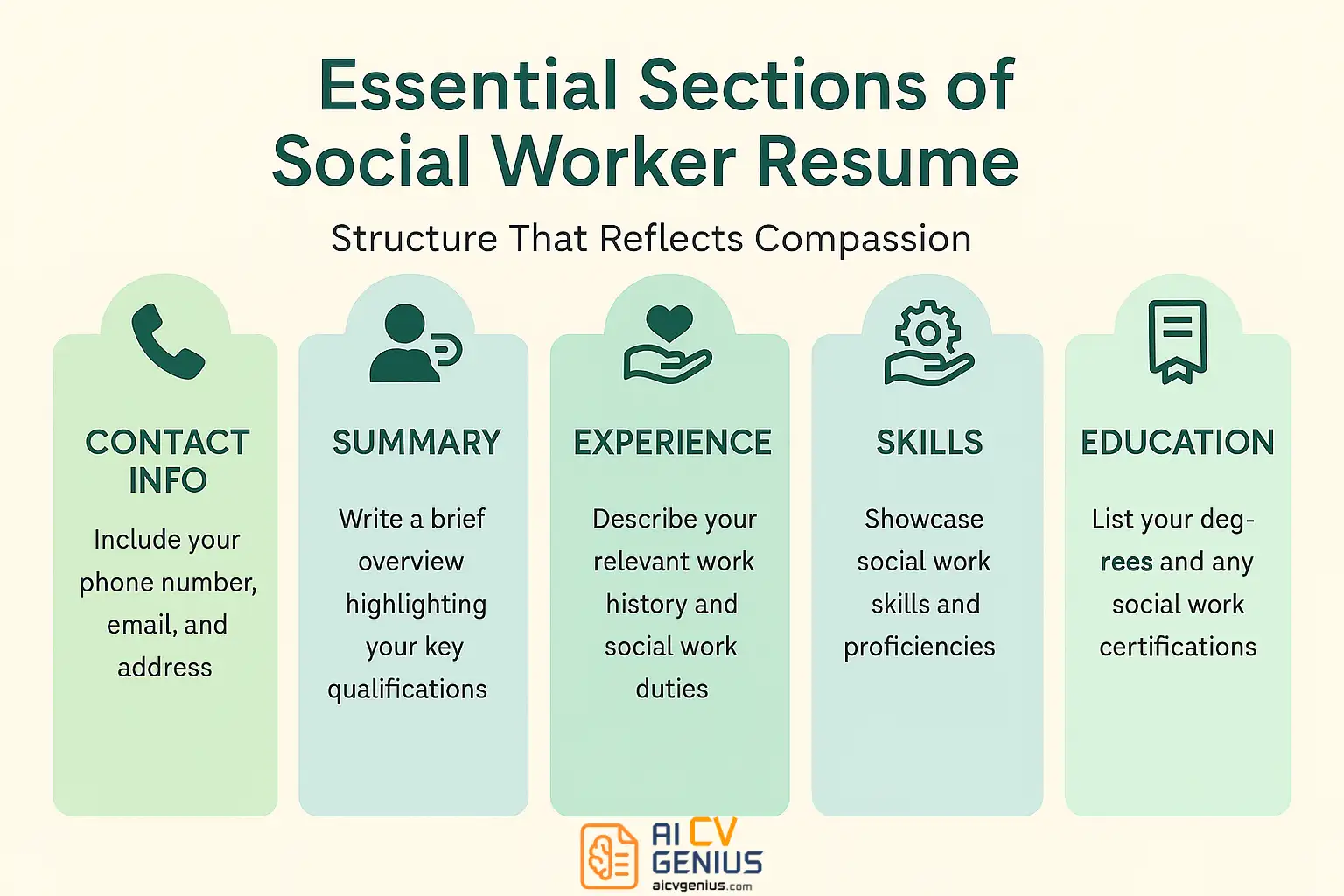
- Structure the body like a hiring friendly flow: Header, Summary or Objective, Skills, Experience, Education, Licensure and Certifications, then optional sections only if relevant.
- Make licensure impossible to miss by listing the full title, state, license number, and dates, then use a clean ATS friendly layout and personalize the template instead of filling it mechanically.
Maria stared at her blank document for the third evening in a row. She’d spent seven years helping families find safety, housing, and hope – yet somehow, turning that into a one-page resume felt impossible. “How do I capture what this job really means?” she wondered. If you’ve ever felt like Maria, you’re not alone. Social workers don’t just “do tasks”; they change lives, navigate complex systems, and advocate tirelessly for the vulnerable. Translating that profound empathy, resilience, and multifaceted impact into the structured format of a resume requires a unique blend of heart and strategy. This comprehensive guide will equip you to do exactly that – transforming your experiences into a compelling narrative that resonates with hiring committees, program directors, and agency leaders who understand the critical weight of your work.
Your resume is more than a formality; it’s the first tangible evidence of your professionalism, organizational skills, and communication style – qualities essential for building trust with clients, colleagues, and supervisors. It needs to convey not just your compassion, but your competence in managing challenging cases, collaborating across disciplines, and meticulously documenting outcomes with the precision demanded by ethical practice and regulatory standards.
The Strategic Importance of a Thoughtful Resume in Social Work
In the field of social work, where human connection and systemic understanding are paramount, your resume serves a deeper purpose than in many other professions. It acts as an initial assessment of your ability to communicate complex situations clearly, organize information effectively, and advocate persuasively – skills you use daily in your practice. Potential employers aren’t just looking for relevant experience; they are scrutinizing your resume for signs of the core competencies that define effective social work: critical thinking, ethical judgment, cultural humility, and resilience.
Whether you’re targeting a role in a community mental health agency demanding crisis intervention skills, a school setting requiring collaboration with educators and families, a hospital environment focused on discharge planning and patient advocacy, or a policy position needing macro-level analysis, your social worker resume template must immediately signal your alignment with the specific demands of that environment. It needs to articulate your proficiency in three key domains:
- ✅ Compassion & Client-Centered Practice: Demonstrating genuine empathy, active listening, and the ability to build rapport with diverse populations while upholding professional boundaries.
- ✅ Competence & System Navigation: Showcasing your knowledge of relevant theories, intervention models, assessment tools, documentation standards (like SOAP notes), and your ability to navigate complex social service, legal, or healthcare systems to connect clients with resources.
- ✅ Clarity & Professional Communication: Presenting information logically, using precise language, documenting outcomes effectively, and demonstrating strong written and verbal communication skills essential for collaborating with interdisciplinary teams, supervisors, and external stakeholders.
A thoughtfully constructed resume transcends a mere list of duties; it becomes a testament to your professional identity, your ethical grounding, and your readiness to make a meaningful impact within their organization and the community it serves. It’s your initial case presentation – making the argument for why you are the right advocate for the role.
Crafting Your Opening Statement: Purpose-Driven Summary or Objective
Positioned prominently at the top, your summary or objective is the first narrative element a recruiter encounters. It must encapsulate your professional essence in just a few lines, setting the tone and immediately highlighting your relevance. The choice between a summary and an objective depends on your experience level and career goals.
Professional Summary (For Experienced Social Workers)
A summary is ideal if you have relevant work history. It synthesizes your years of experience, areas of specialization (e.g., clinical, school, medical, macro), core skills, and significant contributions. Focus on quantifiable impact and specific populations served.
Strong Example 1 (Clinical/Mental Health):
“Licensed Clinical Social Worker (LCSW) with 8+ years of experience providing evidence-based psychotherapy (CBT, DBT) to adults and adolescents experiencing complex trauma and mood disorders in community mental health settings. Expertise in crisis intervention, comprehensive psychosocial assessments, and developing collaborative treatment plans. Proven ability to manage a caseload of 60+ clients while maintaining meticulous documentation and contributing to interdisciplinary team meetings to ensure integrated care.”
Strong Example 2 (School Social Work):
“Dedicated and culturally competent School Social Worker (LSW) with 5+ years supporting diverse K-12 student populations in urban districts. Skilled in individual/group counseling, crisis management, implementing Tier 2/3 interventions (PBIS framework), and connecting students/families with essential community resources. Proven collaborator with teachers, administrators, and parents to address attendance issues, behavioral challenges, and promote a positive school climate, resulting in a documented 15% reduction in disciplinary referrals.”
Strong Example 3 (Medical/Hospital Social Work):
“Compassionate Medical Social Worker (MSW) with 6 years experience in fast-paced hospital environments, specializing in discharge planning, patient advocacy, and psychosocial support for oncology and palliative care patients. Adept at navigating complex insurance systems, coordinating post-discharge care with community agencies, and providing grief counseling to patients and families. Strong collaborator within multidisciplinary teams (physicians, nurses, OTs) to ensure holistic, patient-centered care transitions.”
These summaries are effective because they include credentials (LCSW, LSW, MSW), specify years of experience, mention target populations/settings, list key skills/modalities (CBT, PBIS, discharge planning), quantify impact where possible (caseload size, reduction percentages), and use professional language relevant to the field.
Career Objective (For Entry-Level or Career Changers)
An objective is suitable if you’re a recent graduate, making a significant career change, or targeting a very specific niche. It focuses on your enthusiasm, relevant transferable skills, educational foundation, and clear career aspirations within the target organization.
Strong Example 1 (Recent MSW Graduate):
“Empathetic and highly motivated recent MSW graduate seeking a challenging Social Worker position at [Agency Name], specializing in child welfare. Eager to apply strong clinical assessment, case management, and crisis intervention skills gained through intensive field placements (600+ hours) serving at-risk youth and families. Committed to upholding ethical standards and contributing to [Agency Name]’s mission of strengthening community well-being.”
Strong Example 2 (Career Changer from Education):
“Former elementary school teacher with 7+ years experience in classroom management, student assessment, and parent communication, now transitioning into school social work after completing an MSW. Seeking to leverage strong interpersonal skills, understanding of child development, and passion for advocacy to support student mental health and academic success within the [School District Name] community. Currently pursuing LSW licensure (expected [Date]).”
These objectives work because they clearly state the goal, connect past relevant skills (even non-social work ones), mention specific qualifications (degree, field hours, licensure status), express genuine passion, and tailor the statement to the target employer.
Highlighting Your Core Competencies: The Multifaceted Social Work Skill Set
Social work demands a broad and deep skill set, blending clinical knowledge with interpersonal finesse, administrative rigor with advocacy passion. A dedicated “Skills” or “Core Competencies” section allows recruiters to quickly assess your capabilities. Group skills thematically for enhanced readability and impact. Crucially, ensure these skills are then substantiated with concrete examples in your “Professional Experience” section.
Clinical & Therapeutic Skills
- Psychosocial Assessments & Diagnosis (DSM-5 criteria)
- Individual, Group, and Family Therapy Modalities (Specify: CBT, DBT, MI, SFBT, Play Therapy)
- Treatment Planning & Goal Setting
- Crisis Intervention & De-escalation Techniques
- Trauma-Informed Care Principles & Practices
- Substance Abuse Counseling & Relapse Prevention
- Grief & Bereavement Counseling
- Suicide Risk Assessment & Safety Planning
Case Management & Advocacy Skills
- Client Intake & Needs Assessment
- Development & Monitoring of Service/Care Plans
- Resource Navigation & Linkage (Housing, Financial Aid, Healthcare, Legal)
- Client Advocacy within Systems (Legal, Educational, Healthcare)
- Discharge Planning & Coordination of Care
- Home Visits & Community Outreach
- Understanding of Relevant Legislation & Policy
Documentation & Administrative Skills
- Clinical Documentation (Progress Notes – SOAP/DAP, Biopsychosocial Histories, Treatment Plans)
- Electronic Health Record (EHR/EMR) Systems (Specify systems if possible: Epic, Cerner, NextGen, custom agency software)
- Client Database Management (e.g., Apricot, CaseWorthy, Penelope, Salesforce Nonprofit Cloud)
- Billing & Insurance Authorization Processes (Basic understanding)
- Grant Writing & Reporting Support (For macro roles)
- Microsoft Office Suite / Google Workspace Proficiency
- Maintaining Confidentiality (HIPAA Compliance)
- Time Management & Caseload Organization
Interpersonal & Collaborative Skills
- Active Listening & Empathetic Communication
- Building Rapport & Therapeutic Alliance
- Cultural Humility & Cross-Cultural Communication
- Interdisciplinary Team Collaboration
- Conflict Resolution & Mediation (Basic)
- Public Speaking & Group Facilitation
- Supervision & Mentoring (If applicable)
- Professionalism & Ethical Conduct (NASW Code of Ethics)
- Adaptability & Resilience
Strategic Tip: Tailor this section for each application. Review the job description and highlight the 6-10 skills most critical for that specific role, using the employer’s exact terminology where possible for ATS optimization.
Detailing Your Professional Experience: Showcasing Impact and Outcomes
This is where you provide the evidence for the skills you’ve claimed. Use the reverse-chronological format, listing your most recent position first. For each role, include your Job Title, the Organization Name, City/State, and Dates of Employment. Underneath, use bullet points starting with strong action verbs to describe your responsibilities and, more importantly, your accomplishments. Focus on quantifying your impact whenever feasible, or clearly articulating the positive outcomes of your interventions.
Transforming Duties into Achievements:
❌ Weak (Duty-Focused):
- Conducted client assessments.
- Managed cases for homeless individuals.
- Led group therapy sessions.
- Documented client progress.
- Collaborated with other professionals.
✅ Strong (Impact-Focused):
- Conducted comprehensive biopsychosocial assessments for 150+ new clients annually, informing the development of individualized, strengths-based service plans.
- Managed a complex caseload of 40+ chronically homeless individuals, successfully connecting 70% with stable housing solutions within an average of 6 months through persistent advocacy and resource linkage.
- Developed and facilitated weekly CBT-based support groups for 10-15 clients experiencing anxiety and depression, resulting in participant self-reported improvements in coping skills and reduced isolation.
- Maintained timely and accurate electronic health records (EHR) for all client interactions, consistently meeting agency documentation standards and facilitating seamless care coordination.
- Collaborated effectively within an interdisciplinary team (including psychiatrists, nurses, and case managers) during weekly case conferences to develop integrated treatment strategies for high-risk clients.
- Provided crisis intervention services via phone and in-person for individuals experiencing acute mental health episodes, successfully de-escalating 95% of situations without requiring emergency services involvement.
- Advocated successfully on behalf of 20+ clients to secure disability benefits (SSI/SSDI), navigating complex application processes and appeals.
Even without hard numbers, you can show impact through descriptive outcomes: “Fostered stronger family communication skills through targeted interventions,” “Empowered clients to achieve self-identified goals,” or “Contributed to a safer and more supportive environment by implementing trauma-informed practices.” Use the language of the profession – strengths-based, client-centered, evidence-informed.
Education, Licensure & Certifications: The Foundational Pillars
Your formal education and professional credentials are non-negotiable proof of your qualifications and adherence to professional standards. Present this information clearly and concisely.
Education
List degrees in reverse chronological order:
- Master of Social Work (MSW) | [University Name], [City, State] | [Year Graduated]
- Concentration/Specialization: [e.g., Clinical Practice, Children & Families, Macro Practice]
- Relevant Coursework/Thesis: [Optional: Mention only if highly relevant and adds significant value]
- Honors: [e.g., Summa Cum Laude, Dean’s List]
- Bachelor of Arts in [Major] | [University Name], [City, State] | [Year Graduated]
- Minor: [Optional]
Licensure & Certifications
This is critical. List your highest level of licensure first, followed by other relevant certifications.
- Licensed Clinical Social Worker (LCSW) | [State Name] | License #: [Your License Number] | Issued: [Date], Expires: [Date]
- Licensed Master Social Worker (LMSW) / Licensed Social Worker (LSW) | [State Name] | License #: [Your License Number] | Issued: [Date], Expires: [Date]
- Academy of Certified Social Workers (ACSW) | National Association of Social Workers (NASW) | [Year Obtained]
- Certified Substance Abuse Counselor (CSAC / CADC) | [Issuing Body] | [Year Obtained]
- School Social Work Specialist (SSWS) | [Issuing Body] | [Year Obtained]
- Certificate in Trauma-Informed Care | [Training Institute] | [Year Completed]
- Other Relevant Training: [e.g., Motivational Interviewing Certification, Play Therapy Training] | [Provider] | [Year]
If you are pre-licensure or actively pursuing a license, state that clearly: “LMSW – Licensure Pending (Exam Scheduled [Date])” or “Actively pursuing LCSW supervision (Expected Completion [Date])”. Transparency is key.
Professional Affiliations (Optional but Recommended)
Listing membership in professional organizations signals commitment to the field and ongoing learning.
- Member, National Association of Social Workers (NASW)
- Member, [State Chapter of NASW]
- Member, School Social Work Association of America (SSWAA)
- Member, Society for Social Work Leadership in Health Care (SSWLHC)
Advanced Strategies, Final Review & FAQs
Optional Sections: Adding Value Beyond the Core Requirements
Consider including these sections if they significantly enhance your profile and align with the job requirements:
- ✅ Volunteer Experience: Especially relevant if it involves direct service, advocacy, or leadership in a community setting (e.g., crisis hotline volunteer, board member for a non-profit, mentoring youth). Frame it with the same impact-oriented language as your paid roles.
- ✅ Presentations & Publications: If you’ve presented at conferences, published articles (even agency newsletters), or contributed to research, list these to demonstrate thought leadership and communication skills.
- ✅ Languages: Specify any languages other than English and your proficiency level (e.g., “Spanish – Fluent,” “Mandarin – Conversational,” “ASL – Proficient”). Bilingual ability is a major asset in diverse communities.
- ✅ Professional Development / Continuing Education: Beyond formal certifications, list significant recent trainings or workshops that showcase your commitment to staying current (e.g., “Completed 30+ hours of CEUs in Clinical Supervision in 2024”).
- ✅ Awards & Recognition: Include any formal or informal recognition for your work (e.g., “Employee of the Month,” “Recipient of Community Service Award”).
Only include sections that genuinely add value and strengthen your narrative. Avoid filler.
Design, Formatting, and Tone: Reflecting Professionalism and Empathy
Your resume’s visual presentation and language should mirror the balance inherent in social work: structured yet approachable, professional yet compassionate.
Layout and Formatting
- Length: One page for entry-level to mid-career professionals (under 10 years experience). Two pages are acceptable for highly experienced individuals, supervisors, or those in macro/academic roles with extensive publications or projects, but ensure the most critical information is on page one.
- Format: Choose a clean, professional, ATS-friendly template. Single-column layouts are often safest for parsing. Use clear headings, consistent spacing, and standard bullet points.
- Font: Select a readable, professional font like Inter, Lato, Manrope, Calibri, Georgia, or Garamond. Use 10-12 pt for body text and 14-16 pt for section headers.
- Margins: Maintain standard margins (0.75″ to 1″) for readability and white space. Avoid dense blocks of text.
- File Type: Save and submit as a PDF to preserve formatting, unless the application specifically requests a Word document. Name the file professionally (e.g., “FirstName_LastName_SocialWorker_Resume.pdf”).
Explore clean, modern layouts suitable for human services roles in our Resume Templates Finder.
Tone and Language: Empathy Balanced with Professionalism
While social work is rooted in empathy, your resume language should remain professional, objective, and evidence-based. Avoid overly emotional or subjective statements. Let your actions and outcomes convey your compassion.
| Weak | Strong |
|---|---|
| “Very passionate about helping vulnerable people and making a difference.” | “Dedicated to empowering vulnerable populations by providing strengths-based case management and connecting clients with essential community resources.” |
| “Good communication skills.” | “Facilitated clear and empathetic communication between clients, families, and healthcare providers to ensure alignment on care goals.” |
| “Caring and loving social worker.” | “Delivered trauma-informed care for survivors of domestic violence, fostering a safe environment for disclosure and healing.” |
Use the professional lexicon of the field (e.g., “evidence-based practice,” “psychosocial assessment,” “strengths perspective,” “systems theory,” “cultural humility”) appropriately, but avoid excessive jargon that might alienate non-social work HR screeners. Strive for clarity, precision, and a tone that reflects both competence and care.

Example Resume Structure (High-Level Flow)
- Header: Name, Credentials (e.g., LCSW), Contact Info, LinkedIn URL
- Professional Summary/Objective: 3-5 concise, tailored sentences.
- Skills / Core Competencies: Categorized list (Clinical, Case Management, Admin, Interpersonal).
- Professional Experience: Reverse chronological order. Job Title, Org, Dates. 3-5 impact-focused bullet points per role.
- Education: Degrees (MSW, BSW/BA/BS), University, Year.
- Licensure & Certifications: Clear list with license numbers and dates.
- Optional Sections: Volunteer Work, Professional Affiliations, Presentations/Publications, Languages.
Final Review: The Social Worker Perspective Check
Before submitting, read your resume through the lens of the profession’s core values: Service, Social Justice, Dignity and Worth of the Person, Importance of Human Relationships, Integrity, and Competence. Does your document reflect these principles? Does it convey respect for clients, collaboration with colleagues, and a commitment to ethical practice? Does it feel authentic to who you are as a professional?
Proofread meticulously one last time. A resume free of errors demonstrates the same attention to detail required for accurate case notes and effective client advocacy.
Pros & Cons of Using Resume Templates in Social Work
| Pros ✅ | Cons ❌ |
|---|---|
| Ensures Professional Structure & Consistency: Provides a clean, organized framework expected by employers. | Can Feel Impersonal if Not Customized: Generic templates might lack the warmth or specific focus needed for human services roles. |
| Saves Time on Formatting: Allows you to concentrate on crafting compelling content rather than design. | Risk of Overly Corporate Look: Some templates might feel too rigid or formal for non-profit or community-based settings. Choose designs that feel professional yet approachable. |
| Often ATS-Friendly: Well-designed templates improve readability for both humans and Applicant Tracking Systems. | May Limit Space for Narrative Detail: Highly structured templates might restrict adding nuanced descriptions of client interactions or complex cases. |
| Boosts Confidence: A polished look enhances your professional image and reduces application anxiety. | Over-reliance Can Stifle Authenticity: Filling in blanks might lead to generic phrasing instead of reflecting your unique voice and experiences. |
Recommendation: Use a template as a guide, not a constraint. Select a clean, professional, ATS-friendly design. Prioritize extensive personalization of the content – summary, skills descriptions, and achievement bullet points – to ensure your unique strengths and dedication shine through.
FAQs & Final Thoughts
Final Thoughts: Telling Your Truth with Clarity and Care
Maria eventually finished her resume. It wasn’t flashy, but it was real, grounded in her experiences and structured with care. She described the family stabilization program she co-developed, quantified the increase in resource access achieved through her outreach efforts, and let her calm, confident, client-centered tone carry through. A month later, she received a call from a respected family services organization. The director said, “We were impressed by how clearly you articulated your approach to advocacy and collaboration. You sound like someone who truly understands the complexities of this work.”
That’s the power of a well-crafted social work resume. It doesn’t just list qualifications; it connects – quietly, honestly, powerfully – demonstrating not just what you’ve done, but the thoughtful professional you are. It shows steady hands and a committed heart, ready for the challenges and rewards ahead.
For more guides on crafting resumes that balance heart and structure, visit our Resume Templates Guides, or explore the Blog for career advice on self-care, ethical dilemmas, and professional growth in human-centered work.