
- A lawyer resume should read like a legal brief: Clear structure, precise facts, and credible evidence that survives a fast partner scan.
- Specialized legal templates prioritize what employers verify first: Bar admissions, practice areas, courts or jurisdictions, and quantified outcomes like settlements, verdicts, deal values, and volume of matters handled.
- The core sections must be organized and conservative: Contact and bar info near the top, a 3 to 4 line summary, reverse-chron experience with strong legal action verbs, education and honors, plus skills grouped by research, writing, litigation, transactional, and compliance.
- Content should shift by career stage: New grads emphasize education, clinics, clerkships, and bar status, mid-levels quantify scope and responsibility, seniors lead with leadership, marquee matters, client management, and thought leadership.
- Before submitting, run a legal-specific checklist: Verify bar details, align practice areas to the role, quantify achievements, keep the format clean and ATS-friendly, save PDF and DOCX, and proofread for absolute accuracy.
Every lawyer understands the critical importance of a meticulously crafted argument. In the courtroom, you strategically structure evidence, cite relevant precedents, and present your client’s narrative persuasively. Your resume operates under the same principle. When applying for legal positions, your resume serves as your preliminary case file. It must exhibit structure, precision, and compelling evidence of your qualifications. Utilizing a specialized lawyer resume template provides the necessary framework to present your legal expertise as if delivering closing arguments: rigorously organized, logically sound, and ultimately convincing.
Why Lawyers Need Specialized Resume Templates
Legal resumes possess distinct characteristics compared to those in other professions. Within the legal field, precision, verifiable credentials, and demonstrable credibility are paramount. Your resume must effectively communicate mastery over complex legal subject matter, familiarity with intricate procedural rules, and a consistent history of achieving concrete, often quantifiable, results.
Employers are rarely swayed by ambiguous statements like “involved in numerous cases.” They demand specifics: Which practice areas? What was the nature and volume of client representation? What were the specific outcomes – settlements secured, trials won, high-value deals successfully closed? Did you argue cases in federal or appellate courts? Did you draft complex contracts governing multi-million dollar transactions?
The Courtroom Analogy: Resume as Legal Brief
Conceptualize your resume as a legal brief submitted to the court (the employer). Judges (hiring partners and recruiters) are inundated with filings (applications). Most briefs receive only a cursory scan; only those demonstrating exceptional clarity, compelling arguments, and unwavering credibility warrant thorough review.
A resume that is disorganized, vague, or excessively lengthy mirrors a brief burdened with irrelevant citations – it risks being summarily dismissed. Conversely, a concise, well-reasoned resume stands out, much like a powerful oral argument captures the court’s attention.
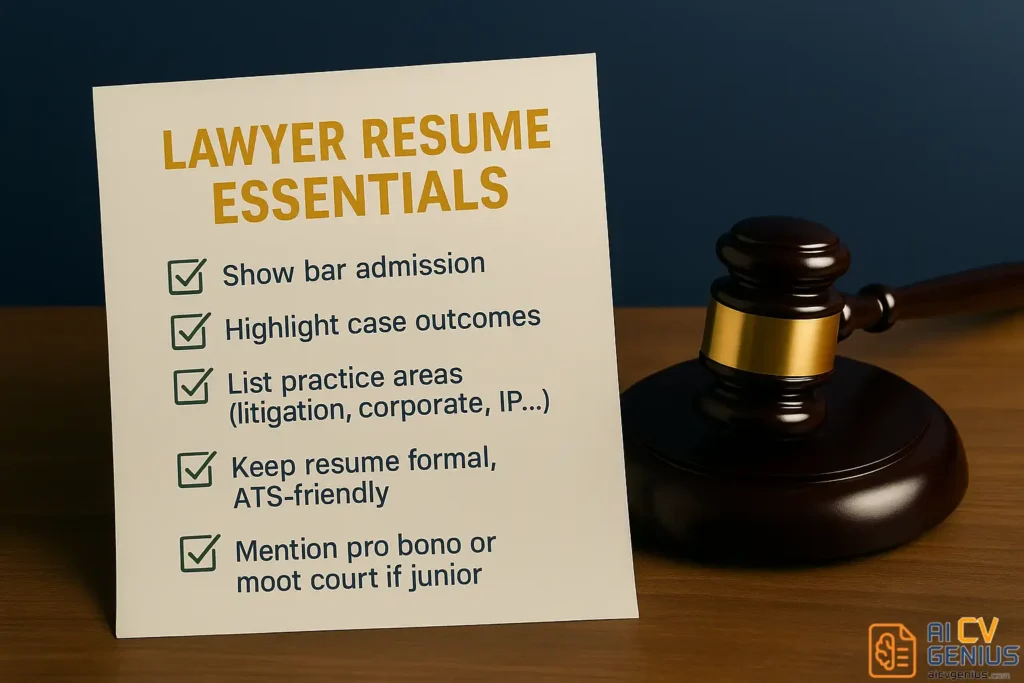
- ✅ Clearly display bar admission details (state(s) and year of admission).
- ✅ Explicitly demonstrate expertise in specific practice areas (e.g., commercial litigation, corporate M&A, intellectual property prosecution, criminal defense, family law).
- ✅ Quantify case outcomes and transaction values whenever possible (e.g., settlement amounts, trial verdicts secured, value of deals closed, number of patents filed).
- ✅ Highlight core legal competencies: advanced legal research (LexisNexis, Westlaw, Bloomberg Law), persuasive legal writing (briefs, motions), meticulous contract drafting, effective negotiation strategies, and strong oral advocacy skills.
- ✅ Maintain a highly formal, professional, and conservative structure, reflecting industry norms.
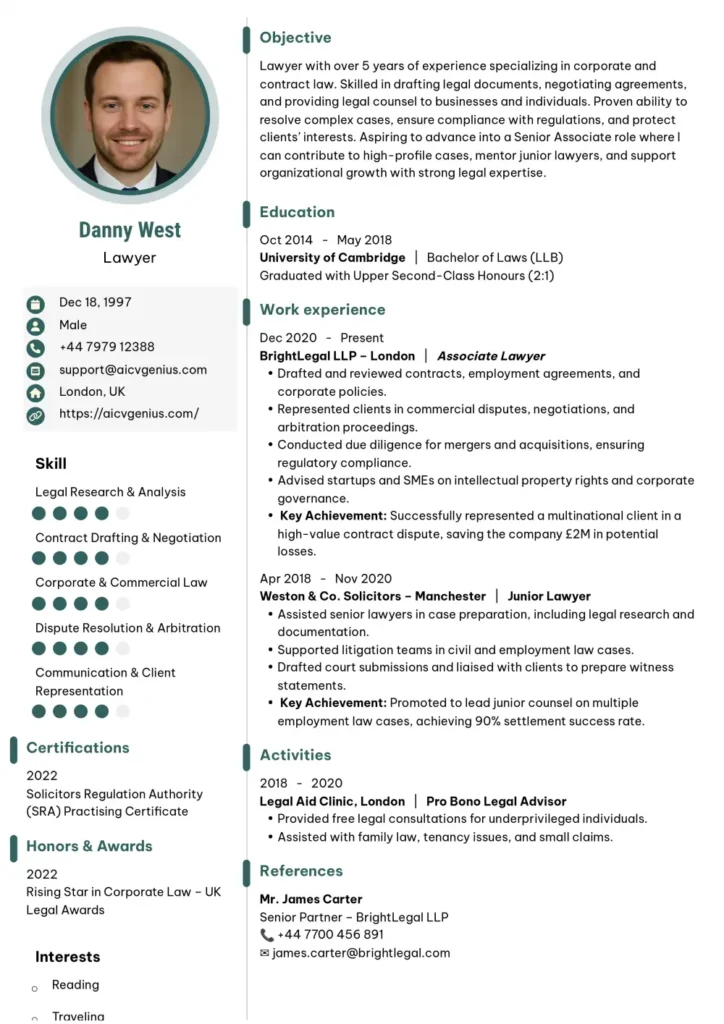
Key Sections in a Lawyer Resume Template
An effective lawyer resume template must strategically organize these essential sections:
Contact Information & Bar Admission
Include your full name, phone number, professional email address, LinkedIn profile URL (ensure it’s updated and professional), and city/state. Crucially, list your bar admission details prominently near the top. Example: “Admitted to the New York State Bar, 2019; Southern District of New York (SDNY), 2020.”
Resume Summary or Profile
A concise 3-4 line persuasive statement, akin to your opening argument, tailored to the specific role or firm. Highlight years of practice, core practice areas, key skills, and a significant accomplishment.
Example:
“Results-oriented Litigation Attorney with 7 years of experience representing corporate clients in complex commercial disputes and intellectual property matters. Skilled in all phases of litigation from discovery through trial advocacy and appellate practice. Proven record of securing favorable judgments and negotiating multi-million dollar settlements. Admitted in California and Ninth Circuit.”
Work Experience (Professional Experience)
This is the evidentiary core of your resume. Use reverse-chronological order. For each position, include Job Title, Firm/Organization Name, Location, and Dates of Employment. Frame each bullet point like a piece of evidence: specific, quantified where possible, and focused on impact. Use strong legal action verbs (e.g., Argued, Drafted, Negotiated, Advised, Represented, Managed, Secured, Litigated, Deposed, Defended).
- “Represented 20+ corporate clients in complex breach of contract disputes in state and federal courts, achieving successful resolution (settlement or judgment) in over 80% of cases.”
- “Drafted, reviewed, and negotiated over 100 commercial contracts, including master service agreements and licensing deals, with aggregate values exceeding $50M+ for technology sector clients.”
- “Led internal investigation and managed e-discovery process involving over 500,000 documents for a major regulatory compliance matter, ensuring timely response and mitigating potential penalties.”
- “Successfully argued motion for summary judgment in federal court, resulting in dismissal of all claims against client in a $5M trade secret dispute.”
Education
List your Juris Doctor (J.D.) or equivalent law degree first. Include the Law School Name, Location, Degree Awarded, and Graduation Date. Emphasize academic honors (e.g., Magna Cum Laude, Order of the Coif, Law Review Editorial Board, Moot Court Competition Winner, Dean’s List).
Include undergraduate degree details similarly. List GPA only if exceptionally high (e.g., top 10-15%) and you are relatively early in your career.
For recent graduates, this section is often placed before Work Experience.
Bar Admissions & Certifications
Create a distinct section if not included with Contact Information. List all jurisdictions where you are admitted to practice law, including the year of admission. Also include admissions to specific federal courts (District Courts, Circuit Courts, Supreme Court).
List relevant professional certifications, such as mediation training, compliance certifications (e.g., CCEP), or advanced degrees like an LL.M. in a specialized area (e.g., Taxation, International Law).
Skills
Categorize skills for clarity, focusing on those most relevant to legal practice.
- ✅ Legal Research & Writing: Advanced proficiency in LexisNexis, Westlaw, Bloomberg Law; drafting persuasive motions, briefs, pleadings, and memoranda.
- ✅ Litigation & Trial Advocacy: Discovery management (e-discovery), depositions, motion practice, courtroom argumentation, cross-examination, jury selection, appellate advocacy.
- ✅ Transactional Skills: Contract drafting, negotiation, due diligence, M&A support, corporate formations, intellectual property filing/prosecution.
- ✅ Compliance & Regulatory: Corporate governance advisory, internal investigations, knowledge of specific regulatory frameworks (e.g., SEC, GDPR, HIPAA – tailor to practice area).
- ✅ Client Management & Communication: Client counseling, case strategy development, negotiation with opposing counsel, clear articulation of complex legal issues.
- ✅ Languages: Specify proficiency if relevant to international practice (e.g., “Fluent in Spanish (Written & Spoken)”).
Representative Matters / Achievements (Optional but Recommended)
If not fully detailed under Work Experience, a separate section can highlight particularly significant or high-profile cases, deals, or accomplishments, especially for mid-level to senior lawyers. Ensure confidentiality obligations are respected.
- “Key member of trial team that secured a $3.2M jury verdict for plaintiff in a complex patent infringement lawsuit.”
- “Successfully defended major pharmaceutical client against federal antitrust claims, resulting in dismissal of the case prior to trial.”
- “Lead associate on $120M cross-border acquisition, responsible for overseeing due diligence and drafting key transaction documents.”
- “Recognized as ‘Rising Star Attorney’ in Commercial Litigation by [State Bar Association Publication or Legal Ranking], 2022.”
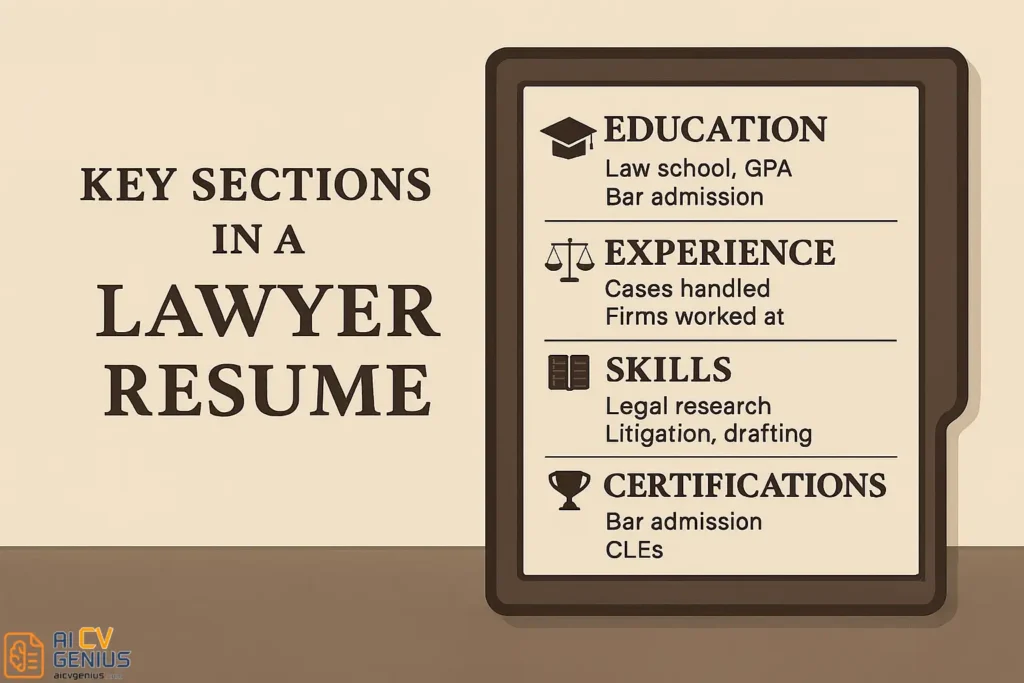
Full Lawyer Resume Example (Mid-Level Associate)
Here is a complete, well-structured example demonstrating the principles discussed above, tailored for a mid-level litigation associate.
AMELIA R. CHEN
123 N. LaSalle Street, Suite 500 | Chicago, IL 60601
(312) 555-0123 | amelia.chen@email.com | linkedin.com/in/ameliachenlegal
BAR ADMISSIONS: State of Illinois (2018); U.S. District Court, Northern District of Illinois (2019)
PROFESSIONAL SUMMARY
Results-driven Litigation Attorney with 7 years of experience in complex commercial disputes and intellectual property matters. Proven ability to manage all phases of litigation, from discovery and motion practice to trial preparation and appellate support. Track record of securing favorable judgments and negotiating multi-million dollar settlements for corporate clients in the technology and financial services sectors.
PROFESSIONAL EXPERIENCE
Senior Associate | Smithson & Grey LLP, Chicago, IL | 2021 – Present
Associate | Smithson & Grey LLP, Chicago, IL | 2018 – 2021
- Represented 25+ corporate clients in state and federal court, focusing on breach of contract, trade secret misappropriation, and patent infringement cases.
- Successfully argued motion for summary judgment in federal court, resulting in the complete dismissal of a $10M+ trade secret claim against a key technology client.
- Managed e-discovery process for multiple complex litigations, overseeing review of over 1.5 million documents and coordinating with e-discovery vendors to ensure defensibility and cost-efficiency.
- Drafted and negotiated 15+ complex settlement agreements, securing outcomes averaging 80% favorable to initial client exposure.
- Deposed over 30 fact and expert witnesses, and defended depositions of key corporate executives.
- Supervised and mentored 3 junior associates and 2 paralegals on case strategy and daily litigation tasks.
Summer Associate | Smithson & Grey LLP, Chicago, IL | Summer 2017
- Researched and drafted memoranda on complex procedural and substantive issues for commercial and IP litigation matters.
- Assisted with deposition preparation and observed court proceedings.
EDUCATION
Northwestern Pritzker School of Law, Chicago, IL
Juris Doctor (J.D.), Magna Cum Laude, May 2018
- Honors: Order of the Coif; Northwestern University Law Review (Senior Editor); Moot Court Competition (Finalist)
University of Michigan, Ann Arbor, MI
B.A. in Political Science, with High Distinction, May 2015
- Honors: Phi Beta Kappa
SKILLS & CERTIFICATIONS
- Legal Tech: Advanced proficiency in Westlaw, LexisNexis, Bloomberg Law, Relativity, and Clio.
- Languages: Fluent in Mandarin Chinese (Written & Spoken).
- Certifications: Certified Information Privacy Professional (CIPP/US).
Case Studies: Tailoring Content from Law Student to Senior Counsel
The emphasis and content of your resume must evolve throughout your legal career:
Law Graduate / Entry-Level Associate (0-2 Years)
- Prioritize Education: Place this section near the top. Highlight law school honors (Law Review, Moot Court participation/awards, high GPA/class rank), legal clinics providing practical experience, and relevant coursework.
- Detail Internships & Clerkships: Describe substantive work performed during summer associate positions, judicial clerkships (state or federal), or internships with government agencies or NGOs. Focus on research, writing samples produced, and exposure to specific practice areas.
- Clearly State Bar Exam Status: Indicate if you are awaiting results or scheduled to sit for the bar exam (e.g., “Sitting for the July 2024 New York Bar Exam,” or “Passed the February 2024 California Bar Exam; admission pending”).
- Showcase Foundational Skills: Emphasize legal research proficiency (Lexis/Westlaw), legal writing ability (mentioning specific documents drafted like memos or motions), and any relevant software skills.
Mid-Level Associate (3–7 Years)
- Focus Shifts to Substantive Experience: Detail the types of cases handled or deals managed (e.g., “Litigated complex commercial contract disputes and employment law cases from inception through resolution,” “Managed due diligence and drafted ancillary agreements for mid-market M&A transactions”).
- Quantify Experience and Outcomes: Provide metrics demonstrating scope and success (e.g., “Managed discovery process involving depositions of 15+ witnesses,” “Negotiated favorable settlements in 90% of assigned tort cases,” “Drafted and reviewed over 50 software licensing agreements”).
- Highlight Growing Responsibility: Mention experience supervising junior associates or paralegals, taking lead roles in depositions or hearings, or having direct client contact and management responsibilities.
- Specify Client Industries: Mentioning industries served (e.g., technology, healthcare, financial services) adds relevant context for targeted applications.
Senior Counsel / Partner / Senior Attorney (8+ Years)
- Demonstrate Leadership and Strategic Impact: Emphasize roles managing legal teams, overseeing major litigation or transactions, developing case strategy, or advising senior management/clients on critical legal risks.
- Highlight Significant Cases, Deals, or Client Relationships: Focus on high-value, complex, or precedent-setting matters. Detail your specific strategic contribution and the outcome achieved for the client or organization.
- Showcase Business Development & Client Management (if applicable): Mention experience originating clients, managing key client relationships, or contributing to firm profitability (especially relevant for partner-track or partner roles).
- Emphasize Thought Leadership & Professional Standing: Include significant publications (law review articles, book chapters), speaking engagements at industry conferences, leadership roles in bar associations or committees, or significant pro bono leadership.
Advanced Considerations for Your Legal Resume
Global Perspective: Crafting Cross-Border Legal Resumes
In an increasingly interconnected global legal market, lawyers frequently handle matters involving multiple jurisdictions or international law. Resume templates and content for these roles should explicitly emphasize:
- ✅ Multijurisdictional Bar Admissions: Clearly list all relevant bar admissions (e.g., New York, England & Wales Solicitor, admitted in specific EU countries).
- ✅ International Arbitration/Litigation Experience: Detail experience with international arbitration bodies (ICC, LCIA, AAA/ICDR), cross-border litigation procedures, or enforcement of foreign judgments.
- ✅ Language Proficiency: Specify fluency level and ability to conduct legal work (drafting contracts, negotiating, advising clients) in multiple languages.
- ✅ Expertise in International Law & Compliance: Highlight experience with international treaties, cross-border M&A regulations, global compliance frameworks (e.g., GDPR, FCPA), international trade law, or specific regional legal systems.
- ✅ Cross-Cultural Competence: Implicitly or explicitly demonstrate experience working effectively with international clients, opposing counsel, or diverse legal teams.
Myths vs. Realities in Lawyer Resumes
Avoid these common misconceptions that can undermine your legal job application:
| Myth | Reality |
|---|---|
| ❌ Legal resumes should be overly verbose and include exhaustive detail on every minor task performed. | ✅ Brevity, precision, and focus on impact are far more persuasive than dense clutter. Prioritize significant accomplishments and tailor content to the specific role. |
| ❌ Simply listing general responsibilities (e.g., “Drafted motions,” “Reviewed documents”) is sufficient. | ✅ Employers prioritize specific outcomes, quantifiable results, and the scope of your contributions. Focus on achievements (cases won, deals closed, value negotiated, specific motions argued successfully). |
| ❌ Using highly creative or visually unconventional resume designs will impress modern law firms or legal departments. | ✅ The legal profession values conservatism, professionalism, and clarity above visual flair. Use clean, traditional, ATS-friendly templates; overly designed resumes can signal a lack of seriousness. |
| ❌ Soft skills like negotiation or client management are subjective and cannot be effectively demonstrated on a resume. | ✅ Demonstrate soft skills through concrete examples and results (e.g., settlement amounts vs. initial demands, number/type of clients advised, leadership via teams managed or projects led). |
Checklist Before Submitting Your Legal Resume
Conduct this final review to ensure your resume makes the strongest possible case:
- ✅ Bar admission details (jurisdictions, years) are clearly stated and accurate, placed prominently.
- ✅ Specific practice areas of expertise are clearly defined and aligned with the target role.
- ✅ Key case outcomes, transaction values, or other significant achievements are quantified wherever possible.
- ✅ Education section is complete, including honors (Law Review, Moot Court, class rank/GPA if strong and relevant).
- ✅ Resume is saved in both visually consistent PDF and ATS-parsable DOCX formats, as per best practices.
- ✅ Format is clean, professional, conservative, and easily scannable (preferably single-column for ATS compatibility).
- ✅ Meticulously proofread multiple times for any typos, grammatical errors, or inconsistencies in dates or details (precision is paramount).
Extended FAQs about Lawyer Resume Template
Typically, one page for law students, recent graduates, and junior associates (up to ~3-5 years of experience). Two pages maximum are generally acceptable and often necessary for mid-level to senior associates, counsel, and partners with extensive relevant experience, significant publications, or numerous high-impact matters. Brevity and relevance are highly valued; avoid filler.
Yes, if you are a recent law school graduate (within the last 1-3 years) AND your GPA/class rank is strong (e.g., top 10-25%, specific honors like Magna Cum Laude). For more experienced attorneys, academic performance becomes less relevant compared to professional achievements and can often be omitted.
Minimally. They prioritize content clarity, professionalism, and error-free presentation far above creative design. Stick to clean, conservative, traditional templates (e.g., Times New Roman or Garamond font, black text, ample white space). Avoid graphics, photos, columns, or unconventional layouts that might hinder readability or ATS parsing.
Focus on specifics and outcomes. List the types of cases handled (e.g., complex commercial, employment discrimination, patent infringement), key actions taken (argued motions, took/defended depositions, first/second chaired trials), number of cases managed, significant verdicts or settlements achieved ($ or specific outcome), and courts appeared before (state/federal/appellate).
Highlight the types and value of deals worked on (M&A, venture capital financing, IPOs, real estate), specific roles played (lead counsel, drafted key documents, managed due diligence), complexity of contracts drafted and negotiated (e.g., cross-border agreements, SaaS contracts), and the industries of clients served. Quantify transaction values ($) whenever possible.
Yes, particularly if you are early in your career, if the pro bono work demonstrates skills relevant to your target role, or if you are applying to firms or organizations known to value social responsibility and community involvement. Briefly describe the nature of the work and your contribution.
For mid-level to senior lawyers, absolutely. These activities demonstrate thought leadership, subject matter expertise, and professional credibility within your practice area. List significant law review articles, book chapters, CLE presentations, or industry conference speaking roles in a dedicated section or under “Professional Activities.”
Use a clean, single-column layout. Employ standard section headings (“Work Experience,” “Education,” “Bar Admissions”). Use common, readable fonts. Avoid tables, text boxes, images, headers/footers containing critical information (like contact details), and excessive formatting. Ensure keywords relevant to the job description (practice areas, specific skills, legal software) are naturally integrated as text. Save as both PDF and DOCX if possible.
Yes, this is common. Clearly state your bar exam status and expected admission date on your resume (e.g., “Passed the July 2024 New York Bar Exam; admission pending,” or “Awaiting results from the February 2025 California Bar Exam”). Firms understand the timeline and often hire pending bar admission.
Keywords should always be tailored to the specific role and practice area. However, common high-value keywords include: Litigation, Arbitration, Mediation, Compliance, Corporate Governance, Mergers & Acquisitions (M&A), Contract Drafting, Contract Negotiation, Legal Research, Legal Writing, Due Diligence, Intellectual Property, Employment Law, Regulatory Affairs, Client Counseling, specific legal software (Westlaw, LexisNexis), and relevant bar admissions.
Final Thoughts: Your Resume as Conclusive Evidence
In the practice of law, every successful argument ultimately hinges on the strength and presentation of the evidence. Your resume functions under precisely the same principle within the context of your job search. It serves as the primary body of evidence detailing your professional career: the complex cases you have adeptly handled, the diverse clients you have diligently served, and the significant victories or favorable outcomes you have secured.
A meticulously chosen lawyer resume template provides the essential structure to organize this evidence into a coherent, persuasive, and impactful document that effectively convinces potential employers you possess the requisite skills and experience to excel as the advocate they need. Just as you would never enter a courtroom without thorough preparation and a compelling case strategy, do not submit a job application without a resume that presents your professional qualifications in the strongest possible light. Ensure clarity, underscore credibility, articulate with conviction – and the favorable verdict, in the form of interview invitations, will likely follow.