
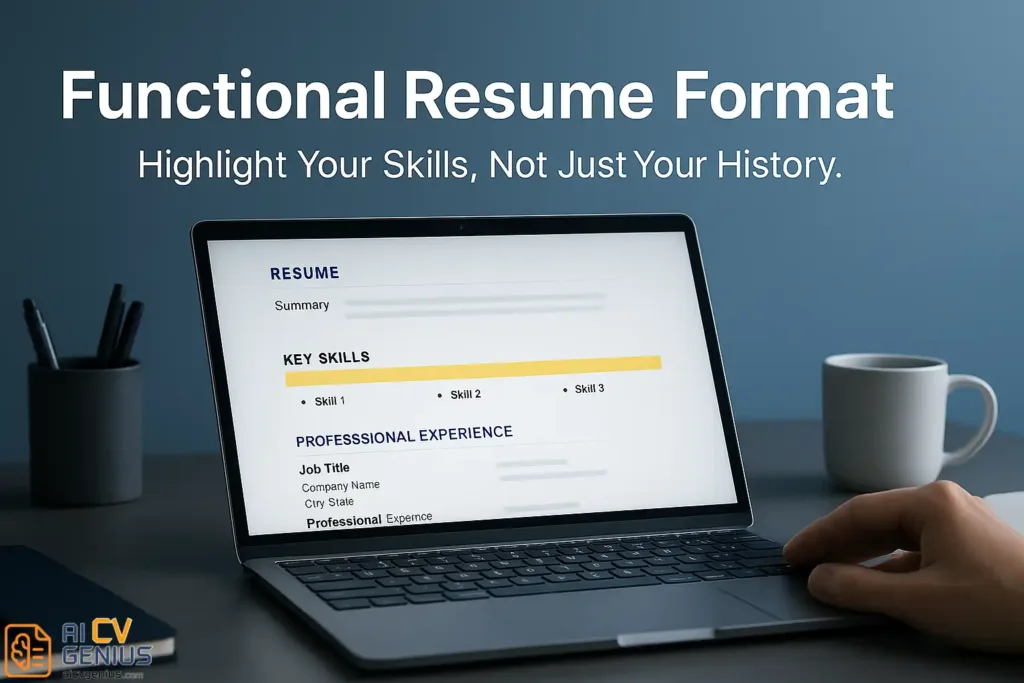
- Functional resume format is a skill-first layout built for non-linear careers: It puts what you can do at the top, and pushes dates and titles into the background so the resume reads like a strengths story, not a timeline.
- Why it works and how it fails: It redirects a recruiter’s first impression away from risk signals (Gaps, job-hopping, unrelated titles), but it backfires if it feels vague or evasive, so every skill must be backed by specific, measurable achievements.
- Best and worst scenarios: It helps career changers, students, freelancers, returners, and anyone with gaps, but it is a poor choice for linear promotion paths, traditional industries, roles that demand a clean chronology, or cases where you cannot prove skills with outcomes.
- Build it with a strict structure: Header, a “bridge” summary that explains your direction, 3 to 5 skill themes pulled from the job description, 2 to 4 quantified proof bullets under each theme, then a minimal work history section with honest dates, plus education, certifications, and optional projects.
- Trust and ATS guardrails: Always include dates, avoid tables or text boxes, use standard headings and keywords naturally, keep formatting clean, and consider the hybrid (Combination) format as the safer default when you want skill emphasis without sacrificing timeline clarity.
Not every career path is a straight line. Life is complex. You may have taken time off to raise a family, cared for a relative, switched industries, gone back to school, or managed a portfolio of freelance projects. A traditional, linear resume can make this rich history look fragmented or full of “gaps.” It fails to tell your true story. That is precisely why the functional resume format exists. It is a strategic storytelling tool.
Unlike the traditional chronological resume, which is obsessed with when you did something, a functional layout focuses on what you can do. It silences the noise of jumbled timelines and instead amplifies the signal of your most relevant skills. It highlights your core competencies, proven achievements, and tangible value right at the top, elegantly placing the “when” and “where” in the background.
This format is a powerful choice for anyone whose skills are stronger than their timeline. It allows you to control the narrative, connecting the dots for the recruiter and proving that your unique path has made you exceptionally qualified. This guide will deconstruct how to build this format with integrity, proving your strengths without being judged by arbitrary timelines.
The Core Psychology: Why This Format Works (and When It Fails)
A functional resume is, at its heart, a psychological tool. It is designed to manage a recruiter’s first impression by redirecting their focus. A chronological resume answers the question, “What did you do last?” A functional resume answers the question, “What can you do for me, right now?”
Hiring managers are trained to spot risk. Gaps in employment, rapid job-hopping, or an unrelated career history can all trigger a “risk” signal. The functional format neutralizes this by presenting your most relevant, valuable skills first. Instead of seeing a “gap,” the recruiter sees “Project Management.” Instead of seeing “Freelancer,” they see “Content Strategy.”
However, this strategy relies on trust. If your functional resume feels vague, evasive, or lacks concrete proof, it backfires. Recruiters become suspicious, believing you are actively hiding something. The key is not to hide your history, but to re-frame it, using verifiable achievements to back up every skill you claim.
The Strategic Scenarios: When to Use a Functional Resume
This format is a specific tool for a specific job. Using it when you don’t need it can be counter-productive. Here are the real-world scenarios where a functional resume gives you a distinct advantage:
- The Career Changer: You are shifting from one industry (e.g., Education) to another (e.g., Tech). A functional resume lets you lead with “Project Management” and “Team Leadership” (skills you have) rather than “10th Grade Teacher” (a title they might not understand).
- The Gap Filler: You have significant employment gaps. Perhaps you took time off for travel, family, health, or personal projects. This format emphasizes the skills you maintained during that time, rather than the blank space on a calendar.
- The Student or New Graduate: You have powerful skills from academics, internships, and volunteer work, but very limited “official” paid experience. This lets you showcase “Data Analysis (Capstone Project)” as a primary skill.
- The Freelancer or Contractor: Your work history is a long list of short-term contracts with multiple clients. A functional resume lets you group this experience logically (e.g., “UX/UI Design,” “Client Management”) instead of presenting a chaotic list of 15 different 3-month jobs.
- The Returning Professional: You are re-entering the workforce after several years away. Your skills are sharp, but your last “official” role was years ago. This format proves your current readiness and value, minimizing the focus on dates.
When You Shouldn’t Use It (The Red Flags)
This format is not a silver bullet. In some contexts, using one can hurt your chances. Be cautious in these scenarios:
- ❌ You have a clear, linear career path. If you have been steadily promoted in your field, a chronological resume is your best friend. It clearly shows your upward momentum, which a functional resume would obscure.
- ❌ You are applying to highly traditional industries. Fields like law, banking, government, or academia are conservative. They expect to see a clear, chronological timeline. A functional resume can be seen as non-standard or even evasive.
- ❌ You have no achievements to back up your skills. The functional format relies 100% on proof. If you claim “Leadership” but have no bullet points with measurable results, the entire resume feels empty.
- ❌ The job application requires a chronological history. Many online application systems (ATS) are built to parse chronological data. A functional format can confuse them, leading to your resume being filtered out before a human sees it.
If you are in one of these situations, a combination resume (also called a hybrid resume) is almost always a better and safer choice. It gives you the best of both worlds.
Functional vs. Chronological vs. Combination: A Quick Guide
Understanding the three main resume formats helps you pick the right tool for your specific career story.
| Format | Focus | Best For |
|---|---|---|
| Chronological | Work history in reverse order. Emphasizes when and where you worked. | Professionals with consistent experience and a clear upward career path. The industry standard. |
| Functional | Skills and achievements, grouped by theme. De-emphasizes dates and titles. | Career changers, freelancers, students, or those with significant employment gaps. |
| Combination (Hybrid) | Blends both. Starts with a strong skills/achievements summary, then follows with a concise chronological work history. | The safest and most flexible option for most professionals, especially experienced career changers. |
How to Structure a Functional Resume: An In-Depth Breakdown
A functional resume is built on a clear, skill-based architecture. Here is the blueprint, section by section, explaining the why behind each component.
- Header: Your name, contact info, and a link to your LinkedIn profile. Clean and professional.
- Professional Summary (or Objective): This is your “bridge.” A 2-3 sentence paragraph that explains why you are using this format. It connects your past skills to the future role you want.
- Key Skills / Competencies: This is the core of your resume. You will create 3-5 skill “themes” or categories relevant to the job.
- Achievements / Proof of Skills: Under each skill theme, you will list 2-4 bullet points. These are not duties; they are quantified achievements that prove you possess that skill.
- Work Experience (or Professional History): This section is intentionally minimal. You simply list your job titles, company names, and employment dates. There are no bullet points here.
- Education & Certifications: Include your degrees, relevant training, or professional courses that support your skill claims.
- Optional Sections: Projects, volunteering, or awards can be added if they provide further, relevant proof of your skills.
Step-by-Step: How to Write a Functional Resume That Builds Trust
Writing this resume is an exercise in strategic storytelling. Let’s go step-by-step.
Step 1 – Start with a Strong, Strategic Summary
This is your introduction. It must be a “bridge” that connects your diverse background to the specific job you want. It must be confident, not apologetic.
Example for a Career Changer (Teacher to Project Manager):
“Dynamic and highly organized professional with 8+ years of experience in education, now transitioning into project management. Proven ability to lead cross-functional teams, manage complex timelines, and communicate with diverse stakeholders to deliver results. Eager to apply proven leadership and planning skills to drive project efficiency at [Company Name].”
This summary immediately re-frames “teacher” as “leader” and “planner,” using the language of the new industry.
Step 2 – Identify and Group Your Skills Logically
Read the job description. What are the top 3-5 skills they are asking for? These will become your “Skill Themes.” Do not use generic terms. Be specific.
Instead of “Leadership,” try “Team Leadership & Mentorship.”
Instead of “Technical,” try “Data Analysis & Visualization (SQL, Tableau).”
Instead of “Communication,” try “Client Communication & Stakeholder Management.”
Other common themes include:
- Project Management & Coordination
- Content Strategy & Creation
- Process Optimization & Efficiency
- Training & Development
Step 3 – Add Evidence (Achievements) Under Each Skill
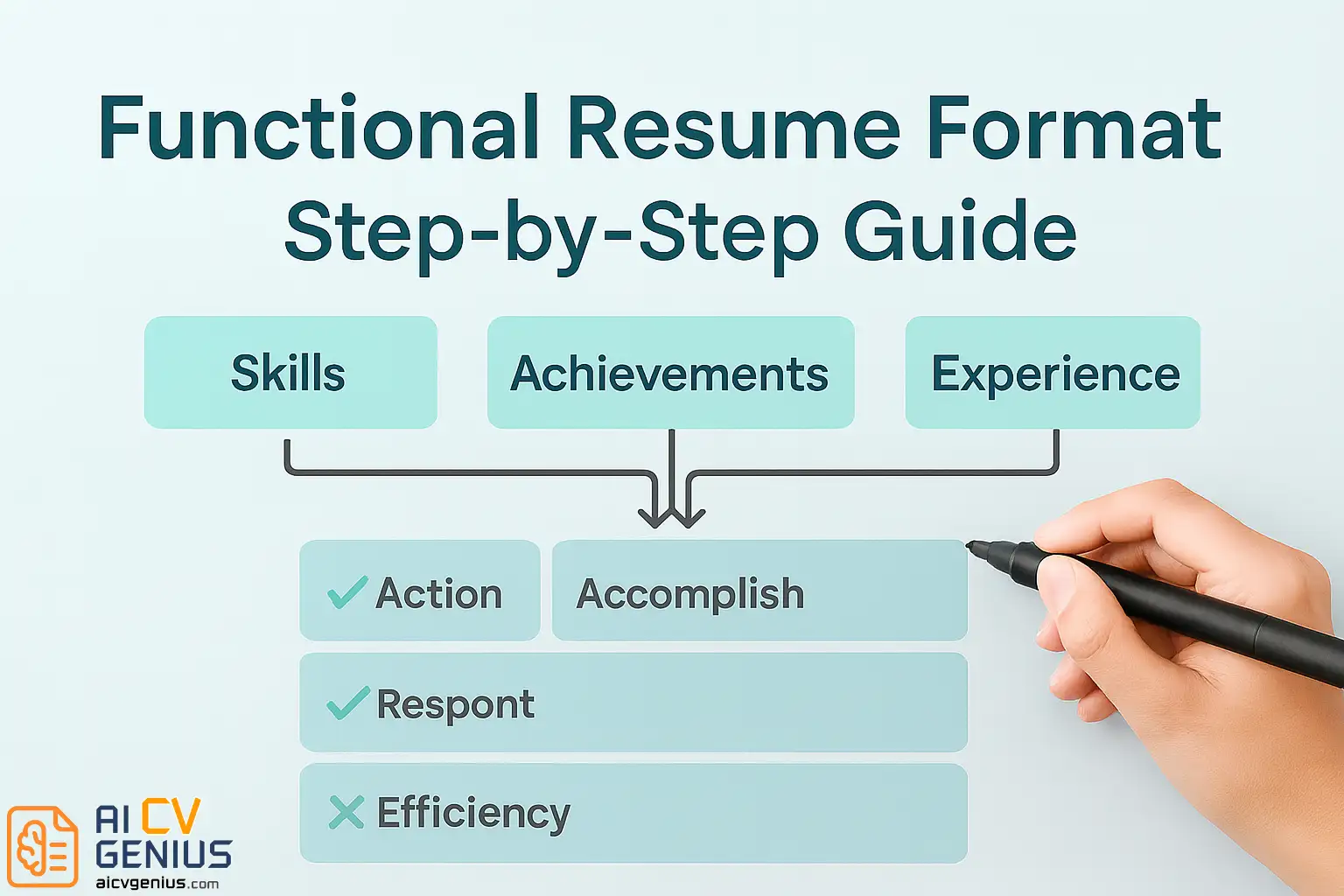
This is the most important step. Under each skill theme, you must add 2-4 bullet points of proof. These achievements must be quantified. Use the Action Verb + Task + Measurable Result formula.
Skill Theme: Project Management & Coordination
- Managed the annual science fair for 300+ students, coordinating 20+ volunteers and judging logistics, resulting in a 15% increase in participation.
- Developed and implemented a new digital curriculum timeline, ensuring 10+ faculty members delivered all milestones on schedule.
- Led a textbook review project, sourcing and vetting 5 new vendors and negotiating contracts that saved the department $12,000 annually.
Skill Theme: Client Communication & Stakeholder Management
- Maintained a 95% satisfaction rate across a portfolio of 100+ clients by providing clear, consistent, and empathetic support.
- Trained and mentored 5 new team members on de-escalation techniques, boosting team productivity and morale by 18%.
- Presented quarterly progress reports to parent-teacher boards, translating complex data into actionable insights.
Step 4 – Keep Your Work Experience Minimal but Honest
This is where recruiters look to verify your claims. Do not omit this section; doing so is the biggest red flag. Keep it simple, clean, and factual. List your roles in reverse-chronological order.
Work Experience
Customer Operations Lead | Nimbus Tech | 2019–2023
Administrative Coordinator | Vega Group | 2015–2019
Office Manager | Local Solutions LLC | 2013–2015
That’s it. No bullets. The achievements are already listed up top, under the skills they prove. This format implies that your achievements were drawn from these roles, which is why honesty is critical.
Step 5 – Quantify Results Everywhere
I am repeating this because it is the secret to making this format work. Numbers build trust. They turn vague claims into concrete facts. Scour your past for anything you can measure:
- Increased efficiency by 25% by automating status reporting.
- Handled 150+ weekly support cases with 98% resolution success.
- Created onboarding modules that reduced new-hire training time by 40%.
- $ Managed a project budget of $50,000, delivering the final product 10% under budget.
Even if you don’t have exact numbers, educated estimates are acceptable (e.g., “Handled approx. 50+ client inquiries daily”).
Step 6 – Make It Visually Balanced
Functional resumes can look dense and “top-heavy” because all the content is at the top. Use white space, clear bold headings for your skill themes, and consistent bullet points. Avoid long paragraphs. Each section should feel like a self-contained, easy-to-read module.
Full Example: Functional Resume Layout (Career Changer)
Here is how all the pieces come together for a professional changing from hospitality management to a corporate operations role.
JANE ROBERTS
jane.roberts@email.com | linkedin.com/in/janeroberts | Austin, TXProfessional Summary
Strategic and people-focused leader with 8+ years of experience in high-volume hospitality management, now transitioning into corporate operations. Proven ability to optimize processes, manage $1M+ P&Ls, and lead teams of 30+ to achieve ambitious targets. Eager to apply rigorous operational and team-building skills to enhance efficiency at [Company Name].Core Competencies & Achievements
Operational & Process Management
- Redesigned inventory management system using advanced Excel tracking, reducing waste by 22% and saving $40,000 annually.
- Streamlined front-desk and housekeeping workflows, cutting average guest check-in time by 3 minutes and boosting positive reviews by 15%.
- Managed all vendor negotiations and procurement, ensuring 100% supply chain continuity during peak season.
Team Leadership & Development
- Recruited, trained, and mentored a high-performing team of 35+ staff, reducing employee turnover by 40% over two years.
- Developed and implemented a new performance review metric, resulting in 3 internal promotions to shift-lead positions.
- Scheduled and managed payroll for all departments, ensuring 100% accuracy and adherence to a $1.2M labor budget.
Client & Stakeholder Relations
- Acted as the primary point of contact for all high-value corporate clients, securing $200K in repeat event bookings.
- De-escalated and resolved 100% of major guest complaints, maintaining a 4.8-star rating on TripAdvisor.
Work Experience
General Manager | The Austin Hotel Group | 2018–Present
Assistant Manager | Downtown Hospitality | 2015–2018Education & Certifications
B.S., Hospitality Management – University of Texas at Austin
Certified Hospitality Administrator (CHA) – 2019
How to Make Recruiters Trust a Functional Resume
The biggest risk of this format is appearing evasive. Trust is your primary currency. Here is how to build it.
- ✅ Be Transparent with Dates: Always include your minimal work history with accurate dates. Hiding dates is the #1 red flag.
- ✅ Use Consistent Formatting: Use the same bullet style and verb tense (past tense for past achievements) throughout. It shows professionalism.
- ✅ Include Measurable Outcomes: As mentioned, numbers are proof. Without numbers, your “skills” are just opinions.
- ✅ Keep Your Tone Confident, Not Defensive: Your summary should sound proactive. You are not “returning after a break”; you are “a professional ready to apply proven skills in a new challenge.”
- ✅ Align with LinkedIn: Your LinkedIn profile should still be chronological. A recruiter will cross-check. The functional resume is your “first look” document, but your LinkedIn provides the full, transparent timeline.
Common Mistakes to Avoid
- ❌ Stuffing too many skills. Listing 10 skill themes is overwhelming. Stick to the 3-5 most relevant themes for the job.
- ❌ Leaving out the Work Experience section entirely. This is an instant rejection. It looks like you are hiding something – because you are.
- ❌ Using vague buzzwords. “Motivated,” “passionate,” and “team player” are meaningless without proof. Let your achievements speak for you.
- ❌ Forgetting to tailor. A functional resume is not a generic, one-size-fits-all document. You must re-prioritize your skill themes for every single job you apply for.
- ✅ The Fix: Always keep your resume clean, proof-based, and honest.
Pros & Cons of Functional Resume Format (Quick Summary)
| ✅ Advantages | ⚠️ Drawbacks |
|---|---|
| Emphasizes your most relevant skills immediately, placing your value front-and-center. | Can be confusing to Applicant Tracking Systems (ATS) and conservative recruiters. |
| Ideal for minimizing career changes, employment gaps, or freelance-heavy history. | Requires very strong, quantifiable achievements to look credible and avoid suspicion. |
| Lets you control your professional narrative and frame your story. | Less common and can look “junior” if you have a strong, linear career path. |
| Focuses the recruiter’s attention on your achievements, not your job titles. | Needs careful formatting to stay readable and not appear “top-heavy” or dense. |
ATS Compatibility: The Technical Hurdle
Many Applicant Tracking Systems (ATS) are programmed to parse chronological resumes. A functional format can, in some cases, cause your resume to be misread or rejected. To mitigate this:
- Use plain section headers: “Key Skills & Achievements,” “Professional Experience,” “Education.”
- Avoid tables or text boxes for your skills; use standard bullet points.
- Always include the “Work Experience” section with dates, as the ATS needs this to create a timeline.
- Use job-related keywords naturally throughout your skill descriptions.
The Safer Alternative: The Hybrid (Combination) Format
If you are worried about the risks of a purely functional resume, the Hybrid (or Combination) Format is your best solution. It is the modern standard for most professionals.
It works like this:
- Header & Professional Summary (Same as functional).
- Key Skills / Competencies Section (A brief, bulleted list of your top 6-9 skills, without achievements under them).
- Professional Experience (A standard, reverse-chronological list of your jobs).
- Under each job title, you list the 3-5 quantified achievements relevant to that role.
This format provides the best of both worlds: it highlights your skills at the top for a quick scan, while also providing the clear, chronological timeline that recruiters and ATS bots trust.
Final Touches Before Sending
- Proofread thoroughly. Typos in a resume focused on “detail” kill credibility instantly.
- Save as a PDF unless the application specifies otherwise. This locks in your formatting.
- Use consistent alignment and bullet styles.
- Match it visually with your cover letter for a cohesive, professional impression. Your cover letter is where you can explicitly tell the “story” of your career change.
Where to Learn More
Your resume format is just the beginning. The content and design must work together.
Browse resume templates for ready-made functional and hybrid layouts that are clean and ATS-friendly.
Visit our career resources for more in-depth comparison guides between resume formats.
Or see cover letter examples to build the perfect companion document that explains your “why.”