
- Why a specialized template: It signals reliability, speed, composure, and teamwork fast, which matters more in restaurants than generic corporate formatting.
- Best structure: Use reverse-chronological with a clear flow (Summary, Skills, Experience, Certifications) so managers can scan in seconds.
- What to highlight: Split skills into hard (POS, food safety, reservations, cash handling) and soft (urgency, de-escalation, multitasking), then prove them with achievement bullets.
- Credibility boosters: List non-negotiables like ServSafe and alcohol permits, keep design clean and ATS-safe, and avoid photos, heavy graphics, and messy layouts.
- Tailor by role: Shift the story for server, cook, host, or manager, use transferable skills if you have no experience, and use metrics-heavy bullets for management impact.
Why a Specialized Restaurant Resume Template is Your Most Important Menu
In the hospitality industry, every second is a first impression. The way a glass is polished, the crispness of a linen, the timing of a greeting – these micro-moments define the guest experience. Your resume is no different. It is the very first table you serve, and the hiring manager is your first guest. A generic, one-size-fits-all resume is the equivalent of serving a pre-packaged meal at a fine dining establishment. It simply doesn’t work.
A well-designed restaurant resume template is engineered for the industry’s specific demands. A general manager isn’t just looking for a warm body; they are scanning for signals of reliability, speed, composure, and teamwork. They need to know, in a glance that often lasts no more than six seconds, if you will break under pressure during the Saturday night rush or if you will be the one holding the team together.
Unlike a corporate resume, which might prioritize long-term projects, a restaurant resume must highlight your ability to execute tasks flawlessly in a high-volume, fast-paced environment. It’s built to showcase your agility, your technical skills at the pass or with a POS system, and your collaborative spirit. Whether you are a line cook, bartender, hostess, or a seasoned restaurant manager, your resume must feel like exceptional service: it should be clean, efficient, professional, and ultimately, memorable. A good format doesn’t just look nice; it saves a busy recruiter precious time, just as a great server anticipates a guest’s needs before they have to ask.
The Blueprint: Building Your Resume Section-by-Section
Restaurant roles are a unique blend of art and science, demanding a delicate balance of technical skills and intangible soft skills. You can teach someone to use a POS system or memorize a menu, but it’s much harder to teach empathy, patience, or an innate sense of urgency. Your resume, therefore, must communicate both structure and warmth, competence and character.
A hiring manager is scanning for two things simultaneously:
- Operational Competence (The “Hard Skills”): Can you do the job? This includes proficiency with tools like Toast, Square, or OpenTable, knowledge of food safety (like ServSafe), cash handling precision, and your ability to follow a recipe or schematic.
- Service Heart (The “Soft Skills”): How will you do the job? This is about your attitude. Are you a team player? Are you dependable? Can you multitask without getting flustered? Can you handle a difficult guest with grace?
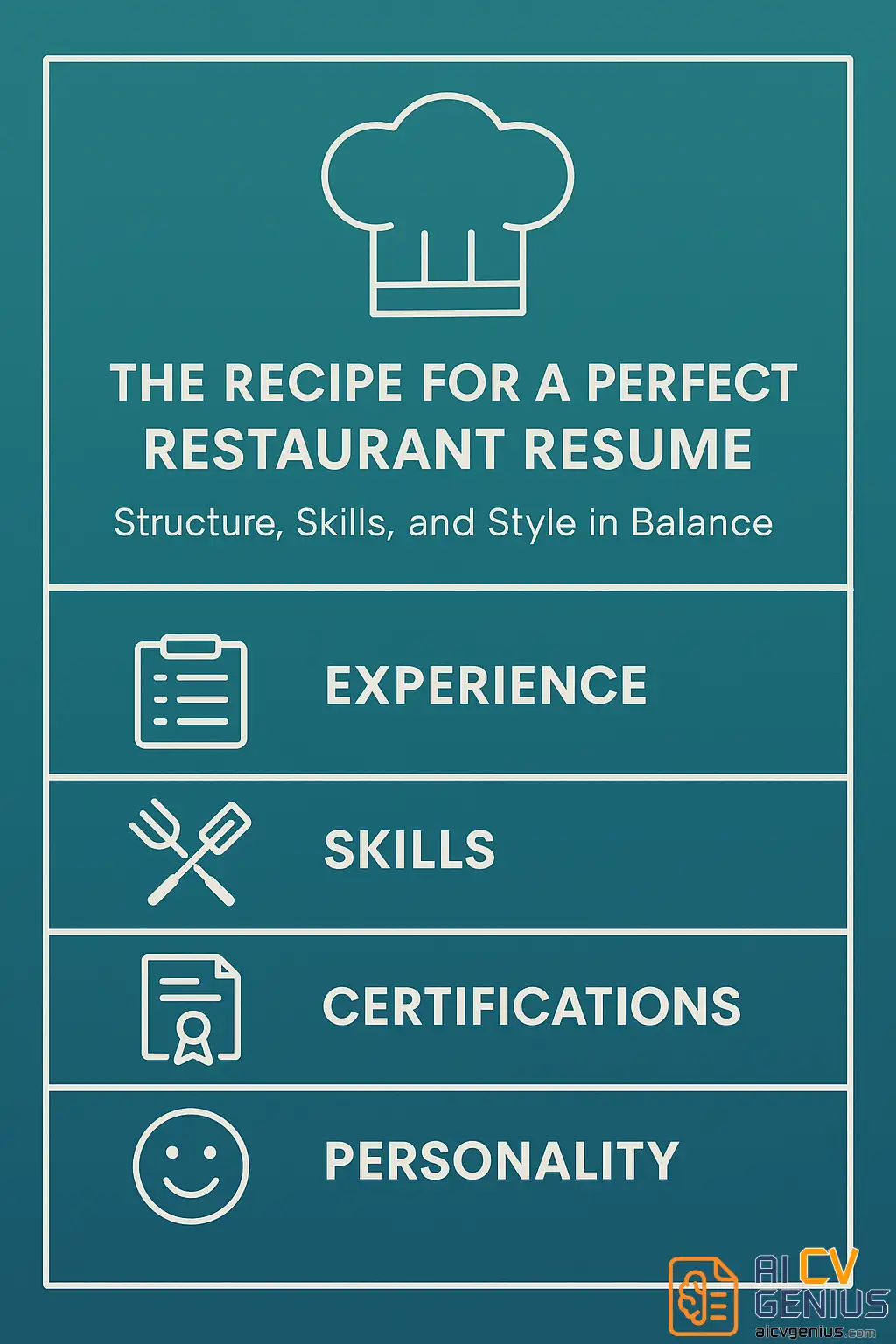
A successful restaurant resume template provides distinct, clear sections for both. It’s not just a list of jobs; it’s a narrative of your reliability. This is why the flow is critical: fast readability, emphasis on teamwork, proof of dependability, and a logical section flow (Summary → Skills → Experience → Certifications).
The Unbeatable Layout: Professional Hospitality Resume Format
The best structure for 99% of restaurant applications is the reverse-chronological format. It lists your most recent job first, which is exactly what hiring managers want to see. A “hybrid” format can also work, leading with a powerful skills section followed by the chronological experience. Here is a breakdown of what makes each section powerful.
| Section | In-Depth Purpose & Strategy |
|---|---|
| Header | This is your business card. Keep it clean. Include your Full Name, a professional email (not hotstuff99@…), your phone number, and your city/state. A LinkedIn URL is great, especially for management roles. |
| Professional Summary | This is your 3-line “elevator pitch.” It’s not an “Objective.” It summarizes your experience, your core strength, and your key skills. It must be customized for every job. (See examples below). |
| Key Skills | This is your “Mise en Place.” A bulleted section, split into Hard Skills (e.g., POS Systems, Food Safety, Inventory) and Soft Skills (e.g., Team Leadership, De-escalation, Multitasking). This allows a manager to scan and confirm you have the basics. |
| Work Experience | The main course. This is where you prove your value. Use the reverse-chronological format. For each job, include your Title, the Restaurant Name, and the dates. Underneath, use 3-5 bullet points that show achievements, not just duties. |
| Education & Certifications | This section is non-negotiable. List your food safety training (ServSafe), alcohol service permits (TIPS), or any other culinary- or management-related education. This shows professionalism and a commitment to safety. |
Crafting the Professional Summary: Your “Specials Board”
The summary is your single best chance to hook the reader. It must be dense with value. Avoid “fluff” like “hard-working team player.” Instead, prove it.
Weak Summary:
“Hard-working server looking for a new opportunity. Skilled in customer service and a fast learner.”
Strong Server Summary:
“Energetic and dependable server with 4+ years of experience in high-volume, upscale casual dining. Expert in guest relations and POS systems, with a proven ability to increase average check size by 15% through intuitive upselling. ServSafe certified.”
Strong Cook Summary:
“Detail-oriented Line Cook with 3 years of experience specializing in sauté and grill stations. Passionate about consistency, speed, and kitchen hygiene. Proven to maintain ticket times under 10 minutes during peak service for a 150-seat restaurant.”
Strong Manager Summary:
“Results-driven Restaurant Manager with 8 years of progressive experience, including FOH and BOH management. Successfully led a team of 30, reduced food costs by 12% through strategic inventory control, and improved staff retention by 25%.”
Essential Skills for Restaurant Jobs: The “Mise en Place” of Your Resume
A dedicated “Skills” section is critical for both the human reader and the Applicant Tracking System (ATS) software. This is where you list keywords the manager is searching for. Always be specific. Don’t just say “POS Systems”; name them.
| Hard Skills (Technical Abilities) | Soft Skills (Service & Character) |
|---|---|
|
|
Under your Work Experience, you will prove these skills. Instead of just listing “Teamwork,” a bullet point might say:
“Acted as a key liaison between FOH and BOH, clearly communicating guest modifications and allergies, resulting in a 99% order accuracy rate.”
Certifications: The Non-Negotiable Signals of Professionalism
In this industry, certifications are not just “nice to have”; they are critical signals of professionalism, safety, and legal compliance. Having them on your resume tells a manager that you are a serious professional who doesn’t need basic training. This section should be clean, clear, and prominent.
- ✅ ServSafe Food Handler / Manager Certification: This is the gold standard. For many BOH roles and all management roles, it’s a requirement. It shows you understand the fundamentals of food safety and hygiene.
- ✅ TIPS or Alcohol Server Permit: For any FOH role (server, bartender, manager), this is essential. It proves you understand the legal responsibilities of serving alcohol and how to do so safely.
- ✅ CPR / First Aid: Especially valuable for management, shift lead, or host roles. It shows you are prepared to handle emergencies, which is a massive plus.
- ✅ Language Certifications: If you work in a diverse, metropolitan area, being certified as bilingual can be a significant advantage in communicating with both guests and fellow staff.
- ✅ Sommelier or Cicerone Levels: For fine dining or craft bar roles, these certifications demonstrate an elite level of expertise and are a major differentiator.
Visual Design & Format: The “Ambiance” of Your Resume
Your resume’s design should reflect the very essence of hospitality: clean, organized, and welcoming. It should be easy to read. This is not the place for flashy graphics, photos of yourself, or bizarre fonts. The goal is elegant readability.
- Fonts: Stick to clean, professional fonts. Sans-serif fonts like Inter, Lato, Roboto, or Calibri are excellent for readability on-screen. A classic serif like Georgia can also work for a more traditional or fine-dining feel.
- White Space: Do not crowd your text. Use 1-inch margins and leave adequate spacing between sections. A resume that is crammed with text is a resume that will not be read. White space is your friend; it guides the reader’s eye.
- Color: Avoid overloading with color. A single, subtle accent color (like a deep blue, burgundy, or dark teal) for your name or section headings can add a touch of class, but it’s not necessary. Black and white is perfectly professional.
- Consistency: This is key. If you use a bullet point for one job, use it for all. If one job title is bolded, all job titles must be bolded. Inconsistency looks sloppy.
Tools like Canva or FreeResumeHub’s Resume Templates Finder can be excellent starting points. They help you build resumes that are specifically tailored to service jobs. However, always choose a template that prioritizes text and structure over heavy graphics. Many Applicant Tracking Systems (ATS) cannot read text inside images, columns, or complicated tables.
Tailoring Your Resume: Scenarios, Examples, and Case Studies
A generic resume is a weak resume. Your content must shift to match the specific role you want. A host’s resume should emphasize organization, while a manager’s must prove leadership and financial acumen. Here is how to adapt your story for different scenarios.
Tailoring Your Focus for Every Role
Your resume’s focus must shift dramatically depending on the role you’re targeting. A “Server” resume that reads like a “Chef” resume will fail. Here are restaurant resume examples for servers and chefs, and others, to illustrate how to pivot your narrative.
| Role | Primary Resume Focus & Narrative |
|---|---|
| Server / Waiter / Bartender | Your resume is a story of profitability and guest experience. You are the face of the business. Focus on customer service, upselling (with numbers!), multitasking (e.g., “Managed a 6-table section during peak hours”), cash handling accuracy, and deep menu knowledge. |
| Chef / Cook (BOH) | Your resume is a testament to consistency, speed, and quality. Focus on kitchen teamwork, station management (grill, sauté, garde-manger), food prep efficiency, inventory control, and upholding food safety standards. “Creativity” is good, but “reliability” is better. |
| Host / Hostess | Your resume must highlight organization and grace under pressure. You are the “Director of First Impressions.” Emphasize guest experience, mastery of reservation systems (OpenTable, Resy), managing waitlists, and being the central communication hub for the floor. |
| Restaurant Manager | Your resume is a business case. It’s all about leadership and metrics. Focus on P&L, cost control, staff training and retention, inventory management, vendor relations, and driving revenue. Every bullet point should ideally tie back to a number or a growth initiative. |
How to Write a Restaurant Resume With No Experience (And Still Get the Job)
This is the question that keeps new job seekers awake at night. If you’re new to hospitality, don’t panic. Managers know that in this industry, attitude beats experience. They would rather hire a positive, reliable, and eager person with no experience than a jaded “veteran” with a bad attitude. Your resume’s job is to showcase that positive, reliable attitude.
When you have no formal restaurant experience, your resume must focus on transferable skills. These are abilities you’ve learned in other areas of life – school, volunteering, retail, or even personal projects – that are directly relevant to a restaurant.
Transferable Skills to Highlight:
- Customer Service: Did you work in retail? You handled customer questions and operated a cash register. That’s a direct-hire skill.
- Teamwork: Were you on a sports team, in a school play, or part of a group project? You know how to collaborate and work toward a common goal.
- Multitasking: Were you a full-time student who also had a part-time job? You can juggle multiple priorities.
- Work Ethic: Did you volunteer? Have perfect attendance? This shows dependability.
Instead of a “Work Experience” section, you might call it “Relevant Experience.”
Example for a “No Experience” Resume:
Relevant Experience
Shift Lead | Gap Retail Store | Anytown, USA | Aug 2023 – Present
- Greeted and assisted over 100+ customers daily in a fast-paced retail environment.
- Handled all cash and credit transactions with 100% accuracy using a modern POS system.
- Trained 2 new team members on store procedures and customer service standards.
Volunteer Event Coordinator | Local Food Bank | Weekends
- Assisted in setting up and serving weekend meals for 200+ guests.
- Maintained a clean and organized service area, adhering to all food safety guidelines.
This tells a manager you are reliable, good with people, and understand service flow – all without ever having worked in a restaurant.
The Powerhouse: Deconstructing the Restaurant Manager Resume Layout
When you graduate to a management role, your resume must evolve. A restaurant manager resume layout is less about what you did and more about what you led others to do. It is a document of leadership and measurable business impact. Your resume must prove you can be trusted with the “three P’s”: People, Product, and Profit.
Your “Work Experience” bullet points must be packed with metrics. Use the PAR (Problem-Action-Result) framework to build them.
Instead of this (Weak): “Responsible for staff training and inventory.”
Use this (Strong & Metric-Driven):
- ✅ (People) Developed and implemented a new FOH staff training program, increasing team knowledge of wine pairings and upselling techniques, which contributed to a 10% rise in beverage sales.
- ✅ (Profit) Reduced inventory waste by 12% in 6 months by introducing a data-driven ordering system and negotiating new terms with two primary vendors.
- ✅ (People) Overhauled the weekly staff schedule to better align with peak/off-peak hours, cutting overtime labor costs by 15% while improving service coverage.
- ✅ (Product) Collaborated with the Head Chef to re-engineer the menu, highlighting high-margin items and improving overall Gross Margin by 4 points.
A manager’s resume can (and often should) extend to two pages if the experience is deep and relevant. It should also feature a more robust “Core Competencies” (Skills) section, including things like P&L Management, COGS Control, Staff Recruitment & Retention, and Vendor Negotiations.
A Case Study: From Dishwasher to Supervisor
I once worked with a young man, let’s call him Miguel. He started as a dishwasher in a local diner, and his first resume was, understandably, just a single line. He wanted to move up but felt stuck. He was reliable, hard-working, and smart, but his resume didn’t communicate any of that. It just said “Dishwasher.”
We sat down and restructured it. We didn’t invent experience, we translated it.
- “Washed dishes” became “Managed high-volume dish-pit operations, processing up to 500 plates per hour during peak service.”
- “Put away boxes” became “Assisted BOH team with inventory management, implementing a new ‘First-In, First-Out’ (FIFO) system for dry storage.”
- “Cleaned the floors” became “Upheld rigorous sanitation standards, consistently scoring 100% on internal hygiene audits.”
We added a “Skills” section for his ServSafe certification (which he got on his own) and his bilingual (Spanish/English) abilities. Within six months, he used that new resume to apply for a shift lead position. He got it. Today, he’s a supervisor. His growth wasn’t just luck; it was about learning to articulate his value with clarity and confidence. A structured resume told his story of dependability far better than any fancy design could.
The Complete Restaurant Resume Example (Putting It All Together)
Theory is one thing; practice is another. Let’s apply every strategy we’ve discussed to build a complete resume for a fictional candidate, Emily Hayes, a senior server.
EMILY HAYES
Senior Server | FOH Trainer
Austin, TX 78701 | (555) 123-4567 | emily.hayes.server@email.com | linkedin.com/in/emilyhayes
PROFESSIONAL SUMMARY
Energetic and dependable Senior Server with 5+ years of experience in high-volume, upscale casual dining. Expert in guest relations, POS systems (Toast, Aloha), and menu knowledge. Proven ability to increase average check size by 15% through intuitive upselling and wine pairing recommendations. TIPS and ServSafe certified, with a passion for training new staff and fostering a positive, team-oriented environment.
KEY SKILLS
HARD SKILLS (TECHNICAL)
| SOFT SKILLS (SERVICE)
|
PROFESSIONAL EXPERIENCE
Senior Server & FOH Trainer | Uchi | Austin, TX (2020 – Present)
- Manage a 6-table section in a high-volume, upscale environment, consistently generating top-tier sales by increasing average check size by 15% through menu knowledge and wine pairings.
- Selected as FOH Trainer; successfully trained and mentored 8 new servers on fine-dining service standards, menu details, and the Toast POS system, improving their 30-day performance scores.
- Act as a key liaison between FOH and BOH, clearly communicating guest allergies and modifications, resulting in a 99.9% order accuracy rate.
- Maintained a 100% accuracy rate on all cash and credit card transactions, balancing a drawer of over $3,000 nightly.
Server & Bartender | The Grove Wine Bar | Austin, TX (2018 – 2020)
- Greeted and served 100+ guests daily, providing detailed knowledge of 50+ wines and food pairings.
- Mastered the Aloha POS system for all order entry and payment processing.
- Assisted with monthly inventory counts for the bar and received “Employee of the Month” twice for reliability and positive guest feedback.
CERTIFICATIONS & EDUCATION
- TIPS (Training for Intervention Procedures) Certified (Active)
- ServSafe Food Handler Certification (Active)
- Bachelor of Arts in Communication | The University of Texas at Austin (2018)
From Good to Great: Final Polish, Pitfalls, & FAQs
Once the core components are in place, the final step is to refine your message and avoid the common mistakes that get otherwise good resumes thrown in the trash. This is about elevating your story from “qualified” to “must-hire.”
Common Mistakes That Get Restaurant Resumes Thrown in the Trash
Having read thousands of resumes, I see the same avoidable mistakes every day. Avoid these “dropped trays” at all costs:
- ❌ Vague Job Duties: Listing “Responsible for customer service” or “Handled food” is useless. It’s a passive description. Use active verbs and show results: “Greeted 50+ tables per shift” or “Prepared and plated appetizers with 100% adherence to plating guides.“
- ❌ Forgetting Certifications: Leaving off your ServSafe or TIPS certification is a critical error. It’s often the first thing a manager looks for.
- ❌ Ignoring Teamwork: Your resume reads like you worked in a silo. A restaurant is a team. Use phrases like “Collaborated with…“, “Assisted…“, “Communicated with…“
- ❌ Complicated, Graphic-Heavy Layouts: Using a template that has progress bars for skills, a photo of yourself, or artsy columns. This is unreadable by ATS software and looks unprofessional.
- ❌ Typos and Grammatical Errors: This is the kiss of death. In an industry where “attention to detail” is paramount, a typo on your resume signals that you are careless. Proofread it. Then have someone else proofread it.
The Core Philosophy of a Professional Hospitality Resume Format
A professional hospitality resume format is not about decoration; it’s about strategic communication. Its entire purpose is to flow. It must guide the hiring manager’s eye from your name, to your value proposition (Summary), to your qualifications (Skills), and finally to your proof (Experience).
The key is to highlight achievements with active verbs. Every bullet point should start with a strong word: “Managed,” “Coordinated,” “Implemented,” “Served,” “Resolved,” “Trained,” “Reduced,” “Increased.”
Recruiters love quick impact lines that are supported by data. Even small numbers make a big difference.
“Coordinated a team of 6 servers during special events, ensuring seamless service for parties up to 150 guests.”
This is infinitely more powerful than, “Worked at special events.” Your resume is your personal menu of strengths. Make every item sound appetizing.
Frequently Asked Questions (FAQ) for Restaurant Resumes
- Use a simple, clean layout. Avoid columns, text boxes, and graphics. A single-column, top-to-bottom layout is safest.
- Use standard headings. Use “Work Experience,” “Skills,” and “Education,” not “My Journey” or “Things I’m Good At.”
- Mirror keywords. Look at the job description. If it asks for “Toast POS experience” and “inventory management,” you must have the words “Toast POS” and “inventory management” in your skills or experience section.
Head Server | The Summer Grill, Ocean City | (Seasonal: May – Sept 2022, 2023)
This shows you are reliable and were invited back. If you have many short-term gigs (e.g., from a temp agency or event company), group them together under one heading:
Events Server | Hospitality Staffing Group | 2022 – Present
- Executed high-end service for various clients including corporate banquets, weddings, and private events (100-500 guests).
- Adapted quickly to new teams and service styles on a weekly basis.
Final Thoughts: Your Resume is Your Story
A restaurant resume template is more than a piece of paper; it’s your professional menu. It’s an advertisement for your skills, your reliability, and your passion for service. Keep it simple, keep it honest, and pack it with achievements. Whether you are just starting as a host or you’re aiming for a multi-unit management role, the right layout – one that is clean, professional, and easy to digest – will serve your story with the clarity and confidence you deserve. Now, go serve that first table.