
- Build an HR resume around measurable business impact, not a task list, and keep it tight at 1 to 2 pages.
- Treat HRIS, ATS, payroll systems, and analytics tools as real keywords, because employers often filter for them.
- Show modern HR range when relevant, including DEI work, data-driven HR decisions, and practical AI or automation outcomes.
- Make credibility easy to spot with clear certifications and a few high-signal achievements that prove outcomes.
- Run a final pass for tailoring, ATS-friendly layout, correct file formats (PDF and DOCX), and ruthless proofreading.
As a Human Resources professional, you navigate the world of resumes daily. You recognize the exceptional ones that articulate a clear career story, and you’ve undoubtedly encountered those that obscure potential. That’s the inherent challenge: when crafting your own HR resume, the standard is exceptionally high. You are expected to exemplify best practices because you often evaluate others. This pressure can be daunting, but the right HR resume template provides the structure needed to translate your diverse experience – from talent acquisition to employee relations – into a compelling narrative showcasing your impact on culture and organizational effectiveness.
The Challenge, Advantage, and Real-World Examples
The HR Resume Paradox: Scrutiny and Advantage
Recruiters hold HR candidates to a higher standard; errors easily overlooked in other fields can be disqualifying. Simultaneously, your insider knowledge of Applicant Tracking Systems (ATS) and recruiter scanning patterns provides a significant advantage. A template designed specifically for HR helps you leverage this advantage, balancing essential structure with effective storytelling to satisfy both software filters and human reviewers. It ensures your strategic contributions aren’t lost in administrative details.
Illustrative Story: The HR Assistant Who Was Overlooked
Consider Maria, applying for an HR Assistant role at a multinational firm. Her resume listed duties such as “responsible for onboarding new hires” and “handled employee personnel files.” The crucial flaw? These descriptions are generic and fail to convey scope or efficiency. Lacking specific numbers, outcomes, or evidence of process improvement, her resume didn’t differentiate her. The recruiter scanned it briefly and moved on, overlooking potentially valuable skills hidden behind vague language.
Illustrative Story: The Resume That Secured the Interview
Contrast Maria’s experience with David’s application for the same role. His resume, utilizing a clean, professional template, focused on quantifiable impact rather than mere duties:
- ✅ Successfully onboarded 45+ new employees across three departments within a 6-month period, achieving 100% compliance with documentation requirements.
- ✅ Led the digitization of 500+ employee personnel files using [HRIS System], reducing average file retrieval time by approximately 60%.
- ✅ Supported employee engagement initiatives (e.g., surveys, events) which correlated with a departmental turnover reduction of 12% year-over-year.
David didn’t just describe tasks – he quantified results and demonstrated efficiency. His resume told a compelling story of tangible impact, leading directly to an interview invitation.
Core Sections of an Effective HR Resume Template
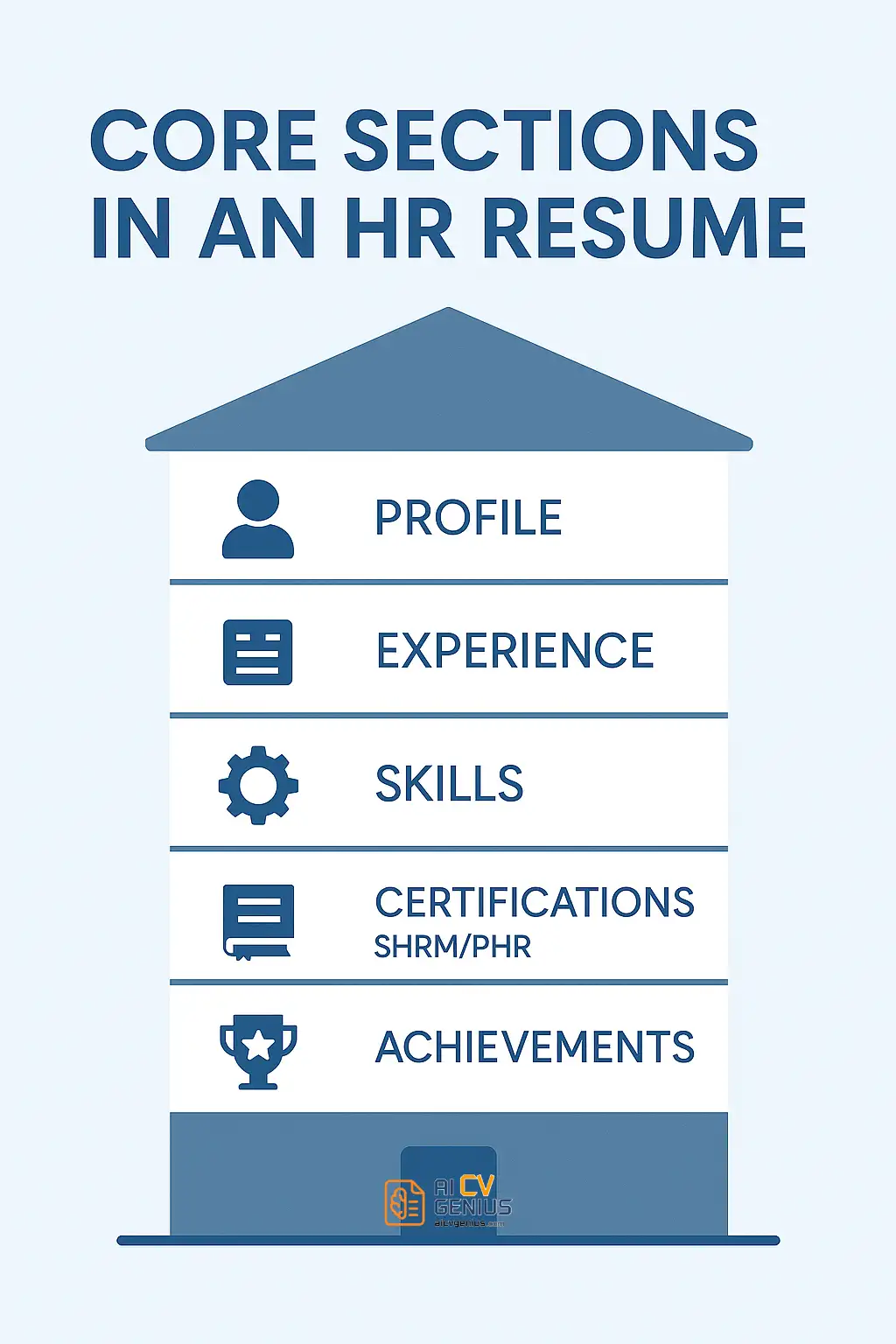
A robust HR resume must include these key sections, optimized for clarity and impact:
Professional Summary / Profile
A concise 3-4 line introductory statement tailored to the target role. Highlight years of experience, key HR specializations (talent acquisition, employee relations, compensation & benefits, HRIS), significant achievements, and relevant certifications. Example: “SHRM-CP certified Human Resources Generalist with 7 years of comprehensive experience across the employee lifecycle, specializing in talent acquisition, performance management, and HR compliance within the tech industry. Proven ability to build inclusive workplace cultures and streamline HR processes using data-driven insights.”
Work Experience
This section is paramount. Use reverse-chronological order. Focus relentlessly on achievements and outcomes, quantifying whenever possible. Start each bullet point with a strong action verb relevant to HR functions (e.g., Managed, Led, Developed, Implemented, Reduced, Increased, Advised, Coordinated, Resolved). Frame responsibilities as accomplishments.
- “Reduced average time-to-hire from 45 days to 30 days for key technical roles by optimizing the recruitment workflow and implementing a new ATS module.”
- “Led the development and launch of a company-wide diversity hiring initiative, resulting in a 20% increase in representation from underrepresented groups within 18 months.”
- “Successfully implemented a new Human Resources Information System (HRIS) [Specify System, e.g., Workday HCM], leading to a 35% reduction in payroll processing errors and improved data accuracy.”
- “Resolved 95%+ of employee relations issues within 48 hours through effective mediation and adherence to company policy and labor laws.”
Skills
Categorize skills for easy scanning by both recruiters and ATS. Be specific.
- ✅ HRIS & ATS Proficiency: Workday, BambooHR, SAP SuccessFactors, ADP Workforce Now, Greenhouse, Lever (Specify systems you have direct experience with)
- ✅ Core HR Functions: Talent Acquisition & Recruitment, Onboarding & Offboarding, Employee Relations, Performance Management, Compensation & Benefits Administration, HR Compliance, Training & Development
- ✅ Compliance & Labor Law Knowledge: FLSA, EEO, FMLA, ADA, OSHA (Specify relevant regulations for your region/industry)
- ✅ Strategic HR Skills: HR Analytics & Reporting, Workforce Planning, Organizational Development, Change Management, Diversity, Equity & Inclusion (DEI) Strategy
- ✅ Software & Tools: Microsoft Office Suite (Advanced Excel), Google Workspace, Project Management Software (e.g., Asana, Trello), Survey Tools (e.g., SurveyMonkey)
Education
List your degree(s) (e.g., Master of Science in Human Resource Management, Bachelor of Arts in Psychology), the full name of the institution, location, and graduation date. Include relevant coursework only if you are early-career (e.g., Organizational Behavior, Employment Law, Compensation Strategy, Business Management).
Certifications
Credentials significantly boost credibility in HR. List prominent certifications clearly: SHRM-CP (Society for Human Resource Management Certified Professional), SHRM-SCP (Senior Certified Professional), PHR (Professional in Human Resources), SPHR (Senior Professional in Human Resources), GPHR (Global Professional in Human Resources) from HRCI, or relevant certifications from CIPD or other recognized bodies. Indicate status if actively pursuing (e.g., “SHRM-CP Candidate, Exam scheduled Dec 202X”).
Achievements / Key Contributions (Optional but Recommended)
If not fully captured in Work Experience, a separate section can highlight significant accomplishments, especially those spanning multiple roles or demonstrating strategic impact.
- “Spearheaded a new employee wellness program resulting in a 10% decrease in reported absenteeism within the first year.”
- “Redesigned the performance review process, leading to a 25% increase in employee satisfaction scores related to feedback and development in annual surveys.”
- “Successfully built and launched a formal mentorship program pairing 30 junior staff members with senior leaders, receiving positive feedback from 90% of participants.”
Complete HR Resume Example (Mid-Level Generalist)
This full, ATS-friendly resume example applies the core principles discussed, focusing on quantifiable achievements and strategic impact. This example uses bolding for internal section headers rather than heading tags for clean parsing.
JANE M. HERNANDEZ, SHRM-CP
(123) 456-7890 | jane.hernandez@email.com | LinkedIn.com/in/janehernandezhr
Professional Summary
SHRM-CP certified Human Resources Generalist with 7 years of comprehensive experience across the employee lifecycle, specializing in talent acquisition, performance management, and HR compliance within the tech industry. Proven ability to build inclusive workplace cultures and streamline HR processes using data-driven insights. Seeking to leverage expertise in employee relations and HRIS management to support organizational growth at [Target Company].
Core Competencies & HRIS Skills
Core HR: Talent Acquisition, Employee Relations, Onboarding & Offboarding, Performance Management, Compensation & Benefits
Strategic HR: HR Analytics, DEI Strategy Implementation, Change Management, Workforce Planning
Compliance: FLSA, FMLA, EEO, ADA, HR Audits
HRIS/ATS: Workday (Advanced), BambooHR, ADP Workforce Now, Greenhouse, Lever
Professional Experience
HR Generalist | TechForward Solutions Inc. | San Francisco, CA | June 2021 – Present
- Managed full-cycle recruitment for 3 departments (Engineering, Marketing, Sales), reducing average time-to-hire from 45 days to 30 days by optimizing workflows and implementing a new Greenhouse ATS module.
- Led the development and launch of a company-wide diversity hiring initiative, resulting in a 20% increase in representation from underrepresented groups within 18 months.
- Resolved 95%+ of employee relations issues within 48 hours through effective mediation and adherence to company policy.
- Coordinated the annual performance review cycle for 250+ employees, achieving a 99% on-time completion rate and training 20 new managers on the process.
HR Coordinator | DataCore Systems | Austin, TX | Jan 2018 – May 2021
- Successfully onboarded 150+ new employees, achieving 100% compliance with documentation requirements and improving 30-day new-hire satisfaction scores by 15% through a revised orientation program.
- Led the digitization of 500+ employee personnel files using BambooHR, reducing average file retrieval time by 60%.
- Supported employee engagement initiatives (e.g., surveys, events) which correlated with a departmental turnover reduction of 12% year-over-year.
Education & Certifications
Master of Science in Human Resource Management
Texas A&M University, College Station, TX
Bachelor of Business Administration
The University of Texas at Austin, Austin, TX
SHRM Certified Professional (SHRM-CP)
Society for Human Resource Management (SHRM), 2020
Tailoring Content Across HR Career Levels
The focus of your resume should evolve with your experience:
Entry-Level (HR Assistant / Coordinator / Intern)
- Emphasize relevant internships, administrative experience, or volunteer roles where HR-related tasks were performed (scheduling interviews, assisting with onboarding paperwork, maintaining employee records).
- Showcase strong organizational skills, attention to detail, proficiency in basic HR software (if any), and MS Office Suite.
- Highlight relevant coursework (HR principles, business communication) and eagerness to learn.
- Quantify where possible: “Supported the onboarding process for approximately 15 new hires per quarter,” or “Processed and verified I-9 documentation for 50+ employees with 100% accuracy.”
Mid-Level (HR Generalist / Specialist / Business Partner)
- Demonstrate experience across multiple HR functions (recruitment, employee relations, benefits, compliance).
- Provide specific examples of programs implemented or processes improved (e.g., performance management cycles managed, training modules developed and delivered, successful resolution of complex employee relations cases).
- Quantify impact: recruitment metrics (time-to-fill reduction, cost-per-hire optimization), employee engagement survey score improvements, retention rate increases influenced by your initiatives.
- Highlight certifications like SHRM-CP or PHR and proficiency in specific HRIS/ATS platforms.
Senior (HR Manager / Director / VP of HR)
- Focus shifts to strategic leadership, organizational impact, and team management. Detail the size of teams managed and scope of budgets overseen.
- Highlight development and execution of major strategic initiatives (e.g., organizational restructuring, implementation of new HR technology platforms, design of total rewards strategy, leadership development programs).
- Emphasize experience in policy development, ensuring legal compliance across complex areas, and managing significant change initiatives.
- Showcase experience partnering with executive leadership, influencing business strategy, and using HR analytics to drive decisions. Mention advanced certifications like SHRM-SCP or SPHR.
Incorporating Modern HR Trends
Today’s HR roles demand expertise beyond traditional functions. Consider highlighting experience in these evolving areas:
DEI (Diversity, Equity, Inclusion)
Crucial in modern workplaces. If you’ve led, developed, or significantly contributed to DEI programs, audits, or training initiatives, detail your role and any measurable outcomes (e.g., improved diversity metrics, enhanced inclusive policies).
HR Analytics & Data-Driven Decision Making
Data proficiency is no longer optional. Mention specific experience using HR data to identify trends (e.g., turnover analysis, engagement drivers), create insightful dashboards (using tools like Excel, Power BI, Tableau), and inform strategic HR decisions.
AI and Automation in HR
Familiarity with AI-powered recruitment tools, chatbots for candidate engagement, or automation of routine HR tasks is increasingly valuable. If applicable, mention specific tools used and the efficiencies gained.
Example:
“Leveraged an AI-powered resume screening tool [Specify Tool] to reduce initial applicant review time by approximately 50%, allowing focus on higher-quality candidates.”
Addressing Global HR and Remote Work Environments
As workplaces become more distributed, showcasing your ability to manage HR functions across borders or within remote settings is key:
- ✅ Highlight experience managing HR processes (onboarding, payroll, compliance) for employees located in multiple states or countries (e.g., “Managed onboarding and compliance for remote employees across 15 US states and 5 international locations”).
- ✅ Demonstrate familiarity with relevant international labor laws, visa processes, or compliance frameworks (e.g., GDPR, specific country regulations).
- ✅ Showcase experience developing and implementing remote work policies, virtual engagement initiatives, or performance management strategies tailored for distributed teams.

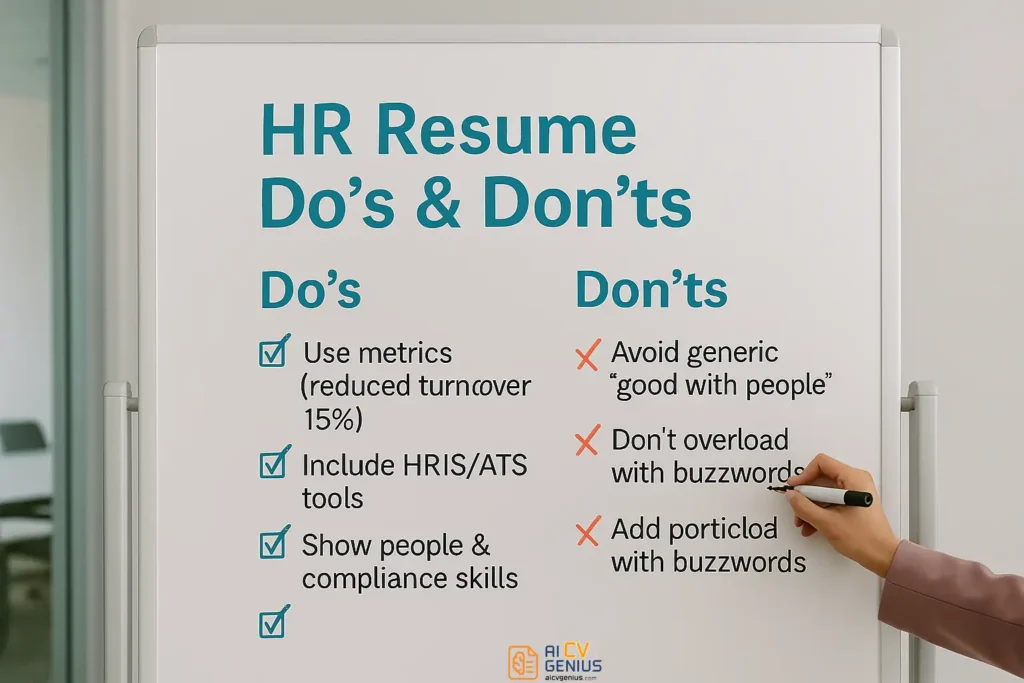
Key Hr Resume Do’s &Amp; Don’ts Include Quantifying Results And Ensuring Ats Compatibility.
Debunking Common HR Resume Myths
Avoid these misconceptions when crafting your HR resume:
| Myth | Truth |
|---|---|
| ❌ HR resumes are primarily administrative and don’t require quantifiable metrics. | ✅ Numbers demonstrating business impact (cost savings, efficiency gains, improved retention, faster hiring) are crucial for showcasing strategic value. |
| ❌ Simply listing soft skills like “good communication” or “strong interpersonal skills” is sufficient. | ✅ Demonstrate these skills through concrete examples and achievements. Instead of listing “communication,” describe how you “Developed and delivered monthly HR newsletters improving internal communication scores by 15%.” |
| ❌ A longer resume detailing every task performed is always more impressive. | ✅ Recruiters value conciseness and relevance. Stick to 1–2 pages maximum, focusing on impactful achievements tailored to the target role. |
| ❌ HR is not a technical field, so listing software skills is secondary. | ✅ Proficiency in HRIS, ATS, payroll systems, and data analytics tools (especially advanced Excel) are often essential requirements and critical keywords. |
Final Checklist Before Submitting Your HR Resume
Perform this meticulous review before sending your application:
- ✅ Is the Professional Summary tailored specifically to the target HR role and company?
- ✅ Does the Work Experience section emphasize quantifiable achievements using strong action verbs?
- ✅ Are relevant HRIS, ATS, and other essential software keywords included naturally throughout?
- ✅ Are key HR certifications (SHRM, HRCI, etc.) listed clearly and accurately?
- ✅ Is the template format clean, professional, easily scannable, and confirmed to be ATS-friendly (preferably single-column)?
- ✅ Have you saved the resume in both visually consistent PDF and ATS-parsable DOCX formats?
- ✅ Has the resume been rigorously proofread multiple times for any typos, grammatical errors, or inconsistencies? (Accuracy is paramount in HR).
FAQs about HR Resume Template
Generally, yes. Since HR professionals are expected to understand resume best practices, errors in formatting, grammar, or clarity can reflect poorly on their attention to detail and professional standards. A flawless presentation is crucial.
Focus on metrics demonstrating impact on key business outcomes: reduction in employee turnover rates (%), improvement in time-to-fill for open positions (days or %), increase in employee engagement survey scores (%), reduction in HR operational costs ($ or %), results of compliance audits (e.g., error rate reduction), training program completion rates or effectiveness scores (%).
No, prioritize professionalism and clarity. A clean, well-structured, ATS-friendly template is far more effective than heavy graphics or unconventional layouts. Subtle use of professional accent colors (like navy or grey) is acceptable, but avoid anything that could hinder readability or ATS parsing.
Absolutely, if you have relevant experience. DEI is a critical focus area in modern HR. Highlighting your contributions to developing, implementing, or supporting DEI initiatives, policies, or training programs is highly valuable to employers.
Focus on transferable skills from internships, volunteer work, academic projects, or even non-HR jobs (e.g., customer service, project coordination). Emphasize strong organizational skills, attention to detail, communication abilities, proficiency in basic office software, and any relevant coursework. A clear, enthusiastic Resume Objective tailored to the role is also important.
Yes, highly. Certifications from recognized bodies like SHRM (SHRM-CP, SHRM-SCP) or HRCI (PHR, SPHR) significantly enhance credibility, demonstrate commitment to the profession, and are often preferred or required for mid-level and senior HR roles. Listing them prominently is essential.
Yes, definitely. Proficiency in specific HRIS (e.g., Workday, SAP SuccessFactors, BambooHR), ATS (e.g., Greenhouse, Lever, Taleo), payroll systems (e.g., ADP), and performance management platforms are essential keywords that both ATS and recruiters look for. Be specific about the systems you know.
Demonstrate them through concrete achievements rather than just listing them. Instead of saying “Strong leadership skills,” describe an achievement like: “Led a project team of 4 to implement a new employee recognition program, resulting in a 15% increase in positive feedback on internal surveys.” This shows leadership in action.
One page is generally preferred for entry-level professionals and those with less than ~7-10 years of experience. Two pages are acceptable and often necessary for mid-to-senior level HR professionals (Managers, Directors, VPs) with extensive, relevant experience and significant leadership accomplishments. Never exceed two pages for standard industry roles. Prioritize relevance and impact.
Yes, customization is crucial for maximizing your chances. While your core experience remains constant, you should tailor your Professional Summary, highlighted Skills, and the specific achievements emphasized in your Work Experience section to directly align with the keywords, requirements, and priorities listed in each unique job description. Generic, one-size-fits-all resumes rarely capture attention effectively.
Final Thoughts: Your Resume as a Reflection of Your HR Expertise
As an HR professional, your resume serves a dual purpose: it is both your personal career narrative and a tangible demonstration of your understanding of effective professional communication and presentation. Utilizing the right HR resume template enables you to strategically combine quantifiable business impact with essential human elements – showcasing your expertise in compliance alongside your ability to foster positive workplace cultures, and your technical proficiency alongside your interpersonal skills.
Remember, recruiters aren’t merely seeking someone to manage HR processes; they are searching for a strategic partner who can attract, develop, and retain talent, ultimately contributing to organizational success. Ensure your resume clearly communicates that you are that partner. By doing so, your resume transcends being just a document – it becomes compelling evidence of the value and leadership you bring.