
- A strong doctor resume is a trust document: It should read like a clinical record of judgment, leadership under pressure, and compassion, not a sterile list of degrees and procedures.
- Hospitals hire to reduce risk: They scan for safety-minded decisions, efficiency and throughput, patient satisfaction signals, and proof you collaborate and lead teams, not act like a solo hero.
- Win the ATS before anything else: Use standard headings, a clean one-column layout, and mirror the exact job-description phrases so the software can match your credentials and priorities.
- Structure it like a patient chart: Clear header with credentials, a dense 3 to 4 line summary, grouped competencies, then achievement bullets written as Action Verb + Project + Metric.
- Prove the human side with evidence: Use proxy metrics and outcomes like HCAHPS, patient education, mentorship, ethics or safety work, and tailor emphasis by specialty while avoiding common mistakes like passive language or using a full CV for a clinical job.
In the field of medicine, trust is the ultimate currency. A great doctor doesn’t just heal the body; they command confidence, communicate with clarity, and lead under pressure. Your Doctor resume must accomplish the same feat. It is more than a simple list of credentials; it is a clinical record of your judgment, your expertise, and your ability to manage the most high-stakes situations in human life.
Whether you are a Resident seeking your first attending position, an experienced Physician pivoting to a new specialty, or a seasoned leader applying for a Chief of Medicine role, your resume must communicate two things with equal force: profound clinical competence and deep, unshakable compassion. Most medical resumes fail because they are sterile. They list procedures and degrees but fail to capture the human element – the leadership in a crisis, the empathy at the bedside, the relentless drive for a better outcome.
This guide will deconstruct the medical hiring process from the inside. We will move beyond a simple CV and build a resume that functions as a powerful narrative – a document that proves you don’t just practice medicine, you advance it. Let’s build a record that does justice to your skill, your humanity, and your career.
The Recruiter’s Diagnosis: What Hospitals Really Want (And How to Pass the ATS)
Before a human ever sees your file, it must pass two gatekeepers: the Applicant Tracking System (ATS) and the recruiter’s initial scan. When a hospital administrator, Chief of Staff, or HR recruiter reviews your resume, they are not just “filling a role.” They are managing profound risk and guarding the hospital’s reputation. Your credentials (MD, board certification) are the minimum entry fee. They are looking for signals that you are a high-value, low-risk asset.
In their brief scan, they are subconsciously asking critical questions:
- 1. Are You a Risk or an Asset? They are looking for a clean record, stable work history, and evidence of sound judgment. A resume that shows leadership in patient safety protocols is a massive green flag.
- 2. Are You Efficient (Patient Throughput)? In a hospital setting, efficiency is critical. Can you manage a high patient load (caseload)? Do you use EMR/EHR systems effectively? Metrics around patient throughput or discharge efficiency are gold.
- 3. Are You Good for Patient Satisfaction (HCAHPS)? Patient satisfaction scores (HCAHPS) directly impact a hospital’s funding and reputation. They are hunting for clues of a good “bedside manner” – keywords like “patient-centered care,” “patient education,” and “compassionate communication.”
- 4. Are You a Team Player? Medicine is collaborative. Do you mentor residents? Do you collaborate with nursing staff? Do you lead multidisciplinary teams? A doctor who is a “solo hero” is a liability.
Your resume’s first job is to pass the ATS, the software filter. This robot is not smart; it simply matches keywords. To pass it, you must mirror the job description’s language precisely. If it asks for “Board Certified in Internal Medicine,” “Epic EMR,” and “patient-centered care,” those exact phrases must be in your resume. Use standard headings like “Clinical Experience” and “Education,” and avoid complex two-column layouts or graphics that the software cannot parse. Your resume’s second job is to proactively answer “yes” to the recruiter’s questions using quantified achievements and strategic language.
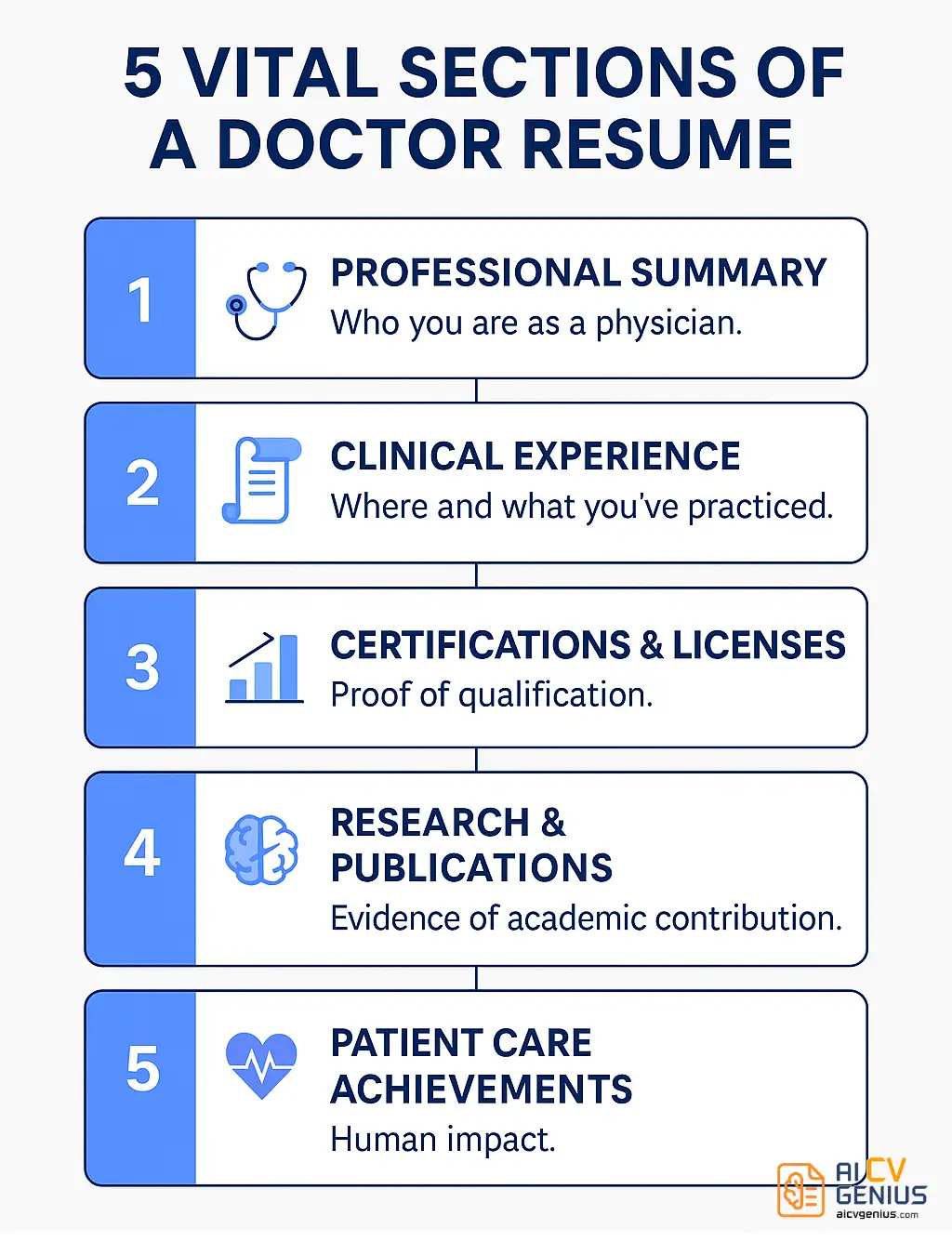
Core Structure: Your Resume as a Clinical Chart
A great doctor’s resume is structured like a patient chart: logical, hierarchical, and instantly scannable, with the most critical information presented first.
1. Header: Patient Demographics (Your Credentials)
Make this clean and unambiguous. This is your professional identity.
Your Name, M.D. (or D.O.)
Board-Certified in [Your Specialty] (e.g., Internal Medicine, Pediatrics)
City, State, Zip | (555) 123-4567 | your.email@domain.com | LinkedIn URL
Pro Tip: Include your LinkedIn URL. It’s a modern standard of professionalism and allows you to add more detail than a 2-page resume permits.
2. Professional Summary: The Synopsis
This is your “abstract” or “synopsis.” In 3-4 lines, you must summarize your entire value proposition. It must be dense with expertise and confidence.
Weak Summary:
“Doctor with 10+ years of experience. Hard-working and passionate about helping patients. Looking for a new and challenging role.” (This is generic and passive).
Strong Summary (Hospitalist):
“Compassionate and efficient Hospitalist with 8+ years of experience managing acute and complex patient cases in a 400-bed teaching hospital. Proven leader in optimizing patient throughput and reducing readmission rates by 15% through improved discharge protocols. Expert in Epic and Cerner.”
Strong Summary (New Resident):
“Highly-motivated recent Medical Resident (Internal Medicine) from [Your Hospital]. Eager to apply rigorous training in diagnostic procedures and patient-centered care to a challenging Attending Physician role. Proven ability to manage high-volume patient loads and collaborate with multidisciplinary teams.”
3. Key Skills / Clinical Competencies: The Vitals
Do not use a generic “skills” list. Group your competencies logically. This shows you think in systems and is highly scannable for recruiters.
| Clinical Expertise | Patient Diagnosis, Treatment Planning, Acute Care Management, Chronic Disease Management, Patient-Centered Care, Clinical Documentation (SOAP) |
| Procedural Skills | (e.g., Central Line Insertion, Intubation, Lumbar Puncture, Suturing, Endoscopy – Be specific to your specialty) |
| Diagnostic & EMR Tools | Epic, Cerner, Meditech, Allscripts, EKG/ECG Interpretation, Telehealth Platforms (Teladoc, Amwell) |
| Interpersonal & Leadership | Compassionate Communication, Patient Education, Multidisciplinary Team Leadership, Mentoring Residents, Conflict Resolution, Patient Safety Protocols |
4. Clinical Experience: The Treatment History
This is the core of your resume. Do not list duties. List achievements. Use the “Action Verb + Project + Metric” formula. Every bullet point should prove your value.
| ❌ Weak Bullet (Duty) | ✅ Strong Bullet (Impact) |
|---|---|
| “Responsible for seeing patients daily.” | “Managed a daily patient load of 20+ in a high-acuity internal medicine ward, coordinating with multidisciplinary teams to ensure continuity of care.” |
| “Worked on improving patient follow-up.” | “Developed and implemented a new post-discharge patient follow-up program, reducing 30-day readmission rates for CHF patients by 18%.” |
| “Trained new residents.” | “Served as Preceptor for 10+ medical residents, providing mentorship and clinical education on diagnostic reasoning and patient communication.” |
More High-Impact Examples:
- ✅ Led a quality improvement initiative to optimize EMR charting, resulting in a 25% reduction in documentation errors.
- ✅ Collaborated with nursing and pharmacy leadership to redesign medication reconciliation protocols, improving patient safety scores by 30%.
- ✅ Maintained a 95th percentile patient satisfaction (HCAHPS) score for compassionate care over 4 consecutive quarters.
- ✅ Managed over 1,500 patient cases annually, consistently meeting or exceeding hospital KPIs for patient throughput.
5. Education, Licensure & Certifications: The Credentials
This section must be clear, precise, and unimpeachable. Group it logically.
Licensure & Board Certification
- Board Certified in [Your Specialty], American Board of [Your Specialty]
- State Medical License: [State Name] (License #), Active
- DEA License, Active
- Basic Life Support (BLS), Advanced Cardiovascular Life Support (ACLS)
Education & Clinical Training
- [Specialty] Residency, [Hospital Name], [City, State] (Year)
- Doctor of Medicine (M.D.), [University Name], [City, State] (Year)
- Bachelor of Science, [Major], [University Name], [City, State] (Year)
Quantifying Compassion: How to Show Your “Human Side”
A doctor’s greatest skill is often their “bedside manner.” But how do you quantify empathy? You use proxy metrics – data points that prove your compassion and communication skills.
- Use Patient Satisfaction Scores: “Consistently maintained patient satisfaction scores in the 90th+ percentile.”
- Highlight Patient Education: “Developed a series of patient education pamphlets on diabetes management, adopted hospital-wide.”
- Show Mentorship: “Mentored 5 junior residents, focusing on empathetic communication and breaking bad news.”
- Mention Awards: “Received the [Hospital Name]’s ‘Compassion in Practice’ Award (2023).”
- Cite Leadership in Care: “Served on the hospital’s Ethics Committee, providing guidance on complex end-of-life care decisions.”
These points prove you are not just a technician but a true healer and leader.
The Complete Doctor Resume Example (Putting It All Together)
Theory is one thing; practice is another. Let’s apply every strategy we’ve discussed to build a complete, two-page doctor resume example. We’ll use a fictional candidate, Dr. Emily Carter, an experienced Hospitalist.
EMILY CARTER, M.D.
Board-Certified Internal Medicine | Hospitalist
Boston, MA 02114 | (555) 987-6543 | e.carter@email.com | linkedin.com/in/emilycartermd
PROFESSIONAL SUMMARY
Compassionate and data-driven Hospitalist with 10+ years of experience managing complex, high-acuity patient cases in a 500-bed urban teaching hospital. Proven leader in quality improvement; spearheaded a discharge optimization protocol that reduced 30-day readmission rates by 18%. Expert in patient-centered care, maintaining a 95th percentile HCAHPS score. Deep proficiency in Epic, Cerner, and Meditech EMR systems.
CORE COMPETENCIES
|
|
|
|
CLINICAL EXPERIENCE
Attending Physician, Hospitalist | Massachusetts General Hospital | Boston, MA (2018 – Present)
- Manage an average daily patient load of 18-22 in a high-acuity internal medicine ward, coordinating with specialists to ensure seamless continuity of care.
- Led a quality improvement initiative to redesign medication reconciliation protocols, collaborating with pharmacy and nursing to reduce medication errors by 30%.
- Consistently maintained patient satisfaction (HCAHPS) scores in the 95th percentile for “Doctor Communication” and “Compassionate Care.”
- Serve as Preceptor for 8 medical residents, providing mentorship on diagnostic reasoning, EMR efficiency, and empathetic patient communication.
Hospitalist | Tufts Medical Center | Boston, MA (2015 – 2018)
- Developed and implemented a new post-discharge patient follow-up program for CHF patients, successfully reducing 30-day readmission rates by 18%.
- Managed over 1,500 patient cases annually, meeting all hospital KPIs for patient throughput and length-of-stay (LOS) targets.
- Served on the hospital’s Ethics Committee, providing guidance on 20+ complex end-of-life care decisions and family conferences.
LICENSURE & CERTIFICATION
- Board Certified in Internal Medicine | American Board of Internal Medicine (ABIM)
- Massachusetts Medical License (Active, License #123456)
- DEA License (Active)
- Advanced Cardiovascular Life Support (ACLS) & Basic Life Support (BLS) Certified
EDUCATION & CLINICAL TRAINING
- Internal Medicine Residency | Brigham and Women’s Hospital | Boston, MA (2012 – 2015)
- Doctor of Medicine (M.D.) | Harvard Medical School | Boston, MA (2012)
- Bachelor of Science, Biology (Summa Cum Laude) | Duke University | Durham, NC (2008)
SELECTED HONORS & PUBLICATIONS
- Resident of the Year Award | Brigham and Women’s Hospital (2015)
- Carter, E. (2019). “Post-Discharge Protocols and Readmission.” New England Journal of Medicine.
- Presenter, “Humanizing Medicine: EMR and Patient Communication,” ACP National Conference (2022).
Advanced Strategies: Specialization, Mistakes, and Templates
Beyond the core structure, several advanced tactics can further refine your resume. This includes tailoring for your specialty, adding supporting achievements, and avoiding common errors.
Tailor for Your Specialty: A CV vs. a Resume
A CV (Curriculum Vitae) is a long, comprehensive record of your entire academic history, including all publications, presentations, and research. It can be 10+ pages and is used for academia, research, or fellowship applications.
A Resume is a concise, 1-2 page summary of your most relevant skills and achievements, tailored for a specific clinical job (e.g., at a hospital or private practice). For most clinical roles, a 2-page resume is preferred.
Tailor your focus based on the role:
| Specialty / Role | Focus | Resume Emphasis & Keywords |
|---|---|---|
| General Practitioner (GP) | Primary care, diagnosis, high patient volume. | Emphasize: Patient education, preventative care, chronic disease management, high patient volume. |
| Surgeon | Procedural skill, team leadership, low error rates. | Emphasize: Caseload volume, specific procedures, low complication rates, team leadership in the OR. |
| Hospitalist | Acute care, efficiency, co-morbidity management. | Emphasize: Patient throughput, discharge planning, readmission rates, collaboration with specialists. |
| Pediatrician | Family communication, preventative care. | Emphasize: Patient/family education, developmental milestones, compassionate communication. |
| Academic/Research | Deep field expertise, teaching, studies. | Emphasize: Publications, clinical trials, grant writing, resident/student mentorship. (Use a CV here). |
Research, Publications, and Memberships
Even for a clinical resume, including these sections demonstrates your commitment to the field. Keep them concise.
Publications & Presentations
- Carter, E. (2022). “Advances in Diabetes Care.” Journal of Clinical Medicine. [Include 1-3 of your most relevant].
- Lead Presenter, “Ethics of AI in Diagnosis,” MedTech Summit, 2024.
Professional Memberships
- American Medical Association (AMA)
- American College of Physicians (ACP)
- [Your Specialty’s Association]
Honors & Awards
- Resident of the Year, [Hospital Name] (2020)
- Outstanding Patient Care Award, [Clinic Name] (2023)
Mistakes That Undermine a Strong Resume
- ❌ Using a CV for a Clinical Job: Sending a 10-page academic CV for a hospitalist role shows you didn’t read the “chart.” Tailor it down to a 2-page resume.
- ❌ Passive Language: “Was responsible for…” or “Duties included…”. This is weak. Use strong action verbs: “Managed,” “Led,” “Developed,” “Optimized.”
- ❌ Listing Jargon, Not Skills: Don’t just list procedures. Explain the outcome of those procedures. (e.g., “Led 50+ successful…”).
- ❌ Forgetting Empathy: A resume full of cold, hard metrics without a single mention of “patient education” or “compassionate care” is a red flag.
Pros & Cons of Using a Resume Template
| Pros | Cons |
|---|---|
| ✅ Ensures a professional, ATS-friendly, and scannable layout. | ❌ Can feel generic if you don’t personalize the content. |
| ✅ Saves significant time on formatting, allowing focus on content. | ❌ Some templates are poorly designed and not ATS-compatible. |
| ✅ Creates a clear hierarchy that hospital recruiters expect. | ❌ May not be flexible enough for a detailed academic CV. |
For a clean, professional template designed for medical roles, explore Resume Templates Finder.
In-Depth FAQs for a Doctor’s Resume
Weak: “Strong communication skills.”
Strong: “Consistently maintained a 95th percentile HCAHPS (patient satisfaction) score.”
Strong: “Developed a patient education guide on post-operative care, now used by the entire surgical department.”
Strong: “Served as mentor to 3 junior residents, focusing on empathetic communication and diagnostic reasoning.”
Final Thoughts: Your Resume is Your First Consultation
Medicine is a field of precision and humanity. Your resume must be the same. It is your first consultation with a potential employer, and it must diagnose their needs and present you as the definitive solution. Recruiters want proof that you are not only a skilled clinician but also a compassionate leader – someone who listens as carefully as they diagnose, who leads as effectively as they treat.
Keep your document factual, clean, quantified, and heartfelt. Precision wins interviews; compassion and proven results win careers. For more healthcare templates, visit Resume Templates Finder or explore additional career tips at Career Resources.