
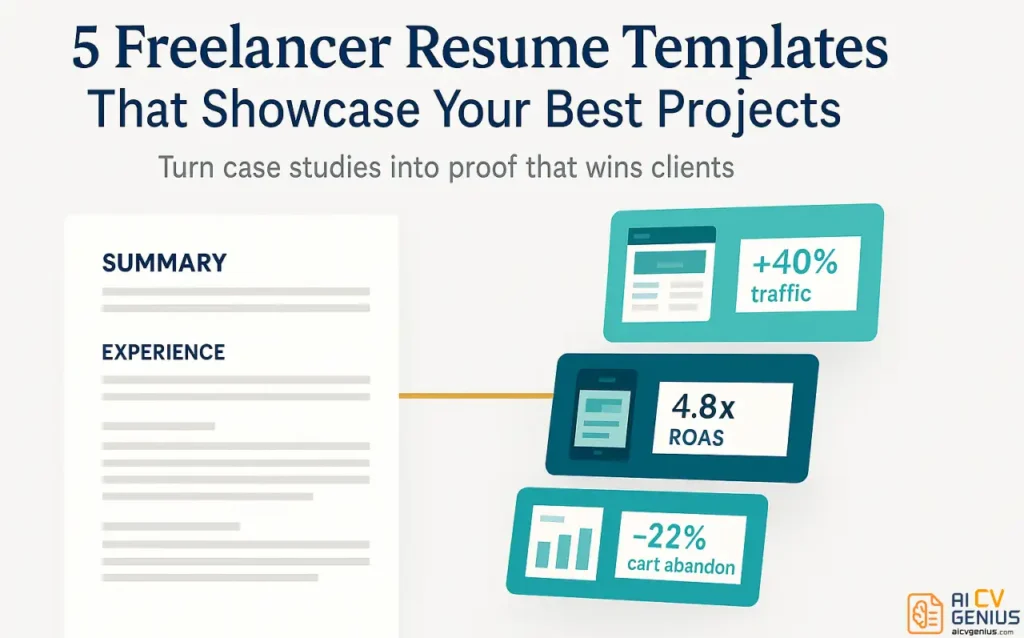
- Mindset shift: A freelancer resume is a sales document that answers “What problems can you solve?” not “Where did you work?”
- Core structure: Lead with a niche value summary, then replace work history with 3 to 5 Project Highlights using Client, Problem, Result.
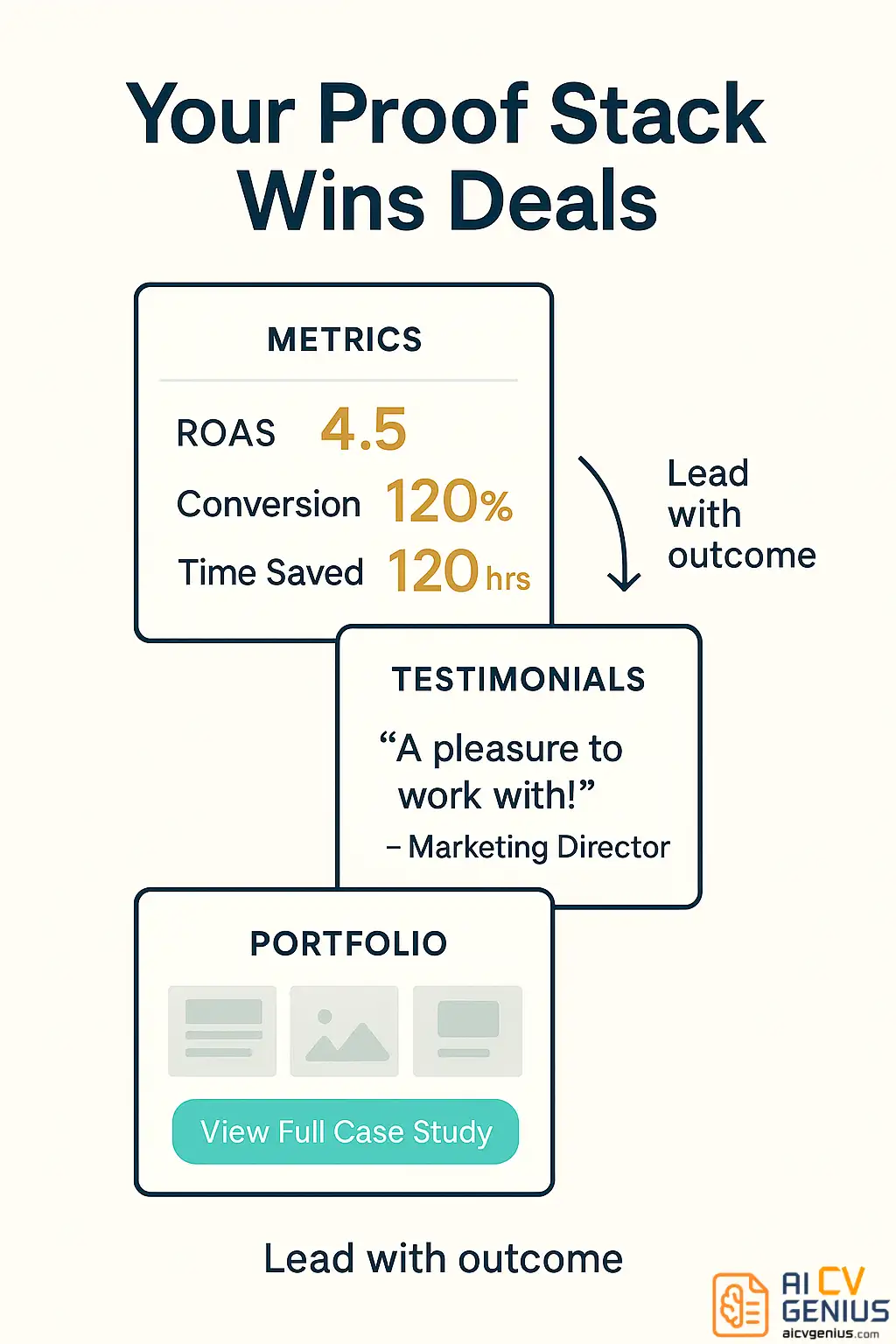
- Trust signals: Add organized skills and tools, place a visible portfolio link at the top, and use short client testimonials as social proof.
- Templates and positioning: Choose a layout that fits writers, designers, developers, marketers, or beginners, and make every example prove outcomes with numbers.
- Common pitfalls and ATS: Avoid “Self Employed” blanks, generic skills, and flashy formatting, stick to clean headings, keyword matching, and a readable one page PDF.
The Freelancer Mindset Shift: Your Resume is a Sales Document
Introduction: The Problem with Traditional Templates
Let’s be honest. Staring at a blank resume template feels like a trap. The blinking cursor in a “Work History” box. The “Company Name” and “Job Title” fields. This entire structure is built on a lie – a lie that your value is defined by who employed you, not what you built.
Your typical resume is a document of corporate history. It lists job titles and companies, proving you can hold a position. But as a freelancer? That entire framework collapses. Clients don’t care about your “employment.” They have a problem – a bleeding-neck, hair-on-fire problem – and they only care about one thing: Are you the person who can solve it?
A freelancer resume template isn’t a job history. It’s a high-impact sales document. It’s a proposal for your next project, disguised as a resume.
The core problem is that 99% of resume templates are designed for 9-to-5 employees. They prioritize loyalty, promotions, and tenure. They have no logical space for client testimonials, complex project breakdowns, measurable ROI, or the stack of “soft” skills – like client management and scope negotiation – that are the real currency of freelancing. When you try to cram your dynamic, project-based career into that rigid, traditional format, you create a document that isn’t just confusing. It actively undersells your expertise and makes you look like an amateur.
This is not just about formatting. It’s about psychology. Your resume needs to stop answering the question “Where did you work?” and start answering the question “What problems can you solve for me?”
This guide provides five downloadable templates meticulously crafted for freelancers. We’re not just moving boxes around. We are fundamentally restructuring the narrative. Whether you’re a writer, designer, developer, marketer, or consultant, these templates are built to showcase projects, prove results, and build trust. Let’s dismantle the old way and build one that actually wins clients.
Why a Freelancer Resume Is Different: Employee vs. Service Provider
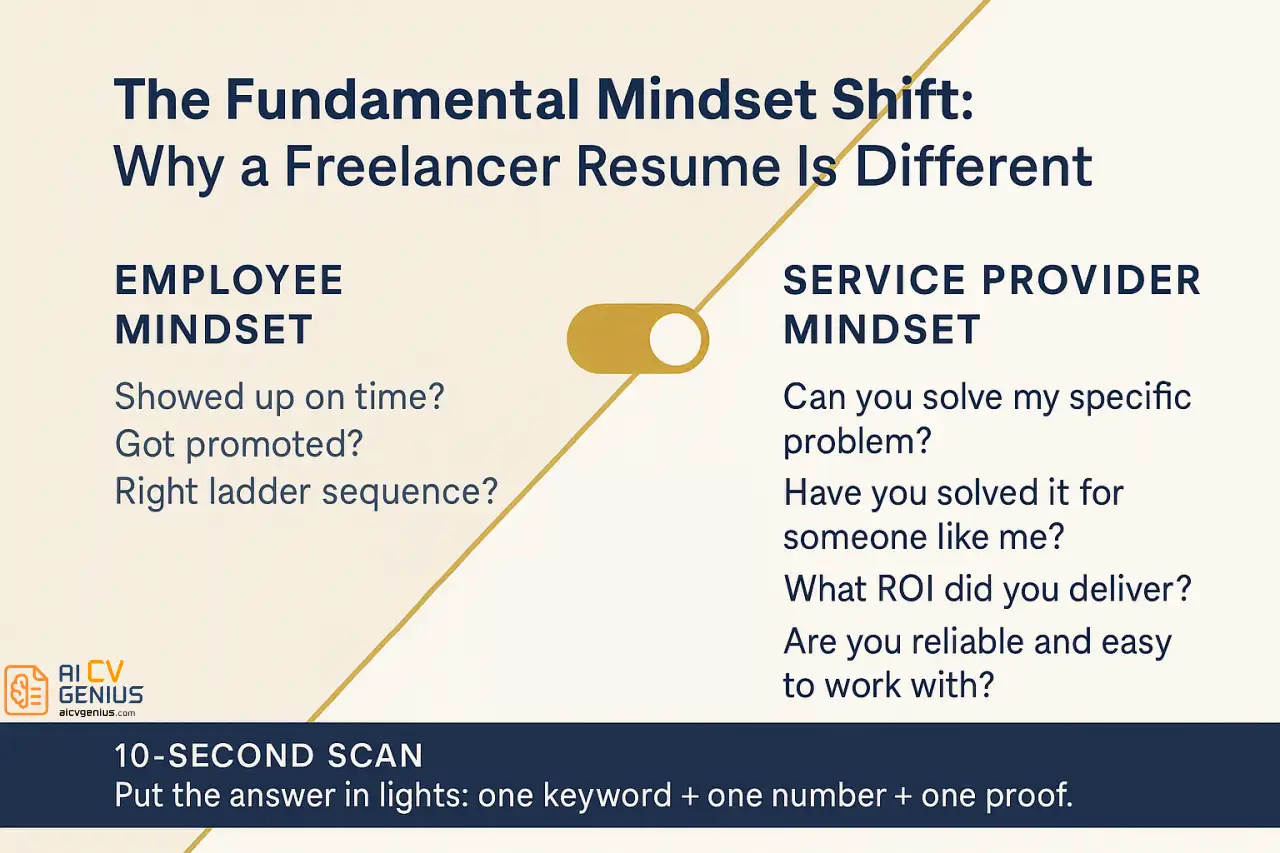
To create a resume that works, you first must accept a fundamental truth: you are not an employee. You are a business-of-one. A service provider. A specialist brought in to achieve a specific, valuable outcome.
A traditional resume is built on the Employee Mindset. It seeks to answer questions like:
- “Did you show up on time for three years?”
- “Did your manager like you enough to promote you?”
- “Do you have the ‘right’ sequence of jobs on your career ‘ladder’?”
A freelancer resume is built on the Service Provider Mindset. It must immediately answer a completely different set of questions:
- “Can you solve my specific, urgent problem?”
- “Have you solved a similar problem for someone like me?”
- “What was the Return on Investment (ROI) of your work?”
- “Are you professional, reliable, and easy to work with?”
Here’s what that mindset shift looks like in practice. First, it’s project-focused, not job-focused. Your “company” (You, Inc.) is irrelevant. What matters are the case studies. Instead of listing employers, you create mini-case studies for your most impressive projects. Second, it leans heavily on social proof over titles. A glowing quote from a “Startup Founder” or “Marketing Director” carries infinitely more weight than a “Senior” job title ever could. Third, it obsessively emphasizes results and metrics. Clients hire you to solve problems and make them money. Your resume must prove, inarguable, that you did exactly that.
Most hiring managers – or, more likely, overwhelmed founders – skim resumes in under 10 seconds. Their eyes are darting, looking for a single keyword, a single number, a single sign that you “get it.” For freelancers, that means your resume must answer their core question instantly: “Can this person deliver what I need?” A traditional format hides that answer. A freelancer-specific template puts it in flashing lights.
Building Your Resume: Core Anatomy & Expert Templates
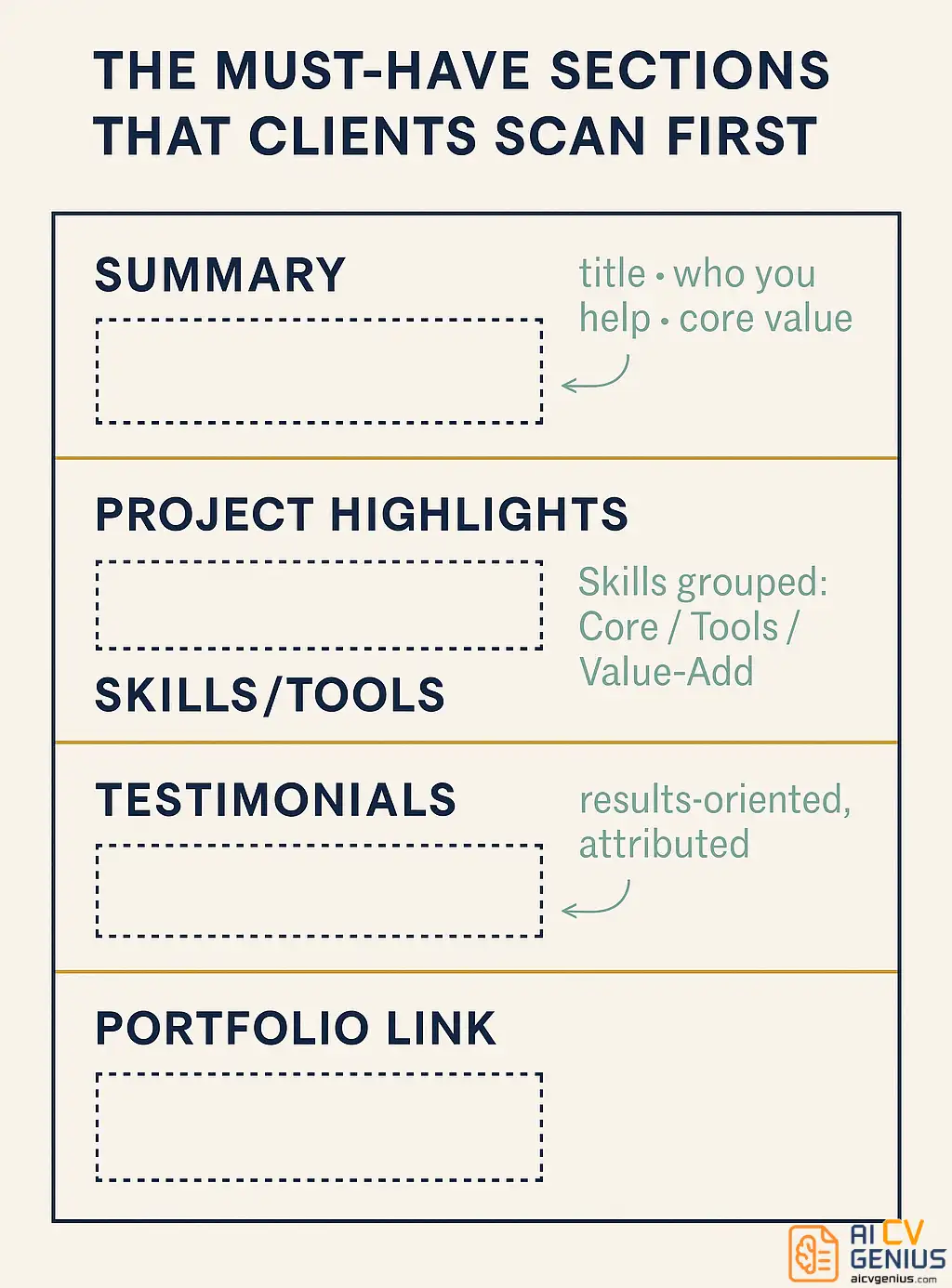
Before we jump into the templates, let’s establish the non-negotiable building blocks. These sections are what separate a powerful freelance resume from one that gets archived. Think of them as the chassis of your new sales document.
1. The “Above the Fold” Hook: Your Professional Summary
This is the most important real estate on your resume. It’s the first 3-4 lines they read. This is not an “Objective” (e.g., “Seeking a challenging role…”). It’s your entire value proposition, distilled into a powerful elevator pitch. It must be confident, clear, and client-focused.
A winning formula is:
[Your Professional Title] + [Who You Help] + [The Core Value You Deliver]
Weak Example:
“Experienced freelancer looking for new writing opportunities in the tech space.”
Strong Example:
“B2B SaaS Content Writer helping cybersecurity startups reduce churn and increase demo sign-ups through data-driven, long-form content.”
The second example instantly qualifies you, identifies your niche, and states the business results you drive. The client immediately knows if you’re a potential fit.
2. Project Highlights (The Core of Your Resume)
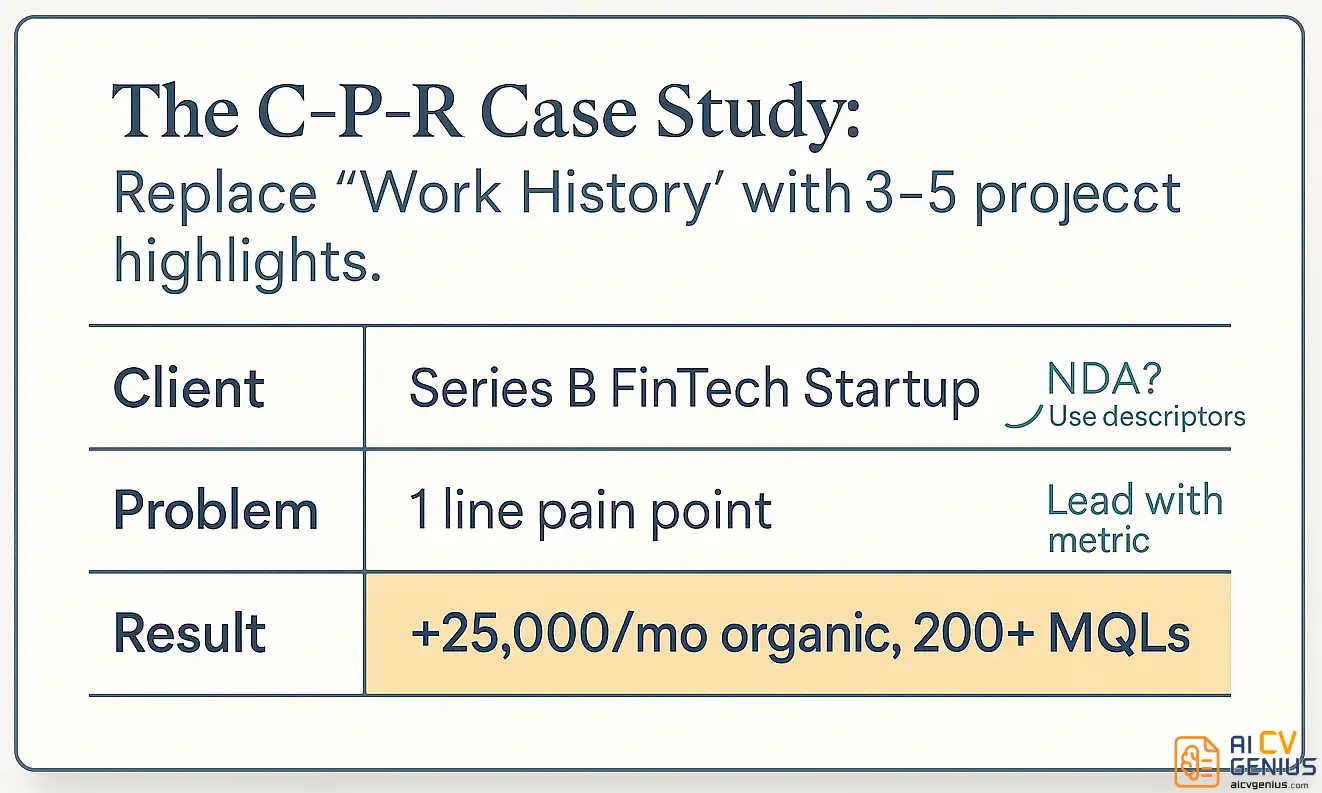
This is your resume’s anchor. This section replaces the traditional “Work History.” Do not, under any circumstances, just list “Self-Employed” from 2018-Present. That is a black hole of information. Instead, you create 3-5 “Project Highlights.”
For each project, use a simple, powerful structure. I call it the C-P-R Formula: Client, Problem, Result.
- Client: Who was it for? (e.g., “Mid-Sized E-commerce Brand” or “Series B FinTech Startup”). Anonymize if under NDA.
- Problem: What was the challenge they hired you to solve? (e.g., “Low organic traffic,” “Outdated brand identity,” “Inefficient internal reporting system”).
- Result: What was the specific, measurable outcome? (e.g., “Increased organic traffic by 40% in six months,” “New branding led to a 15% rise in foot traffic,” “Reduced manual data entry by 80%”).
Don’t just say “Designed a website.” Say, “Redesigned an e-commerce checkout flow for a Shopify merchant, resulting in a 22% reduction in cart abandonment.” One is a task; the other is a solution.
3. Skills, Tools, and Proficiencies (The “How”)
Freelancers are the ultimate jugglers. Your skills section must reflect this reality, but it needs to be organized. A random “brain dump” of 50 skills is overwhelming. Group them logically to prove your expertise.
Instead of one giant list, create categories:
- Core Competencies: These are your high-level strategies. (e.g., SEO Strategy, Brand Identity Design, Full-Stack Development, Paid Acquisition).
- Technical Proficiencies / Tools: These are the specific platforms you’ve mastered. (e.g., Figma, Webflow, Adobe CC, React, Node.js, Google Ads, Ahrefs, HubSpot).
- Value-Add Skills: These are the “soft” skills that are mission-critical for freelancing. (e.g., Client Communication, Project Scoping & Proposals, Time Management, Asynchronous Collaboration, Feedback Integration).
This organized structure makes it easy for a client to scan and confirm you have the exact toolkit they need.
4. Client Testimonials (Your Social Proof Engine)
This is your secret weapon. Traditional employees almost never have this. You do. A testimonial is third-party validation that you are who you say you are. It builds immediate trust.
Scatter 1-2 short, powerful quotes throughout your resume. Place them near relevant projects or in a small, dedicated section. The key is to get results-oriented testimonials. If a client emails you, “You were great to work with!” write back and ask: “Thank you so much! I’m thrilled you’re happy with the outcome. Would you mind if I asked for a more specific testimonial? I’d love to use ‘Working with [Your Name] on the new ad campaign was a breeze, and we saw our ROAS double in the first month.'”
Always attribute them. “Sarah M., Founder, XYZ Startup” is far more credible than an anonymous quote. This is not optional – it’s what separates a professional from an amateur.
Template 1: The Results-Driven Freelance Writer/Editor
For writers, words are your product, but results are your selling point. Clients don’t just want good writing; they want writing that converts, ranks, or engages. This template proves you’re a strategic partner, not just a “word-slinger.” It focuses on content types, niches, and the measurable impact of your work.
️Key Features: A “Niches & Specializations” section, a “Publications & Features” list, and project examples that tie writing directly to business goals like traffic, leads, or sign-ups.
Resume Summary Example:
Freelance B2B SaaS Writer with 4+ years creating high-conversion content for FinTech and cybersecurity startups. Published in TechCrunch, HubSpot, and Buffer. Proven track record of increasing organic traffic by 50-70% for clients through strategic, long-form guides and data-driven blog posts. Specialized in breaking down complex technical topics into actionable, reader-friendly content that generates qualified leads.
Project Example (Expanded with C-P-R):
Client: Mid-sized SaaS company (NDA)
Problem: Client’s existing blog content was not ranking on Google and failed to capture high-intent leads for their product marketing software.
Project: Developed a new SEO content strategy and personally authored a 12-part “Product Marketing Hub” content series.
Result: The series now generates 25,000+ monthly organic visits, ranks for 50+ high-intent keywords, and has directly captured 200+ qualified email signups within its first 6 months.
For writers, showing your range and your concrete results is everything. Clearly state your niche (e.g., “DTC E-commerce Copywriter,” “Healthcare Tech Writer”) to attract the right clients. Always include a prominent link to your portfolio, which should contain 3-5 of your absolute best, most relevant writing samples.
Want more strategies for positioning yourself as a writer? Check out our guide on career resources for freelancers.
Template 2: The Strategic Freelance Graphic Designer
Designers have a visual advantage, but a common trap is letting the portfolio do all the talking. Your resume is the narrative behind the visuals. It needs to explain the why. This template balances visual elegance (with clean, strong typography) with clear, quantifiable project outcomes. It proves you’re not just a pixel-pusher, but a strategic problem-solver.
️Key Features: A prominent, impossible-to-miss portfolio link at the top. A “Design Proficiencies” section (Figma, Adobe CC, Webflow) and an “Areas of Expertise” section (e.g., Brand Identity, UI/UX Design, Marketing Collateral).
Resume Summary Example:
Freelance Brand & UI/UX Designer with 6+ years crafting compelling visual identities and user-centered digital experiences for startups and CPG brands. Expert in the full Adobe Creative Suite and Figma. Helped 20+ clients elevate their visual presence, with designs that directly increased social engagement by an average of 35% and improved user-flow completion rates.
Project Example (Expanded with C-P-R):
Client: Local specialty coffee chain (3 locations)
Problem: The client’s branding felt dated and failed to connect with a younger, tech-savvy demographic, causing them to lose business to competitors.
Project: Executed a complete rebrand, including a new logo system, modern menu boards, packaging, and a full suite of cohesive social media templates.
Result: The new, unified branding contributed to a 15% increase in foot traffic (tracked via loyalty program) and a 50+ average new Instagram follower growth per week, successfully repositioning the brand.
Your portfolio link is non-negotiable. But don’t force the client to guess the story. Use your resume to describe the business challenge you were given and the business result you delivered. Clients scrolling through 50 resumes may not click every portfolio, but they will read a result like “increased foot traffic by 15%.”
If you’re transitioning from another field into design, read our post on how to position yourself during a career change.
Template 3: The Problem-Solver Freelance Developer
For developers, clients are looking for more than a list of languages. They’re looking for reliability, clean code, and a problem-solver who can take a concept from idea to launch. This template emphasizes your tech stack, yes, but it frames it within the context of complex projects you’ve successfully shipped.
️Key Features: Prominent GitHub and portfolio links. A clear “Tech Stack” section (e.g., Frontend, Backend, Database, DevOps). Project descriptions that focus on what you built and why it mattered.
Resume Summary Example:
Full-Stack Developer with 5+ years building scalable, high-performance web applications for e-commerce, SaaS, and FinTech clients. Specialized in the MERN stack (React, Node.js, Express, MongoDB) and PostgreSQL. Delivered 30+ projects from custom dashboards to full-scale enterprise apps. Known for clean, maintainable code, on-time delivery, and proactive communication to keep projects on track.
Project Example (Expanded with C-P-R):
Client: E-commerce startup (Series A)
Problem: The client was using a dozen spreadsheets to manage inventory, leading to constant stock errors and thousands of dollars in lost sales.
Project: Architected and built a custom inventory management system (React, Node.js, PostgreSQL) with real-time analytics and third-party API integrations.
Result: The new system reduced manual data entry by 80%, eliminated stock-out errors, and improved order processing speed by 40%.
For developers, listing your tech stack is essential, but don’t just list them. Show what you built with them. Instead of “JavaScript,” say “Built 10+ custom React SPAs for client-facing dashboards.” Link to live sites or GitHub repos for every project possible. Prove you don’t just write code – you build solutions.
For more tips on standing out as a technical professional, explore our resume templates and guides.
Template 4: The ROI-Driven Freelance Marketer
For freelance marketers, there is only one language that matters: ROI. Clients hire you to grow their business, and your resume must be a testament to your ability to do so. This template is aggressively data-driven, highlighting campaign results, channel mastery, and hard growth metrics.
️Key Features: A “Key Achievements” section with 2-3 massive wins. “Platform Expertise” (Google Ads, Meta Ads, HubSpot, Salesforce). Project examples that live and die by their metrics.
Resume Summary Example:
Freelance Digital Marketer & Paid Media Strategist with 7+ years managing multi-channel campaigns for DTC brands and SaaS companies. Expert in paid media (Meta & Google), email marketing automation, and SEO. Consistently deliver 3-5x ROAS for clients through data-driven strategies, rigorous A/B testing, and continuous funnel optimization.
Project Example (Expanded with C-P-R):
Client: Online fitness & wellness brand
Problem: The client’s ad spend was inefficient (1.5x ROAS) and failing to build a long-term customer base.
Project: Audited and rebuilt their entire Facebook and Instagram ad funnel. Managed a 6-month, $25K campaign with new creative, lookalike audiences, and a lead-magnet-to-tripwire email sequence.
Result: Generated $120K in top-line revenue from $25K ad spend (a 4.8x ROAS), and grew their qualified email list by 3,000 subscribers.
Marketers must speak in numbers. Never say “Ran ads.” Say “Managed a $50K budget to generate $200K in revenue.” Include every metric you can: Revenue, ROAS (Return on Ad Spend), CPL (Cost Per Lead), CAC (Customer Acquisition Cost), Conversion Rate, or Engagement Rate. Your resume should look like a financial report of your successes.
Template 5: The “No Clients, No Problem” Entry-Level Freelancer
New to freelancing? This is the biggest hurdle. How do you build a resume with no client projects? The answer: you reframe. You don’t have “client work,” but you have experience. This template is skills-first, emphasizing personal projects, spec work, and volunteer experience as proof of your capability.
️Key Features: A skills-first layout (skills section comes before project section). A “Projects” section that includes personal, spec, and volunteer work. A focus on coursework, certifications, and a strong desire to learn.
Resume Summary Example:
Aspiring Freelance Content Writer with a passion for storytelling and digital marketing. Recently completed a [Your Certification] certification and built a personal blog with 500+ monthly readers. Skilled in foundational SEO, WordPress, and long-form writing. Eager to bring a strong work ethic and fresh ideas to help brands grow their audience.
Project Example (Using a Personal Project):
Project: [Your Blog Name] – Personal Blog on Sustainable Living
Problem: Wanted to gain hands-on experience in SEO, content creation, and audience building.
Project: Wrote and published a 10-article series on sustainable living, performing all keyword research, writing, and promotion.
Result: Grew the blog to 500+ monthly organic visitors within 4 months, with 2 articles ranking on the first page of Google for their target keywords.
If you’re starting out, never lie or invent experience. Instead, highlight what you’ve actually done. Build a spec website for a local business. Write a 5-article content series for a non-profit. Redesign an app you hate and post the case study. Frame every single one of these as a professional project with a goal and an outcome. Clients care about what you can do, not just who paid you to do it.
For more advice on building your career from scratch, check out how to improve your CV.
The Complete Freelancer Resume Example (Putting It All Together)
Theory is one thing; practice is another. Let’s apply these strategies to build a complete resume for a fictional candidate, Alex Chen, a Freelance Graphic Designer, based on the principles in this guide.
ALEX CHEN
Freelance Brand & UI/UX Designer
Brooklyn, NY 11201 | (555) 123-4567 | alex.chen.design@email.com | alexchendesign.com
PROFESSIONAL SUMMARY
Freelance Brand & UI/UX Designer with 6+ years crafting compelling visual identities and user-centered digital experiences for CPG and SaaS startups. Expert in Figma and Adobe CC. Helped 20+ clients elevate their visual presence, with designs that directly increased social engagement by an average of 35% and improved user-flow completion rates by 20%.
CORE COMPETENCIES & TOOLS
|
|
|
PROJECT HIGHLIGHTS (CASE STUDIES)
Project: E-commerce Checkout Redesign | Client: Series B FinTech Startup (NDA)
- Problem: The client’s checkout flow was complex and causing a high cart abandonment rate (approx. 75%).
- Action: Conducted user research, mapped the ‘as-is’ flow, and designed a streamlined 3-step checkout process in Figma with clear error states and visual trust signals.
- Result: The new design, validated through A/B testing, reduced cart abandonment by 22% and increased average order value by 8%.
Project: CPG Brand Identity Launch | Client: Local Specialty Coffee Chain
- Problem: The client’s branding was dated and failed to connect with a younger demographic, losing market share to new competitors.
- Action: Executed a complete rebrand (logo, packaging, menu boards, social media templates) focused on a modern, minimalist, and eco-friendly aesthetic.
- Result: The rebrand contributed to a 15% increase in foot traffic (per loyalty program data) and a 50+ average weekly increase in Instagram followers.
Project: SaaS Website & Dashboard UI | Client: Cybersecurity Startup
- Problem: The client’s website was confusing, and their product dashboard was cluttered, leading to low demo sign-ups and high user churn.
- Action: Designed a new, conversion-focused landing page and a clean, component-based UI for their product dashboard in Figma.
- Result: The new landing page increased demo sign-ups by 40%, and the new dashboard UI received a 90% positive feedback score from existing users.
CLIENT TESTIMONIALS
“Working with Alex on our rebrand was a dream. He didn’t just give us a logo; he gave us a strategy. Our foot traffic increased 15% in the first quarter after launch.”
– Sarah M., Founder, Local Coffee Chain
“Alex’s UI design for our dashboard was a game-changer. He took a complex set of data and made it intuitive. Our user feedback has been 90%+ positive since the update.”
– David K., Head of Product, Cybersecurity Startup (NDA)
EDUCATION & CERTIFICATIONS
- Google UX Design Professional Certificate (Coursera, 2021)
- BFA in Graphic Design | Pratt Institute, Brooklyn, NY (2018)
Advanced Strategies, FAQs & Common Pitfalls
Framing Your Client Roster (Even If It’s Small or Secretive)
One of the biggest anxieties freelancers face is describing their clients. “What if I only worked for a small local bakery?” “What if I signed a strict NDA?” Here’s how to frame it professionally.
First, focus on the project, not the client’s logo. The result matters more than the company’s name.
Weak:
“Worked for a small local bakery.”
Strong:
“Developed a new e-commerce strategy for a hospitality client, increasing online pre-orders by 60%.”
See? The second one sounds like a million-dollar project. The “client” is secondary to the result.
Second, use descriptive categories for NDAs. Clients not only understand NDAs, they respect you for honoring them. It shows you’re a professional who can be trusted with sensitive information. Use descriptions like:
- “Fortune 500 Tech Company”
- “Series C FinTech Startup”
- “High-Growth E-commerce Brand”
- “Major Healthcare Provider”
This gives all the necessary context (industry, scale) without revealing a name. Your resume isn’t a confessional; it’s a marketing tool.
Career-Killing Mistakes on Freelancer Resumes (And How to Fix Them)
Even seasoned freelancers make critical, unforced errors on their resumes. These mistakes can cost you high-value opportunities by making you look disorganized or results-averse. Here are the biggest ones to avoid.
❌ The “Self-Employed” Black Hole
Listing “Freelance Writer” at “Self-Employed” from 2015-Present is the single worst mistake you can make. It’s a black hole of information. It tells the client nothing. It could mean you had 100 clients, or it could mean you had zero and watched Netflix.
The Fix: Obliterate this entry. Replace it entirely with the “Project Highlights” section. List 3-5 distinct, impressive projects with their own C-P-R (Client, Problem, Result) breakdowns.
❌ The “What” Without the “So What” (No Measurable Results)
Listing your tasks is weak. “Wrote blog posts,” “Designed logos,” “Built a web app.” This is the “what.” The client is desperate to know the “so what.”
The Fix: For every task, add a result. “Wrote blog posts that increased organic traffic by 50%.” “Designed a logo that was part of a rebrand leading to a 15% sales lift.” “Built a web app that automated a 10-hour/week manual process.”
❌ The “Microsoft Office” Problem (Generic Skills List)
A skills list that says “Microsoft Office, Communication, Teamwork” is a waste of space. It’s assumed. It tells the client nothing about your specialized value.
The Fix: Be specific and strategic. Group your skills into “Core Competencies,” “Technical Proficiencies,” and “Value-Add Skills” as described earlier. “Proficient in Google Analytics, Mailchimp, and Ahrefs” is strong. “Communication” is weak.
❌ Burying the Lead (Missing or Hidden Portfolio Link)
If you’re a writer, designer, developer, or any creative, your portfolio is your single greatest asset. Hiding the link at the bottom of page two, or not including it at all, is a critical error.
The Fix: Your portfolio link (and GitHub, for devs) should be in your header, right under your name and contact info. Make it a clickable hyperlink in the PDF. Make it impossible to miss.
❌ The “Every Project” Brain Dump (Resume Too Long)
You’re proud of your 50+ projects. We get it. But listing all of them is overwhelming and signals that you don’t know how to prioritize.
The Fix: Your resume is a highlight reel, not the entire movie. Stick to your best 5-8 projects that are most relevant to the client you’re targeting. Save the rest for your “Full Portfolio” or LinkedIn.
❌ The “Pretty” Template That Can’t Be Read
Using a highly visual template with skill bars, graphs, photos, or multiple columns is a huge mistake. First, it looks unprofessional. Second, it will instantly fail any Applicant Tracking System (ATS).
The Fix: Stick to a clean, single-column format with strong typography. Let the content of your resume (your results, your testimonials) be the impressive part, not the flashy design.
At a Glance: Traditional Resume vs. Freelancer Resume
Still not sure how the two documents differ? Here’s a simple, side-by-side comparison. The entire philosophy is different.
| Element | Traditional Resume (Employee Mindset) | Freelancer Resume (Service Provider Mindset) |
|---|---|---|
| Primary Goal | Show loyalty and fit in a hierarchy | Show ROI and ability to solve a problem |
| Work Experience | Lists Job Titles and Employers | Features Project Highlights and Client Results |
| Focus | Job responsibilities and tasks | Deliverables, outcomes, and metrics |
| Skills Section | Often generic (e.g., “Teamwork”) | Specific tools, platforms, and competencies |
| Social Proof | Promotions, internal awards | Client testimonials, case studies |
| Key Document | The resume is the main document | The resume is a 1-page “trailer” for the portfolio |
| Portfolio Link | Optional, often irrelevant | Essential (at the top of the resume) |
| Length | 1-2 pages, details all history | Strictly 1 page (the portfolio does the heavy lifting) |
A Note on ATS (Applicant Tracking Systems) for Freelancers
Many large clients, and especially creative agencies, use Applicant Tracking Systems (ATS) to filter resumes before a human ever sees them. Even as a freelancer, you need to know how to get past these bots.
1️⃣First, use standard section headings. The bot is programmed to look for “Work Experience” (or “Project Experience”), “Skills,” and “Education.” Creative headings like “My Journey” or “Stuff I’m Awesome At” will confuse the system and get your resume thrown out. Stick to the classics.
2️⃣Second, mirror keywords from the project brief. If the client is looking for a “Webflow developer” with “e-commerce experience,” those exact phrases should appear in your resume summary and project descriptions. This is a simple matching game. Don’t make the bot guess.
3️⃣Third, avoid complex formatting. This is the big one. ATS cannot read tables, graphics, columns, or text inside headers/footers. A beautiful, two-column resume will be parsed as gibberish. Stick to a simple, single-column format with clear headers. Save the fancy design for your portfolio, where it belongs.
4️⃣Fourth, always send a PDF. A .docx file can have its formatting destroyed when opened on a different system (e.g., Mac vs. PC). A PDF locks in your formatting and is readable by all modern ATS. The only exception is if the application explicitly demands a .docx file.
For more ATS strategies, check out how recruiters scan a CV.
FAQs and Final Thoughts
Frequently Asked Questions (The In-Depth Strategy)
Your Resume Is a Tool, Not a History Lesson
A strong freelancer resume template does more than list what you’ve done. It makes a powerful, data-driven argument for what you can deliver. The templates and strategies in this guide are all built around one central idea: stop thinking like an employee and start thinking like a business partner.
Your resume is your sharpest tool for client acquisition. It’s not a chore; it’s an opportunity. When you stop trying to fit your dynamic, project-based career into a rigid, traditional box, you’ll stop getting traditional, low-value offers.
Use a template designed for how you actually work. Stop documenting your history and start marketing your solutions. Showcase your best projects, quantify your results relentlessly, and let your portfolio and testimonials close the deal. This is how you stop competing on price and start winning on value.
Ready to build a resume that actually wins more – and better – clients? Explore our full collection of resume templates and start landing the freelance opportunities you deserve.