

- What they are testing: Risk, market awareness, confidence, and whether your expectations fit their budget.
- Prework: Know your minimum, your target, and your anchor, based on real market data for title, location, and company size.
- Best first move: Pivot politely and ask for their budgeted range before you give any number.
- If pushed: Give a confident range tied to your value, keep flexibility around total compensation, and avoid single numbers or apologetic language.
- Offer stage: Pause, review the package, counter with a clear ask, and if base is fixed, negotiate levers like bonus, PTO, flexibility, title, or development.
The Moment You Hear “What Are Your Salary Expectations?”
You are mid-interview. The conversation is flowing. You have built rapport. The recruiter smiles politely, leans back, and asks the one question that makes your pulse quicken and your palms sweat:
“So… what are your salary expectations?”
In an instant, a dozen calculations fire off in your brain. You know this is a high-stakes moment. Say a number too low, and you leave thousands on the table, permanently capping your future earnings at that company. Say a number too high, and you risk pricing yourself out of the job entirely. It feels like walking a tightrope.
This is not just a question about pay. It is a sophisticated test of your self-awareness, your research, your confidence, and your understanding of the market. How you handle this single moment says more about your professionalism than almost any other question.
“The salary question isn’t about a number – it’s about how well you understand your own worth.”
Why Employers Ask This Question (And What They’re Really Testing)
Most candidates assume this is a trap designed to lowball them. While that can be a factor, the primary driver for recruiters is simpler and more pragmatic: risk management and alignment.
Hiring is expensive and time-consuming. The last thing a company wants is to go through three rounds of interviews, fall in love with a candidate, and then find out their expectations are $50,000 over the approved budget. Asking early is a simple qualification step.
They are trying to quickly assess:
- ✅ 1. Have you done your homework? A candidate who blurts out a number wildly out of sync with the market or role seniority shows they haven’t done basic research.
- ✅ 2. Are you in the right ballpark? Do your expectations fit within the pre-approved salary band for this position?
- ✅ 3. How do you handle a “business” conversation? Do you get flustered, apologetic, or defensive? Or are you calm, confident, and professional? This signals how you might handle future negotiations with clients or stakeholders.
- ✅ 4. How do you value yourself? A candidate who immediately undersells themselves (“I’m happy with anything, really”) can paradoxically signal a lack of confidence in their own abilities.
When you treat this question as a calm, collaborative business discussion instead of a high-stakes test, everything changes. You shift from “I hope they like me” to “Let’s determine if this is a mutual fit.”
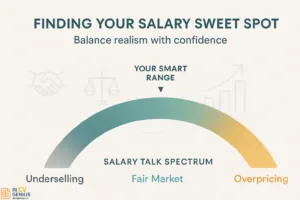
Understanding the Psychology of Salary Talks: Anchoring
Money is emotional. For many of us, it is tied to our sense of identity, value, and security. That is why these conversations trigger anxiety. But in a negotiation, the most important psychological concept to understand is anchoring.
The “anchor” is the first number put on the table. Every single number that follows will be judged in relation to that anchor. If you say “$60,000,” you have anchored the conversation at $60k. Their counter-offer of $65k will feel like a “win,” even if they were authorized to pay $80k. If they say “$50,000,” they have anchored low, and your request for $70k might seem like a huge jump.
This is why the “first-number” rule is so debated. The person who states the first number sets the anchor. Your goal is to avoid anchoring yourself too low. The best strategy is to get them to state their budgeted range first. This is your primary objective.
Phase 1: Your Pre-Interview Research (Know Your Numbers)
Never, ever go into an interview without knowing your numbers. Confidence does not come from memorizing a script; it comes from doing the research. Preparation gives you a foundation of data, which is the ultimate antidote to anxiety.
You need to determine three key numbers:
- Your “Walk-Away” Number (The Minimum): This is your absolute floor. It is the lowest number you would accept, considering your bills, financial goals, and self-worth. You never state this number, but you must know it for your own boundaries.
- Your “Target” Number (The Goal): This is the realistic, well-researched number you are aiming for. It should be based on your skills, experience, and what the market pays for this specific role, in this specific industry, in this specific location.
- Your “Anchor” Number (The Ask): This is the number you will state if you are forced to go first. It should be 10-15% above your target. This high-but-defensible number anchors the negotiation in your favor and gives you room to be “negotiated down” to your actual target, making both sides feel like they won.
To find this data, use multiple sources to create a credible range. Check Glassdoor, LinkedIn Salary, Payscale, and industry-specific salary reports. Remember to filter by job title, location, and company size. A “Project Manager” in San Francisco makes a different salary than one in St. Louis.
| Preparation Step | Why It Matters | Action |
|---|---|---|
| Research Market Range | Prevents you from underselling or overpricing yourself. | Use Glassdoor, LinkedIn Salary, Payscale. Filter by location & company size. |
| Know Your Minimum | Clarifies your boundaries and prevents you from accepting a bad offer. | Calculate your budget, bills, and financial goals. (Keep this private). |
| Set a Target Range | Gives room for negotiation while staying confident and realistic. | This is your “ideal” number, based on your research. |
| Helps justify your range with evidence and impact. | List 3-5 bullet points of your key achievements and metrics. | Do not forget to connect salary to value. |
When your resume clearly articulates this value, it makes the salary conversation much easier. Explore our AI Resume Templates to see layouts designed to highlight your metrics and achievements, giving you a strong foundation for your negotiation.
Phase 2: How to Answer (Strategies and Scripts)
When the question comes, stay relaxed. Take a breath, smile, and use one of these strategies, in this order of preference.
1️⃣Strategy #1: The Pivot (Get Them to Go First)
This is your best-case scenario. You deflect the question politely and professionally, inviting them to share their budgeted range. This gives you all the power, as they set the low anchor, not you.
*Script 1 (Focus on the Role):
“That’s a great question. Right now, I’m focused on learning as much as I can about this role and the team to make sure I’m the best fit. I’d love to know what the budgeted salary range is for this position.”
*Script 2 (Focus on Fit):
“I’m really excited about this opportunity. I’m flexible on salary, as the total compensation package – including benefits, bonuses, and growth opportunities – is most important to me. Could you share what salary band you have in mind for this role?”
*Script 3 (Direct and Confident):
“I’m happy to discuss compensation. To make sure we’re aligned, what is the range you’ve budgeted for this role?”
Nine times out of ten, the recruiter will appreciate the professional pivot and will give you the range. If they do, your answer is simple: “That sounds like a range we can definitely work with.”
2️⃣Strategy #2: The Range (If They Push Back)
Sometimes, a recruiter will push back, saying, “We’d really like to know your expectations first.” This is the time to use your “Anchor” number. You will state a range, not a single number, to show flexibility.
Your range should be well-researched and confident. The bottom of your range should be at or slightly above your “Target” number. This anchors the negotiation high.
*Script 1 (The Confident Range):
“Based on my research for this type of role, my skills in [Your Key Skill], and the market rates in [Your City], I’m targeting a range of $85,000 to $95,000. However, I’m flexible and open to discussing the full compensation package.”
*Script 2 (Linking to Value):
“Given my five years of experience in [Your Field], including my track record of [Your Key Achievement, e.g., ‘increasing lead gen by 30%’], I am seeking compensation in the range of $70,000 to $80,000.”
This anchors the conversation at $70k-$80k, making it very likely you’ll land at or above your “Target” of $65k.
Common Mistakes That Cost You Thousands
How you phrase your answer matters. Avoid these common pitfalls that instantly strip you of negotiating power.
| ❌ The Mistake | Why It’s Bad | ✅ Better Strategy |
|---|---|---|
| Giving a Single Number (e.g., “$70,000”) | You’ve just set a ceiling. You will never get more than this, and they will likely try to offer you less. | Always give a 10-15k range (e.g., “$75k-$85k”). |
| The “Desperate” Answer (e.g., “I’m open to anything!”) | This signals a lack of confidence and invites a lowball offer. | “I’m flexible, but based on my research, I’m targeting…” |
| Apologizing for Your Worth (e.g., “I’m hoping for… maybe $60k?”) | The hesitant tone and “hoping” language makes it sound like you don’t believe you’re worth it. | Own your range calmly. “I am seeking…” |
| Using “I need” or “I want” | This frames it around your personal needs, not your professional value. | Reframe to “Based on my research and experience…” or “The market rate for this role is…” |
| Giving a Number Too Early | Never state your number before you understand the role’s full scope and have proven your value. | Use Strategy #1: The Pivot. Always deflect the first time. |
How to Handle “Required” Salary Fields on Online Applications
This is a common frustration. An online form forces you to enter a number before you have even spoken to a human. You have a few options:
- Enter “0” or “1”: This often bypasses the filter and signals you want to discuss it.
- Enter Your Target Range: If it allows, enter your range (e.g., “75000-85000”).
- Enter Your “Anchor” Number: If it requires a single number, enter your “Anchor” (your high, desired number). It’s better to anchor high and be filtered out (if they truly can’t afford you) than to anchor low and be stuck.
- Enter Your “Target” Number: This is a safe, middle-ground approach.
If there is a notes field, always add “Negotiable depending on full scope of responsibilities and total compensation package.” For more deep-dive prep, check our Career Resources section for templates and strategy guides.
Phase 3: How to Negotiate When You Get the Offer
You did it. They’ve extended a verbal offer. DO NOT ACCEPT ON THE SPOT. This is your last, best moment to negotiate.
1️⃣Step 1: The Pause and Thank You.
No matter the number, your first words are always the same. Be gracious and enthusiastic.
“Thank you so much! I am thrilled about this offer and really excited about the opportunity to join the team.”
2️⃣Step 2: The Ask for Time.
Never negotiate in the same call. You need time to review the full package and compose your thoughts. This also shows you are thoughtful and not impulsive.
“This is wonderful. I’d like to review the full details of the offer, including the benefits package. Would it be possible for you to send that over in an email? I can get back to you by [Date, e.g., ‘end of day tomorrow’].”
3️⃣Step 3: The Counter-Offer (The “Gratitude-Gap-Ask”).
You will do this over the phone or email (phone is often better). Use this simple, non-confrontational formula.
- Gratitude: “Thank you again for this offer. I am very excited about this role.”
- The Gap: “I have reviewed the offer. Based on my [Your Value, e.g., ‘experience managing a $1M portfolio’] and the market data for this role, the offer of [$70,000] is a bit lower than my expectations. My target range was closer to [$80,000].”
- The Ask: “Would you be able to match my target of $80,000?” (Or, for a softer approach: “Is there any flexibility to bring the offer closer to $75,000?”)
Then, stop talking. The silence can be uncomfortable, but the first person to speak often loses. Be calm, polite, and confident.
Beyond Salary: Look at the Whole Package
If the company says “We can’t budge on the base salary,” your negotiation is not over. This is when you pivot to the total compensation package. Salary is just one part of your compensation.
Script: “I understand that the base salary is firm. In that case, could we discuss flexibility in other areas? I’d be willing to accept $70,000 if we could [Your Ask].”
Levers you can pull:
- Sign-on Bonus: A one-time payment to “bridge the gap.”
- More Vacation Time: An extra week of PTO can be worth thousands in mental health.
- Remote Work / Flexibility: “Could we formalize a hybrid schedule of 3 days remote?”
- Performance Bonus: “Could we set a 6-month review with a 5% bonus if I hit X, Y, and Z goals?”
- Title: A “Senior” title can set you up for your next job.
- Professional Development: A $2,000 stipend for courses or conferences.
Sometimes a slightly lower salary with fantastic flexibility or growth opportunities is a better long-term deal.

How Confidence Shapes Perception
Confidence does not come from memorizing a script. It comes from deep preparation and a mindset shift. When you know your worth, your tone, eye contact, and body language naturally align. You are not an applicant asking for a favor; you are a professional discussing the terms of a partnership.
Even if the employer offers less, they will remember your professionalism and clarity. Many managers will find the money for a candidate who confidently articulates their value. They respect the person who knows their worth.
“When you articulate your worth with composure, you invite respect instead of rejection.”
The Core Lesson: Communicate, Don’t Defend
Handling salary expectations interview questions is not about being aggressive or overly polite. It is about clarity. You are not defending your personal needs; you are communicating your professional market value.
Speak with data, respect, and composure. The goal is not to “win” – it is to find a mutual “yes.” That is how professionals turn a dreaded question into a conversation of mutual understanding and respect.