
- Why it matters: A formal resume adds context, credibility, results, and ATS readability that a portfolio link alone often cannot.
- What to include: Use a clean structure with header, 3 to 5 line summary, grouped skills, and curated project entries with outcomes.
- How to write projects: Treat each engagement like a mini case study that states deliverables, key actions, and a measurable result.
- How to stand out: Tell a coherent niche story, prioritize results over tasks, keep design readable, and tailor for each serious opportunity.
- How to keep it effective: Quantify impact even with estimates, add 1 to 3 testimonials, and refresh your resume every few months to stay current.
Being a freelancer means you wear many hats: creator, marketer, accountant, negotiator – sometimes even therapist. You are the CEO, the intern, and the entire marketing department rolled into one. Yet, amidst this whirlwind of responsibilities, when it comes to landing your next project, one seemingly traditional tool often decides whether potential clients or agencies take you seriously: your freelance resume template. It’s far more than just paperwork or a list of past gigs; it’s the professional snapshot, the curated narrative that shows the world not just what you can do, but how you deliver tangible value, solve specific problems, and operate reliably – all on your own terms.
In a gig economy saturated with talent, standing out requires more than just a slick portfolio. Your resume provides the structure, the context, and the quantifiable evidence that builds immediate trust, especially with larger organizations or for longer-term contracts where reliability and professionalism are paramount.
Why a Formal Resume Still Matters (and Often Outperforms a Portfolio Link Alone)
Many freelancers understandably believe their online portfolio, personal website, or LinkedIn profile is sufficient. “My work speaks for itself,” they argue. While a strong portfolio is undeniably crucial for showcasing the quality of your output (especially in creative fields), a resume serves a distinct and equally vital function. It organizes your professional story, establishes credibility quickly, and allows potential clients, project managers, or HR departments to assess your fit within their specific needs – often in less than 10 seconds.
Think about the client’s perspective. They are often sifting through dozens, if not hundreds, of proposals or profiles. A well-structured resume offers:
- Immediate Context: It provides a chronological or skill-based overview of your career trajectory, areas of specialization, and the types of clients or industries you’ve served. A portfolio might show beautiful designs, but the resume explains who those designs were for and what business problem they solved.
- Quantifiable Results: Resumes excel at highlighting measurable achievements (e.g., “Increased client’s web traffic by 30%,” “Managed project budgets up to $50k,” “Delivered 15+ articles per month”). Portfolios often focus on the visual or final product, sometimes omitting the crucial business impact.
- Professionalism & Standardization: Especially when dealing with corporate contracts, agencies, or long-term retainer agreements, clients often expect or even require a formal document outlining your background. It signals that you understand professional norms and can integrate seamlessly into more structured environments.
- ATS Compatibility: Many larger companies and platforms use Applicant Tracking Systems (ATS) to filter candidates, even for contract roles. A text-based, keyword-optimized resume is essential for passing these initial digital gatekeepers, whereas a portfolio link alone might be ignored by the system.
Your resume acts as your professional executive summary or business brochure. While your portfolio shows the ‘what’ (your skills in action), your resume explains the ‘who’ (your professional identity), the ‘why’ (the purpose and impact of your work), and crucially, the ‘how’ (your reliability, process, and ability to deliver consistently). It builds the trust foundation upon which great client relationships are built.
Understanding the Freelancer Identity: More Than Just a Series of Gigs
Unlike traditional employees who often follow a linear path within one or two companies, freelancers build careers across a diverse landscape of projects, clients, industries, and sometimes even distinct roles. One month you might be a UX consultant for a fintech startup; the next, you could be a content strategist for a non-profit, followed by a project manager for a short-term agency contract. A powerful freelance resume must reflect this inherent adaptability while simultaneously maintaining a clear, coherent professional focus. It needs to weave these disparate threads into a compelling narrative of growth, expertise, and consistent value delivery.
Here’s the fundamental truth: your resume is not a passive historical record or an exhaustive list of every small project you’ve ever touched. It is an active sales and marketing tool. Its primary purpose is to persuade a potential client that you are the best, most reliable solution to their specific problem. Therefore, it should strategically highlight:
- Patterns of Excellence: Showcase recurring themes in your work – perhaps consistently delivering projects ahead of schedule, specializing in a particular niche (like B2B SaaS marketing), or excelling at turning complex requirements into simple solutions.
- Quantifiable Results: Emphasize the measurable impact you’ve made. Clients hire freelancers to achieve outcomes – increase revenue, reduce costs, improve efficiency, boost engagement. Your resume needs concrete data points.
- Professionalism & Reliability: Demonstrate that you operate like a business, not just a hobbyist. Mention your process, communication style, ability to meet deadlines, and experience managing client expectations.
- Adaptability & Collaboration: Highlight your ability to quickly integrate into new teams or understand different industry contexts. Show that you thrive without constant supervision yet collaborate effectively when needed.
Your resume tells the story of someone who is not just skilled, but also disciplined, proactive, and capable of managing themselves and delivering exceptional results – a true independent professional.
Core Structure of a Winning Freelance Resume: Building Your Blueprint
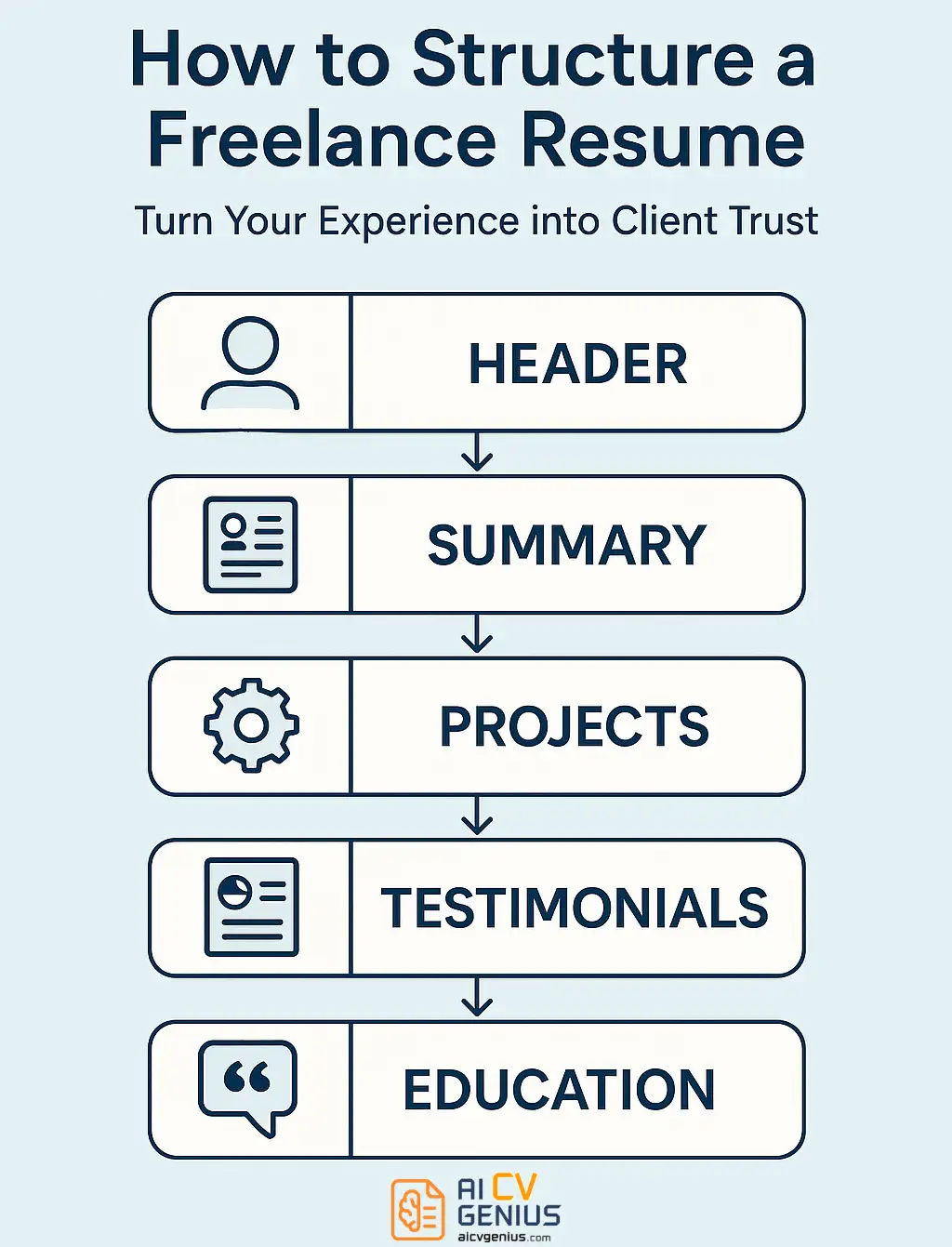
While the content needs personalization, the structure of a freelance resume generally follows established best practices for clarity and impact. Think of this structure as the framework ensuring your key selling points are immediately visible.
1. Header and Contact Information: Your Digital Business Card
Position this clearly at the very top. It needs to be professional and provide multiple ways for potential clients to learn more or get in touch.
- Your Name: Use a slightly larger font size.
- Professional Title: Be specific and benefit-oriented. Instead of just “Freelancer,” use titles like “Freelance Graphic Designer & Brand Strategist,” “Independent Marketing Consultant (SaaS Specialist),” or “Contract Full-Stack Web Developer.” This immediately frames your expertise.
- Essential Links: Include direct links to your professional website, online portfolio (Behance, Dribbble, GitHub, Contently, personal site), and your LinkedIn profile. Ensure these links are clickable in the PDF version.
- Location: Mention your city and state/country. Even if you work globally, it provides context. Specifying “Remote” or “Available Worldwide” can also be helpful.
- Professional Email Address: Use an address associated with your freelance business (e.g., yourname@yourbusiness.com or a clean Gmail/Outlook address). Avoid unprofessional or outdated email addresses.
- Phone Number (Optional but Recommended): Include a reliable contact number.
Skip: Full home address (privacy risk), date of birth, marital status, or photos (unless standard practice in your region/industry).
2. Professional Summary: Your 30-Second Pitch
This is arguably the most critical section. In 3–5 concise lines, you must summarize your core expertise, target industries or client types, key skills, and the primary value you deliver. Tailor this section for every significant application or proposal. It should directly address the needs implied in the job description or project brief.
Avoid generic statements like: “Hard-working and versatile freelancer seeking challenging projects.”
Focus on specific value propositions:
Example (Freelance Writer):
“Results-driven B2B Content Writer specializing in the cybersecurity sector. Proven ability to translate complex technical concepts into engaging blog posts, white papers, and case studies that generate qualified leads. Over 5 years experience helping SaaS companies increase organic traffic (avg. 40% YoY) and establish thought leadership. Proficient in SEO best practices and data-driven content strategy.”
Example (Freelance UX Designer):
“User-centric Freelance UX/UI Designer with 7+ years experience crafting intuitive interfaces for mobile apps and web platforms in the e-commerce and healthcare industries. Expertise in user research, wireframing (Figma, Sketch), prototyping, and usability testing. Passionate about creating seamless user journeys that demonstrably improve conversion rates (achieved up to 25% uplift for previous clients) and user satisfaction.”
This section sets the stage and tells the client immediately if you’re potentially the right fit.
3. Key Skills and Tools: Your Technical & Creative Arsenal
Create a dedicated section that highlights your core competencies and technical proficiencies. Group skills logically to make them easily scannable. This helps with both human readability and ATS keyword matching. Be specific and prioritize skills mentioned in the job description.
Instead of a random list: Figma, Photoshop, Writing, SEO, HTML, Project Management…
Organize into categories:
- ✅ Creative Design & Tools: Brand Identity Design, UI/UX Design, Illustration, Wireframing, Prototyping | Software: Adobe Creative Suite (Illustrator, Photoshop, InDesign), Figma, Sketch, Canva Pro
- ✅ Web Development & Technologies: Front-End Development (HTML5, CSS3, JavaScript ES6+), Back-End Development (Node.js, Python/Django), Database Management (SQL, MongoDB) | Frameworks/Libraries: React, Vue.js, jQuery | Platforms: WordPress, Webflow, Shopify
- ✅ Content Creation & Marketing Strategy: SEO Copywriting, Blog Writing, White Papers, Case Studies, Email Marketing, Social Media Strategy, Content Calendar Management | Tools: Google Analytics, SEMrush, Ahrefs, Mailchimp, HubSpot
- ✅ Project Management & Collaboration: Agile Methodologies, Client Communication, Budget Management, Deadline Adherence, Remote Team Coordination | Tools: Asana, Trello, Jira, Slack, Notion
Listing specific tools demonstrates practical proficiency and helps clients visualize you fitting into their existing workflows.
4. Project Portfolio / Professional Experience: Showcasing Your Impact
This is where you detail your freelance work. Instead of listing employers (which might be numerous and short-term), focus on significant projects or client engagements. For each entry, treat it like a mini case study:
- Project Title / Client Type: Briefly describe the project or anonymize the client if necessary (e.g., “Brand Identity Redesign for E-commerce Startup,” “Content Strategy for National Non-Profit,” “Full-Stack Development for SaaS Platform”).
- Your Role/Deliverables: Clearly state what you were hired to do (e.g., “Lead UX Designer,” “Primary Content Writer,” “Developed front-end components”).
- Key Actions & Skills Used: Briefly mention the process or specific skills applied (e.g., “Conducted user interviews,” “Wrote 10+ SEO-optimized articles,” “Built REST APIs”).
- Measurable Result: This is crucial. Quantify the outcome whenever possible (e.g., “Resulted in a 60% increase in trial sign-ups within three months,” “Contributed to a 25% decrease in bounce rate,” “Delivered project 2 weeks ahead of schedule”).
Example Project Entry (Freelance Developer):
E-commerce Platform Optimization | B2C Retail Client (Confidential) | (Jan 2024 – Apr 2024)
Role: Contract Front-End Developer
- Optimized page load speeds across key product pages using lazy loading techniques and image compression (React, Next.js).
- Refactored CSS codebase for improved maintainability and reduced style conflicts.
- Collaborated with backend team via Git to integrate new payment gateway APIs.
- Result: Achieved an average 35% improvement in Core Web Vitals scores and contributed to a 10% uplift in mobile conversion rates.
If you have long-term retainers or consistent work with a few key clients, you can list those relationships similarly to traditional employment, but still emphasize project-based achievements within that relationship.
5. Testimonials and Endorsements: Social Proof That Builds Trust
Unlike traditional employees who rely on internal references, freelancers thrive on external validation. Including 1-3 short, powerful quotes from satisfied clients directly on your resume can significantly boost credibility. Choose testimonials that highlight specific strengths relevant to the roles you’re targeting (e.g., reliability, creativity, communication, results).
“Jane’s strategic approach to content doubled our organic leads in just six months. She’s reliable, insightful, and a pleasure to collaborate with.” – CEO, Tech Startup (SaaS)
“David delivered pixel-perfect designs ahead of every deadline. His attention to detail and proactive communication made the entire redesign process seamless.” – Marketing Director, Health & Wellness Brand
Always ask for permission before using a client’s name or company. If needed, anonymize slightly (e.g., “Project Manager, Global Agency”). Position these strategically, perhaps in a sidebar or near the end, to reinforce your claims.
6. Education & Certifications: Foundational Knowledge & Continuous Learning
Include relevant degrees, diplomas, and professional certifications. For freelancers, showcasing ongoing learning is particularly important as it demonstrates initiative and adaptability – key traits for independent work. Include:
- Formal degrees (e.g., Bachelor of Arts in Communication)
- Industry-specific certifications (e.g., Google Analytics Certified, AWS Certified Developer, PMP Certification)
- Significant online courses or bootcamps (e.g., UX Design Immersive from General Assembly, HubSpot Inbound Marketing Certification, Coursera Specializations relevant to your field)
List these concisely, including the institution/platform and year completed. Prioritize credentials most relevant to the type of freelance work you seek.
7. Optional Add-Ons: Enhancing Your Narrative
Depending on your field and experience, consider adding brief sections for:
- ✅ Achievements & Awards: Industry recognition, features in publications, significant contest wins.
- ✅ Publications & Speaking Engagements: Published articles, blog posts on reputable sites, conference talks, podcast appearances relevant to your expertise.
- ✅ Languages: Specify language and proficiency level (e.g., Spanish – Native, French – Conversational). Especially valuable for international clients or roles requiring multilingual skills.
- ✅ Volunteer Work: If it showcases relevant skills (e.g., managing communications for a non-profit, designing a website for a local charity).
Use these sections strategically to provide additional layers of credibility or personality, ensuring they remain relevant to your professional brand.
How to Make Your Freelance Resume Stand Out From the Crowd
In a competitive market, a generic resume gets lost. Here’s how to elevate yours:
1. Tell a Coherent Story, Not Just a List of Gigs
Connect the dots between your projects. Show progression. Did you start with smaller clients and scale up? Did you specialize in a niche over time? Frame your experience as intentional growth, not random assignments. Your summary and project descriptions should reflect this narrative arc.
Instead of: “Worked on various design projects.”
Try: “Progressed from designing social media graphics for small businesses to leading full brand identity projects for mid-sized tech startups, consistently focusing on user-centric design principles.”
2. Focus Obsessively on Results, Not Just Tasks
Clients hire freelancers to solve problems and achieve outcomes. Every project description should answer: “What changed because of my work?” Use numbers, percentages, and tangible outcomes.
- Instead of: “Managed client’s social media accounts.”
- Try: “Managed client’s Instagram and LinkedIn presence, increasing average monthly engagement by 45% and generating 20+ qualified leads through targeted content campaigns.”
Even if exact numbers are unavailable or confidential, use descriptive outcomes: “Streamlined the client’s onboarding process, significantly reducing user confusion,” or “Developed brand messaging that resonated strongly with the target Gen Z audience.”
3. Keep It Visually Clean, Professional, and On-Brand
As a freelancer, your resume’s design is a reflection of your professionalism. Choose a clean, modern, ATS-friendly template. Use consistent fonts, ample white space, and clear section headings. If you’re a designer, ensure the aesthetic aligns with your personal brand, but prioritize readability over excessive creativity.
Explore minimalist yet impactful templates from our Resume Templates Finder that balance professionalism and scannability.
4. Tailor Ruthlessly for Each Significant Opportunity
Don’t send the exact same resume to every client or for every project proposal. Adapt your summary, skills section, and highlighted projects to directly address the specific needs and language used in the job description or project brief. This shows you’ve done your research and understand their context.
For example, if applying for a role needing SEO expertise, bring your SEO-related projects and skills to the forefront. If targeting a corporate client, emphasize professionalism, communication, and experience with larger teams or budgets.
Sample Freelance Resume Example (Text Version – Expanded)
Jane Doe
Freelance Graphic Designer & Brand Identity Specialist
janedoe.design | London, UK | jane@janedoe.com | LinkedIn: /in/janedoe | Portfolio: janedoeportfolio.comProfessional Summary:
Highly creative and results-oriented freelance Graphic Designer with 7+ years of experience helping startups and established agencies craft compelling visual identities that drive user engagement and brand recognition. Specializing in brand strategy, UI/UX design for web/mobile, and marketing collateral. Proven ability to translate client visions into impactful designs that achieve measurable business goals, such as increasing conversion rates and enhancing brand consistency across all touchpoints. Proficient in Adobe Creative Suite, Figma, and Webflow.Key Skills:
- Branding & Identity: Logo Design, Style Guides, Brand Strategy, Visual Identity Systems
- UI/UX Design: Wireframing, Prototyping, User Flows, Interaction Design, Responsive Web Design
- Graphic Design: Marketing Collateral, Social Media Graphics, Presentations, Print Design, Typography, Illustration
- Tools & Technologies: Adobe Creative Suite (Illustrator, Photoshop, InDesign – Expert), Figma (Expert), Sketch, Webflow (Intermediate), Canva Pro, Basic HTML/CSS
- Professional Skills: Client Communication, Project Management (Asana), Deadline Adherence, Creative Problem-Solving, Remote Collaboration (Slack, Zoom)
Selected Projects & Client Impact:
Brand Redesign & UI Kit Development | Tech Startup (SaaS) | (Jun 2023 – Oct 2023)
- Led the complete redesign of the client’s brand identity, including logo, color palette, typography, and visual guidelines.
- Developed a comprehensive UI kit in Figma for their web application, ensuring consistency across 50+ screens.
- Collaborated closely with the development team to ensure seamless implementation.
- Result: The new design contributed to a 40% increase in user onboarding completion rates and received overwhelmingly positive feedback from early adopters.
Social Media Campaign Visuals | Sustainable Fashion Brand (Eco Brand) | (Feb 2023 – May 2023)
- Designed a series of visually engaging Instagram graphics, stories, and Reels covers for a new product launch campaign.
- Developed a cohesive visual theme aligned with the brand’s sustainable ethos.
- Utilized Canva Pro and Adobe Spark for rapid iteration and delivery.
- Result: Campaign visuals achieved a 2x higher engagement rate compared to previous campaigns and were featured by several industry influencers.
Website Redesign & UX Optimization | Digital Marketing Agency | (Sep 2022 – Dec 2022)
- Redesigned the agency’s corporate website (WordPress theme customization) focusing on improved navigation and clearer service communication.
- Conducted user testing on wireframes to identify pain points in the original site structure.
- Implemented clearer calls-to-action and optimized information architecture.
- Result: The redesigned website saw a 20% increase in average session duration and a 15% decrease in bounce rate within the first quarter post-launch.
Testimonials:
“Jane’s designs consistently exceed expectations. She blends creativity with strategic thinking and unwavering reliability.” – Sarah K., CEO, Tech SaaS Client (Amsterdam)“Working with Jane was a dream. She understood our brand vision immediately and delivered stunning visuals ahead of schedule.” – Mark P., Marketing Lead, Eco Brand
Education & Certifications:
- Bachelor of Fine Arts (BFA) in Graphic Design | University of the Arts London | London, UK | 2017
- Certified UX Designer | Interaction Design Foundation (IDF) | 2021
- Webflow 101 Crash Course | Webflow University | 2023
Design Tools for Creating Freelance Resumes: Choosing Wisely
Numerous tools can help you create a professional-looking freelance resume:
- Online Resume Builders (Canva, Kickresume, Enhancv, Zety): Offer pre-designed, often customizable templates. Great for speed and ease of use. Ensure the chosen template is ATS-friendly (prioritize text-based layouts). Many offer free basic versions.
- Graphic Design Software (Figma, Adobe XD, Illustrator, InDesign): Provide maximum creative control for designers who want a fully custom layout. Requires design skills and careful attention to ensure text is selectable and ATS-compatible (export as an accessible PDF).
- Word Processing Software (Microsoft Word, Google Docs): Offer simple, reliable, ATS-friendly templates. Excellent for prioritizing content and clarity over complex design. Many professional templates are available online for these platforms.
You can explore detailed comparisons and recommendations in our Reviews section. The best tool depends on your technical skills, design preferences, and the importance of ATS compatibility for your target clients.
Tips for Different Freelance Professions: Tailoring Your Story
While the core structure remains similar, the emphasis shifts based on your field:
For Designers & Visual Communicators:
Your resume itself is part of your portfolio. Keep the layout visually engaging but highly functional and readable. Use typography effectively. Ensure a prominent link to your online portfolio (Behance, Dribbble, personal site). Highlight collaborations, client feedback, and the impact of your design solutions (e.g., improved usability, increased conversions).
For Developers & Engineers:
Show technical depth, problem-solving prowess, and reliability. Include links to your GitHub profile, live projects, or relevant code repositories. Clearly list your tech stack (languages, frameworks, databases, cloud platforms). Crucially, describe the business outcome or user benefit of each project, not just the technologies used (e.g., “Developed feature that reduced user error rates by 15%,” not just “Used React and Node.js”).
For Writers, Marketers & Strategists:
Demonstrate range and results. Showcase experience across different content types (blog posts, white papers, ad copy, email campaigns) or marketing channels (SEO, SEM, social media, automation). Mention specific analytics tools used (Google Analytics, SEMrush) and quantify achievements (e.g., improved CTR by X%, increased organic traffic by Y%, generated Z leads). Writing about outcomes proves your strategic value beyond just content production.
For Consultants, Coaches & Advisors:
Emphasize transformation and strategic impact. Focus on how your advice, strategy, or coaching improved client performance, team morale, operational efficiency, or profitability. Client testimonials and data-backed case study summaries are essential. Frame your expertise around solving specific business problems.
How to Quantify Your Freelance Work (Even Without Hard Data)
Numbers provide concrete proof of your value. Aim to include metrics in as many project descriptions as possible. Think in terms of:
- Efficiency/Time Savings: “Reduced report generation time by 50%,” “Delivered project 3 weeks ahead of schedule.”
- Growth/Engagement: “Increased social media followers by 2,000,” “Improved email open rates by 15%.”
- Revenue/Cost Savings: “Contributed to a $100k sales pipeline,” “Identified cost savings of $10k annually.”
- Scale/Volume: “Managed 5 concurrent client projects,” “Wrote 20+ articles per month,” “Designed interfaces for an app with 50,000+ users.”
- Quality/Satisfaction: “Achieved a 95% client satisfaction score,” “Reduced bug reports by 30% post-launch.”
If exact numbers are confidential or unavailable, use estimates, ranges, or qualitative descriptors that imply scale or improvement: “Significantly improved user workflow clarity,” “Managed a substantial project budget,” “Consistently met tight deadlines for a high-volume client.” The goal is to move beyond simply stating tasks to demonstrating tangible impact.
Maintaining and Updating Your Resume: A Living Document
Unlike traditional employees who might update their resumes only when actively job searching, freelancers operate in a constantly evolving market. Your skills, projects, and client base change frequently. Treat your resume as a dynamic document that reflects your current capabilities and focus.
- Schedule Quarterly Updates: Set a calendar reminder every 3-4 months to review and refresh your resume. Add significant new projects, recently acquired skills or certifications, and compelling new results or testimonials.
- Remove Outdated or Less Relevant Information: As you gain more experience, prune older or less impactful projects to keep the focus sharp and the document concise (ideally 1-2 pages).
- Keep Design Consistent: Ensure your resume’s visual style remains aligned with your personal brand (website, portfolio, LinkedIn).
- Maintain a “Master” Version: Keep a comprehensive version with all projects and details. Use this as a base from which you can quickly tailor shorter, targeted versions for specific applications.
Regular maintenance ensures you’re always ready to seize new opportunities without scrambling to update outdated information.
Top Mistakes Freelancers Make on Resumes (And How to Avoid Them)
| ❌ Mistake | ✅ Fix |
|---|---|
| Listing every small gig – overwhelms and dilutes impact. | Curate ruthlessly – focus on 3–5 high-impact, relevant projects per page. |
| Using informal language or emojis – undermines professionalism. | Maintain a professional, confident, approachable tone; skip emojis. |
| Forgetting outcomes or client context – tasks without proven value. | Include a clear result or problem solved for every project (quantify when possible). |
| Overloading design elements – cluttered layout, hard-to-read fonts, ATS issues. | Prioritize clarity and readability; use design to support structure, not dominate it. |
| Generic summary and skills – fails to differentiate. | Tailor summary/skills to each opportunity; use keywords from the brief. |
| Broken links or outdated portfolio – erodes trust immediately. | Double-check all links (portfolio, LinkedIn, website) and feature recent, relevant work. |
Advantages and Limitations of a Freelance Resume: Setting Expectations
| Pros ✅ | Cons ❌ |
|---|---|
| Builds immediate credibility and trust, especially with corporate or agency clients unfamiliar with freelance platforms. | Requires frequent updates due to the project-based nature of freelance work. Can quickly become outdated. |
| Effectively showcases adaptability, self-management, and experience across diverse industries or client types. | Can be challenging to present a clear, linear career path compared to traditional employment history. |
| Opens doors to larger, longer-term contracts, retainer agreements, or collaborations requiring formal vetting. | Needs a well-designed, scannable layout to avoid appearing cluttered or overwhelming due to varied projects. |
| Reinforces your professional brand and narrative when presented alongside your portfolio and website. | Some clients (especially in highly visual fields or startup environments) may still prefer portfolio-first approaches and might only skim the resume. |
| Essential for passing ATS filters used by larger organizations or recruitment platforms. | Quantifying results can sometimes be difficult due to NDAs or lack of access to client-side analytics. |
Understanding these points helps you leverage the resume effectively as part of your broader freelance marketing toolkit.
When to Send Your Resume vs. Portfolio or Website Link: Strategic Choices
The best approach often depends on the context and the client:
- Formal Applications (Corporate, Agency, Long-Term Contracts): Always attach your tailored resume (PDF format). Include portfolio/website links within the resume header and potentially in your cover email/message. The resume provides the structured overview they expect.
- Creative/Visual Role Pitches: Lead with your portfolio link. Briefly introduce yourself and mention that a detailed resume is available upon request or attached for their reference. Let the visuals make the first impact.
- Cold Outreach or Networking: Share your LinkedIn profile or personal website link initially. If the conversation progresses towards a specific project, offer to send your resume for a more detailed background overview.
- Freelance Platform Profiles (Upwork, Fiverr Pro): Your platform profile often serves as a hybrid of resume and portfolio. Ensure it’s fully optimized with skills, project examples, and client testimonials. Keep a separate formal resume ready if clients request it off-platform.
Ideally, your resume, portfolio, website, and LinkedIn profile should present a consistent brand narrative, complementing rather than contradicting each other. Together, they tell the full story: the evidence (resume), the proof (portfolio), and the personality (website/LinkedIn) behind your freelance brand.
Using AI Tools to Enhance Your Resume: Smart Assistance, Not Replacement
AI-powered tools can significantly streamline the resume creation process for freelancers:
- Grammar & Tone Polishers (Grammarly, ProWritingAid): Help ensure your writing is clear, concise, professional, and error-free.
- AI Resume Builders (Kickresume AI, Rezi AI): Can generate initial drafts, suggest bullet points based on roles, analyze for keywords, and offer ATS compatibility checks.
- Content Refinement Tools: Can help rephrase sentences, suggest stronger action verbs, or tailor summaries to specific job descriptions.
However, rely on AI as an assistant, not an author. Always review and personalize AI-generated content to ensure it accurately reflects your unique experience, voice, and achievements. Authenticity remains crucial for building client trust. Technology supports your message – it doesn’t replace the human touch that ultimately wins projects.
Adapting Your Freelance Resume for Remote Full-Time or Hybrid Roles
Many successful freelancers eventually consider transitioning to full-time remote or hybrid positions. Your freelance experience is a significant asset in this context, demonstrating valuable traits:
- Self-Discipline & Time Management: Proven ability to work independently and meet deadlines without direct supervision.
- Communication Skills: Expertise in asynchronous communication (email, Slack) and remote collaboration tools.
- Adaptability: Experience working with diverse clients, projects, and industries.
- Problem-Solving & Initiative: Track record of identifying issues and finding solutions independently.
When adapting your resume for these roles:
- Use a clear Professional Summary highlighting your years of freelance experience and core skills relevant to the full-time role.
- Structure your “Experience” section chronologically if possible, grouping projects under longer client relationships or using “Self-Employed/Freelance [Your Title]” as the employer.
- Emphasize collaboration, communication tools (Slack, Zoom, Asana), and measurable results achieved remotely.
- Quantify achievements consistently.
Explore examples and strategies for showcasing freelance work effectively for traditional roles in our Career Resources section.
Final Touches Before Sending: The Professional Checklist
Before you hit “Send” or “Upload”:
- ✅ Proofread Meticulously: Check for typos, grammatical errors, and inconsistencies (dates, formatting). Read it backward, sentence by sentence.
- ✅ Check All Links: Ensure portfolio, website, and LinkedIn links work correctly.
- ✅ Verify Contact Information: Double-check your email address and phone number.
- ✅ Save as PDF: Use a professional filename (e.g., “FirstNameLastName_Freelance[YourSpecialty]_Resume.pdf”). Ensure the PDF text is selectable (not an image).
- ✅ Tailor One Last Time: Reread the job description/project brief. Does your summary directly address their needs? Are the most relevant projects highlighted?
- ✅ Backup Your Work: Save both the final PDF and the editable source file (e.g., Word doc, Figma file) for future updates.
This final quality check demonstrates the same attention to detail you bring to your client work.
Conclusion: Your Resume as a Reflection of Your Brand
A freelance resume isn’t merely about listing past projects – it’s about strategically connecting the dots between your unique skills, quantifiable results, and the client’s needs. It’s about building trust before the first conversation even begins. When crafted with care, clarity, and compelling evidence, your resume transforms from “just another freelancer application” into a powerful introduction to a recognized professional – someone clients are eager to collaborate with.
Combine your best, most relevant projects with measurable success metrics. Weave in authentic client feedback. Ensure the design is clean, professional, and easy to scan. That’s the trifecta – creativity, results, and trust – that consistently wins high-value freelance work, project after project.