

- Core idea: Handle job rejection like data, not a verdict, then decide your next move calmly.
- First move: Use the 24-hour rule to feel the sting, then stop the spiral and switch back into action mode.
- Keep doors open: Reply professionally within 24 to 48 hours so you stay on the “silver medalist” list and in the recruiter’s network.
- Get useful feedback anyway: Ask once, then run a ruthless self-audit on your resume targeting, research, pitch clarity, STAR stories, and the questions you asked.
- Improve faster: Track where rejections happen, fix the weak link for that stage, and reframe rejection as redirection while you apply smarter, often via referrals.
The email lands. That single, polite, soul-crushing line: “We’ve decided to move forward with another candidate.” It feels like a punch to the gut. You invested hours – tailoring your resume, meticulously researching the company, practicing answers in the mirror, navigating multiple interview rounds – all to end up exactly where you started: square one. If you’re wondering how to handle job rejection without spiraling into a vortex of self-doubt or losing the fragile momentum you’ve built, you are not alone. This experience is one of the most universal, and universally painful, parts of a professional career.
Here’s the critical truth that most people miss in the moment of disappointment: the rejection itself is just an event. It’s a data point. What truly matters, what defines your career trajectory, is how you respond to it. A single rejection feels like a verdict on your worth, but it’s not. It’s a statement about a specific match, at a specific time, for a specific role. And it is almost never as personal as it feels.
How you react in the hours and days that follow is a choice. A thoughtful, professional follow-up can – and often does – keep the door open for future opportunities. A period of honest, structured reflection can reveal the exact flaw in your strategy that needs fixing. And a crucial mindset shift can transform what feels like a debilitating failure into a necessary redirection. This guide is a step-by-step playbook for navigating the aftermath of rejection, moving you from processing the sting to landing your next, better opportunity.
Step 1: The 24-Hour Rule (Acknowledge the Sting, Don’t Be Consumed by It)
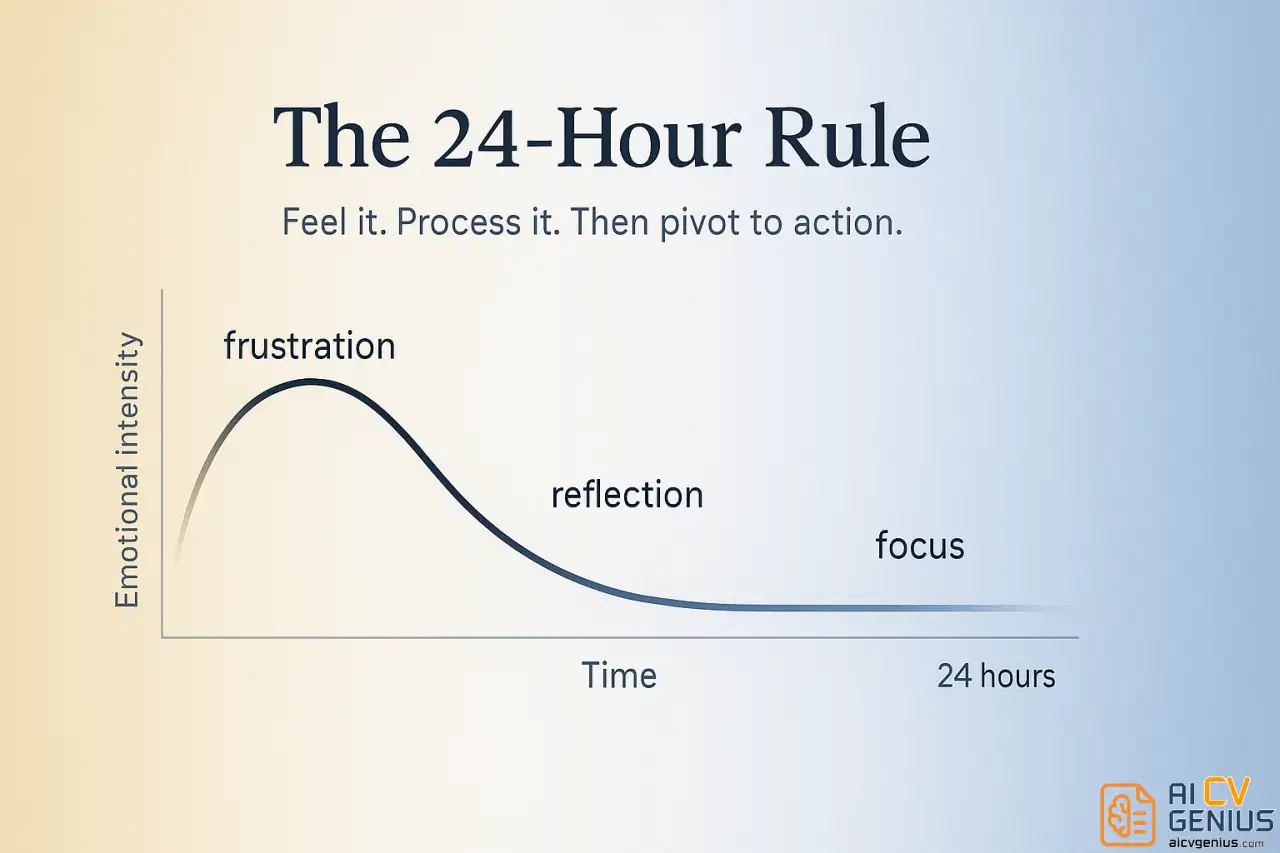
Let’s start by validating your feelings: it’s perfectly okay to feel terrible. Job rejection is not a minor inconvenience; it’s a social and professional slight that taps into our deepest fears of not being “good enough.” Neuroscientists have shown that the brain processes social rejection using the same pathways that process physical pain. That “punch to the gut”? It’s not just a metaphor. You’re allowed to feel disappointed, frustrated, angry, confused, or just plain sad. Suppressing these emotions in the name of “professionalism” doesn’t work; it just bottles them up, leading to stress and burnout.
So, here is your first concrete action: The 24-Hour Rule. You have 24 hours to process this rejection however you need to. Vent to a trusted friend or partner (not on social media). Go for a hard run. Binge-watch a stupid comedy. Play video games. Eat the ice cream. Do whatever non-destructive activity allows you to feel and release the frustration.
But – and this is the most critical part of the rule – you set a hard boundary. This is a 24-hour pass, not a permanent residence. When you wake up the next day, the period of emotional wallowing is over. You pivot from feeling to acting. This simple boundary is incredibly powerful. It gives you the space to be human and acknowledge the disappointment without letting that disappointment derail your entire week or sabotage your job search.
What to Absolutely Avoid During This 24-Hour Window
While processing, you must resist the urge to take actions that will harm your long-term search. Your judgment is clouded by emotion. Do not:
- ❌ Send an emotional, defensive, or argumentative reply. Firing off an email demanding “Why?!” or pointing out their mistake is a career-ending move. It burns the bridge and marks you as unprofessional.
- ❌ Post a vague, passive-aggressive rant on LinkedIn. “Disappointed to see the hiring process isn’t about talent anymore…” or “Thrilled to be ‘exploring new opportunities’ after another ‘great’ final-round interview…” This makes you look bitter and unemployable. Recruiters see this and will avoid you.
- ❌ Panic-apply to 50 random jobs. This “shotgun” approach feels productive, but it’s the opposite. You’ll send out non-tailored resumes and weak cover letters, leading to… more rejection. It just feeds the negative cycle.
- ❌ Catastrophize. Do not allow the thought “I’ll never get a job” to take root. One rejection is a single data point, not a prediction of your future.
The 24-hour rule is your emotional quarantine. Respect it. Once it’s over, you move to Step 2 with a clearer head.
If you’re finding that these rejections are particularly painful because you’re trying to pivot, you’re not alone. Navigating a new field is tough. Our guide on writing a career change resume can help you reframe your experience more effectively.
Step 2: Respond Professionally (The 5-Minute Action That Builds Bridges)
Most candidates do one of two things after a rejection email: they either reply angrily (see above) or, more commonly, they do nothing. They simply delete the email and move on, assuming the conversation is over. This is a massive missed opportunity.
Sending a short, gracious, professional reply is one of the single smartest, highest-ROI actions you can take. It achieves several critical things:
- ✅ It Preserves the Network: The hiring manager and recruiter are people you may encounter again. Leaving a final, positive impression is just smart networking.
- ✅ It Sets You Apart: 99% of candidates don’t do this. Your polite reply immediately marks you as a mature, professional, and thoughtful person – precisely the kind of person they want to hire.
- ✅ It Keeps You on the “Silver Medalist” List: Hiring mistakes happen all the time. The #1 candidate might reject their offer, fail a background check, or quit after three weeks. When this happens, where does the hiring manager look first? Not at the giant pile of unvetted applications. They look at their “silver medalists” – the strong candidates who just missed the cut. Your gracious email keeps you at the very top of that list.
- ✅ It Opens the Door for Other Roles: The recruiter who rejected you for Role A might be hiring for Role B next week, and you might be perfect for it. Your professional reply ensures they want to contact you about it.
Here are two simple, effective templates. Send one within 24-48 hours of receiving the rejection (after your 24-hour emotional window has closed).
Template 1: The Standard Professional Reply
Subject: Re: [Job Title] Position
Dear [Hiring Manager’s Name],
Thank you for letting me know your decision. While I’m naturally disappointed, I truly appreciate you taking the time to speak with me. I genuinely enjoyed our conversation and learning more about [Company Name] and the work your team is doing.
Please keep me in mind if any other opportunities arise that might be a good fit. I remain very interested in the company and would welcome the chance to work with you in the future.
Thanks again for your time and consideration.
Best regards,
[Your Name]
Template 2: The Final-Round “Close Call” Reply
Use this if you made it to the final round and built a strong rapport. It’s slightly more personal and directly asks for feedback.
Subject: Re: [Job Title] Position
Hi [Hiring Manager’s Name],
Thank you for the update. While I’m disappointed to hear I wasn’t the final candidate chosen, I want to say again how much I enjoyed our discussions, especially our conversation about [mention a specific topic you enjoyed, e.g., “the future of your new platform”].
I remain very impressed with [Company Name] and the team. If you have any feedback you’d be willing to share about my interview or application, I would be truly grateful as I continue my search.
Please do keep me in mind for the future. I hope our paths cross again.
Best,
[Your Name]
This simple act of professionalism costs you five minutes and can pay dividends for years. For more tips on professional communication, check out our collection of cover letter writing tips.
Step 3: Seek Feedback (But Don’t Expect It, and Do This Instead)
As noted in the template above, it’s smart to ask for feedback. But you must manage your expectations. Most employers will not give you detailed feedback. It is not because they are unkind. It is for two primary reasons:
- Legal Liability: This is the biggest reason. Many corporate legal departments train HR and managers never to give specific feedback. If they say, “We went with someone who had more management experience,” and you later find out the person hired didn’t, that could be grounds for a lawsuit. It’s safer for them to say nothing.
- Time: Hiring managers are incredibly busy. They may have interviewed 10 final-round candidates. They simply do not have the time to write a thoughtful, constructive critique for all nine rejected candidates.
So, ask once, politely, in your reply email. If they don’t respond, do not follow up and ask again. You will appear pushy and entitled. However, if they do respond and offer feedback (especially over the phone), treat it like gold.
What to Ask If They Agree to Give Feedback
If you get them on the phone, do not be defensive. Your only job is to listen and learn. Use these non-confrontational questions:
- ✅ “Thank you so much for this. I’m always trying to improve. Was there a specific skill or area of experience where the chosen candidate had a clear advantage?” (Focuses on the other candidate’s strengths, not your weaknesses).
- ✅ “Reflecting on my interview performance, was there an answer I gave that felt unclear or didn’t fully address what you were looking for?” (Shows self-awareness).
- ✅ “Given your understanding of my background now, what advice would you have for me as I pursue similar roles in the industry?” (Positions them as a mentor, which encourages honest advice).
Again, thank them profusely and move on.
The Real Work: The Unflinching Self-Assessment
Since you usually won’t get external feedback, the most important work is your own honest self-assessment. This is where real growth happens. As soon as you’re out of the 24-hour emotional window, sit down with a notebook and do a “rejection post-mortem.” Be brutally honest.
Your Self-Assessment Checklist:
- The Application: Did I really tailor my resume for this job? Did I use their keywords? Did I write a custom cover letter that showed my specific interest in this company? Or did I send a generic one?
- The Research: Did I go into the interview knowing what this company does, who its competitors are, and what its recent news is? Did I have a good answer for “Why do you want to work here?”
The “Tell Me About Yourself”: Did I have a crisp, 90-second answer prepared that pitched me perfectly for the role, or did I ramble?
- The Behavioral Questions: When they asked, “Tell me about a time…,” did I use the STAR method (Situation, Task, Action, Result)? Or did I give vague, rambling stories without a clear outcome? Did I have my 3-5 best “STAR stories” prepared in advance?
- My Questions: At the end, when they asked, “Do you have any questions for us?” did I ask smart, insightful questions (e.g., “What does success look like in this role at 6 months?” or “What are the biggest challenges this team is facing right now?”)? Or did I ask weak questions (“What’s the vacation policy?”) or, worse, say “No, you covered everything”?
- The Vibe: Was I enthusiastic and high-energy, or did I seem bored or nervous? Did I build rapport with the interviewer?
If you honestly answer these questions, you will almost always find a weak spot. That’s your new focus area. If your application materials are the problem, our guide to improving your CV can help.
Step 4: Become a Rejection Detective (One ‘No’ Is Noise, Ten ‘No’s’ Is a Pattern)
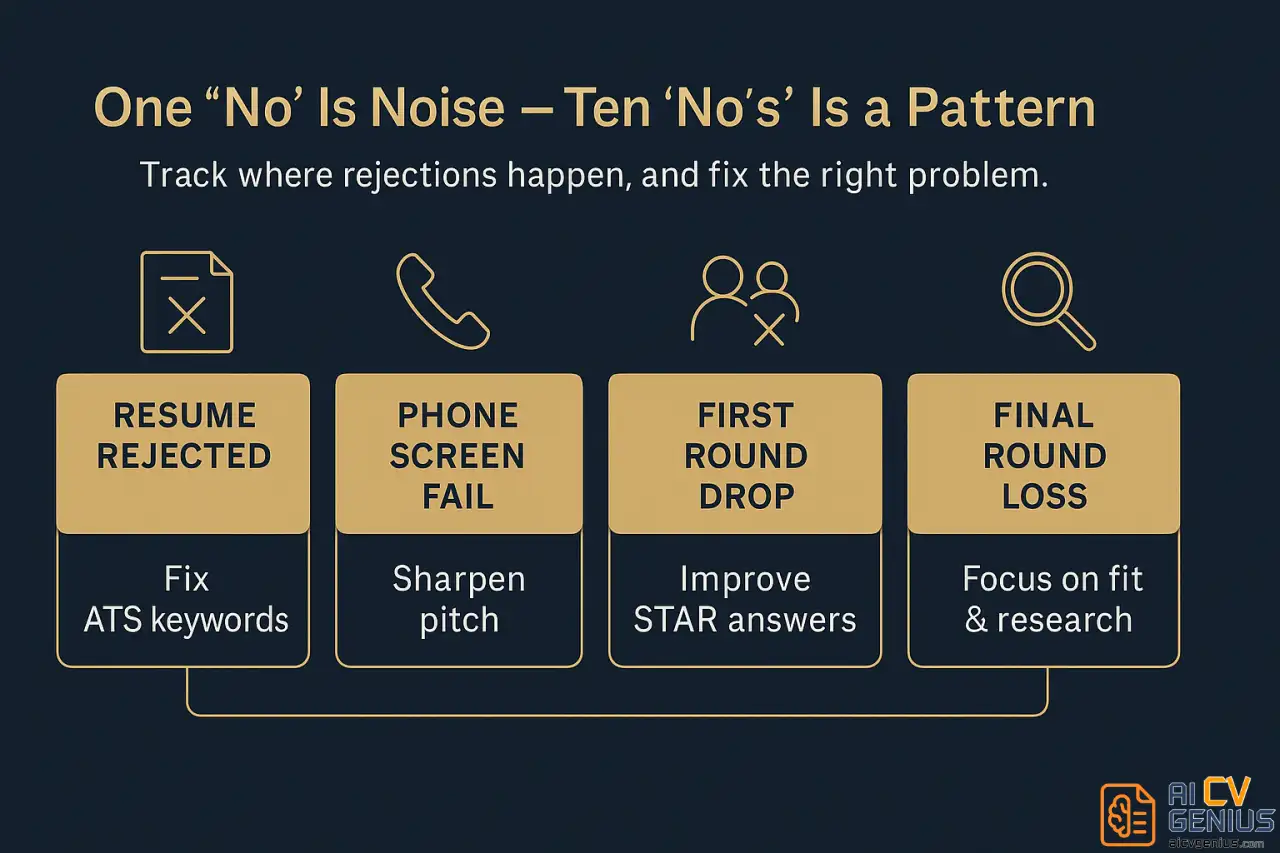
A single rejection is just noise. It tells you nothing. The CEO’s cousin might have applied. The role’s budget might have been cut. The hiring manager might just have been in a bad mood. You cannot and should not draw any conclusions from one rejection.
But multiple rejections, especially at the same stage, are not noise. That is a pattern. And patterns are data. Data is fixable.
This is why you must track your job applications. Create a simple spreadsheet with these columns:
| Date Applied | Company | Role | Source (LinkedIn, Indeed, Referral) | Stage Reached | Rejection Received (Y/N) | Notes |
After you have 15-20 entries, sit down and be a detective. Look for the trend.
| Where You’re Consistently Getting Rejected | The Likely Problem | The Strategic Fix |
|---|---|---|
| Stage 1: Immediate Rejection (Within 48 hours of applying) | Your resume is being filtered out by the Applicant Tracking System (ATS). It lacks the right keywords, has bad formatting, or doesn’t show the minimum qualifications. | Fix your resume. Read the job description and literally use its keywords (e.g., “project management,” “demand generation”) in your resume. Quantify your achievements. Simplify your formatting (no tables, columns, or fancy fonts). |
| Stage 2: After the Phone Screen | You are failing to communicate your value concisely. Your “Tell me about yourself” answer is weak, you sound unenthusiastic, or you can’t clearly explain why you want this job. | Practice your pitch. Write and memorize a 90-second “elevator pitch” that covers who you are, what you do, and why you’re a perfect fit for this role. Practice it until it sounds natural. |
| Stage 3: After the First-Round Interview | Your answers to behavioral questions are weak. You are rambling, not using the STAR method, or not providing specific, quantifiable examples of your work. | Prepare your STAR stories. Write down 5 of your biggest accomplishments and structure them using Situation, Task, Action, Result. Practice telling them out loud. |
| Stage 4: After the Final-Round Interview | This is the toughest. It’s often not about competence but about “fit.” The other candidate may have had slightly more niche experience, or they just “clicked” better with the team. | Focus on connection and research. In final rounds, show deep research about the company’s challenges. Ask smart questions about team culture and long-term strategy. This is where you also double-down on showing enthusiasm. |
Tracking this data turns rejection from a personal failure into a simple diagnostic problem. You’re no longer “a failure”; you’re a person who needs to “improve their STAR-method answers.” That’s a much easier problem to solve.
Step 5: Reframe the Narrative (Rejection is Redirection)
This is the most important psychological step. You must actively reframe what the rejection means. If you let it, your brain will tell you a story of failure: “I’m not good enough,” “I’m not qualified,” “I’ll never find a job.” This story is toxic and, worse, it’s false. You need to replace it with a more accurate, constructive one.
Rejection is not failure. It is redirection.
Every “no” you receive is simply the universe closing a door that wasn’t right for you, forcing you to keep walking toward the one that is. Every successful person on this planet can point to a “dream job” rejection that, in hindsight, was the best thing that ever happened to them.
- The startup that rejected them went bankrupt six months later.
- The “perfect” boss they wanted to work for turned out to be a notorious micromanager.
- Not getting that job forced them to apply for a different one, where they met their future co-founder or learned a skill that defined their career.
You cannot see the full picture while you’re in it. You don’t know if you just dodged a bullet. You don’t know if this “no” is protecting you from a toxic culture, a dead-end role, or an impending layoff. All you know is that this one path wasn’t the path. That’s it.
Constructive Reframes to Replace Negative Self-Talk
When your brain serves up a negative thought, actively replace it with one of these. This is cognitive reframing, and it’s a skill you can build.
| Instead of | Try |
|---|---|
| “I’m not good enough.” | “I wasn’t the right fit for that specific role at that specific time. That’s okay. The right fit is still out there.” |
| “I’ll never get hired.” | “This is a numbers game. Every ‘no’ is just a data point that gets me closer to the ‘yes’.” |
| “I completely wasted my time preparing for that interview.” | “I just got a free practice session. I learned what questions this industry is asking and sharpened my answers for the next, better opportunity.” |
| “They rejected me.” | “They selected someone else. That is a statement about that person, not a verdict on me. My qualifications are still valid.” |
This isn’t “toxic positivity.” It’s realistic, constructive optimism. You are acknowledging the disappointment but refusing to let it define your worth. If rejection is hitting you particularly hard, it’s okay to take a step back and focus on your mental health. Job searching is a full-time, high-stress job in itself. For more strategies, our career resources for professionals can help.
Step 6: Get Back Out There (But Smarter This Time)
After your 24-hour rule, your professional reply, and your self-assessment, it’s time to re-engage. But do not go back to doing the exact same thing. That is the definition of insanity. You must use what you’ve learned to be smarter.
- 1️⃣ Refine Your Assets: Based on your self-assessment (Step 3) and pattern analysis (Step 4), fix the weak link. Is it your resume? Your cover letter? Your interview stories? Fix that before you send out your next application.
- 2️⃣ Pivot from “Cold Apply” to “Warm Intro”: The “black hole” of online applications is the most demoralizing part of the search. Stop relying on it. Your new goal: at least 50% of your applications should be via referral. How?
- Go on LinkedIn. Find a company you like.
- Search for people with your target title who work there.
- Filter by “2nd Connections” to see who you know in common.
- Ask your mutual connection for a “warm introduction.”
- If you have no connection, message an alum from your university or someone with a similar background. Ask for a 15-minute “informational interview” to learn about their role. Do not ask for a job. Build a relationship. Then ask about openings.
- 3️⃣ Target Fewer, Better Jobs: Stop the shotgun approach. Applying to 50 jobs with a 2% chance is worse than applying to 10 jobs with a 30% chance. Identify 10-15 “high-fit” roles. Spend one hour on each application, tailoring your resume and cover letter perfectly. This high-quality, low-quantity approach yields far better results and is less damaging to your morale.
How to Stay Motivated When Rejections Pile Up
If you’re months into your search, motivation is the real currency. You have to protect it.
- Track Your Efforts, Not Just Outcomes: Don’t just track rejections. Track the things you can control. “Sent 5 high-quality applications.” “Had 2 informational interviews.” “Published 1 LinkedIn article.” These are wins, regardless of the outcome.
- Set Non-Application Goals: Dedicate 20% of your “job search” time to not applying. Use it for upskilling (taking an online course), networking (virtual coffee chats), or building a project for your portfolio. This feels productive and breaks the monotony.
- Have an “Off” Switch: Job searching is not a 24/7 activity. Set “business hours.” For example: 9 AM to 1 PM, Monday-Friday. Outside those hours, you are not job searching. You are living your life. This prevents burnout.
If your resume is the thing that’s consistently failing, it’s time to fix it for good. Our resume templates and guides can provide a fresh start.
Step 7: Turn the Rejection Into a Tangible Win
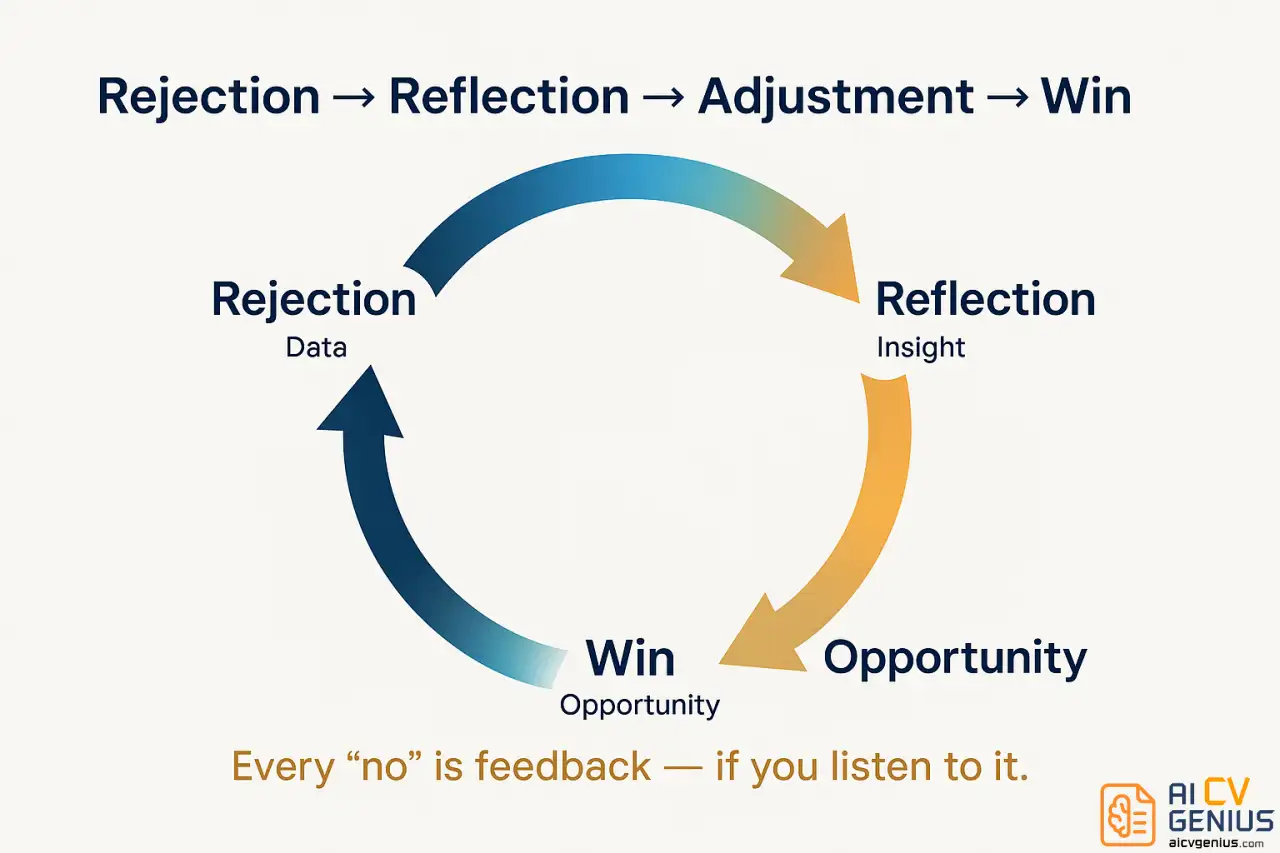
The final, most advanced step is to use the rejection as literal fuel. Not in a vague, “I’ll show them” way, but in a practical, strategic one. Every “no” contains a lesson. Your job is to extract it and turn it into a tangible asset.
- The Skill Gap Win: The recruiter said, “We went with someone with more direct data visualization experience.”Your Action: You don’t just say “okay.” You sign up for a Tableau or Power BI fundamentals course. You find a public dataset and build a small project. You add “Tableau” and the project to your resume and LinkedIn. The next time, you don’t have that skill gap.
- The Network Win: You had a great conversation with the hiring manager, even if you didn’t get the job.Your Action: You connect with them on LinkedIn with a polite note: “Hi [Name], thanks again for your time during the interview process for the [Role] role. I really enjoyed our chat about [Topic]. I’d love to stay connected.” Now they are part of your professional network. They see your posts. When they have another opening, you’re not a cold applicant; you’re a warm connection.
- The “Wrong Game” Win: You keep getting rejected from “Senior Manager” roles, but you’re getting interviews for “Manager” roles.Your Action: You stop applying for “Senior Manager” for now. You pivot your strategy to focus on the “Manager” roles, land one, and build the specific experience you need to get that “Senior” title in 18-24 months. You’ve learned what the market actually thinks, and you’ve adjusted your strategy instead of banging your head against a wall.
Real Example: How Rejection Led to a Better Outcome
A candidate, let’s call her Maria, applied for a product marketing role at a top-tier tech company. She made it to the final round and was rejected. When she asked for feedback, the manager was kind enough to be honest: “You’re brilliant strategically, but your portfolio examples were all B2C. We really need someone who’s lived in the B2B SaaS world.”
Maria was crushed. But after her 24-hour rule, she took that feedback literally. She spent the next two months doing a pro-bono project for a friend’s small B2B SaaS startup. She built a go-to-market plan, wrote three case studies, and ran a small product launch. She put this one project at the top of her portfolio.
Three months later, a better role at a better company opened up. She applied. In the interview, they asked about B2B experience. She walked them through her pro-bono project. She got the job, and the offer was $15,000 higher than the one she was rejected for. The rejection wasn’t a failure; it was a diagnostic test that told her exactly what she was missing.
That’s what this process is about. Rejection isn’t failure. It’s feedback. It’s data. It’s a temporary setback that only becomes permanent if you quit. If your resume is the source of your rejections, learn why your resume isn’t getting responses and fix it.
Advanced FAQ: Your Toughest Rejection Questions Answered
Final Thoughts: Rejection Is Redirection, Not a Verdict
If you’re reading this article, chances are you’ve been rejected recently. And it stings. There is no way around that. But here is the most important takeaway: how to handle job rejection is one of the most critical and defining skills of a successful career. You will be rejected again. Everyone is. The most successful people you know have been rejected from more opportunities than you’ve even applied for.
What separates people who land great jobs from those who stay stuck isn’t a lack of talent or credentials. It’s resilience. It’s the ability to take a hit, feel the sting, and then, with clear eyes, analyze the data, learn the lesson, and get back in the game. Every rejection is an opportunity to refine your resume, sharpen your interview skills, and get one step closer to the right ‘yes’.
The job you didn’t get? It probably wasn’t the right one. The right opportunity, the one that truly fits your skills and values, is still out there. When you find it, all these “no’s” will make perfect sense in hindsight. They were just the necessary, bumpy steps on the road that led you somewhere better.
So, take your 24 hours. Feel the disappointment. Then, send that professional reply. Ask for (or do) your feedback session. Analyze the pattern. Reframe the narrative. And keep going. Your next win is closer than you think.
Ready to improve your job search strategy? Visit our career blog for more guides on resumes, interviews, and landing the job you deserve.