
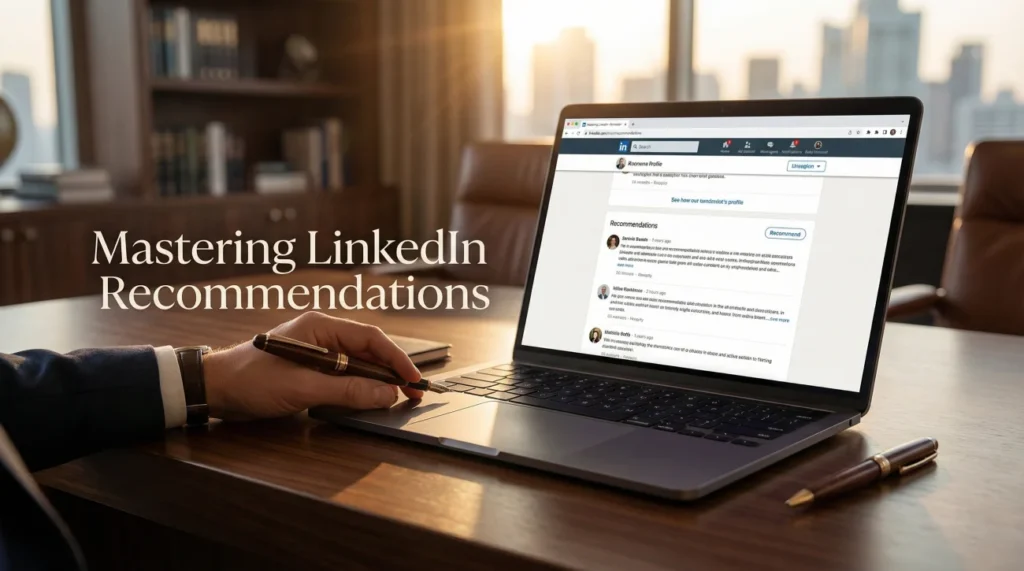
- Why recommendations matter: Social proof beats self claims, 3 to 5 strong recommendations increase credibility and can help search visibility.
- Who to ask: Prioritize 1 to 2 former managers, add 1 to 2 close peers, and include 1 client if your role is client facing.
- How to request: Avoid the built in button, send a personal message with context, one shared project, and 1 to 2 specific points they can mention.
- How to get better quality: Provide suggested bullet points or a draft they can edit, and give an easy out so it stays comfortable.
- Reciprocity and structure: Be ready to write one back, keep it 3 to 5 sentences with Context, Skills, Impact, and a clear endorsement.
Why LinkedIn Recommendations Matter (Social Proof)
LinkedIn recommendations are third-party endorsements that appear on your profile. Unlike self-written summaries or skill endorsements you can add yourself, recommendations come from people you’ve worked with.
This matters because recruiters trust what others say about you more than what you say about yourself. A profile with 3-5 strong recommendations signals credibility. A profile with zero recommendations raises questions: why hasn’t anyone vouched for this person?
Recommendations also improve your search ranking. LinkedIn’s algorithm prioritizes profiles with recommendations when recruiters search for candidates.
But most people don’t ask for recommendations because they’re not sure how. The templates below show exactly what to say.
Who to Ask for LinkedIn Recommendations
Not all recommendations carry equal weight. Strategic choices matter.
Former Managers (Highest Value)
Recommendations from managers carry the most weight because they’ve directly evaluated your performance. Aim for 1-2 manager recommendations.
Who to prioritize:
- Direct managers from your last 2-3 roles
- Managers who saw you at your best
- Managers you left on good terms with
Avoid: Managers you clashed with or who may give lukewarm endorsements. It’s better to have no recommendation than a mediocre one.
Colleagues and Peers (For Teamwork Skills)
Peer recommendations demonstrate collaboration skills and how you work within teams. These work best when they highlight specific projects or skills.
Who to ask:
- Colleagues you worked closely with on major projects
- Team members from cross-functional initiatives
- Peers who can speak to specific technical or soft skills
Clients or Customers (For External Validation)
If you work in client-facing roles (sales, consulting, customer success), client recommendations prove external impact. These are especially valuable because they’re unbiased third parties.
Who to ask:
- Clients you delivered significant results for
- Long-term accounts you managed successfully
- Customers who’ve explicitly praised your work
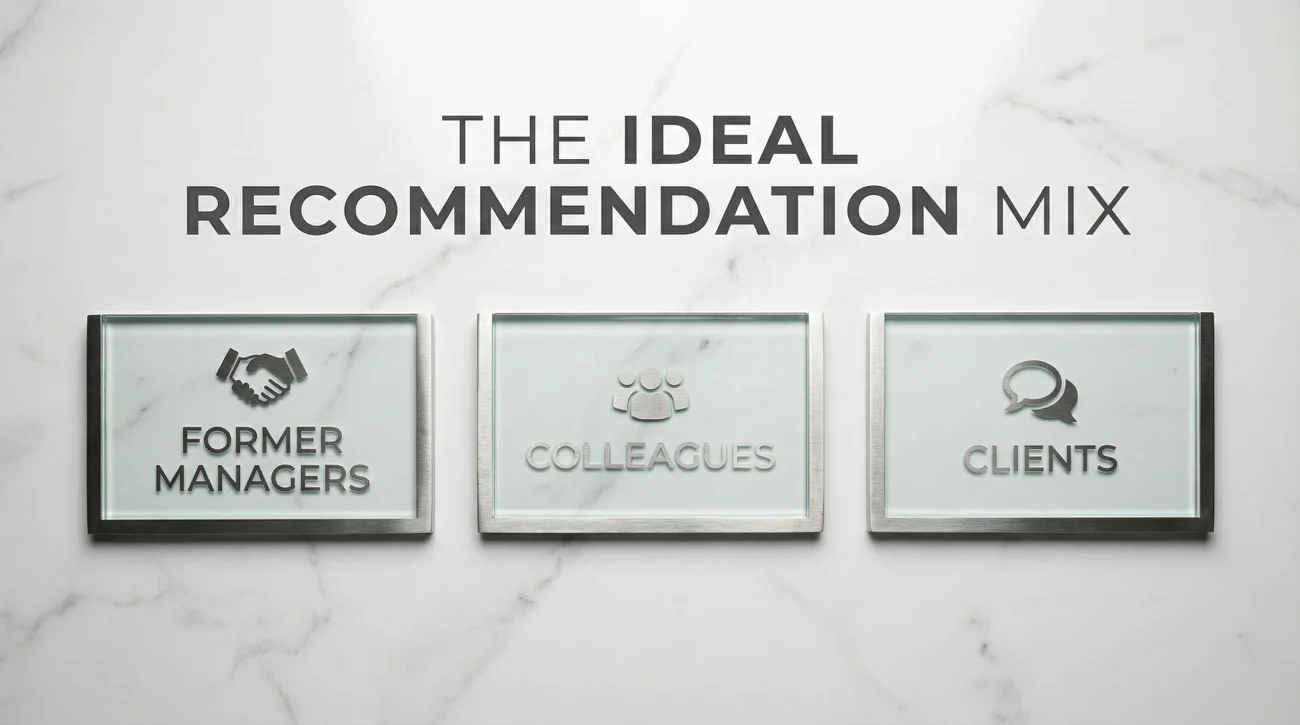
Ideal Mix: 3-5 Recommendations
- 1-2 from former managers
- 1-2 from colleagues or peers
- 1 from a client (if applicable)
This combination demonstrates that you perform well under management, collaborate effectively, and deliver value to external stakeholders.
For comprehensive profile optimization, see our complete resume and LinkedIn guide.
Don’t Use LinkedIn’s “Request Recommendation” Button

LinkedIn has a built-in “Request Recommendation” feature. Don’t use it.
The automated request is impersonal and provides no context. It asks people to write something with zero guidance, which means they either ignore it or write something generic like “Great to work with, very professional.”
Better approach: send a direct message explaining what you’re asking for and why.
The Right Way to Ask
- Send a personalized LinkedIn message (or email if you’re closer)
- Remind them of your working relationship and specific projects
- Explain why you’re asking (job searching, updating profile, etc.)
- Make it easy: suggest 1-2 specific things they could mention
- Give them an easy out if they’re too busy
The templates below show this approach in action.
3 LinkedIn Recommendation Request Templates
Template 1: Asking a Former Manager
Hi [Name],
I hope you’re doing well! I’m updating my LinkedIn profile and would really appreciate a recommendation from you, if you have time.
Working under your leadership at [Company] was one of the most formative experiences in my career. I especially valued what I learned about [specific skill or approach] during our work on [specific project].
If you’re comfortable writing a brief recommendation, it would be great if you could touch on [1-2 specific skills or achievements]. For example:
• [Specific skill]: e.g., “project management and ability to coordinate cross-functional teams”
• [Specific achievement]: e.g., “leading the [project name] initiative that reduced costs by 20%”Completely understand if you’re busy – no pressure at all. Happy to return the favor with a recommendation for you as well.
Thanks,
[Your Name]
Why it works:
- References specific working relationship
- Provides concrete suggestions (makes writing easier)
- Gives them an out if they’re too busy
- Offers reciprocity
Template 2: Asking a Colleague
Hi [Name],
Hope things are going well at [Company]! I’m in the process of updating my LinkedIn profile and thought I’d reach out to see if you’d be willing to write a brief recommendation.
I really enjoyed collaborating with you on [specific project], especially [specific aspect you worked on together]. I think we made a great team on that initiative!
If you have time, it would be helpful if you could mention:
• How we worked together on [project] • [Specific skill]: e.g., “my ability to coordinate between design and engineering teams”No worries if you’re swamped – I know how busy things can get. I’d be happy to write one for you as well if you’re interested.
Thanks!
[Your Name]
Why it works:
- Emphasizes collaboration (not hierarchy)
- References shared work for context
- Suggests specific themes without being pushy
- Friendly, casual tone appropriate for peers
Template 3: Asking a Client or Partner
Hi [Name],
I hope you’re doing well! I wanted to reach out because I’m updating my LinkedIn profile and would be honored if you’d consider writing a recommendation based on our work together.
I really valued our partnership on [specific project or account]. Seeing [specific positive outcome] was incredibly rewarding, and I appreciated your feedback throughout the process.
If you’re comfortable sharing, it would be great if you could briefly mention:
• The work we did together on [project/initiative] • [Specific outcome or skill]: e.g., “responsiveness and ability to solve problems quickly”I completely understand if you don’t have time – no pressure whatsoever. Thank you for being such a great partner to work with!
Best,
[Your Name]
Why it works:
- Acknowledges partnership (not vendor-client hierarchy)
- References specific positive outcomes
- Professional tone appropriate for client relationships
- Emphasizes outcome over process
For more networking and outreach strategies, explore our networking and cover letter guide.
Pro Tip: Write Suggested Bullet Points
The secret to getting good recommendations: make it as easy as possible for people to write them.
Most people agree to write recommendations but then procrastinate because they don’t know what to say. Help them by suggesting 1-2 specific points they could mention.
Example of Helpful Suggestions
Instead of: “Could you write about my project management skills?”
Try: “If you’re comfortable, it would be great if you could mention how I coordinated the product launch across engineering, marketing, and sales – I know that multi-team coordination was something you mentioned appreciating.”
This gives them:
- A specific project to reference
- The skill to highlight (coordination)
- Context they can expand on
You Can Even Draft It For Them (Sometimes)
For very busy people or those who struggle with writing, you can offer to draft the recommendation for them to edit:
“I know you’re incredibly busy, so I’ve drafted something below if it’s helpful. Feel free to edit, use as inspiration, or write something completely different – whatever works best for you.”
Then include a 3-4 sentence draft they can approve or modify. Many people will appreciate this and just approve it with minor tweaks.
How to Give a Good LinkedIn Recommendation
Reciprocity matters. If you’re asking for recommendations, be prepared to write them for others.

Structure of a Strong Recommendation
Keep it to 3-5 sentences following this pattern:
- Context: How you worked with the person and for how long
- Skills: 1-2 specific strengths they demonstrated
- Impact: A concrete example or result
- Endorsement: Clear statement you’d work with them again
Example of a Good Recommendation
I worked with Sarah for two years at [Company], where she led our content marketing strategy. Her ability to combine data analysis with creative storytelling was remarkable – she consistently produced content that both ranked well in search and resonated with our audience. Under her leadership, our blog traffic grew by 200% and became our top lead generation channel. I’d work with Sarah again in a heartbeat and highly recommend her to any team looking for a strategic, results-driven marketer.
Why it works:
- Specific context (2 years, content marketing)
- Named skills (data analysis + storytelling)
- Concrete results (200% growth, top lead gen channel)
- Clear endorsement (work together again)