
- What this guide does: Helps career changers position their background as an advantage and build a credible IT resume story.
- What recruiters scan for: Proof you are serious, basic IT foundations, and fit for how IT teams work.
- The 5 part resume plan: Lead with a forward facing summary, put technical skills and certifications near the top, add real projects, then reframe old experience as an IT bridge.
- How to translate your past: Turn previous work into IT language using transferable skills and before and after bullet rewrites with outcomes.
- What to avoid and what seals the deal: Skip vague summaries and missing projects, keep formatting clean, and use a short cover letter to connect the dots.
Why Changing Careers to IT Is a Strategic Move
Ten years ago, switching into tech felt like trying to scale a fortress wall. It seemed reserved for computer science graduates and coders who spoke a different language. Today, that wall is gone. The path to a tech career has been democratized by online learning, remote work, and a profound industry shift.
Companies have realized a hard truth: it is easier to teach a good problem-solver the basics of IT than it is to teach a technical expert how to solve problems. Whether you are a teacher managing a chaotic classroom, a nurse triaging patient needs, or a retail manager handling a supply chain crisis, you already possess the core logic that IT is built on.
That is why a well-crafted career change to it resume is your most critical tool. It is not an apology for what you haven’t done; it is a confident argument for how your unique background makes you a more valuable, well-rounded, and effective IT professional. Your goal is not to hide your past – it is to prove it is the foundation for your future.
The IT Recruiter’s Psychology: What They Fear vs. What They Want
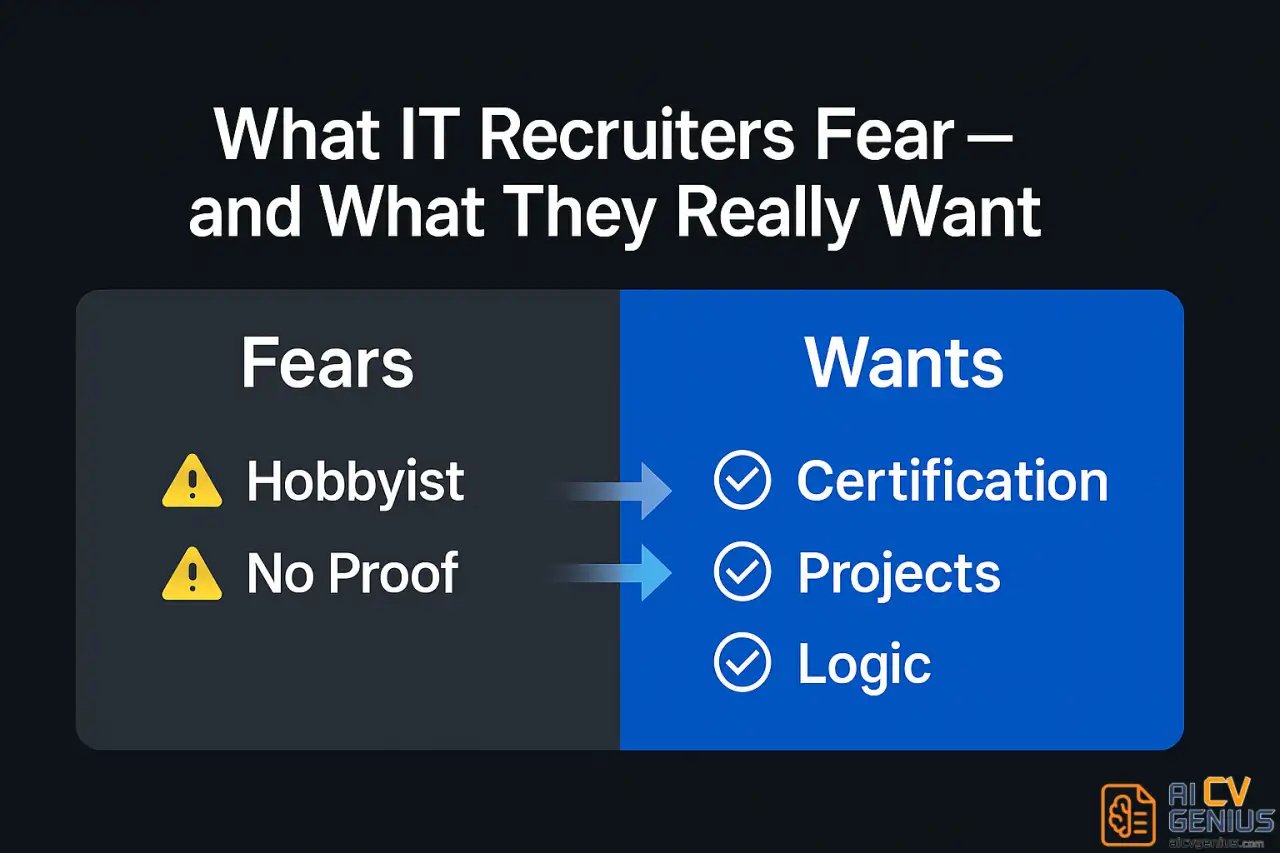
When an IT manager looks at a career-change resume, they are conducting a rapid risk assessment. Their brain is firing off two sets of questions simultaneously.
Their FEARS (What They Scan For):
- Is this just a “hobby”? Are they just curious, or are they serious? Will they quit when it gets hard?
- Do they have any foundational knowledge? Can they talk about a network, a database, or a script, or will I have to teach them what an IP address is?
- Are they a “culture fit”? IT culture is often about deep focus, accepting criticism of your work (e.g., code reviews), and asynchronous communication. Will their old environment (e.g., heavy face-to-face meetings) clash with this?
What They WANT (What You Must Prove):
- ✅ Evidence of Learning (Momentum): A finished certification (like CompTIA A+ or Google’s) is 100x more valuable than “currently learning.” It shows you can finish what you start.
- ✅ Raw Problem-Solving Ability: They want people from diverse backgrounds. A teacher who managed 30 different “user issues” (students) at once is a fantastic problem-solver. A logistics manager who optimized a workflow is a systems thinker.
- ✅ Business Acumen: This is your secret weapon. You understand why the technology matters. You have seen the business from the “user” side. You have empathy for the sales team, the customer, the finance department. This is a skill most junior IT grads lack entirely.
Your resume’s job is to silence their fears and amplify their wants.
How to Write Your IT Career Change Resume
Step 1: Define Your “Landing Zone” in IT
Before you write a single word, you must define what part of IT you are moving into. “IT” is not a job; it is an ocean of different careers. Each one requires a different story. You cannot aim for “a job in tech.” You must aim for a specific job.
Your background makes you a natural fit for some roles over others:
- IT Support / Help Desk: The classic entry point. Perfect for people from customer service, retail, or hospitality. Mindset: You are an “empathetic problem-solver.”
- Data Analytics: A natural fit for anyone in finance, marketing, or operations. If you lived in Excel, this is your path. Mindset: You are a “storyteller with numbers.”
- Cybersecurity: Great for people from military, law enforcement, or any detail-oriented compliance/legal role. Mindset: You are a “protective systems-thinker.”
- UX/UI Design: For the visually-minded. Teachers, graphic designers, and even writers make great UX designers. Mindset: You are an “advocate for the user.”
- Software Testing / QA: Ideal for anyone meticulous, detail-oriented, and process-driven (e.g., admin, logistics). Mindset: You are a “process-improver.”
Once you choose your landing zone, you can tailor your entire resume. A career change to it resume for a data analyst looks completely different from one for cybersecurity.
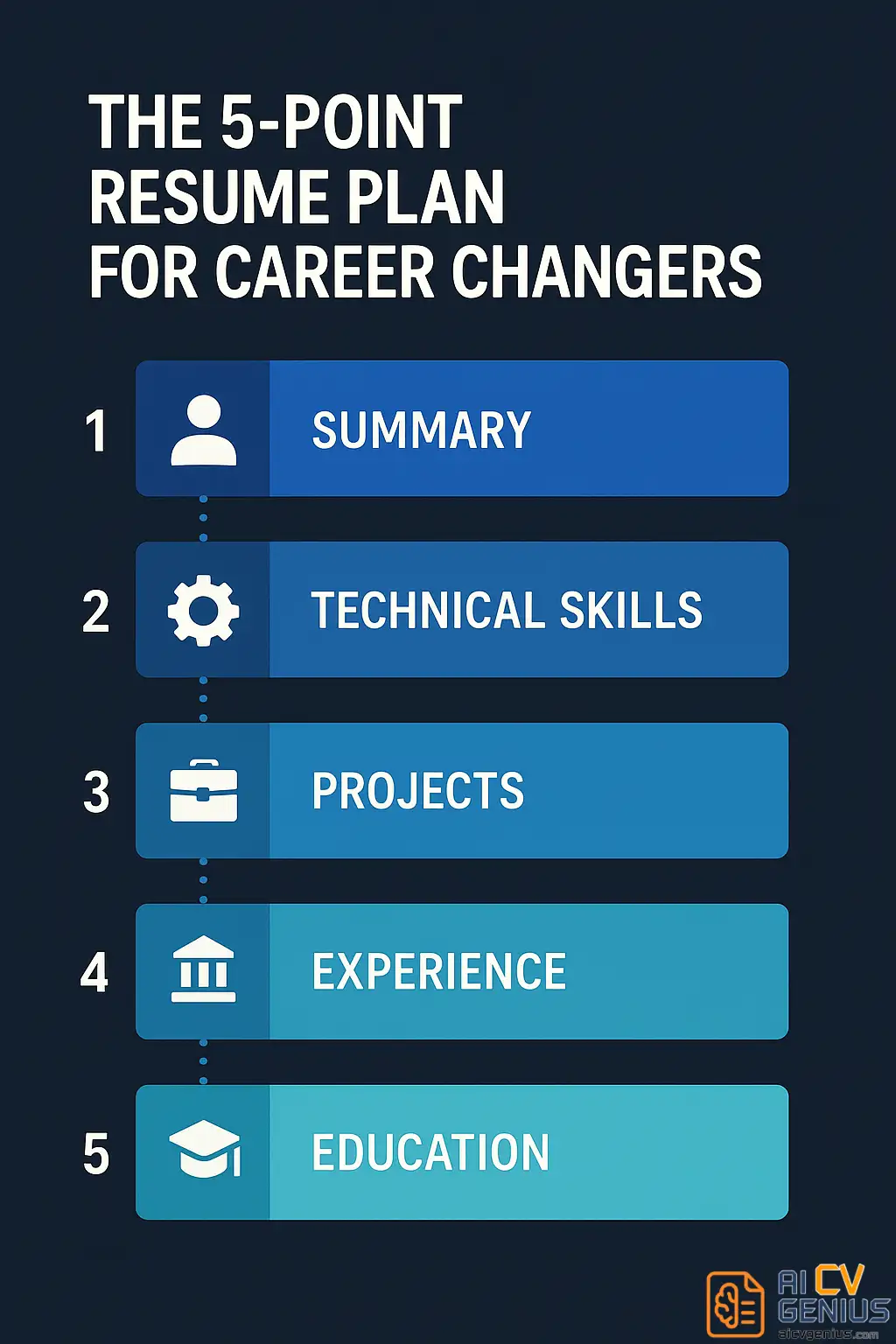
Step 2: Follow the 5-Point Plan for Career Changers
Let’s walk through how to build a career change resume for it professionals that proves you are a strategic hire, not a risky bet. You will de-emphasize old job titles and emphasize relevant skills and projects.
1. Start with a Forward-Facing Summary (Your “Pitch”)
This is the most important section. Do not summarize your past roles. Summarize your new direction. It must be confident and state your new IT goal clearly.
Weak Summary:
“Hard-working retail manager with 10 years of experience in customer service, now looking for an opportunity in the IT field.”
(Focuses on the past, sounds passive).
Strong Summary:
“Motivated professional transitioning into IT support, combining 10 years of customer-facing problem-solving with a CompTIA A+ Certification. Eager to apply proven analytical and troubleshooting skills to improve user satisfaction and resolve technical issues efficiently.”
(Names the new role, states the certification, and maps old skills to new ones).
2. Create a “Technical Skills & Certifications” Section (Your “Proof”)
For a career changer, this section goes above your professional experience. The recruiter needs to see your new technical proof immediately. This silences their biggest fear.
Organize it clearly. Do not just list tools; categorize them.
Technical Profile
- Certifications: CompTIA A+ (2025), Google IT Support Professional (2024)
- Operating Systems: Windows 10/11, macOS, Linux (Ubuntu)
- Tools: Active Directory (user management), ServiceNow, Jira, Zendesk, Wireshark
- Hardware: PC/Laptop diagnosis & repair, Printer troubleshooting, Network cabling
This looks professional and credible. It shows you speak the language.
3. Add a “Relevant IT Projects” Section (Your “New Experience”)
If you lack paid IT experience, projects are your new experience. This section is non-negotiable. It shows initiative and practical application. It can also go above your old work history.
Example Project Section:
- Home Network & Server Lab
A paragraph explaining what you did: “Designed and configured a home network using a Ubiquiti router and switches; set up a pfSense firewall. Built a home server using a Raspberry Pi to run Pi-hole for network-wide ad blocking and Plex for media streaming.” - PC Build & Troubleshooting
“Assembled a custom-built gaming PC, including component selection, installation, OS configuration, and driver troubleshooting. Regularly diagnose and repair hardware and software issues for 10+ friends and family.” - Python Automation Script
“Developed a simple Python script to automate the sorting of 1,000+ files from a ‘Downloads’ folder into categorized subfolders, saving an estimated 1 hour of manual sorting per week.”
4. Re-Frame Your “Professional Experience” (The “Bridge”)
This is where you build the bridge. Do not list every duty from your old job. Only list achievements that map to your new IT goal. Use the “Bullet Transformation” method below. Every bullet point must scream “IT mindset.”
5. Education (The “Foundation”)
List your degree, but also your recent learning. This shows momentum.
Example:
B.A. in English – University of Texas, Austin (2018)
Ongoing Coursework: Python for Everybody (Coursera), AWS Cloud Practitioner Essentials
This structure tells a clear story: “Here is my new goal (Summary), here is my proof (Certs), here is my hands-on practice (Projects), and here is how my old job prepared me (Experience).”
Step 3: Highlight Transferable Skills (The Core Strategy)
This is how you connect your past to your future. Transferable skills for it career change are not just soft skills; they are the logic of your old job applied to tech. Here are the most valuable ones and how to frame them.
| Your Old Skill (What You Did) | The IT Translation (What It Really Is) |
|---|---|
| Customer Service / Retail | Incident Management & Triage: You handled inbound “tickets” (complaints), diagnosed the problem (triage), and “resolved” the incident to the user’s (customer’s) satisfaction. |
| Teaching / Training | Technical Documentation & Onboarding: You took a highly complex subject, broke it down into simple steps (documentation), and taught it to non-technical users (students). |
| Admin / Operations | Process Improvement & Automation: You found a repetitive, manual workflow (like filing or invoicing), created a better system (e.g., an Excel template), and improved efficiency. This is the root of scripting and automation. |
| Finance / Marketing | Data Analysis & Reporting: You used Excel to analyze data, find a trend, and build a report/dashboard that helped someone make a business decision. This is exactly what a data analyst does. |
| Project Coordination | Agile Workflow / Stakeholder Management: You juggled a task, a deadline, and multiple people’s expectations. This is the core of project management and Scrum. |
Step 4: Transform Your Experience Bullets
Here’s how to reframe previous experience effectively. Notice how the “After” versions use IT keywords like “troubleshooting,” “documentation,” and “process.”
Example 1: From Teacher to UX/UI Designer
| Before | After (Targeting UX/UI) |
|---|---|
| “Planned daily lessons for 30 students.” | “Developed and iterated on 50+ unique lesson plans based on real-time user feedback (student comprehension).” |
| “Taught English literature.” | “Communicated complex abstract concepts (literature) to a non-technical audience in a simple, engaging format.” |
Example 2: From Customer Service to IT Help Desk
| Before | After (Targeting Help Desk) |
|---|---|
| “Answered customer calls and emails.” | “Managed an inbound queue of 50+ daily ‘tickets’ (calls/emails), maintaining a 95% customer satisfaction rate.” |
| “Helped customers with problems.” | “Acted as Tier 1 support, troubleshooting user issues, escalating complex problems, and documenting solutions.” |
Example 3: From Finance Analyst to Data Analyst
| Before | After (Targeting Data Analyst) |
|---|---|
| “Created monthly sales reports in Excel.” | “Built and automated 3 monthly sales dashboards in Excel, using PivotTables and VLOOKUPs to analyze 20,000+ rows of data.” |
| “Checked spreadsheets for errors.” | “Performed data cleaning and validation on quarterly financial models to ensure 100% accuracy before leadership review.” |
Key Advice and Common Pitfalls
Common Mistakes to Avoid at All Costs
- ❌ Using an Old Summary: Leading with “Experienced Retail Manager…” is an instant ‘no’. Lead with your future, not your past.
- ❌ Hiding Your Certs: Don’t put your new CompTIA cert at the bottom under “Education.” It’s your #1 asset. Put it at the top.
- ❌ No Projects Section: A resume with no certs and no projects will be ignored. It shows a lack of initiative.
- ❌ Using Jargon from Your Old Industry: Remove all insider terms from your old job (e.g., “SKUs,” “Planograms,” “Pro-formas”). Replace them with IT-friendly terms (“assets,” “documentation,” “dashboards”).
- ❌ A Sloppy Format: IT is a field of precision and logic. A resume with bad formatting or typos signals you lack attention to detail. Use a clean, modern layout from our Resume Templates Finder.
Why Your Cover Letter is Not Optional
For a career changer, the cover letter is more important than the resume. The resume shows the “what”; the cover letter explains the “why.” It is your only chance to connect the dots for the recruiter.
Your cover letter must do three things in three short paragraphs:
- The “Hook”: State the role you want and your enthusiasm. Acknowledge your career change directly and confidently.
- The “Bridge”: Pick one experience from your old job and one project from your new learning. Connect them. (e.g., “My time managing logistics taught me the importance of a clear, documented process. I applied this by building a home lab where I documented every step of my firewall configuration.”)
- The “Close”: Reiterate your confidence and passion for learning.
A great cover letter makes the recruiter want to find the skills on your resume. We have dedicated guides for this in our Cover Letters section.
Pros & Cons of Highlighting Career Change on Resume
| Pros | Cons |
|---|---|
|
|
In-Depth FAQs for Your IT Career Change
- Pack your “Technical Skills” section with keywords from the job description (e.g., “Active Directory,” “ServiceNow,” “TCP/IP”).
- Use IT-friendly verbs in your experience section (e.g., “troubleshot,” “documented,” “escalated,” “configured,” “automated”).
- Your “Projects” section will be full of relevant keywords (“configured firewall,” “built PC,” “Python script”).
The ATS will see a high keyword match even if the titles are different.
- People: Did you help a customer, train a new hire, or de-escalate a conflict? That is User Support.
- Process: Did you follow a checklist, create a new workflow, or organize a messy system? That is Process Improvement & Documentation.
Focus on those examples. They are 100% relevant.
Weak Answer: “I was bored at my old job and sales was a dead end.” (Negative)
Strong Answer: “I enjoyed my 7 years in sales, but I found my real passion was in the process of fixing things. I was always the person who automated our Excel reports or troubleshot the team’s printer. I realized I was doing IT support as a hobby, and I decided to make that my career. That’s why I got my A+ certification and am so excited about this role.”
Answer: “You are right, I don’t have paid IT experience yet. But I do have practical, hands-on experience. In my home lab, I configured a pfSense firewall and set up Active Directory to manage users, which is a key part of this job description. I also built and troubleshoot my own PC. My goal in this role is to apply that practical knowledge in a professional environment.”
Final Thoughts: Your Past is Your Superpower
A career change to it resume is not about erasing your past – it is about reframing it. Your journey is your biggest asset. You have a perspective that lifelong tech specialists will never have. You understand the end-user. You know what it is like to be on the other side of a support ticket.
When you combine that empathy and business knowledge with new, proven technical skills (certs and projects), you are not just a “beginner.” You are a strategic, low-risk, high-potential hire. Own your story, build the bridge, and you will find the IT world is more welcoming than you ever thought possible.