
- Core idea: Transferable skills are the bridge that makes career changes look logical, even when job titles do not match.
- What they are: Underlying work abilities that travel across industries, like communication, planning, problem solving, and leadership.
- 3 categories: People skills, process skills, and thinking skills, a strong resume shows proof across all three.
- How to find yours: Break down proud wins, list the skills behind them, spot repeated patterns, and ask trusted coworkers for outside perspective.
- How to show them: Weave skills into summary and experience with reframed, metric backed bullets, mirror job description language, and avoid vague skill lists.
Introduction: The Power of Transferable Skills
The Career Changer’s Secret Weapon: Why Transferable Skills Matter More Than Job Titles
For most of modern history, a career path was a straight line. You started in a mailroom, and you climbed a predictable ladder. Today, that ladder is gone. It has been replaced by a web, a matrix, or just plain chaos. People change roles, industries, and entire professions multiple times.
In this new, fluid economy, what makes these jumps successful is not luck. It is not just about who you know. It is about transferable skills: the core competencies that are so fundamental, they stay useful wherever you go.
Employers no longer expect a perfect, 1:1 match for their job description. They are looking for professionals who can adapt, learn quickly, and bring a unique perspective from different worlds. Transferable skills are your proof. They are the narrative thread that connects your seemingly unrelated past to your ambitious future, proving that your experience always counts, especially in a new context.
“You’re not starting from zero – you’re starting from a wealth of experience. You just need to learn how to translate it.”
What Are Transferable Skills? A Deeper Look
At their simplest, transferable skills are abilities that move with you from one job to another. But the concept is deeper than that. They are the underlying principles of work, abstracted from specific tools or titles.
Think of it like language. Knowing how to use a specific, proprietary software (like an internal sales tool) is like knowing a single, rare dialect. But knowing how to communicate clearly, listen actively, and build rapport is like understanding the rules of grammar itself. You can learn any new dialect once you understand grammar.
This is why a high-school teacher can become a brilliant corporate project manager. Let’s break it down:
| The Old Role (Teacher) | The Transferable Skill |
|---|---|
| Managed a classroom of 30 teenagers with competing needs. | Stakeholder management, conflict resolution, and public speaking under pressure. |
| Designed a 9-month curriculum to meet state standards. | Long-range strategic planning, project management, and execution against a firm deadline. |
Managing a retail team, leading a platoon, or running a busy restaurant kitchen all use the same core skills as running a project in a tech startup: resource allocation, problem-solving, and leadership under pressure. Your resume’s job is to make this connection impossible for a recruiter to miss.
The Three Core Categories of Transferable Skills
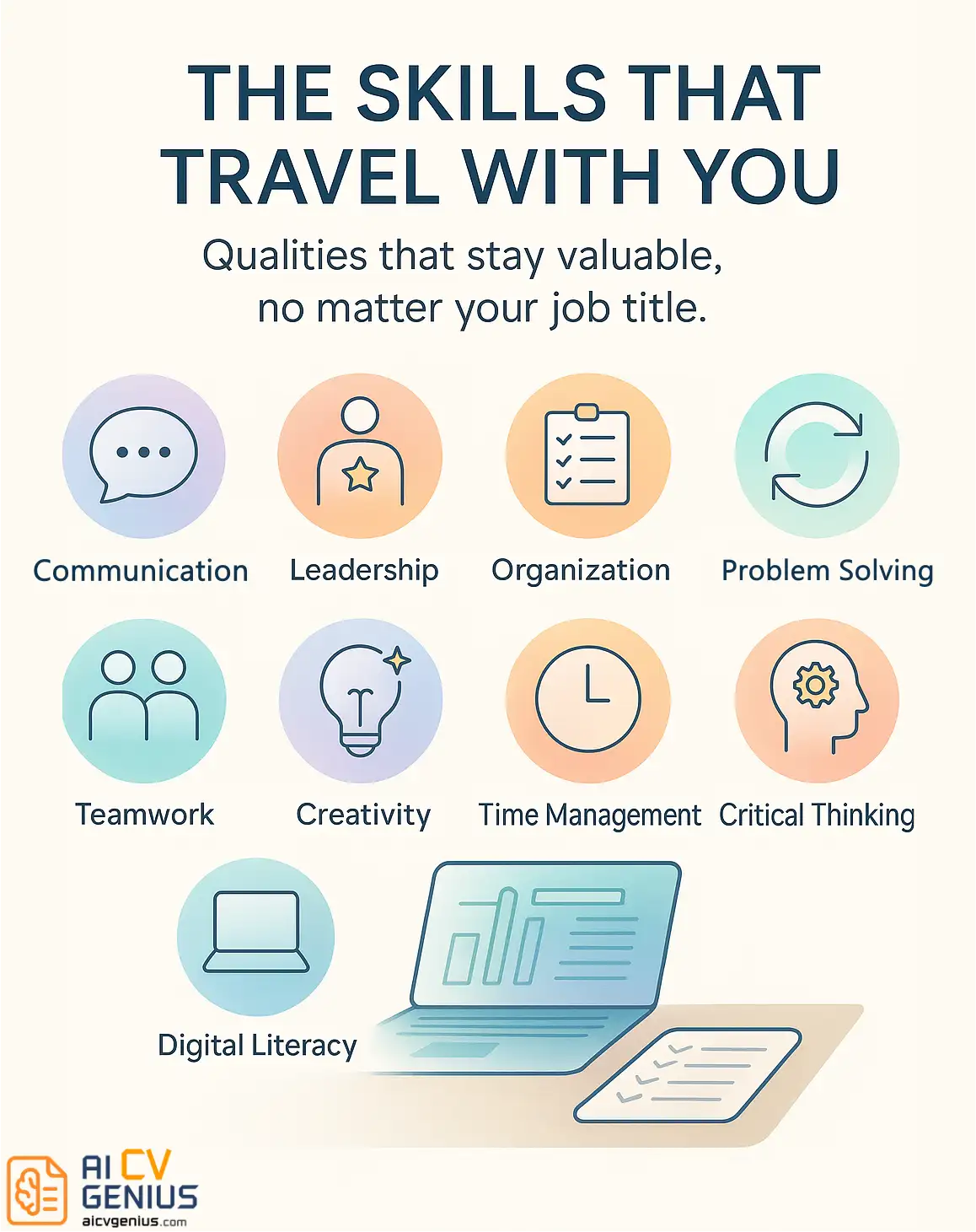
To identify your own, it helps to group them into three main buckets. A powerful resume shows strength across all three.
| Category | Description | Examples |
|---|---|---|
| 1. People Skills (The Diplomat) | How you interact, collaborate, and lead. This is your Emotional Intelligence (EQ). | Communication, Teamwork, Leadership, Mentorship, Negotiation, Conflict Resolution, Empathy, Customer Service, Stakeholder Management. |
| 2. Process Skills (The Architect) | How you organize, plan, and deliver work. This is your efficiency and reliability. | Project Management, Organization, Time Management, Strategic Planning, Process Improvement, Workflow Automation, Quality Assurance. |
| 3. Thinking Skills (The Strategist) | How you analyze, innovate, and create value. This is your intellectual horsepower. | Critical Thinking, Problem-Solving, Data Literacy, Analytical Reasoning, Adaptability, Creativity, Research, Decision-Making. |
You did not just “handle customers.” You practiced empathy and conflict resolution (People Skills).
You did not just “file reports.” You managed a process and ensured data literacy (Process & Thinking Skills).
Why Recruiters Value These Skills More Than Ever
When a hiring manager looks at a resume from a career changer, they are performing a risk calculation. “This person does not have the 10 years of experience I asked for… but can they do the job?”
Transferable skills are what swing this calculation in your favor. They reduce the perceived risk of hiring you. Here’s how:
- They Signal Adaptability: The modern workplace is defined by constant change. Tools become obsolete. Markets shift. A candidate with proven transferable skills (like adaptability and critical thinking) is a safer long-term bet than a candidate with 10 years in one rigid, outdated software.
- They Predict Trainability: A person with strong analytical reasoning and research skills can learn a new industry or tool far faster than a person who lacks that foundation. Recruiters hire for trainability.
- They Bring Fresh Perspective: A manager who only hires from within their own industry ends up with a team that has the same blind spots. A candidate from a different field – a journalist moving to content marketing, for example – brings a totally new perspective on storytelling and audience engagement. This diversity of thought is a competitive advantage.
It’s how that teacher becomes a project manager. The tools change, but the core principles of leadership, planning, and communication do not.
How to Identify and Showcase Transferable Skills
How to Identify Your Own Transferable Skills: A 4-Step Workshop
You have them. The hard part is seeing them clearly. Think less about your daily tasks and more about the challenges you had to overcome. Go through your last 2-3 roles and ask these questions.
1️⃣Step 1: Deconstruct Your Achievements
Write down 3-5 things you are genuinely proud of from your past jobs.
- Example: “I launched a new community newsletter.”
2️⃣Step 2: Ask “What Did it Really Take?”
Now, list the skills behind that achievement. Be brutally honest.
- Example: “It took… research (to see what others did), writing (to craft the content), project management (to hit the deadline), persuasion (to get my boss to approve it), and data analysis (to track the open rates).”
3️⃣Step 3: Look for Patterns
What patterns repeat in your work, no matter the role? What problems do people always bring to you? That is your superpower.
- Do you always end up being the one who “calms down” an angry client? You have conflict resolution and empathy.
- Are you the one who builds the spreadsheet that everyone else ends up using? You have systems thinking and process improvement.
- Do you mentor the new hires, even when it’s not your job? You have leadership and communication.
4️⃣Step 4: Ask Your Network
Email two or three former colleagues you trust and ask them a simple question: “When you think of me at work, what’s the first skill or strength that comes to mind?” Their answers will often surprise you and reveal strengths you took for granted.
Top 12 Transferable Skills Employers Value in 2026
Here are the most in-demand skills and, crucially, how to phrase them as resume-worthy achievements.
| Skill | What It Shows | Example Achievement |
|---|---|---|
| Communication | Clarity, persuasion, and empathy. | “Presented complex sales data to a 10-person non-technical leadership team, influencing a new Q3 strategy.” |
| Leadership & Mentorship | Guidance and accountability. | “Mentored 3 new hires, creating a training doc that was adopted by the department and reduced ramp-up time by 20%.” |
| Problem-Solving | Calm analysis under pressure. | “Diagnosed a recurring bug in the payment workflow and collaborated with engineering to deploy a fix, reducing customer complaints by 40%.” |
| Project Management | Organization and execution. | “Managed a 5-person team to launch a new marketing campaign, delivering the project on time and 10% under budget.” |
| Adaptability | Resilience and learning agility. | “Adapted to a sudden company-wide shift to HubSpot CRM, self-teaching the tool and migrating all client data in one week.” |
| Creativity & Innovation | Finding better ways to work. | “Proposed and developed a new automated email nurture sequence that boosted lead conversion by 15%.” |
| Collaboration | Team synergy and empathy. | “Partnered with the sales and product teams to D; align customer feedback, leading to two new features in the product roadmap.” |
| Digital & Data Literacy | Comfort with modern tech and data. | “Used Google Analytics to identify a 50% drop in traffic from a key source, leading to a successful SEO fix.” |
| Time Management | Prioritization and focus. | “Managed 5 concurrent projects by prioritizing tasks in Asana, resulting in 100% of deadlines being met for two quarters.” |
| Analytical Thinking | Insight-driven decision-making. | “Analyzed customer survey data to identify that 60% of churn was due to poor onboarding; pitched a new plan to fix it.” |
| Negotiation & Influence | Driving consensus without authority. | “Negotiated new terms with a software vendor, saving the company $15,000 annually while maintaining a strong partnership.” |
| Conflict Resolution | Navigating difficult conversations. | “Mediated a dispute between two departments over project scope, facilitating a new agreement that got the project unblocked.” |
How to Add Transferable Skills to Your Resume (In Every Section)
Listing them in a “Skills” section is not enough. You must weave them into the very fabric of your resume. Here is how.
1. The Professional Summary: Your North Star
This is your 3-line elevator pitch. For a career changer, this is the most important section. It must connect your past to your future and name the skills that bridge the gap.
Example (Teacher -> Project Manager):
“Strategic and organized educator with 8+ years of experience in instructional design and team leadership. Seeking to leverage proven skills in project management, stakeholder communication, and curriculum planning to drive efficient project delivery in a tech environment.”
Example (Retail -> Customer Success):
“Empathic relationship manager with 5+ years in high-volume retail. Transitioning to Customer Success, bringing expert-level skills in conflict resolution, customer retention, and data-driven upselling to help build long-term client loyalty.”
2. The Experience Section: The Power of Reframing
This is where you prove your summary. Do not just list your old duties. Translate them. Reframe your responsibilities using the language of your new industry.
Example: Retail Store Manager
❌Before (Weak – Task-focused):
- Responsible for managing 10 employees and handling the store schedule.
- Dealt with customer complaints.
- Tracked weekly sales numbers.
✅After (Strong – Skill-focused for a Customer Success role):
- Led and mentored a 10-person team, handling all scheduling, training, and performance reviews to achieve 95% team retention.
- De-escalated 15+ high-stakes client issues per week, resolving conflicts to maintain a 98% customer satisfaction score.
- Analyzed weekly sales data to identify low-performing products and retrained staff on upselling techniques, boosting average order value by 12%.
This is the “translation” that gets you the interview. You are showing Leadership, Conflict Resolution, and Data Analysis – all critical for Customer Success.
3. The Skills Section: The Keyword Scan
This section is for the ATS (Applicant Tracking System). After you have proven your skills in the experience section, you can list them here for a quick scan.
❌Weak: Problem-Solving, Teamwork, Communication, Leadership. (Too vague!)
✅Strong (Specific and Categorized):
- Leadership & Management: Project Management, Team Mentorship, Stakeholder Communication, Conflict Resolution
- Analytical Skills: Data Analysis, Process Improvement, Market Research, Google Analytics
- Technical Skills: Salesforce, HubSpot, Asana, Google Workspace, Figma
How to Reverse-Engineer a Job Description
The company tells you exactly which transferable skills they want. Your job is to find them and mirror them.
Look at this sample from a “Content Marketing Manager” job description:
“The ideal candidate will manage our editorial calendar, collaborate with freelance writers, and analyze content performance to make data-driven decisions. Must be able to communicate complex topics clearly and adapt to changing priorities in a fast-paced environment.”
The transferable skills they are screaming for are:
- ✅ Project Management (“manage our editorial calendar”)
- ✅ Collaboration / Leadership (“collaborate with freelance writers”)
- ✅ Data Analysis (“analyze content performance”)
- ✅ Communication (“communicate complex topics”)
- ✅ Adaptability (“adapt to changing priorities”)
Your resume must now be tailored to include these exact phrases and, more importantly, bullet points that prove you have done them.
Strategy, Pitfalls, and Future-Proofing
What to Avoid: Common Mistakes When Listing Transferable Skills
This is where most people fail. Avoid these traps.
| ❌ The Mistake | ✅ The Fix (What to do instead) |
|---|---|
| The “Vague List” | Never just list “Teamwork” or “Problem-Solving” in your skills section. It is a meaningless claim. You must prove it with a story. |
| The “Unrelated Story” | Your example of “leadership” from your PTA bake sale is not as strong as one from your last job. Keep examples professional and relevant. |
| The “Task, Not Skill” | “Wrote emails” is a task. “Communicated complex policy changes to a 30-person team, ensuring 100% compliance” is a skill. |
| The “Hiding Your Past” | Do not delete your “irrelevant” jobs. It looks suspicious. Reframe them. Show how being a bartender taught you more about high-stakes sales than any office job could. |
The Future-Proof Career: Why These Skills Are Your Best Asset
As Artificial Intelligence automates more technical, repeatable tasks, what is left for humans? The skills that cannot be automated: empathy, creativity, critical thinking, and collaboration.
A hard skill, like knowing a specific coding language, might have a 5-year shelf life. A transferable skill, like knowing how to learn and how to communicate, has a lifetime value. They are your insurance against obsolescence.
For more ideas on building these skills, explore our Career Resources section. If you want to see how these skills look on a finished document, our AI Resume Templates are all designed to highlight these skills clearly.
Final Thoughts: You Are Not Starting Over
When you write your resume, remember this: employers do not just hire your past experience; they hire your future potential. Your transferable skills are the bridge between where you have been and where you are going. They are the proof that you are a learner, a solver, and an adapter.
Describe them with honesty, strategic examples, and confidence. Your next career step will not feel like a desperate leap. It will feel like a natural, logical evolution.
“Every skill you’ve earned still belongs to you – it just needs a new context to shine.”