
- What the weakness question really tests: Self-awareness, honesty, coachability, and accountability more than the flaw itself.
- Best way to answer: Use the P.A.R.L. story Problem, Action, Result, Learning to show growth without sounding scripted.
- What to avoid: Fake humblebrags, dodging the question, or naming a core job requirement as your weakness.
- How to pick a safe weakness: Choose one that is real, manageable, and non-essential to the role then show your system to handle it.
- How to deliver it: Practice out loud without memorizing, keep it calm and human, and have a second weakness ready if pushed.
Introduction: The “Weakness” Question
The Interview Question That Isn’t About Weakness at All
The interview is going perfectly. You have built rapport, your answers are flowing, and you feel a surge of confidence. Then, the hiring manager pauses, smiles politely, and asks the one question designed to stop you in your tracks:
“So, tell me about your weaknesses.”
You freeze. Your mind races. You know it is a trap. Say something too honest, and you sound unqualified (“I’m terrible with deadlines”). Say something fake, and you sound like a robot (“My weakness is that I’m a perfectionist”).
Welcome to the single most misunderstood riddle in the modern interview. We have been trained to dread this question, to dodge it, and to deflect it. But what if we have been looking at it all wrong?
Here is the truth: This question has nothing to do with your weakness. It is not a test of your flaws. It is a profound test of your character. The interviewer is not trying to find a reason to reject you; they are trying to find a reason to trust you. How you handle this single moment reveals more about you than any other answer.
Decoding the Psychology: What Are They Really Testing?
When an interviewer asks this, they are not a “flaw-hunter.” They are a “risk-assessor.” They are trying to answer a few critical, underlying questions about what it is actually like to work with you:
- ✅ 1. Self-Awareness (Do you know yourself?): Are you self-reflective? Do you understand your own tendencies, blind spots, and triggers? People who lack self-awareness are notoriously difficult to manage.
- ✅ 2. Honesty (Are you trustworthy?): Are you willing to be vulnerable and authentic? Or will you present a fake, polished version of yourself? Trust is the foundation of all team collaboration.
- ✅ 3. Coachability (Are you willing to grow?): This is the most important one. Do you have a growth mindset? When given feedback, do you get defensive, or do you get curious? They want to hire people who are “coachable,” not “fixed.”
- ✅ 4. Accountability (Do you own your actions?): Do you blame circumstances and other people, or do you take ownership? A candidate who can calmly own a flaw is a candidate who will calmly own a mistake on the job.
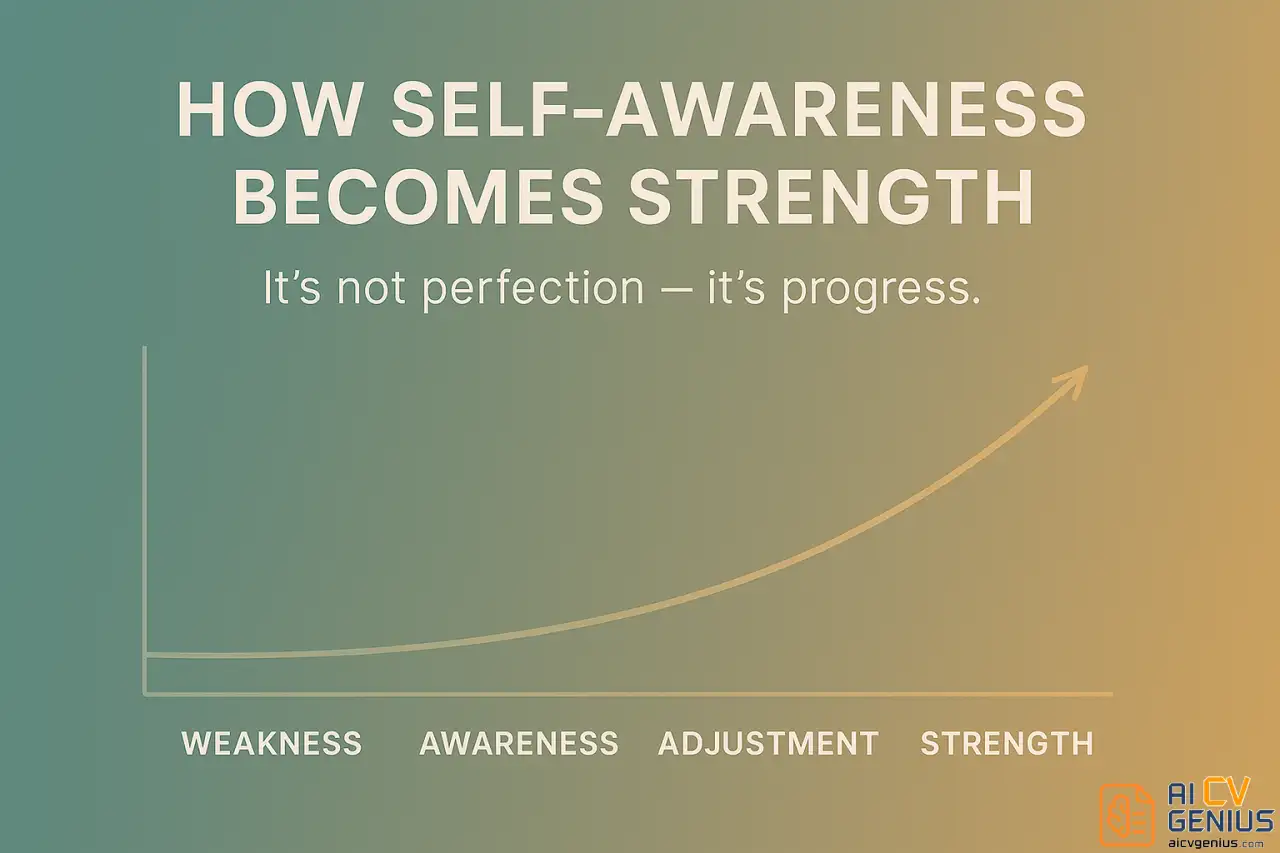
They do not expect you to be perfect. They expect you to be in-progress. Your weakness is not the problem. Your relationship with your weakness is everything. They are looking for humility, not humiliation.
Crafting Your Answer: Framework and Pitfalls
The “P.A.R.L.” Framework: A Story Structure for Honesty
Forget the old “weakness-sandwich” (strength-weakness-strength). It is transparent and feels like a script. A much more powerful, human approach is to tell a concise story of growth. We call this the P.A.R.L. Framework: Problem, Action, Result, Learning.
- Problem (The Weakness): State the weakness clearly and honestly. Name it. (e.g., “In the past, I struggled with impatience…”)
- Action (The System): What specific, proactive steps did you take to manage it? This is the proof you are coachable. (e.g., “I joined Toastmasters,” “I built a new checklist,” “I read a book and implemented a new rule for myself…”)
- Result (The Proof): How did your action lead to a tangible improvement? This shows your system works. (e.g., “My team now gives me positive feedback on my communication,” “I haven’t missed a deadline since…”)
- Learning (The Insight): What higher-level wisdom did you gain? This is the most impressive part. It shows you are a reflective professional. (e.g., “I learned that speed without clarity is just churn.”)
This formula turns a “confession” into a compelling story of ownership and growth. It is the core of emotional intelligence.
The 3 Answers That Instantly Raise Red Flags
The content of your answer is a test. Here are the three most common ways to fail:
- ❌ 1. The “Fake Weakness” (Humblebrag):
- “I’m a perfectionist.”
- “I work too hard.”
- “I care too much.”
Why it fails: This is the most common and least-trusted answer. It is a cliché that signals a lack of self-awareness and a refusal to be honest. The interviewer has heard it a dozen times today. At best, it is boring; at worst, it is arrogant.
- ❌ 2. The “Non-Answer” (Dodge):
- “I don’t really have any major weaknesses.”
- “My weakness is probably chocolate or puppies.”
Why it fails: This is an immediate red flag for arrogance and a lack of self-reflection. It tells the interviewer you are either dishonest or lack the maturity to analyze yourself.
- ❌ 3. The “Job-Killer” (Core Flaw):
- (For a Project Manager) “I’m not very organized and often miss deadlines.”
- (For a Salesperson) “I’m not a people person and I hate making cold calls.”
- (For an Accountant) “I struggle with details and numbers.”
Why it fails: This is too honest. Never state a weakness that is a fundamental, non-negotiable requirement of the job you are applying for. It is the definition of disqualifying yourself.
How to Pick the “Right” Weakness: The Goldilocks Rule
A good answer follows the “Goldilocks Rule”: it cannot be too big (a job-killer) or too small (a fake flaw). It has to be just right. A “just right” weakness is:
- ✅ Real: It must be a genuine area for improvement.
- ✅ Manageable: It must be something you can actively work on and improve.
- ✅ Non-Essential: It cannot be a core competency for the role.
| Weakness Category | Good Examples | When It’s Safe |
|---|---|---|
| Communication Style | Impatience, Being too direct, Fear of public speaking | For roles that are not primarily client-facing or public-facing. |
| Task Management | Overcommitting, Procrastinating on admin tasks, Hesitancy to delegate | For individual-contributor roles or new managers. |
| Knowledge Gaps | Not an expert in a specific (non-essential) software, Too focused on one industry | When you can show you are a fast learner in other areas. |
| Personal Tendencies | Being self-critical, Impatient with process, Hesitancy to ask for help | For almost any role, as these show high standards and independence. |
Example Answers and Special Cases
5 In-Depth Example Answers (The P.A.R.L. Framework in Action)
Here are five strong, detailed answers you can adapt. Notice how each one tells a story of growth.
Example #1 – The Weakness: Fear of Public Speaking
Problem: “An area I have actively worked on is my confidence in public speaking. Early in my career, I would avoid any opportunity to present, which I knew was holding me back from sharing my team’s work.”
️Action: “About two years ago, I made a personal commitment to fix this. I joined my local Toastmasters chapter, which was terrifying at first, but it gave me a safe place to practice. I also started volunteering to present small, internal-only updates in our team meetings to build my comfort level.”
Result: “I have made huge progress. Last quarter, I successfully co-presented our team’s project to the entire 30-person department. I still get nervous, but I now have the tools and the practice to manage it effectively and communicate clearly.”
Learning: “I learned that confidence isn’t something you have, it’s something you build. And I realized that avoiding a weakness doesn’t fix it – only direct, consistent practice does.”
Example #2 – The Weakness: Hesitancy to Delegate
Problem: “When I was first promoted to a team lead, my biggest weakness was a hesitancy to delegate. I had a ‘do-it-myself’ mentality because I didn’t want to burden my team or risk a drop in quality.”
️Action: “I quickly realized I was becoming a bottleneck and, ironically, holding my team back. I read ‘The E-Myth’ and started a new system. I spent time creating detailed ‘playbooks’ for my core tasks and held training sessions to empower two of my senior reports to take them over.”
Result: “The result was transformative. Not only did it free me up to focus on high-level strategy, but my two reports felt more ownership and developed new skills. Our team’s productivity actually increased because I was no longer in the way.”
Learning: “I learned that real leadership isn’t about being the best ‘doer’ on the team; it’s about being the best ‘multiplier’ and trusting your team to succeed.”
Example #3 – The Weakness: Overcommitting (The “Yes-Man”)
Problem: “My natural tendency is to be enthusiastic and say ‘yes’ to every new project or request. In the past, this led to me overcommitting, which diluted my focus and caused me to work nights and weekends to catch up, risking burnout.”
️Action: “I had to build a personal ‘triage’ system. I now use a simple Eisenhower Matrix to map all requests by ‘Urgency’ and ‘Importance.’ When a new request comes in, I am now transparent with my manager and team. I say, ‘I can absolutely do that, but my top priority is X. Should this new task take precedence?'”
Result: “This has made me far more effective. My work quality is higher because I am focused, and my manager has more visibility into my bandwidth. I am still the enthusiastic ‘yes’ person, but now it is a ‘yes, and here is how it fits’ conversation.”
Learning: “I learned that being a good teammate isn’t about saying ‘yes’ to everything. It is about protecting your focus so you can deliver excellent work on the things that matter most.”
Example #4 – The Weakness: Impatience / Being Too Direct
Problem: “I am a very fast-paced worker, and my weakness has been impatience with people or processes that I feel are too slow. In meetings, I would sometimes cut people off, not because I was being rude, but because I wanted to get to the solution.”
️Action: “I received some hard-but-fair feedback from a mentor about this. Since then, I have implemented a very simple rule for myself: I actively pause for three seconds before I speak in a group discussion. It feels like an eternity to me, but it gives others space to finish their thought. I also force myself to ask one clarifying question before I offer my own opinion.”
Result: “It has completely changed my working relationships. My team now sees me as a more thoughtful and collaborative partner, not just someone who is trying to rush to the end. And frankly, our solutions are better because I am listening more.”
Learning: “I learned that moving fast is worthless if you leave your team behind. True efficiency comes from collaboration and buy-in, not just speed.”
Example #5 – The Weakness: Being Overly Self-Critical
Problem: “My biggest personal challenge has been a tendency to be overly self-critical. While it comes from a place of wanting to do great work, it used to lead to ‘analysis paralysis’ on first drafts, where I would spend too much time perfecting something before I even shared it for feedback.”
️Action: “I have learned to separate ‘high standards’ from ‘impossible perfection.’ I now live by a ‘strong first draft’ rule. I time-box my initial work on a project and then force myself to share it with a trusted colleague for feedback, even when I think it’s not ‘ready.'”
Result: “This has been a game-changer. I get my work done faster, and the final product is better because it includes collaborative feedback early in the process, not just at the end. It has also made me a more resilient employee.”
Learning: “I learned that perfection is the enemy of progress. It is far more valuable to be iterative and collaborative than to try and be perfect in a silo.”
Special Cases: Graduates, Career Changers, and Senior Leaders
Your answer should evolve with your career.
- If you are a New Graduate: You may not have deep professional flaws. Focus on academic habits or learning curves.Example: “As a recent graduate, my weakness is a lack of deep, real-world corporate experience. I am strong on theory but know I have a lot to learn about practical application. That is why I am so eager for this role – I am a fast learner and I am ready to absorb everything I can.” (This shows humility and eagerness).
- If you are a Career Changer: Your “weakness” is simply your newness to the field. Frame it as a positive.Example: “My obvious weakness is that I have not spent the last 10 years in this industry. But my strength is that I bring a fresh perspective. In my last role in hospitality, I learned to manage high-stress, client-facing conflicts every single day. I am excited to bring that proven resilience to this new challenge.”
- If you are an Experienced Leader: Your weaknesses should be more strategic and focused on leadership evolution.Example: “As I have moved into senior leadership, I have had to evolve from being ‘in the weeds’ to being a high-level strategist. My weakness was wanting to check every detail. I have learned to fight that urge and now focus on building strong systems and trusting my directors to manage the details.”
Practice, FAQ, and Final Thoughts
Connect Your Answer to Your Resume
Your answer should be consistent with the story your resume tells. If your resume is full of leadership roles, your “delegation” story is a perfect fit. It shows the human journey behind the bullet points. Your answer should feel like the “behind-the-scenes” commentary to your professional story. You can explore formats that help tell this story in our Resume Templates Finder.
Practice, But Do Not Script
You must practice this answer out loud. Record yourself on your phone. The goal is to sound reflective, not rehearsed. If you sound like you are reading a script, you lose all the trust you are trying tobuild. Know your P.A.R.L. bullet points, but let the exact wording be natural and conversational.
Your tone should be calm and self-aware. A slight smile when you state the weakness signals that you are at peace with it and not defensive. Remember: you are not confessing; you are reflecting on your growth.
In-Depth FAQ: Your Toughest “Weakness” Questions
Example: “That’s a fair question. Another area I have worked on is my tendency to be too focused on the details. I can get lost in a spreadsheet and lose sight of the bigger picture. I have learned to manage this by forcing myself to start with the ‘top-line summary’ first, and then dive into the data. It helps me stay oriented.”
- Weakness is about a trait or tendency you have to manage (e.g., impatience).
- Failure is about a specific event or project that went wrong (e.g., “We missed the launch date”).
Your failure story should use the STAR method. Your weakness answer uses the P.A.R.L. framework. A “failure” is a great source for a “weakness” story.
Example: “To be honest, it is something I am actively working on right now. My tendency is still [weakness]. The system I just put in place last month is [Action]. I am not perfect at it yet, but I am committed to the process and already seeing improvement in [Result].” This shows profound self-awareness and commitment.
Example: “I used to think caffeine could replace a project plan. Turns out, it can’t. I’ve since become a dedicated planner… and I still drink the caffeine.” This shows personality, but only use it if the room feels warm.
Final Thoughts – Real Confidence Starts With Imperfection
When you own your weakness, you show courage. When you hide it, you show fear. Recruiters are not looking for flawless robots. They are looking for self-aware, accountable, and resilient human beings who are committed to getting better.
So the next time an interviewer asks, “What are your weaknesses?”, do not freeze. Take a breath. Smile. And see it for what it truly is: your single best chance to show them how you have learned to grow.
You can learn more reflection frameworks and storytelling techniques in our Career Resources hub.