
- The article breaks down 20 common interview questions and explains the real purpose behind each one, so you can answer what the interviewer is actually trying to learn.
- It gives a repeatable structure for key questions like “Tell me about yourself,” strengths, weaknesses, and “Why this job,” emphasizing short, relevant stories over rambling timelines.
- For behavioral questions, it repeatedly uses the STAR approach to turn “I’m good at X” into proof, with sample answers drawn from work, internships, school projects, and volunteering.
- It covers riskier questions such as leaving a job, salary expectations, failures, and trick questions, pushing for calm framing, professionalism, and a focus on growth without sounding defensive.
- It closes with practical reminders: Research the company, prepare a small set of adaptable stories, ask thoughtful questions at the end, and treat preparation as the fastest path to confidence.
Job interviews are both exciting and nerve-wracking. Most candidates worry about what questions they’ll be asked and how best to respond. The reassuring truth? Interviewers often rely on a core set of common interview questions designed to assess skills, experience, and personality fit.
By preparing thoughtful, structured answers for these frequently asked questions, you can walk into your next interview feeling confident and ready to articulate your value effectively. Let’s explore the 20 most common interview questions, understand the underlying reasons employers ask them, and learn how to answer each with clarity, impact, and authenticity.
1. Tell Me About Yourself
❓Why they ask: This serves as an icebreaker and allows the interviewer to gauge your communication style, understand your career narrative, and assess how well you connect your background to the requirements of the role.
How to answer: Keep your response concise, professional, and highly relevant. Structure it as a brief (60-90 second) elevator pitch using a simple formula:
- Present: Briefly describe your current role or situation (e.g., recent graduate, current position).
- Past: Highlight 1-2 key experiences or skills from your background that directly relate to the target job.
- Future: Connect your past and present to this specific opportunity, explaining why you are interested and a good fit.
Sample Answer (For a recent graduate applying for a Marketing Assistant role):
“I recently graduated with a Bachelor’s degree in Marketing from [University Name], where I developed a strong foundation in digital marketing principles and content creation. During my final year project, I led a team that created a social media campaign for a local non-profit, increasing their engagement by 20%. I’m now eager to apply my analytical skills and creative energy to a dynamic marketing assistant role like this one at [Company Name], contributing to impactful campaigns.”
2. What Are Your Strengths?
❓Why they ask: To evaluate your self-awareness, understand your key capabilities, and determine how well your strengths align with the specific demands of the job.
How to answer: Select 2–3 strengths that are directly relevant to the requirements listed in the job description. For each strength, provide a brief, concrete example demonstrating how you’ve successfully applied it in a past situation (work, academic, or volunteer).
Sample Answer (For a Data Analyst role):
“One of my core strengths is analytical thinking. I genuinely enjoy digging into complex datasets to uncover actionable insights. For instance, during my internship at [Previous Company], I analyzed customer purchasing patterns using SQL and Excel, identifying a previously overlooked segment that led to a targeted marketing campaign yielding a 15% increase in repeat purchases. I’m also highly detail-oriented, ensuring accuracy in data processing and reporting, which I believe is crucial for this role.”
3. What Are Your Weaknesses?
❓Why they ask: To assess your honesty, self-awareness, and commitment to professional growth. They want to see if you can identify areas for improvement and take steps to address them.
How to answer: Choose a genuine, manageable weakness that is not central to the core functions of the job. Importantly, frame it positively by emphasizing the steps you are actively taking to improve. Avoid clichés (“I’m a perfectionist”) or critical flaws (“I struggle with deadlines”).
Sample Answer:
“In the past, I sometimes found it challenging to delegate tasks effectively, as I wanted to ensure everything was done perfectly myself. However, I recognized this could slow down team progress. I’ve since actively worked on improving my delegation skills by focusing on providing clear instructions, setting realistic check-in points, and trusting my colleagues’ abilities. This has significantly improved team efficiency on recent projects.”
4. Why Do You Want This Job?
❓Why they ask: To gauge your genuine interest in the specific role and company, determine if you’ve done your research, and understand how you see this position fitting into your career goals.
How to answer: Demonstrate genuine enthusiasm based on specific aspects of the role, the company’s mission, values, or recent work. Connect your skills and aspirations directly to the opportunity. Show you aren’t just looking for any job, but this job.
Sample Answer (For a role at a renewable energy company):
“I’m incredibly passionate about sustainability, and [Company Name]’s pioneering work in developing innovative solar panel technology truly excites me. This specific Project Manager role aligns perfectly with my experience in managing cross-functional technical projects and my desire to contribute directly to solutions addressing climate change. I was particularly impressed by your recent [mention specific project or achievement], and I believe my skills in [mention 1-2 key skills] would allow me to make a significant contribution here.”
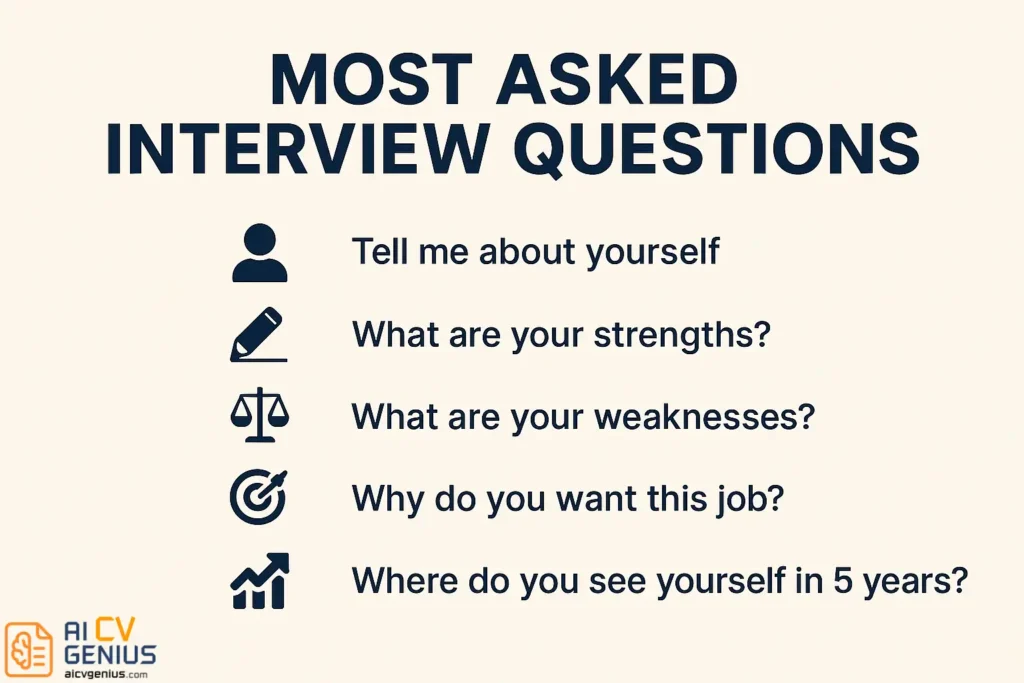
5. Where Do You See Yourself in Five Years?
❓Why they ask: To understand your career ambitions, assess your long-term potential within the company, and gauge whether your goals align with the growth opportunities the role might offer.
How to answer: Focus on professional growth, skill development, and increasing responsibility within the context of the company or industry. Avoid overly specific job titles or mentioning plans to leave. Show ambition balanced with realistic expectations.
Sample Answer:
“In five years, I envision myself having become a true expert in [relevant field, e.g., digital marketing analytics] within a company like yours. I aim to have taken on progressively challenging projects, potentially contributing to strategic initiatives, and perhaps mentoring junior team members. Ultimately, I want to be making a significant, measurable impact within my domain.”
6. Why Should We Hire You?
❓Why they ask: This is your direct opportunity to sell yourself. They want to hear your unique value proposition – what makes you the best fit compared to other candidates?
How to answer: Deliver a concise, confident “sales pitch” highlighting your 2–3 most relevant qualifications (skills, experiences, achievements) that directly address the key requirements of the role. Reiterate your enthusiasm and understanding of the company’s needs.
Sample Answer (For a Customer Support role):
“You should hire me because I possess a unique blend of technical troubleshooting skills and proven excellence in customer communication. In my previous role at [Previous Company], I consistently maintained a 95%+ customer satisfaction rating while resolving complex technical issues efficiently. I’m adept at [mention specific software/skill required] and genuinely passionate about providing exceptional support, which aligns perfectly with [Company Name]’s commitment to its users.”
7. Describe a Time You Faced a Challenge at Work (and How You Overcame It)
❓Why they ask: To assess your problem-solving abilities, resilience, critical thinking skills, and how you perform under pressure.
How to answer: Use the STAR Method (Situation, Task, Action, Result) to structure your response clearly. Choose a specific, significant challenge where you played an active role in the solution. Focus on your actions and the positive outcome.
Sample Answer:
“(S) In my previous project management role, our team discovered a critical software bug just one week before a major client launch deadline. (T) My task was to coordinate the debugging process while managing client expectations and ensuring the launch remained on track. (A) I immediately organized a cross-functional meeting with developers and QA, prioritized bug fixes based on impact, established a clear communication channel with the client providing daily updates, and reallocated resources to accelerate testing. (R) As a result, we successfully resolved the critical bug, deployed the software on schedule, and retained the client’s confidence, leading to a contract extension.”
8. Tell Me About a Time You Showed Leadership
❓Why they ask: To evaluate your ability to influence, motivate, guide others, take initiative, and drive results, even without a formal leadership title.
How to answer: Again, use the STAR Method. Select an example where you took initiative, guided a team or project, resolved a conflict, or inspired others towards a common goal. Focus on your specific leadership actions.
Sample Answer:
“(S) During a challenging group project in my final year of university, our team was struggling with conflicting ideas and lack of direction halfway through. (T) Recognizing we were falling behind schedule, I took the initiative to facilitate a structured brainstorming session to align our approach. (A) I encouraged everyone to voice their perspectives, helped synthesize the best ideas into a cohesive plan, assigned clear roles based on individual strengths, and established regular check-ins to monitor progress and maintain momentum. (R) As a result, the team became more focused and collaborative, ultimately delivering a high-quality project that received top marks in the class. Several team members later commented on how my initiative helped get us back on track.”
9. Describe a Time You Worked Effectively in a Team
❓Why they ask: To assess your collaboration skills, communication style within a group, and ability to contribute positively to team goals.
How to answer: Use the STAR Method, focusing on your specific role within the team and how your actions contributed to the group’s success. Highlight communication, cooperation, and shared achievement.
Sample Answer:
“(S) In my internship last summer, I was part of a five-person marketing team tasked with developing a promotional campaign for a new product. (T) My role involved researching target audience demographics and assisting with content creation. (A) I actively participated in team brainstorming sessions, shared my research findings clearly, provided constructive feedback on content drafts, and volunteered to help proofread the final materials to ensure consistency. I made sure to communicate proactively via our shared project management tool. (R) Our collaborative effort resulted in a successful campaign launch that exceeded initial engagement targets by 25%. The positive team dynamic allowed us to deliver high-quality work under a tight deadline.”
10. How Do You Handle Stress or Pressure?
❓Why they ask: To understand your coping mechanisms, resilience, and ability to maintain performance during challenging or high-stakes situations.
How to answer: Provide specific, healthy strategies you use to manage stress. Focus on proactive techniques like organization, prioritization, clear communication, or taking brief breaks. Give a brief example if possible.
Sample Answer:
“I find that staying organized and prioritizing tasks helps me manage pressure effectively. When faced with multiple competing deadlines, I typically take a moment to create a clear to-do list, break down large tasks into smaller steps, and identify the most critical items. For example, during finals week in college, I successfully balanced studying for four exams and completing a major project by meticulously scheduling study blocks and project milestones each day. Clear communication with stakeholders about realistic timelines is also key for me.”
11. What Do You Know About Our Company?
❓Why they ask: To determine if you’ve done your homework and are genuinely interested in their organization, not just any job.
How to answer: Demonstrate your research. Mention specific aspects like their mission, values, recent achievements, key products/services, target market, company culture (if known), or recent news that impressed you. Connect this knowledge back to your interest in the role.
Sample Answer:
“I know [Company Name] is a recognized leader in the [Industry] sector, particularly known for its innovative approach to [mention specific product/service/initiative]. I was especially impressed by your recent [mention recent news, award, or project] and your stated commitment to [mention company value, e.g., sustainability, customer focus]. That focus on [value] strongly resonates with my own professional values and is a key reason I’m excited about the possibility of contributing to your team.”
12. What Motivates You?
❓Why they ask: To understand your drivers, work ethic, and whether your motivations align with the role and company culture.
How to answer: Be honest, but focus on intrinsic motivators related to professional achievement, learning, problem-solving, contributing to team success, or making an impact. Connect your motivation to the type of work involved in the role.
Sample Answer:
“I’m primarily motivated by the challenge of solving complex problems and seeing the tangible results of my work. I find it incredibly rewarding to analyze a difficult situation, develop a strategic solution, and then witness its positive impact. For instance, in my last project, optimizing a key logistics process directly resulted in reducing average delivery delays by 20%, which was very satisfying to see translate into improved customer feedback.”
13. Why Are You Leaving Your Current Job? (Or Why Did You Leave Your Last Job?)
❓Why they ask: To understand your reasons for seeking new opportunities and ensure you are leaving for positive reasons (growth, new challenges) rather than negative ones (poor performance, conflict).
How to answer: Be positive and professional. Focus on seeking new opportunities, growth, skill development, or alignment with different career goals. Never speak negatively about previous employers, managers, or colleagues.
Sample Answer:
“I’ve learned a great deal and truly valued my time at [Previous Company], particularly in developing my skills in [mention a skill]. However, I’m now seeking an opportunity where I can take on greater responsibility in [mention area relevant to new role, e.g., strategic project management] and contribute to a company focused on [mention aspect of new company, e.g., international markets]. This role at [Company Name] seems like an excellent fit for that next step.”
14. What Are Your Salary Expectations?
❓Why they ask: To ensure your expectations align with their budget for the role and to gauge your understanding of market rates.
How to answer: Research typical salary ranges for similar roles in your location and industry beforehand (using sites like Glassdoor, Salary.com, LinkedIn Salary). Provide a realistic range rather than a single fixed number. You can also defer the discussion until later in the process if you prefer.
Sample Answer (Providing a range):
“Based on my research for [Job Title] roles with similar responsibilities in the [City/Region] area, and considering my [mention years/level] experience, I’m targeting a salary range between $X and $Y. However, I’m flexible and open to discussing the total compensation package.”
Sample Answer (Deferring):
“I’m focused on finding the right fit and learning more about the specific responsibilities of this role first. I’m confident we can reach a mutually agreeable figure if this proves to be the right opportunity.”
15. Do You Have Any Questions for Us?
❓Why they ask: To assess your level of engagement, critical thinking, and genuine interest in the role and company beyond the initial description.
How to answer: Always say yes and have 2-3 thoughtful questions prepared. Avoid asking basic information easily found online or questions solely focused on salary/benefits at this stage. Ask questions about the team, the role’s challenges, company culture, opportunities for growth, or the interviewer’s own experience.
Sample Answer Questions:
“Could you describe a typical day or week in this role?”
“What does success look like in the first 3-6 months for the person hired into this position?”
“How does the team typically collaborate on projects?”
“What opportunities are there for professional development or learning within the company?”
“What do you enjoy most about working here?”
16. Tell Me About a Time You Failed or Made a Mistake
❓Why they ask: To evaluate your ability to take responsibility, learn from errors, demonstrate resilience, and show humility.
How to answer: Choose a genuine but relatively minor professional mistake (not a catastrophic failure or ethical lapse). Use the STAR Method, focusing on the Situation, your specific mistake (Task/Action), the immediate consequences, and most importantly, what you learned and how you applied that learning to prevent recurrence (Result/Learning).
Sample Answer:
“(S) Early in my first marketing internship, I was responsible for scheduling social media posts for a week-long campaign. (T/A) Due to a misunderstanding of the scheduling tool’s time zone settings, I accidentally scheduled all posts to go live 5 hours later than intended on the first day. (Result) This resulted in missing the peak engagement window and lower initial reach. I immediately identified the error, corrected the schedule for the remaining days, and documented the correct procedure for the team wiki. (Learning) It taught me the critical importance of double-checking technical settings, especially for time-sensitive tasks, and I haven’t made a similar scheduling error since.”
17. How Do You Prioritize Tasks When Faced with Multiple Deadlines?
❓Why they ask: To assess your organizational skills, time management abilities, and strategic thinking when managing workload.
How to answer: Describe a specific system or method you use. Mention factors like urgency, importance, effort required, and impact on overall goals. Mention communication with stakeholders if priorities need clarification.
Sample Answer:
“When faced with multiple deadlines, I typically start by listing all tasks and assessing their urgency and importance, often using something like the Eisenhower Matrix (Urgent/Important). I clarify deadlines and expectations with stakeholders if needed. I then focus on completing high-priority, high-impact tasks first while blocking out time for focused work. I also utilize project management tools like [mention tool, e.g., Trello or Asana] to track progress and adjust priorities dynamically as needed.”
18. How Do You Handle Conflict with a Colleague or Manager?
❓Why they ask: To evaluate your interpersonal skills, emotional intelligence, professionalism, and ability to navigate disagreements constructively.
How to answer: Emphasize open communication, active listening, seeking to understand different perspectives, focusing on the issue (not the person), and working towards a mutually agreeable solution. Provide a brief, professional example if possible.
Sample Answer:
“When conflicts arise, my approach is to address the issue directly and professionally, focusing on understanding the other person’s perspective through active listening. I aim to find common ground and collaborate on a solution that addresses the underlying problem. For instance, in a previous team project, a colleague and I had differing opinions on the best approach for data visualization. I initiated a one-on-one discussion, listened carefully to their reasoning, explained my perspective based on user feedback, and we ultimately agreed on a hybrid approach that incorporated the strengths of both ideas, leading to a more effective final product.”
19. What Are Your Career Goals (Short-term and Long-term)?
❓Why they ask: Similar to the “Where do you see yourself in five years?” question, this probes your ambition, direction, and how this specific role fits into your broader professional aspirations.
How to answer: Align your goals with the opportunities offered by the role and company. Short-term goals (1-3 years) should focus on mastering the role, acquiring specific skills, and contributing effectively. Long-term goals (5+ years) can be broader, involving increased responsibility, specialization, or leadership, ideally within the same industry or company context.
Sample Answer:
“My short-term goal is to fully master the responsibilities of this [Job Title] role, particularly deepening my expertise in [mention specific skill area, e.g., cloud infrastructure management]. Long-term, I aspire to grow into a senior technical leadership position where I can contribute to strategic architectural decisions and potentially mentor emerging engineers within a forward-thinking company like yours.”
20. Why Should We Not Hire You? (Potential Trick Question)
❓Why they ask: This unconventional question tests your self-awareness, honesty, and ability to handle unexpected or slightly awkward situations professionally.
How to answer: Reframe a minor, manageable weakness (similar to the “What are your weaknesses?” question) as something that might require initial adjustment but demonstrates your commitment to growth. Alternatively, mention a specific skill required for the role that you are still actively developing but show enthusiasm for learning. Avoid highlighting major flaws or lack of core qualifications.
Sample Answer:
“If the role requires immediate, deep expertise in [mention a specific niche software you have less experience with], I might need a brief ramp-up period as my primary experience has been with [mention related software you know well]. However, I’m a very fast learner, as demonstrated by [give brief example of quickly learning something new], and I’m confident I could become proficient rapidly with the resources available here.”
Checklist: Essential Do’s and Don’ts in Interviews
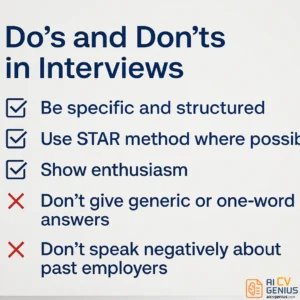
- ✅ DO thoroughly research the company, the role, and your interviewers beforehand.
- ✅ DO prepare specific examples using the STAR Method for behavioral questions.
- ✅ DO listen carefully to each question before answering thoughtfully and concisely.
- ✅ DO dress professionally (even for video interviews) and maintain positive body language.
- ✅ DO ask insightful questions at the end to show engagement and interest.
- ✅ DO send a personalized thank-you email within 24 hours after the interview.
- ❌ DON’T speak negatively about past employers, managers, or colleagues.
- ❌ DON’T give vague, generic, or one-word answers. Provide specific examples.
- ❌ DON’T interrupt the interviewer. Allow them to finish their question or thought.
- ❌ DON’T ask about salary or benefits too early in the process (unless the interviewer brings it up).
- ❌ DON’T forget to clearly articulate why you are specifically interested in this company and this role.
Table: Comparing Weak vs Strong Interview Answers
The difference often lies in specificity, structure, and focusing on impact:
| Question | Weak Answer | Strong Answer (STAR Method or Specific Example) |
|---|---|---|
| What are your strengths? | “I’m a hard worker and very organized.” | “One key strength is my organizational skill. In my last internship, I was tasked with coordinating project files for a team of 5. I implemented a standardized digital filing system using [Software], which reduced average document retrieval time by approx. 30% and eliminated version control issues.” |
| What are your weaknesses? | “I don’t really have any major weaknesses,” or “I’m a perfectionist.” | “I used to be hesitant asking for clarification, sometimes leading to minor misunderstandings early in projects. I’ve learned the importance of proactive communication and now make it a point to confirm requirements upfront, which has significantly improved project alignment and efficiency.” |
| Why do you want this job? | “It seems like a good opportunity and the pay is decent.” | “I’m particularly drawn to this role because it directly aligns with my passion for [Specific Area] and offers the chance to contribute to [Company’s Specific Goal/Project]. I admire [Company Name]’s commitment to [Company Value], and I believe my skills in [Skill 1] and [Skill 2] would allow me to quickly add value to your team’s efforts in [Specific Area].” |
FAQ: Common Interview Questions
Final Thoughts: Preparation Breeds Confidence
Job interviews don’t have to feel like unpredictable interrogations. Once you anticipate and prepare thoughtful responses for these 20 common interview questions, you’ll recognize the underlying patterns: recruiters consistently seek evidence of self-awareness, problem-solving capabilities, teamwork aptitude, relevant skills, and genuine motivation.
By structuring your answers clearly (especially using the STAR Method for behavioral questions), providing specific, concrete examples drawn from your unique experiences, and conveying authentic enthusiasm for the opportunity, you significantly differentiate yourself from less prepared candidates. Remember, thorough preparation is the most effective antidote to interview anxiety – and the resulting confidence is often the deciding factor that wins interviews and secures job offers.