
- How to prepare for a job interview works best as a workflow, not a pep talk: Research, role alignment, rehearsal, logistics, presence, and follow-up.
- Preparation prevents the two fastest dealbreakers: Vague answers and shallow company knowledge.
- A 10-step playbook covers the core moves: Company research, job description analysis, STAR stories, smart questions, resume review, outfit planning, practice for nerves, logistics checks, body language, and a thank-you email within 24 hours.
- Day-before execution matters more than last-minute cramming: Confirm details, tighten your stories, and set up a calm, repeatable routine.
- The main takeaway is simple: Preparation creates control, and control makes you sound authentic instead of scripted.
Mastering Interview Preparation: From Research to Follow-Up
The interview isn’t just a test of your knowledge – it’s a pivotal moment to demonstrate you are the ideal fit, both professionally and personally. Yet, countless candidates approach interviews underprepared, relying solely on spontaneous confidence. The reality? Thorough preparation transforms interview anxiety into strategic readiness and nervous energy into focused performance.
This comprehensive guide details exactly how to prepare for a job interview methodically, from initial research to post-interview follow-up. We cover what essential information to gather, critical items to bring, strategic points to articulate, and how to optimize every interaction. Whether navigating your first professional interview or your tenth, applying these steps will equip you to enter the conversation with clarity, composure, and control – significantly enhancing your chances of success.
Why Diligent Interview Preparation is Non-Negotiable
Recruiters possess a keen ability to discern unprepared candidates – often revealed through vague responses, apparent lack of enthusiasm, or superficial understanding of the role and company. Conversely, meticulous preparation signals unwavering professionalism, exceptional attention to detail, and genuine respect for the opportunity presented. It fundamentally shifts the dynamic from a simple Q&A session to a compelling professional dialogue.
- ✅ Enables you to articulate your value proposition with clarity and conviction.
- ✅ Differentiates you as a candidate genuinely invested in the specific company and role.
- ✅ Fosters a stronger, more authentic connection with the interviewer(s).
- ✅ Significantly reduces the likelihood of making unforced errors under pressure.
Let’s systematically explore the precise steps required to prepare like a top-tier candidate.
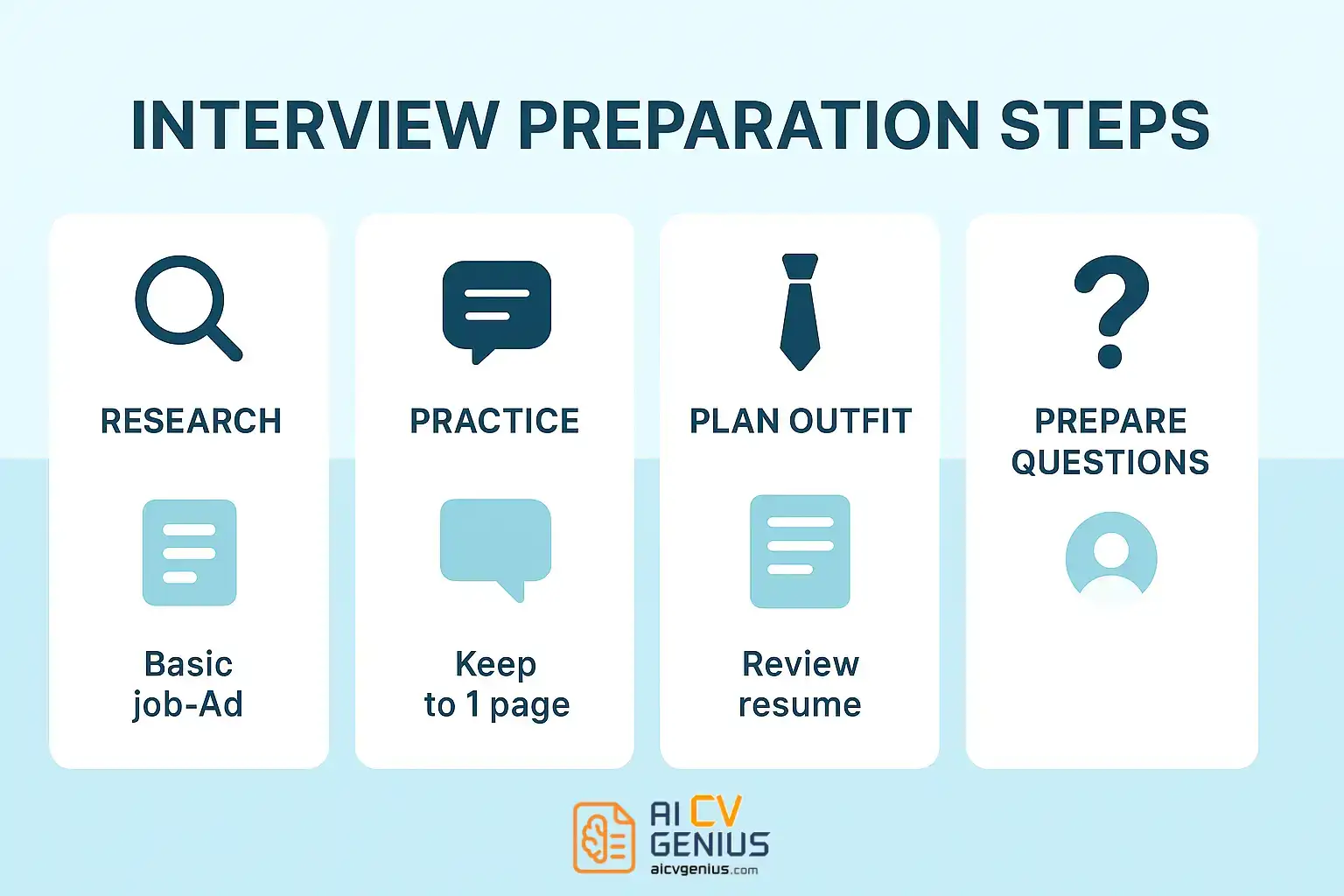
The Preparation Playbook: 10 Steps You Can Execute
Step 1: Conduct In-Depth Company Research
Entering an interview without a solid understanding of the organization signals disinterest. Demonstrate genuine curiosity and strategic alignment by thoroughly researching the company beforehand. Focus on:
- Reviewing the company’s official website, specifically the “About Us,” “Mission/Values,” and “Careers” pages for cultural insights and strategic priorities.
- Checking their LinkedIn Company Page for recent updates, employee profiles, and company culture indicators. Scan recent news articles or press releases mentioning the company for current initiatives or challenges.
- Understanding their core products or services, target market, primary competitors, and recent performance indicators (if publicly available).
- Identifying your interviewer(s) via LinkedIn (if names are provided). Understanding their background and role within the company can help tailor your conversation.
Pro Tip: Weave specific research findings naturally into your answers or questions.
Example:
“I noticed [Company Name] recently launched [Specific Initiative/Product]. I’m curious how this role might contribute to that effort, as my background in [Relevant Skill] seems particularly well-aligned.”
This demonstrates concrete engagement beyond generic interest.
Step 2: Meticulously Analyze the Job Description
Interviewers expect candidates to possess a thorough understanding of the role they are pursuing. Treat the job description as your primary roadmap, highlighting critical skills, essential responsibilities, key performance indicators (if mentioned), and recurring keywords. Then, strategically map your specific experiences and quantifiable achievements directly against these requirements.
Example Alignment:
If the job description repeatedly emphasizes “proven project management skills” and “experience leading cross-functional teams,” ensure you prepare specific examples (ideally using the STAR method) that vividly demonstrate your proficiency in precisely those areas.
The job description explicitly outlines the employer’s priorities – use it as your definitive checklist for tailoring your preparation and responses.
Step 3: Prepare Structured Answers to Common Interview Questions
While spontaneity is valuable, most interviews incorporate a predictable set of foundational questions. Preparing structured responses (not memorized scripts) builds confidence and ensures clarity. Focus on anticipating and outlining answers for questions like:
- “Tell me about yourself.” → Utilize the concise Past–Present–Future (PPF) framework. (Find detailed guidance in our Career Resources section).
- “Why are you interested in this specific role and our company?” → Directly connect your skills, values, and career goals with the company’s mission, culture, and the opportunity itself. Demonstrate genuine alignment based on your research.
- “What are your greatest strengths and weaknesses?” → Highlight strengths directly relevant to the job requirements, providing brief evidence. Address weaknesses honestly but frame them constructively, emphasizing steps taken towards improvement.
- Behavioral Questions (“Tell me about a time you…”): Prepare 5-8 specific examples using the STAR method (Situation, Task, Action, Result) illustrating key competencies like problem-solving, teamwork, leadership, handling pressure, dealing with failure, and taking initiative.
Crucial Tip: Practice articulating your answers aloud. Hearing yourself speak helps refine pacing, identify awkward phrasing, manage time effectively (aim for 1-2 minutes per behavioral answer), and build genuine fluency and confidence far more effectively than silent mental rehearsal.
Step 4: Prepare Insightful Questions to Ask the Interviewer
Near the interview’s conclusion, you will invariably be asked,
“Do you have any questions for us?” Responding with “No” signals disinterest or lack of preparation – a significant missed opportunity.
Prepare 3-5 thoughtful, specific questions that demonstrate genuine curiosity about the role, the team dynamics, company culture, strategic priorities, or opportunities for professional growth. Avoid asking basic information readily available online or focusing prematurely on salary/benefits.
- “Could you describe the key priorities or challenges for this role within the first 3-6 months?”
- “How does this team typically collaborate on projects, and what are the communication norms?”
- “What opportunities exist for professional development, training, or mentorship within the team or company?”
- “How would you characterize the team’s culture or working style?”
- (If appropriate, ask the interviewer): “What do you enjoy most about working at [Company Name]?”
Asking insightful questions transforms the interview from a one-sided interrogation into a collaborative, engaging professional dialogue, leaving a stronger positive impression.
Step 5: Review Your Resume and Key Achievements Thoroughly
Re-familiarize yourself intimately with every detail presented on the resume you submitted. Every listed skill, project, or bullet point represents potential discussion fodder. Be prepared to elaborate confidently and specifically on any aspect the interviewer might inquire about.
Mentally revisit your most significant past experiences and prepare concise narratives (ideally structured using STAR) that vividly illustrate your core competencies and value proposition – particularly focusing on achievements you can quantify with specific metrics (%, $, #).
If needed, ensure your resume’s presentation aligns effectively with your professional narrative by exploring layouts in the Resume Templates Finder designed for clarity and impact.
Step 6: Plan Your Professional Attire Strategically
Your attire significantly contributes to the crucial first impression before any substantive conversation begins. Aim for professionalism aligned with the company’s culture.
- Research the typical dress code for the company or industry (e.g., formal business attire for finance/law, business casual for tech/marketing, smart casual for startups). When in doubt, err slightly more formal.
- Choose clean, well-fitting, wrinkle-free clothing appropriate for the context. Ensure shoes are polished and professional.
- Minimize distractions: Avoid overly bright colors, bold patterns, excessive jewelry, or strong fragrances.
- Ensure your chosen outfit is comfortable and allows you to sit and move naturally without feeling restricted or self-conscious.
Feeling comfortable and appropriately dressed inherently boosts confidence and allows you to focus entirely on the conversation.
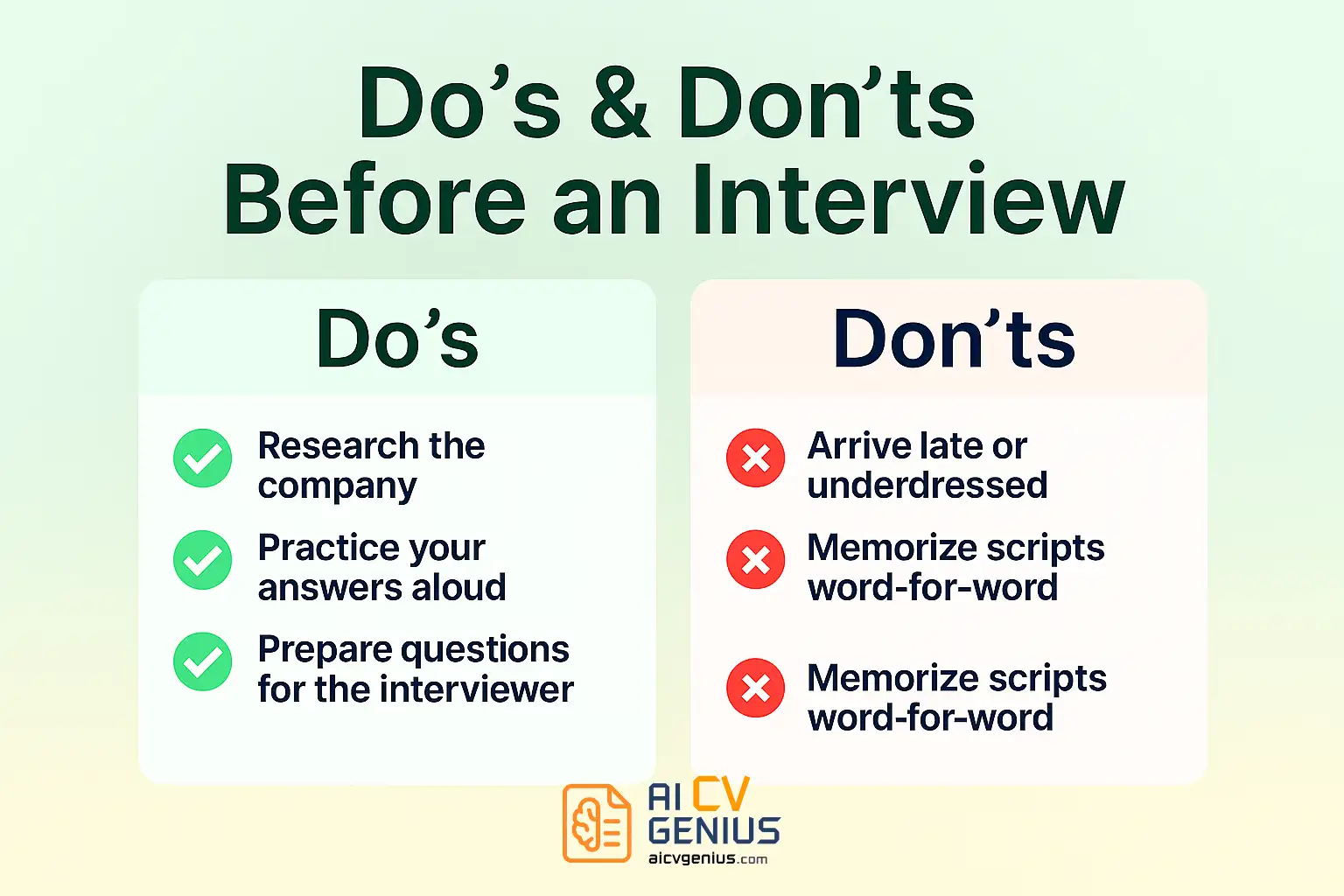
Step 7: Rehearse Effectively and Manage Pre-Interview Nerves
Experiencing pre-interview anxiety is entirely normal, even for seasoned professionals. The goal isn’t necessarily to eliminate nerves completely, but rather to channel that energy constructively through preparation and practice.
- Conduct mock interviews with a trusted friend, mentor, or career coach. Practice answering common questions and receive constructive feedback on content and delivery.
- Record yourself answering key questions (audio or video). Critically evaluate your pacing, vocal tone, clarity, body language, and use of filler words (“um,” “uh”). Adjust accordingly.
- Utilize relaxation techniques immediately before the interview: practice slow, deep breathing exercises; engage in brief mindful meditation; visualize a positive, confident interaction.
- Reframe your mindset: View the interview not as a high-stakes test you might fail, but as a collaborative professional conversation aimed at mutual discovery – determining if there’s a good fit for both parties.
- Remind yourself of your strengths and preparation: Acknowledge the effort you’ve invested. Trust that you are qualified and capable.
️Key Insight: Interviewers value authenticity and composure under pressure. Demonstrating self-awareness and maintaining a calm demeanor, even if slightly nervous, often leaves a stronger positive impression than attempting flawless but robotic perfection.
Step 8: Confirm All Logistical Details Meticulously
Avoid unnecessary stress caused by last-minute logistical issues. Confirm everything at least 24 hours in advance:
- Exact interview time, including correct time zone (especially critical for remote/international interviews).
- Precise location details (address, floor, suite number) for in-person interviews, including commute time and parking options. For virtual interviews, confirm the meeting platform link (Zoom, Teams, Google Meet) and test it beforehand.
- Necessary documents to bring/have ready: multiple printed copies of your resume (for in-person), portfolio samples (if applicable), list of references (if requested), government-issued ID (for building security).
- Technology check for virtual interviews: Ensure stable internet connection, functional webcam and microphone, quiet background environment, and fully charged device.
Step 9: Practice Confident Nonverbal Communication
Your body language often conveys messages more powerfully than your spoken words. Consciously practice projecting confidence and engagement:
- Maintain appropriate, steady eye contact (without staring intensely) to signal engagement and honesty.
- Sit or stand upright with open, relaxed posture (avoid slouching or tightly crossed arms).
- Use natural, controlled hand gestures sparingly to emphasize key points. Avoid fidgeting.
- Nod occasionally while listening attentively to show understanding and engagement.
- Offer a genuine, warm smile when greeting, introducing yourself, and concluding the interview.
Step 10: Plan Your Post-Interview Follow-Up Strategy
The interview doesn’t conclude when you leave the room (physical or virtual). Professional follow-up reinforces your interest and leaves a lasting positive impression.
Action Item: Send a brief, personalized thank-you email to each interviewer within 24 hours. Reiterate your enthusiasm for the role, briefly mention a specific point discussed that resonated with you, and reaffirm your key qualifications. Keep it concise and error-free.
Example:
“Dear [Interviewer Name], Thank you again for taking the time to speak with me today about the [Job Title] position. I truly enjoyed learning more about [mention specific aspect] and am even more enthusiastic about the opportunity to contribute my skills in [mention key skill] to your team. I look forward to hearing about the next steps.”
This simple, professional courtesy often differentiates candidates and demonstrates strong follow-through.
Readiness Tools: Pros & Cons, Plus a Final Day-Before Checklist
Pros & Cons of Rigorous Interview Preparation
| Pros | Cons |
|---|---|
| ✅ Significantly boosts confidence and measurably reduces interview anxiety. | ❌ Requires substantial time commitment, especially for thorough research and practice. |
| ✅ Improves clarity, conciseness, and overall professionalism of responses. | ❌ Risk of answers sounding overly rehearsed, scripted, or inauthentic if not practiced for natural delivery. |
| ✅ Demonstrates genuine interest, strong work ethic, and respect for the company and opportunity. | ❌ Necessitates consistent effort and self-discipline to prepare effectively for multiple interviews. |
| ✅ Dramatically increases the likelihood of making a strong positive impression and advancing in the hiring process. | ❌ Preparation alone doesn’t guarantee success – genuine alignment, cultural fit, and specific qualifications remain crucial factors. |
Checklist: Final Review Before Your Interview
Run through this list on the day of (or day before) your interview:
- ✅ Reviewed company background, role requirements, and interviewer profiles one last time.
- ✅ Mentally rehearsed key STAR story examples and main talking points for common questions.
- ✅ Prepared 3-5 insightful questions to ask the interviewer(s).
- ✅ Confirmed all logistical details (time, location/link, required documents). Professional attire selected and ready.
- ✅ Printed necessary documents (resume copies, reference list if requested) or ensured digital files are easily accessible.
- ✅ Conducted tech check (internet, camera, mic) for virtual interviews. Device fully charged.
- ✅ Allowed ample buffer time for commute (in-person) or setup (virtual) to avoid rushing.
FAQs and Final Thoughts
FAQs: Interview Preparation
Final Thoughts: Preparation as Empowerment
Thoroughly preparing for a job interview transcends merely rehearsing potential answers – it fundamentally involves aligning your professional narrative, cultivating a confident mindset, and meticulously managing your presentation. This preparation process itself empowers you, transforming inherent uncertainty into strategic control and enabling you to transform yourself from simply another resume in the pile into a memorable, compelling candidate whom employers can trust to deliver.
The more rigorously prepared you become, the more naturally authentic and relaxed you will feel during the actual conversation. You cease scrambling reactively for words and begin proactively leading your own story with conviction.
For deeper dives into specific interview storytelling techniques (like STAR mastery), explore our comprehensive Career Resources section. Ensure your foundational document effectively supports your narrative by utilizing professional layouts from our Resume Templates Finder. And if you’re refining your crucial introductory pitch, review impactful examples in our Cover Letters hub.
Remember this empowering truth: the most successful interviews rarely feel like interrogations – they evolve organically into collaborative professional conversations. Consistent, strategic preparation is precisely what facilitates that crucial transformation.