
- What it really means: Communication is not “talking a lot”, it is clarity, empathy, and influence that build trust and prevent misalignment.
- Why recruiters care: They want a force multiplier who reduces friction, reports clearly in remote work, and keeps teams aligned.
- What to prove: Show written, verbal, listening, and digital communication, each one looks different and needs evidence.
- How to show it: Replace “excellent communication” claims with achievement bullets that show what you clarified, negotiated, facilitated, or translated, plus results.
- Make it measurable: Add proof like time saved, fewer meetings, faster onboarding, higher retention, better satisfaction, and use strong action verbs that imply communication.
Introduction: The Core Skill of Communication
The “Soft Skill” That’s Not Soft at All: Why Communication Is Your Most Valuable Asset
Every job listing on earth, from software engineering to brain surgery, seems to end with the same lazy phrase: “Strong communication skills required.” We read it, we nod, and we add “Excellent communication skills” to our resume, right next to “Team Player.”
But what does it really mean? And how do you prove you have it on a two-dimensional piece of paper without sounding like a cliché?
Here is the truth: communication skills are not “soft” at all. They are the single most complex, difficult, and valuable set of skills in the professional world. They are not about talking a lot or having a big vocabulary. They are about clarity, connection, empathy, and influence.
In a world of remote work, AI, and global teams, your technical skills might get you the interview, but your communication skills will get you the job, the promotion, and the trust of your team. This guide will break down what “communication” truly means and how to prove it, not just claim it.
“Good communication doesn’t just get the message across. It builds trust, prevents chaos, and makes you the person everyone wants to work with.”
Why Recruiters Are Secretly Obsessed With Communication
When a hiring manager reads your resume, they are not just looking for a “doer.” They are looking for a “force multiplier” – someone who makes the entire team better, smarter, and more efficient. That is what great communication does.
In today’s hybrid and remote workplaces, communication is the entire operating system. Managers cannot see you working; they only see the output of your work and the clarity with which you report it. A project’s success or failure hinges entirely on communication.
They are screening for candidates who can:
- ✅Reduce Friction: Can you explain a complex idea simply? Can you write an email that gets a clear answer on the first try, without five follow-ups?
- ✅Build “Digital Trust”: In a remote world, trust is built through clear, reliable, and empathetic digital communication. Are your Slack messages considerate? Do you show up prepared for Zoom calls?
- ✅Prevent Misalignment: The #1 cause of project failure is not a lack of technical skill; it is a lack of communication. Recruiters want people who ask good questions, clarify assumptions, and keep everyone aligned.
- ✅Manage Up and Across: Can you give your manager a clear update? Can you negotiate a deadline with another department? This is far more valuable than any single technical skill.
That is why communication is consistently ranked as one of the top skills employers value. They know it is the invisible engine behind all teamwork, leadership, and problem-solving.
How to Prove Communication Skills on a Resume
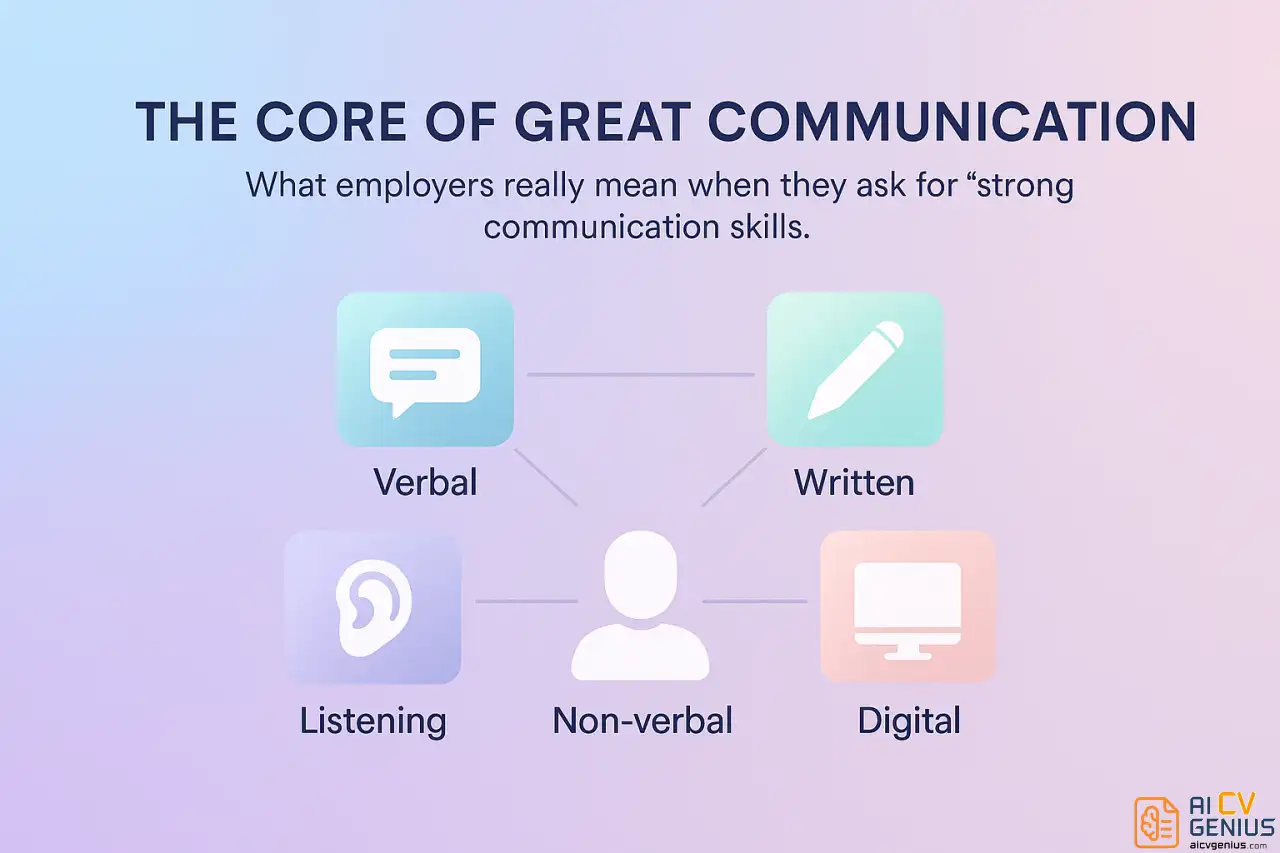
The Four Dimensions of Communication (And How to Show Them)
Saying you have “communication skills” is too vague. A great resume shows proof of these four distinct dimensions, often without ever using the word “communication.”
| Dimension | What It Really Is | How to Prove It on a Resume |
|---|---|---|
| 1. Written | Clarity, conciseness, and tone. Can you write an email, report, or message that is easy to understand and provides a clear call to action? | “Authored the weekly project status report for 15 stakeholders.” “Wrote clear technical documentation, reducing support tickets by 20%.” |
| 2. Verbal | Persuasion, presentation, and clarity. Can you explain a complex idea in a meeting? Can you read the room and adjust your tone? | “Presented quarterly findings to executive leadership.” “Trained and onboarded 5 new team members on company software.” |
| 3. Listening | The most important dimension. Empathy, curiosity, and conflict resolution. Do you make others feel heard? Do you ask clarifying questions? | “Mediated a conflict between two departments, finding a new workflow.” “Gathered client feedback to redefine project scope.” |
| 4. Digital / Non-Verbal | Your “digital body language.” Zoom etiquette, Slack professionalism, and asynchronous clarity. Are you reliable and present in a remote setting? | “Coordinated a 10-person remote team across 3 time zones.” “Facilitated engaging weekly Zoom meetings for the project team.” |
In 2026, Digital Communication has become the default. Your ability to convey tone, respect, and priority through text is a non-negotiable skill.
The Golden Rule: Show, Don’t Tell (And Ditch the “Skills” Section)
This is the biggest mistake most people make. They go to their “Skills” section and write:
– Excellent communication skills
This is a lazy, unsubstantiated claim. It has become white noise. Recruiters’ eyes glide right over it. It tells them nothing. You must prove it by weaving it into your achievements. Let your accomplishments be the evidence.
Use your experience bullet points to tell mini-stories (using the PAR: Problem-Action-Result model) where communication was the key to your success.
The “Before” and “After” of Communication Bullets
| Before (Weak) | After (Strong) |
|---|---|
| Responsible for team meetings. | Facilitated weekly cross-functional meetings, clarifying action items and aligning 3 departments, ensuring the project stayed on schedule. |
| Wrote emails to clients. | Managed all client communications, translating complex technical data into clear, actionable reports that improved client retention by 15%. |
| Worked with the sales team. | Collaborated with the sales team to negotiate contract terms, resulting in a 10% increase in average deal size. |
The “After” examples show communication as a strategic tool, not a passive trait. If you are struggling to phrase your bullets this way, our AI Resume Templates are built around this “show, don’t tell” logic.
Real-World Examples for Different Professions
Communication looks different for every role. Here is how to phrase it to show you understand the nuances of your specific field.
- Project Manager: “Authored and maintained the central project documentation, serving as the single source of truth for all stakeholders and reducing weekly status meetings by 50%.”
- Data Analyst: “Presented complex data findings to non-technical VPs, translating statistical models into clear business recommendations that shaped the new marketing strategy.”
- ️ Sales Professional: “Practiced active listening to understand client pain points, leading to a more consultative sales approach and a 25% increase in qualified leads.”
- Designer (UX/UI): “Facilitated user feedback sessions and synthesized qualitative data into clear design requirements for the engineering team.”
- Software Engineer: “Wrote and maintained 15+ technical documents for a new API, reducing new-hire onboarding time by 30%.”
- Customer Service: “De-escalated conversations with sensitive clients, resolving issues in one call and improving my personal satisfaction score to 98%.”
- Marketing: “Pitched and presented the new Q3 campaign strategy to leadership, securing a $50k budget.”
How to Measure Communication (Yes, You Can!)
Metrics turn your “soft” skill into a “hard” result. It proves your communication has tangible business value. Look for these metrics in your past work:
- Efficiency: Did you reduce time? (e.g., “Reduced meeting times,” “Fewer revision cycles,” “Faster project delivery”).
- Adoption/Understanding: Did you train people? (e.g., “Trained 15 new hires,” “Onboarded 3 teams,” “Increased adoption of new software by 40%”).
- Engagement: Did you improve a metric? (e.g., “Improved survey participation,” “Increased client satisfaction scores,” “Reduced support tickets”).
- Scale: Did you manage a large group? (e.g., “Presented to 50+ employees,” “Coordinated with 5 departments,” “Managed 20 client accounts”).
Even one of these numbers transforms a bullet point from “I did a thing” to “I made an impact.”
Action Verbs That Scream “Great Communicator”
Ditch “Led” and “Managed.” Use more specific, evocative verbs in your resume bullets to imply communication:
| Advised | Authored | Clarified |
| Coordinated | Corresponded | De-escalated |
| Delivered | Demonstrated | Facilitated |
| Influenced | Interpreted | Mediated |
| Negotiated | Persuaded | Presented |
| Pitched | Synthesized | Translated |
If you are unsure how to phrase your accomplishments, explore our Career Resources library for more pre-written examples categorized by role.
Future-Proofing Your Communication Skills
The Future of Communication: Why AI Makes Human Skills More Valuable
Many worry that AI will make skills obsolete. When it comes to communication, it does the opposite. AI is a fantastic tool for generating text, but it cannot (yet) provide the most critical human elements:
- Empathy: AI cannot read a room, understand a client’s hesitation, or know how to deliver sensitive feedback.
- Strategic Nuance: AI cannot decide what to say, why to say it, and who to say it to. That is a human judgment.
- Trust-Building: Empathy, vulnerability, and active listening build human-to-human trust in a way code cannot.
- Prompt Crafting: The most valuable “AI skill” is a communication skill. Knowing how to ask an AI the right question to get the right output is a high-level communication task.
In 2026, your value is not in writing the first draft (AI can do that). Your value is in the editing, the empathy, the strategic “why,” and the human connection you build.
How to Genuinely Practice and Improve Communication
This is a skill, not a trait. You can get better at it with deliberate practice.
- Practice Writing: Read your emails out loud before sending them. Is the tone right? Is the call to action clear? Start a blog or journal to practice articulating complex thoughts.
- Practice Listening: In your next conversation, make it your goal to not talk about yourself. Ask “why” and “how” questions. Try to summarize the other person’s point: “So, if I’m hearing you right, your main concern is…”
- Practice Speaking: Join Toastmasters. It is a safe, structured environment to fail and get feedback. Volunteer to present in low-stakes team meetings. Record yourself on your phone explaining a complex topic in 60 seconds.
- Seek Feedback: Ask a trusted manager or mentor, “When I presented in that meeting, was my main point clear? How was my pacing?” Be specific.
Conclusion and FAQ
Final Thoughts: The Core Skill
Communication is not a “soft skill.” It is the core skill. It is the foundation of leadership, the engine of teamwork, and the framework for problem-solving. It is what turns your individual experience into collective influence and transforms simple tasks into genuine trust.
When you build your resume, do not just tell them you are a good communicator. Show them. Prove it with every metric, every action verb, and every bullet point. That is how you turn a piece of paper into a handshake, and a handshake into an offer.
In-Depth FAQs on Communication Skills
- “Authored detailed technical documentation for 3 new features.”
- “Clarified project requirements between the product manager and engineering team.”
- “Presented a code review to the senior dev team, explaining my architecture choices.”
- “Mentored two junior developers, explaining complex codebases and best practices.”
- Stakeholder Reporting
- Technical Documentation
- Client Negotiation
- Public Speaking
- Meeting Facilitation
These are more concrete and believable.