
- Main point: Your LinkedIn headline is 220 characters that decide visibility, clicks, and search appearance.
- Audience first: Choose One primary audience (Recruiter, Client, or Peer) or your headline becomes blurry and weak.
- Core framework: Use A-D-V (Anchor role, Differentiator skills or niche, Value outcome) to stay keyword-rich without sounding robotic.
- What to copy and avoid: Use targeted examples by career stage and industry, and avoid defaults, vague “creative” phrases, keyword stuffing, audience mismatch, and stale headlines.
- Make it work long-term: Do quick keyword research from real job posts, use clean separators like |, review analytics, and iterate instead of “set and forget.”
You have 220 characters. In that tiny space, a recruiter, a potential client, or a future collaborator scrolling at high speed will decide if you are “invisible” or “interesting.” That’s the power of your LinkedIn headline.
It’s not your resume. It’s not your portfolio. It’s just those few words at the top of your profile. Yet, most professionals waste this critical space with the default: “Marketing Manager at Company X.”
If you are actively job searching, trying to build authority in your field, or attracting high-value clients, your headline is doing 90% of the work. A boring headline makes you invisible in searches. A powerful one opens doors. This guide isn’t just a list of LinkedIn headline examples; it’s a deep dive into the strategy of crafting a headline that gets you found and, more importantly, gets you clicked.
Your Headline: The Most Valuable Digital Real Estate You Own
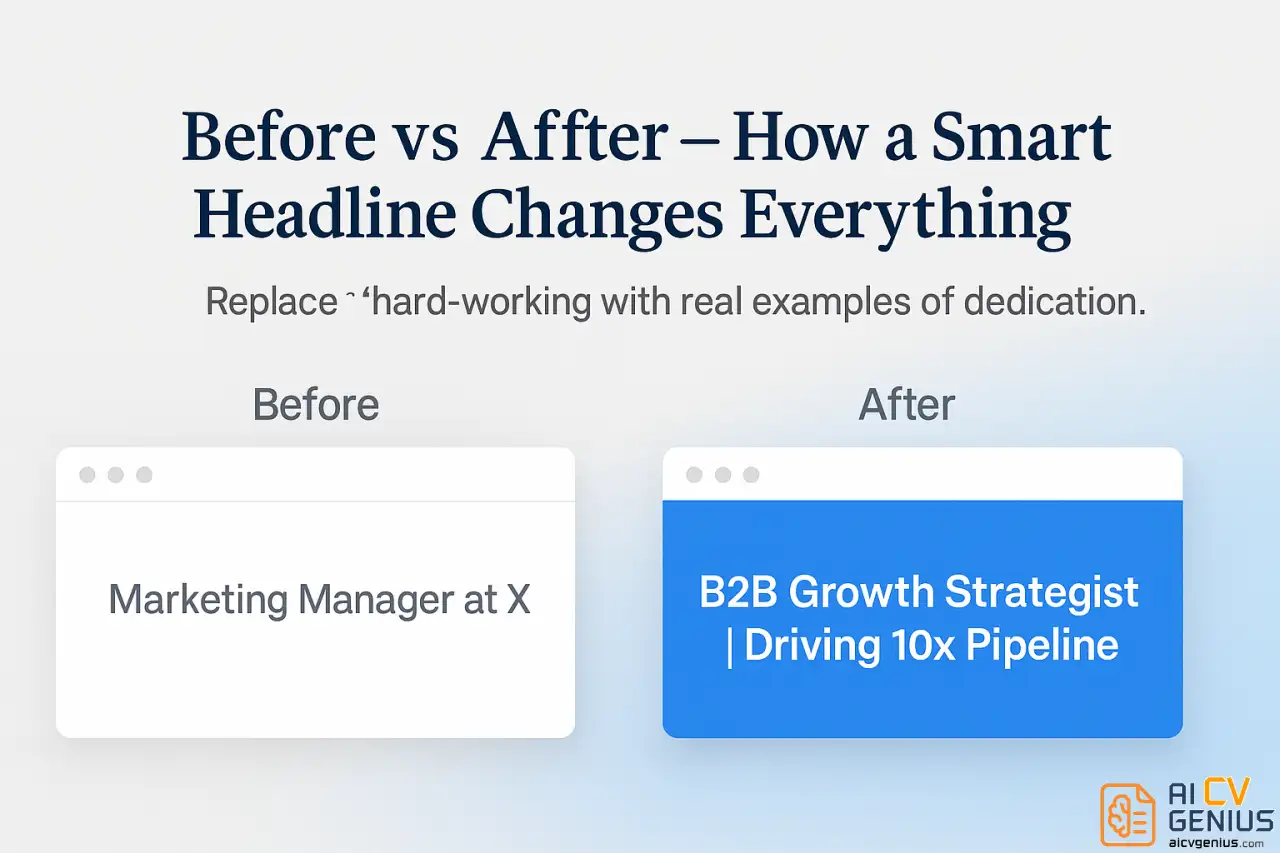
Here’s a simple test. Go to LinkedIn and search for a common job title, like “content marketing manager” or “Python developer.” What do you see? You don’t see full profiles. You see a long list of headshots, names, and headlines. This is the entire battlefield. Your headline is your first and, often, only impression.
Most people default to LinkedIn’s auto-generated headline. This is a critical mistake. It works if you’re the CEO of a Fortune 500 company. For everyone else, it’s a massive, wasted opportunity. Why? Because recruiters and clients are not just searching for job titles; they are searching for solutions, skills, and specializations.
Your headline is not just a title; it is a 24/7 sales pitch and SEO tool. A “Data Analyst” headline competes with 500,000 others. But “Data Analyst | SQL, Python & Tableau | Turning Healthcare Data into Actionable Insights” tells a completely different, and far more compelling, story.
Furthermore, LinkedIn’s algorithm lives and breathes keywords. It prioritizes profiles with keyword-rich, optimized headlines. The more specific and relevant your headline is to your target audience, the more visible you become. A great headline doesn’t just wait to be seen; it actively seeks out the right people.
Who Are You Writing For? The 3 Audiences on LinkedIn
Before you write a single word, you must identify your primary audience. Your headline will change depending on who you’re trying to attract.
- The Recruiter / Hiring Manager: This audience is looking for a match to a job description. They search using specific keywords (e.g., “React Developer,” “PMP,” “SaaS Sales”). Your headline must be rich with these exact-match keywords to even appear in their search.
- The Potential Client / Customer: This audience is not looking for a job title. They are looking for a solution to their problem. They search for outcomes (e.g., “lead generation,” “startup financial models,” “conversion copywriter”). Your headline must be value-driven and speak directly to their pain point.
- The Peer / Collaborator: This audience is looking to network and gauge your expertise. They are impressed by authority, niche specialization, and social proof (e.g., “Forbes contributor,” “Ex-Google,” “Cybersecurity Speaker”).
You must choose one primary audience. A headline trying to attract all three will attract no one. The examples below are all targeted to a specific audience.
The A-D-V Formula: A Powerful Headline Framework
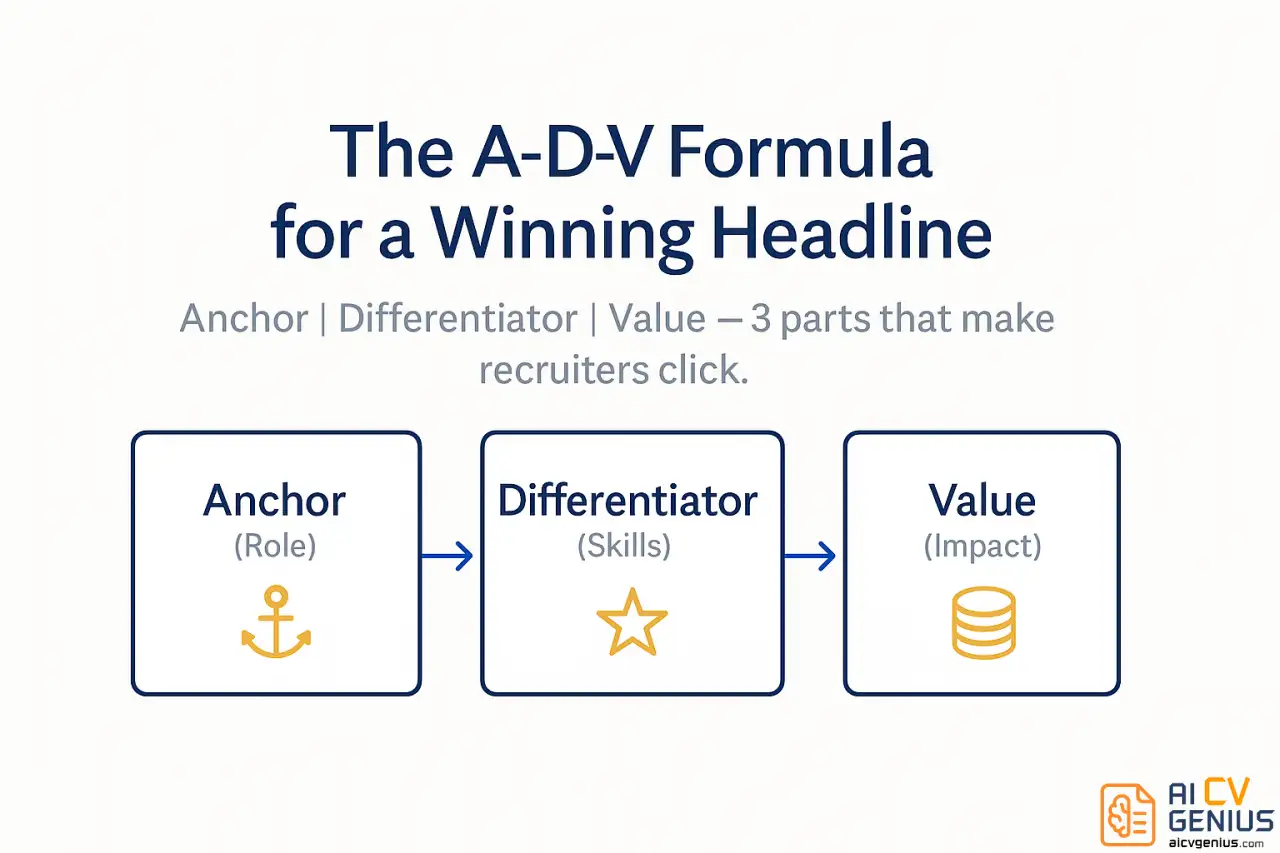
Forget generic templates. The best headlines follow a simple, powerful formula. I call it the A-D-V formula: Anchor, Differentiator, Value.
Part 1: The Anchor (Role / Expertise)
This is your “who you are.” It’s the primary keyword that makes you searchable. It anchors your profile in a specific industry or role. For job seekers, use the title you want, not the one you have.
- Instead of: “Marketing Professional”
- Use: “Senior Content Marketing Manager” (if that’s your target)
- Instead of: “Creative Problem Solver” (No one searches for this)
- Use: “UX/UI Designer”
Part 2: The Differentiator (Key Skills / Niche)
This is your “how you do it.” What makes you different from the 500,000 other people with your same “Anchor”? This is where you add your 2-4 most valuable keywords, tools, or specializations.
- Anchor: “Software Engineer”
- Differentiator: “| React, Node.js & AWS”
- Anchor: “Digital Marketing Strategist”
- Differentiator: “| SEO & B2B Demand Generation”
Part 3: The Value (Proposition / Impact)
This is the hook. It’s your “so what?” and answers the “why” for your audience. It explains the result of your work. This is what makes someone click.
- Anchor + Differentiator: “Product Manager | SaaS & Mobile Apps”
- Value: “| Building Features That Users Actually Love”
- Anchor + Differentiator: “Freelance Copywriter | Tech & B2B”
- Value: “| Helping Startups Sound as Smart as Their Code”
The Complete Formula: [Anchor] | [Differentiator] | [Value]
30+ LinkedIn Headline Examples By Career Stage and Industry
For Job Seekers and Career Changers
The Strategy: Your primary audience is the Recruiter. You must be heavy on keywords for your target role and clearly (but professionally) signal your availability.
Example 1:
"Marketing Manager | B2B SaaS, Demand Generation & HubSpot | Actively Exploring New Opportunities"
Why it works: “Actively Exploring” is a professional way to say “job seeking.” It’s packed with the keywords (B2B SaaS, Demand Gen, HubSpot) that a recruiter will use in their search filter.
Example 2:
"Former Teacher Transitioning to UX Design | Google UX Certified | Figma & Prototyping | Portfolio: [YourSite.com]"
Why it works: Addresses the career change head-on, proves commitment with a certification, lists the key tools (Figma), and smartly includes a portfolio link. For more, see our career change resume guide.
Example 3:
"Seeking Data Analyst Role | SQL, Python & Tableau | Passionate About Turning Raw Data into Business Decisions"
Why it works: “Seeking” is direct. It lists the non-negotiable hard skills (SQL, Python, Tableau) and adds a strong value proposition (not just “analyzing data” but “making decisions”).
Example 4:
"Sales Development Representative | Exceeding Quotas & Building Pipeline | Open to New Challenges in Tech Sales"
Why it works: It’s results-focused (“Exceeding Quotas”) and specifies the target industry (“Tech Sales”). “Open to New Challenges” is a confident signal of availability.
For Students and Recent Graduates
The Strategy: Your audience is the Recruiter for internships or entry-level roles. You must compensate for lack of experience with credentials, passion, and proven initiative.
Example 5:
"Computer Science Student @ Stanford | Software Engineering Intern @ Meta | Passionate About AI & Machine Learning"
Why it works: Leverages social proof (Stanford, Meta) immediately. Shows a clear, specialized career direction (AI/ML) which is more impressive than a generalist.
Example 6:
"Recent Marketing Graduate (Top 10%) | Google Analytics & Hootsuite Certified | Seeking Entry-Level Social Media Role"
Why it works: Leads with a credential (Top 10%), proves initiative with relevant certs, and clearly states the target role. Find more help in our career resources for job seekers.
Example 7:
"Aspiring Software Developer | Java, Python & React | Building 3 Full-Stack Projects | Eager to Contribute to a Team"
Why it works: “Aspiring” is honest. It proves skill by “doing” (“Building 3 Full-Stack Projects”) which beats classroom theory every time. It shows a team-player attitude.
Example 8:
"Finance Major @ NYU | Investment Banking Intern @ Goldman Sachs | CFA Level 1 Candidate"
Why it works: A powerful combination of credentials. It shows a prestigious internship and serious commitment to the field by pursuing the CFA.
For Tech and IT Professionals
The Strategy: Your audience is the Tech Recruiter or Hiring Manager. Your headline MUST be 80% keywords (tech stack, certs) and 20% value.
Example 9:
"Full-Stack Developer | React, Node.js, TypeScript & AWS | Building Scalable Web Applications for FinTech"
Why it works: A perfect keyword-heavy headline. It lists the exact stack recruiters search for and adds a high-value industry specialization (FinTech).
Example 10:
"Senior DevOps Engineer | Kubernetes, Terraform, Docker & CI/CD | I Automate Everything So You Can Ship Faster"
Why it works: All the key technologies are there. The value prop is simple, powerful, and speaks directly to a hiring manager’s pain point (deployment speed).
Example 11:
"Data Scientist | Python, Machine Learning & NLP | Helping E-commerce Brands Predict Customer Behavior"
Why it works: It combines the technical skills (Python, ML, NLP) with a clear, valuable, and non-technical business outcome for a specific industry.
Example 12:
"Cybersecurity Analyst | Penetration Testing, Risk Assessment & Network Security | CISSP & Security+ Certified"
Why it works: Clearly defines the specialization (Pen Testing) and lists the most in-demand, searchable certifications (CISSP, Sec+).
Example 13:
"Agile Project Manager (PMP) | Scrum Master (CSM) | Leading Technical Teams to Deliver On-Time, On-Budget"
Why it works: Leads with the role and immediately backs it up with the two most important certifications (PMP, CSM). The value prop is a classic, powerful promise.
For Marketing and Sales Professionals
The Strategy: Your audience (Recruiter or Client) cares about one thing: Results. Your headline must be results-driven, using numbers and ROI language.
Example 14:
"Content Marketing Manager | SEO & Thought Leadership | Grew Organic Traffic from 10K to 500K/Month"
Why it works: This is a “stop-scrolling” headline. It shows the specialization (SEO) and a massive, quantified result.
Example 15:
"B2B Sales Executive | Enterprise SaaS Solutions | Consistently Exceeding Quota by 150%+"
Why it works: Specifies the niche (Enterprise SaaS) and presents a powerful, quantified performance metric that proves they are a top performer.
Example 16:
"Digital Marketing Strategist | Paid Social (Meta/TikTok) & PPC | Managing $2M+ in Annual Ad Spend for DTC Brands"
Why it works: It shows platform specialty (Meta/TikTok), mastery of scale (“$2M+ Ad Spend”), and a clear industry focus (DTC).
Example 17:
"Email Marketing Specialist | HubSpot & Klaviyo Expert | I Turn Subscribers into Customers (15% Avg. CVR)"
Why it works: Lists key tools, has a great value prop (“Turn Subscribers into Customers”), and backs it up with a specific metric (15% Avg. CVR).
For Creative Professionals
The Strategy: Your audience (Recruiter or Client) wants to see skills, but also personality and a unique point of view. You have more license to be creative.
Example 18:
"Brand Designer & Visual Storyteller | Helping Startups Go from 'Good Idea' to 'Unforgettable Brand'"
Why it works: “Visual Storyteller” adds creative flair. The value prop speaks directly to a startup founder’s primary pain point (looking legitimate).
Example 19:
"UX/UI Designer | Figma & Adobe XD | Creating Intuitive, Human-Centered Experiences for 1M+ Users"
Why it works: Lists the essential tools, uses key industry language (“Human-Centered”), and shows experience at scale (“1M+ Users”).
Example 20:
"Freelance Writer | B2B Tech & SaaS | Bylines in TechCrunch, VentureBeat & Forbes | Ghostwriting for CEOs"
Why it works: Leads with a clear niche, provides incredible social proof (bylines), and adds a high-value service (Ghostwriting).
Example 21:
"Video Producer & Editor | Corporate & Commercial Content | 50M+ Combined Views Across Campaigns"
Why it works: Defines the service and provides a massive, undeniable metric of reach and effectiveness.
For Executives and Senior Leaders
The Strategy: Your audience is Peers, Boards, and C-level Recruiters. Focus on high-level strategic impact, team building, and P&L/revenue responsibility.
Example 22:
"Chief Marketing Officer (CMO) | Scaling B2B Brands from $10M to $100M+ ARR | Building High-Performance Teams"
Why it works: It’s all about strategic, quantified impact at scale. “Building… Teams” is key leadership language.
Example 23:
"VP of Product | I Build Teams That Ship Great Products | Former Amazon & Google PM"
Why it works: Simple, confident value prop (“Build Teams That Ship”) combined with elite FAANG social proof.
Example 24:
"CEO & Founder | Sustainable Fashion Tech | On a Mission to Reduce Industry Waste by 30%"
Why it works: Combines role, industry, and a powerful, memorable mission statement that attracts like-minded talent and investors.
Example 25:
"Chief Financial Officer (CFO) | M&A and IPO Expert | Guiding Tech Companies Through High-Growth Transitions"
Why it works: Highlights an extremely high-value, specific expertise (M&A, IPO) and defines the exact scenario they thrive in.
For Freelancers and Consultants
The Strategy: Your audience is the Potential Client. Your headline must be 100% focused on their problem and your solution. Use “Helping [X] do [Y].”
Example 26:
"Fractional CFO | Helping Series A/B Startups Secure Funding & Scale Profitably | Ex-Deloitte"
Why it works: Defines the exact target client (Series A/B Startups), their exact problem (Funding & Scale), and adds credibility (Ex-Deloitte).
Example 27:
"LinkedIn Consultant | Helping B2B Founders Generate Leads Without Paying for Ads"
Why it works: A perfect client-facing headline. It names the client, the result, and overcomes a common objection (Paid Ads).
Example 28:
"Freelance Conversion Copywriter | Helping SaaS Companies Turn Free Trials into Paid Users"
Why it works: Speaks directly to the #1 goal of any SaaS company. It’s not about “writing blogs”; it’s about “getting paid users.”
Example 29:
"Executive Career Coach | I Help Tech Leaders Land $300k+ Roles in 90 Days"
Why it works: Ultra-specific promise, target audience, and timeframe. This confidence attracts high-paying clients.
Example 30:
"WordPress & Webflow Developer | Helping Small Businesses Build Websites That Actually Get Customers"
Why it works: It differentiates from thousands of other developers by focusing on the business result (“get customers”), not just the technical skill.
LinkedIn Headline Formulas: Quick Reference
Use these tested formulas as starting points for your own headline:
| Formula Type | Structure | Best For | Example |
|---|---|---|---|
| The Classic (A-D-V) | [Role] | [Skills/Niche] | [Value Prop] | Most professionals | “Product Manager | Agile & Roadmapping | Shipping Features Users Love” |
| The Job Seeker | [Target Role] | [Key Skills] | Seeking [Type] Opportunities | Active job hunters | “Data Analyst | SQL & Tableau | Actively Exploring Remote Opportunities” |
| The Student | [Status] @ [School] | [Skills/Interests] | [Aspiration] | Students, recent grads | “CS Student @ MIT | AI/ML Enthusiast | Seeking Summer 2026 Internship” |
| The Results-Driven | [Role] | [Specialization] | [Quantified Achievement] | Experienced professionals | “Sales Manager | B2B SaaS | Grew Territory Revenue 300% in 2 Years” |
| The Consultant | [Service] | Helping [Target Client] [Achieve Outcome] | Freelancers, consultants | “Brand Strategist | Helping DTC Brands Stand Out in Crowded Markets” |
| The Niche Expert | [Expertise] for [Industry] | [Specific Outcome] | Specialists | “Conversion Rate Optimization for E-commerce | Increasing AOV by 25%+” |
| The Career Changer | Transitioning from [Old Field] to [New Field] | [New Skills/Certs] | Career changers | “Former Lawyer Transitioning to Tech | Product Management Certificate” |
| The Authority | [Role] | [Social Proof] | [Mission] | Leaders, writers | “Cybersecurity Expert | Forbes Contributor | Securing Our Digital Future” |
5 LinkedIn Headline Mistakes That Make You Invisible
Avoid these common pitfalls that cause even qualified professionals to get overlooked:
- ❌ Mistake 1: Using LinkedIn’s default headline.The Problem: “Marketing Manager at ABC Company” tells people what you are, not what you do or what you’re worth. It’s a 0% effective headline that blends into the background and has poor SEO value.
- ❌ Mistake 2: Being too vague or “creative.”The Problem: Headlines like “Passionate Problem Solver,” “Making Magic Happen,” or “Thought Leader” are meaningless. No recruiter searches for “magic maker.” You must use the clear, industry-standard terms your audience is actively searching for.
- ❌ Mistake 3: Keyword stuffing.The Problem: “Marketing | SEO | SEM | PPC | Content | Social Media | Email | Analytics | Strategy | Growth” is unreadable. It looks desperate and robotic. Pick 3-4 high-impact keywords and weave them into a natural-sounding headline.
- ❌ Mistake 4: Forgetting your audience.The Problem: A tech-heavy headline (“Python, C++, Java, AWS, K8s”) might be great for a recruiter but will completely confuse a potential freelance client who just wants a “website that works.” Know your audience and write for them.
- ❌ Mistake 5: Never updating it.The Problem: Your headline should evolve. A headline optimized for a job search is different from one for building authority. If your headline still reflects a job you left two years ago, you look sloppy and unengaged.
Advanced Tips: Optimizing Your Headline for Search and Engagement
Once you have a solid draft, fine-tune it with these advanced strategies:
Do Real Keyword Research (The 5-Minute Version)
This is the most important step.
1. Open 10-15 job postings for the role you want.
2. Copy/paste the “Requirements” sections into a word cloud tool (or just a text document).
3. Look for the terms that appear most frequently. Are they “HubSpot,” “Salesforce,” “Demand Generation,” “PMP,” “AWS”?
4. Those are your high-value keywords. You must include the most relevant ones in your headline.
A Note on Separators: | vs. – vs. /
The “vertical pipe” ( `|` ) is the unofficial standard for LinkedIn headlines. It’s clean, professional, and provides the best separation. The em-dash ( ` – ` ) is a good, slightly more “editorial” alternative. Slashes ( `/` ) can look cluttered and are best used to group related concepts (e.g., “UX/UI Designer”). We recommend the vertical pipe.
Test and Iterate
Your headline isn’t permanent. Write a new one and check your “Profile Views” and “Search Appearances” in your LinkedIn Analytics for the next 7 days. Did they go up? You’re on the right track. Did they drop? Your keywords might be wrong. Tweak and test again.
Frequently Asked Questions (From the Expert’s Desk)
Your Headline is Your Personal Brand’s Front Door
The best LinkedIn headline examples all share one trait: they instantly communicate value. They are generous to the reader. They don’t make the recruiter guess what you do. They don’t make the client guess how you can help. They state it clearly, confidently, and concisely.
Your headline is not a “set it and forget it” task. It is the most dynamic and high-impact tool on your profile. The headline that got you a job last year is not the same one you should use to attract consulting clients today.
Take 30 minutes. Go through the A-D-V formula. Do the 5-minute keyword research. Choose one of the expert examples in this guide and make it your own. This small investment of time will fundamentally change your visibility and the quality of opportunities that come your way.
Ready to optimize the rest of your profile? Now that your headline is strong, learn how to create a resume that matches its power.
Want more LinkedIn optimization tips? Explore more practical headline ideas at Linkedin Headline: The Ultimate Guide.