
- Big promise: Switching careers is a deliberate 5-step plan, not “follow your passion” advice.
- Why you feel stuck: Golden handcuffs, identity foreclosure, and sunk cost thinking keep you in the wrong lane.
- Step 1 to 2: Run a four-list “career autopsy,” then validate ideas with 3 to 5 informational interviews using hard questions.
- Step 3 to 4: Build a transition bridge with 2 to 3 real projects and strategic certs, then rebrand your resume and LinkedIn around the pivot narrative.
- Step 5: Use the network side door with soft asks and value-first outreach, plus a checklist and FAQ to keep the process on track.
You wake up on Monday morning with that familiar, dull knot in your stomach. You check your email before your feet even hit the floor. Another week, another series of meetings that feel pointless, doing work that doesn’t excite you. You’re good at your job. You’re paid decently. But you cannot shake the profound, persistent feeling that you are in the wrong place, living someone else’s definition of success.
If that sounds familiar, you are not alone. When you search for how to switch careers, you are joining millions of people who have come to the same terrifying realization: staying in the wrong career is far riskier than making a change.
Here’s what most career advice gets fatally wrong: they tell you to “follow your passion” or “find your purpose.” That is abstract, unhelpful, and frankly, privileged advice. Passion doesn’t pay the bills. A vague sense of “purpose” doesn’t create a strategic plan. Switching careers isn’t a single “aha!” moment of clarity. It is a deliberate, methodical process of self-investigation, market-testing, and strategic risk-taking.
This five-step plan isn’t a magic wand. It’s a blueprint. It works whether you’re 25 or 55, whether you have a robust savings account or are living paycheck-to-paycheck. It’s not quick, and it’s not easy. But it is the right way to do it.
The Psychology of “Stuck”: Why Is It So Hard to Leave?

Before we get to the “how,” we must address the “why.” Why do so many brilliant, capable people stay in jobs they hate? It’s often a combination of three powerful forces:
- The “Golden Handcuffs”: Your salary, benefits, and seniority are comfortable. The idea of giving them up, even temporarily, feels like jumping out of a plane without a parachute.
- Identity Foreclosure: You’ve spent a decade becoming “The Marketing Director” or “The Senior Lawyer.” If you’re not that… who are you? Your job has become intertwined with your identity.
- The “Sunk Cost” Fallacy: You think, “I’ve already spent 10 years and $100,000 on this career path. I can’t just throw that all away.” This faulty logic keeps people trapped by their past instead of building their future.
The strategy in this guide is designed to systematically dismantle these fears. You are not “throwing anything away.” You are leveraging your experience, identity, and skills to build something new. You are not jumping; you are building a bridge, one plank at a time.
Step 1: Conduct a “Career Autopsy” (Not Just an Assessment)
Before you can figure out where you’re going, you must get brutally honest about where you are. The “Ikigai” framework is a good start, but let’s make it more practical. You need to separate what you’re good at from what you loathe.
The Four-List Framework
Get a piece of paper and make four columns. Be specific. Don’t write “meetings”; write “presenting in large meetings” or “one-on-one brainstorming meetings.”
- List 1: What I’m Good At & I Enjoy (Your “Zone of Genius”):These are the tasks that make time disappear. The work that energizes you. (Example: “Organizing a chaotic project into a clear plan,” “Mentoring a junior employee,” “Deep-diving into a spreadsheet to find a story.”)
- List 2: What I’m Good At & I Loathe (Your “Burnout Zone”):This is the most critical list. This is the work you get praised for but which drains your soul. Your next career must minimize these tasks. (Example: “Presenting to executives,” “Cold-calling new clients,” “Managing the team’s interpersonal conflicts.”)
- List 3: What I’m Bad At & I Enjoy (Your “Learning Zone”):These are your hobbies and interests. Can any of these be developed into a skill? (Example: “Dabbling in Python,” “Writing my personal blog,” “Organizing the school fundraiser.”)
- List 4: What I’m Bad At & I Loathe (Your “Danger Zone”):Tasks you dread and are also not good at. Your next job should have none of these. (Example: “Detailed financial forecasting,” “Public-facing customer support.”)
Your ideal career change lives in List 1, is supported by skills from List 3, and avoids everything in Lists 2 and 4. You are no longer just looking for what you’re “good at.” You are looking for the intersection of Good At + Enjoy.
Step 2: Research Like a Journalist (Not a Job Seeker)
You have your new target: a role that maximizes your “Zone of Genius.” Now you must test if that role exists in the real world and if it’s what you actually think it is. This is where most people fail. They Google “best jobs for career changers” and read a few inspiring blog posts.
You must do the opposite. You must become a skeptic and try to disprove your new career idea. This is how you find the truth.
Conduct “Informational Interviews” with a Twist
Find three to five people on LinkedIn who are currently in the role you’re considering. Send them a message (a Premium InMail is often worth the cost) that is respectful of their time and specific.
The Script That Works:
“Hi [Name], I’m currently a [Your Role] at [Your Company] and I’m deeply impressed by your work in [Their Field]. I’m doing research on making a strategic pivot in my own career, and your journey from [Their Old Field] to [Their New Field] is exactly what I’m hoping to learn from. Would you be open to a 15-minute chat about your experience?”
When you get on the call, do not ask, “Do you like your job?” You will get a generic, polite “yes.” Ask hard, specific questions:
- ✅ “What is the most frustrating, tedious, or ‘soul-crushing’ part of your job that no one talks about?” (This identifies if their “Loathe” list is your “Enjoy” list).
- ✅ “If you look at your calendar from last week, what did you actually spend most of your time doing?”
- ✅ “What’s the difference between someone who is ‘good’ at this job and someone who is ‘great’ at it?”
- ✅ “What skills from my marketing/finance/legal background do you think would be valuable, and what’s a ‘red flag’ that you see on resumes from people like me?”
- ✅ “What’s the one online course, book, or certification that you feel is actually respected in your field?”
After three of these calls, you will have a crystal-clear picture of the job’s reality. You will either be more excited than ever, or you will have successfully dodged a bullet. Both are wins.
Step 3: Build Your “Transition Bridge” (Close the Gap)
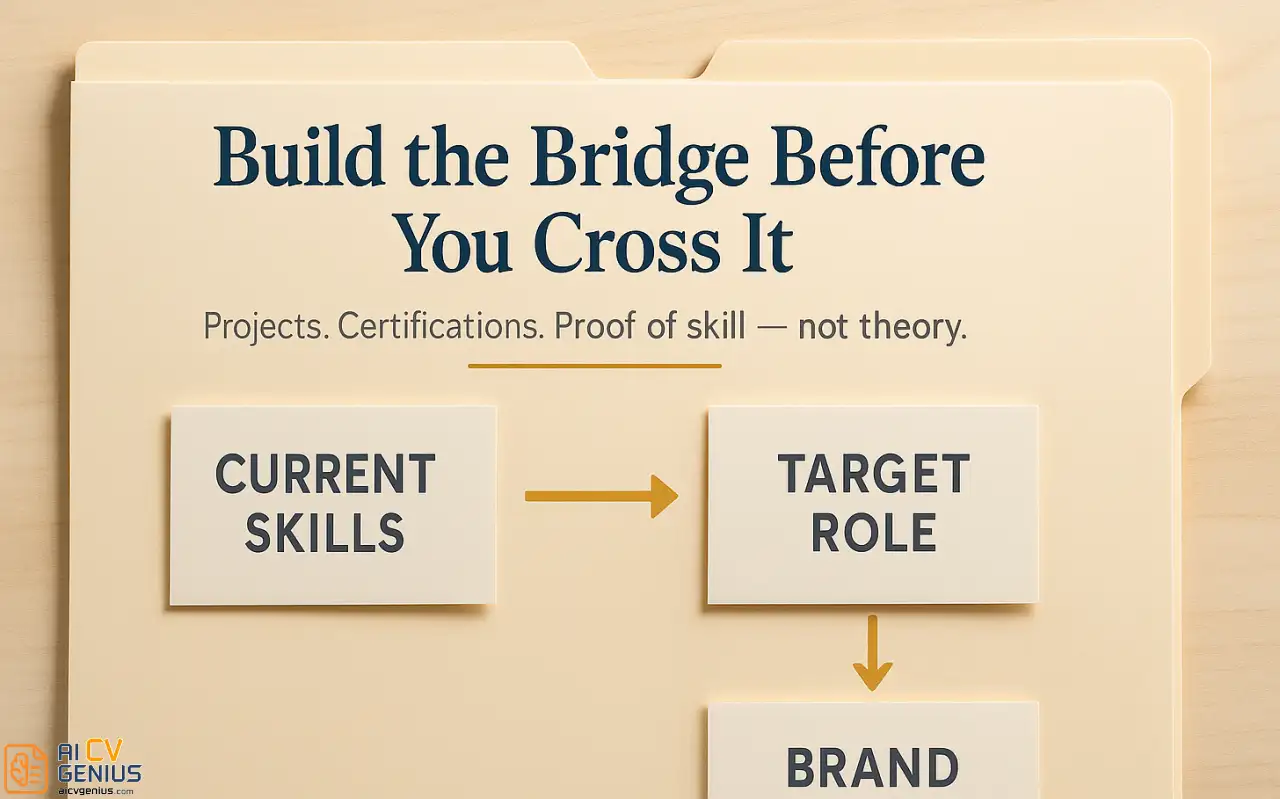
You’ve confirmed your target career. You know the reality. Now you have a “skill gap”: the bridge between the skills you have and the skills you need. Do not quit your job to “go back to school.” That is the slowest, most expensive, and riskiest way to do it. You must build your bridge while still on the “safe” side of the canyon (i.e., while still employed).
How to Build Experience Without Quitting Your Job
Employers do not care about a degree. They care about evidence. They want to see you can do the work. Here’s how you get that evidence.
- 1. “Intrapreneurship” (The Internal Move): This is the #1 best way. Find a project at your current company that lets you build your target skill. Ask to join the UX team’s next sprint. Offer to help the data team with a report. This way, you are getting paid to learn.
- 2. High-Skill Volunteerism (The Nonprofit “In”): Do not just offer to “help out.” Offer your specific skills. “I’m a project manager, and I’d like to offer 5-10 hours a week to help you manage the logistics for your upcoming annual gala.” This gives you a real project, real results, and a powerful portfolio piece.
- 3. The Micro-Freelance Project (The “Get Paid to Learn” Model): Go on Upwork or find a small local business. Offer to do a small, defined project for a low price (or even for free). “I’ll redesign your 3-page website for $500.” You’re not doing it for the money. You’re doing it for the portfolio piece and the testimonial.
- 4. Strategic Certifications (The Keyword): Only get certifications that hiring managers actually search for. (e.g., PMP for Project Management, AWS for Cloud, Salesforce Administrator, Google Analytics/Ads). These are “keywords” that get your new resume past the automated filters.
Your goal is to have 2-3 tangible projects you can put on your new resume. A resume with “3 projects” is infinitely stronger than one with “0 experience.”
Step 4: Rebrand Your Narrative (Resume & LinkedIn)
You now have the skills and the projects. It’s time to rewrite your story. You are no longer a “Marketing Manager.” You are a “Marketing professional pivoting into UX Design, leveraging 10 years of customer empathy to build user-centric products.”
Your resume and LinkedIn profile must reflect where you are going, not just where you have been. This is crucial to pass the 6-seconds-resume-rule.
The Career Change Resume Formula
- 1. The “Pivot” Summary: Your summary is now the most important section. It must tell the story in 3 lines.Example: “Data-driven Marketing Manager making a strategic transition to Data Science. Leveraging 8+ years of experience in analyzing customer behavior (SQL, Python) to build predictive models. Recently completed 3 projects in machine learning and data visualization.”
- 2. A “Key Projects” Section: Create a new section at the top of your resume, right below your summary. List your 2-3 new projects (from Step 3) with bullet points showing the results.
- 3. Translate Your Old Experience: Go through every bullet point of your old jobs and rewrite them using the language of your new career.• Old: “Managed a team of 5 sales reps.”• New (for a PM role): “Led a 5-person cross-functional team, managing stakeholder expectations and driving project timelines.”
For detailed guidance, check out our guide on how to write a career change resume and learn why ‘responsible for’ kills your resume.
Update Your LinkedIn Headline
Your headline is your personal search-engine-optimization.
• Old: “Senior Account Manager at XYZ Corp”
• New: “Senior Account Manager | Aspiring Product Manager | Certified Scrum Master (CSM) | Building User-Focused Solutions”
This shows recruiters both what you are and what you’re targeting.
Step 5: Activate Your Network (The “Side Door” Entry)
Here’s a statistic that should terrify you: up to 80% of jobs are never posted publicly. They are filled through referrals. If your entire strategy is applying to job boards, you are fighting 90% of the candidates for 20% of the jobs.
You must get in through the “side door” – a referral from a human being.
How to Network Without Feeling “Gross”
Networking isn’t about “using” people. It’s about “helping” people and building genuine connections. Your goal is not to ask for a job; it’s to ask for advice.
- ✅ Go Back to Your 3 People: Reconnect with the people you had informational interviews with. “Hi [Name], quick update – your advice was so helpful that I went and got my [Certification] and just completed [Project]. I’m now starting my active search, and I was wondering if you had any advice on companies that value [Skill]?”
- ✅ The “Soft Ask”: Post on LinkedIn. “Thrilled to share I’ve just completed my [Certification/Project] as I pivot from [Old Field] to [New Field]! I’m excited to find a team where I can apply my skills in [Skill 1] and [Skill 2]. Open to any advice or connections!”
- ✅ Offer Value First: When you connect with someone, offer them something. “I saw you’re hiring for X, and while I’m not a fit, my former colleague [Name] would be perfect. I’m happy to introduce you.” This builds social capital.
The goal is to be top-of-mind. When a hiring manager says, “I need to hire a junior UX designer,” you want your contact to say, “You know who you should talk to? My friend [Your Name]. They’re pivoting from marketing and just did this incredible project…”
Special Considerations: Age, Money, and Fear
“Is it too late to switch careers at 40 (or 50)?”
No. But how to switch careers at 40 is different. Your strategy is not to “start over.” Your strategy is to “pivot.” You must leverage your 20+ years of experience as an asset, not a liability.
• Your Advantage: You have deep soft skills – managing stakeholders, handling difficult conversations, mentoring, and understanding business – that 25-year-olds do not.
• Your Strategy: Don’t apply for entry-level roles. Apply for mid-level or senior roles that hybridize your old and new skills. (e.g., “Product Marketing Manager” for a tech company, “Head of Operations” for a creative agency). Frame your experience as a unique combination that makes you more valuable.
“How do I switch with no experience?”
This is what Step 3 is for. “No experience” is a choice. You can get experience before you apply. A single, high-quality freelance or volunteer project (as detailed in Step 3) instantly transforms you from “zero experience” to “a professional with project experience.”
What are the best jobs for career changers?
The jobs for career changers that are most “porous” are those that:
1. Are in high demand (tech, healthcare, skilled trades).
2. Value transferable skills (sales, customer success, project management).
3. Are project-based (UX design, content writing, data analysis), where your portfolio matters more than your degree.
Examples: Customer Success Manager (from account management), Project Manager (from any ops role), UX/UI Designer (from graphic design/marketing), Data Analyst (from finance/marketing).
Your Career Change Checklist
Use this career change checklist to stay on track. This is a 6-18 month process. Be patient.
| Phase | Action Item | Status |
|---|---|---|
| 1. Discover | Complete the 4-List “Career Autopsy” | ☐ |
| Identify 2-3 potential career paths | ☐ | |
| 2. Validate | Conduct 3+ informational interviews for Path #1 | ☐ |
| Decide to “Proceed” or “Test Next Path” | ☐ | |
| 3. Build | Complete Skill Gap Analysis for chosen path | ☐ |
| Complete 2-3 “Transition Bridge” projects | ☐ | |
| Get 1-2 new certifications (if strategic) | ☐ | |
| 4. Rebrand | Create a “Key Projects” section for resume | ☐ |
| Rewrite resume summary and bullet points | ☐ | |
| Update LinkedIn headline and “About” section | ☐ | |
| 5. Launch | Share your journey/projects on LinkedIn | ☐ |
| Follow up with informational interview contacts | ☐ | |
| Start applying (target 20% online, 80% network) | ☐ |
Frequently Asked Questions
You Are Not Starting Over. You Are Pivoting.
Learning how to switch careers is not about throwing your past in the trash and starting from scratch. That’s a rookie mistake. Every single year of your experience – every difficult boss, every boring project, every success and failure – is valuable.
You’re not starting over. You’re leveraging. You’re building on a 10, 20, or 30-year foundation of professional skills. You’re not becoming a “beginner.” You are becoming a highly experienced professional who is adding a new technical specialty.
Yes, it will be uncomfortable. Growth is always uncomfortable. But staying in a job that makes you feel dead inside is also uncomfortable – it’s just a slow-burn discomfort that leads to regret. One type of discomfort is the pain of growth. The other is the pain of stagnation. Choose your discomfort.
Start today. Not tomorrow. Send one email for an informational interview. Do the 4-List exercise. Small, consistent actions are what build a bridge to a new career. Your future self will thank you for it.
Ready to take the first step? Start by updating your application materials with our guide on career resources.