
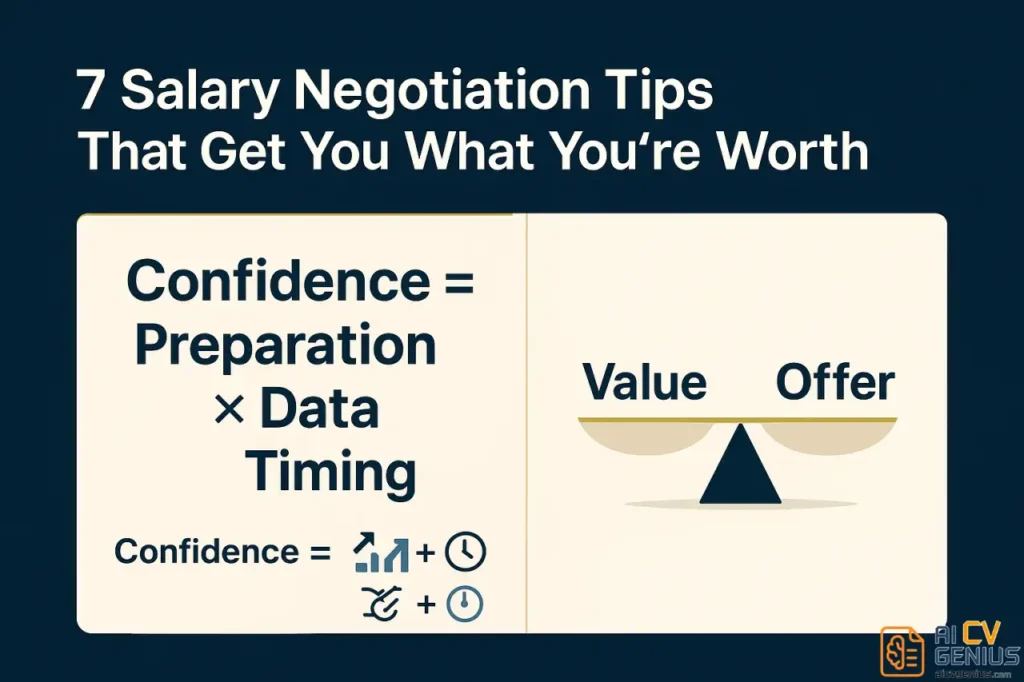
- Protect your leverage: Don’t give the first number, deflect and ask for their budgeted range.
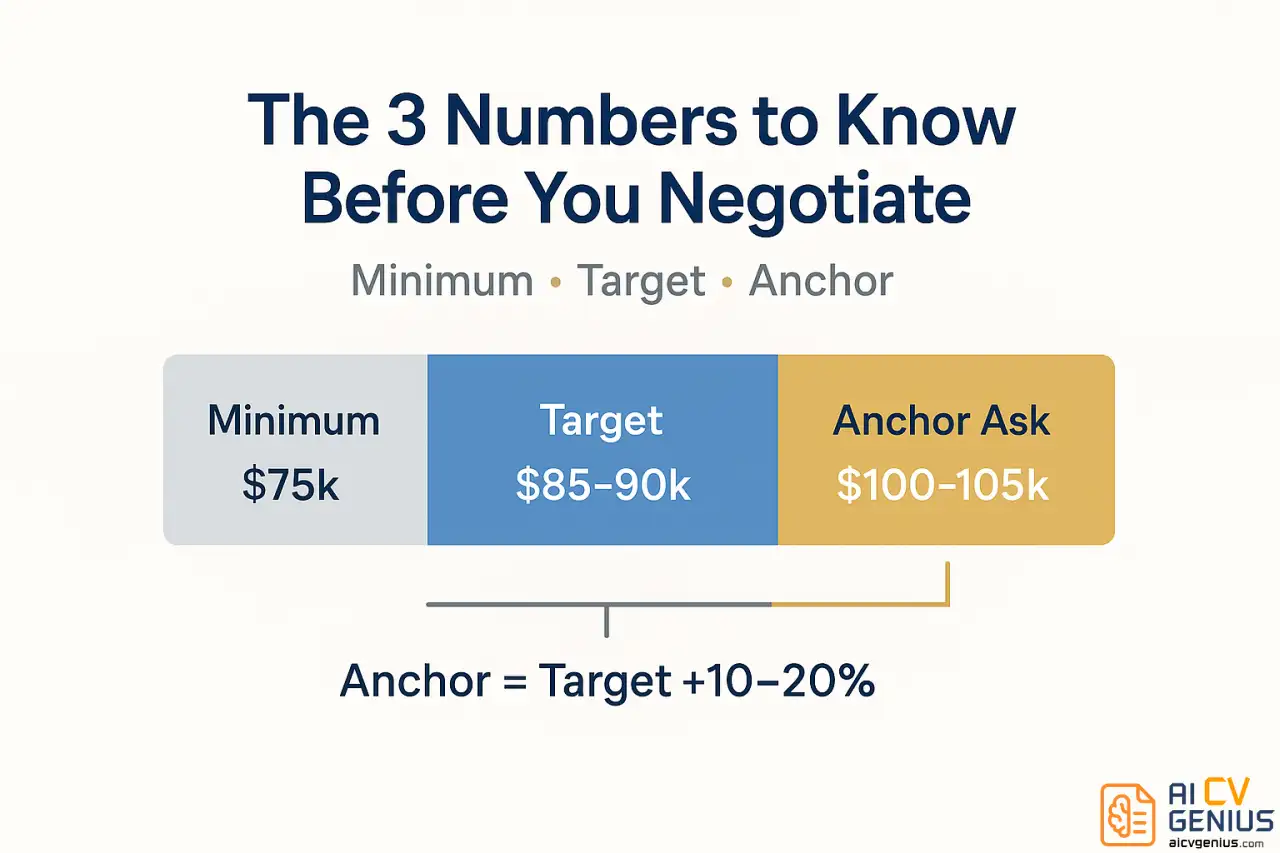
- Prepare with data: Research market pay, then set three numbers, Walk away, Target, And a high Anchor ask.
- Use the pause: Thank them, request 24 to 48 hours, and review total compensation, not just base salary.
- Counter like a pro: Send an evidence based email that ties your ask to market rates, role priorities, and quantified wins.
- Negotiate beyond salary: If base is firm, push for signing bonus, PTO, flexibility, earlier review, or title, and walk away from toxic pressure tactics.
You see the email. Subject: “Your Offer from [Company Name]”. Your heart does a kick-flip. You open it, scan past the pleasantries, and there it is: the salary. The number. Your first instinct, flooded with relief and excitement, is to fire back an email screaming, “Yes! I accept!” But wait. Pause. Breathe. That number, sitting innocently on your screen, is almost never the final number. It’s the starting number. If you accept it without a conversation, you are likely leaving thousands of dollars on the table – money that compounds, year after year, over your entire career. These salary negotiation tips 2026 are not just suggestions; they are a strategic framework designed to help you ask for – and get – what you are worth, without sounding greedy, arrogant, or jeopardizing the offer.
The fear of negotiation is real, but it’s also incredibly costly. Research from Harvard and other institutions consistently shows that a vast majority of employers (over 80-85%) not only expect you to negotiate but have budgeted for it. They are often more impressed by candidates who negotiate, as it signals confidence and an understanding of their own value. Yet, studies also show a staggering gap: while most who negotiate get something, a huge percentage of professionals (especially women and new graduates) never even try.
This gap isn’t about qualifications or worth. It’s about confidence and, more importantly, possessing a proven strategy. This guide is your new playbook. We will move beyond vague advice and into the specific psychology, proven tactics, and word-for-word scripts that work in today’s complex hiring market. Forget what you think you know; it’s time to learn how to do this right.
Tip 1: Master the Art of Deflection (Never Say the First Number)
This is the cardinal, unbreakable, golden rule of salary negotiation: whoever mentions a specific number first, loses leverage. This is a fundamental concept in negotiation theory called “anchoring.” The first number on the table becomes the psychological anchor for the rest of the conversation. Every other number is then viewed in relation to that anchor.
Here’s how this trap works in practice, and why it’s so damaging:
- ️Scenario A (You lowball yourself): A recruiter asks, “So, what are your salary expectations?” You, wanting to seem reasonable, say $80,000. The problem? Their approved budget for the role was $90,000 to $100,000. You have just single-handedly cost yourself a minimum of $10,000 per year. They will not correct you; they will happily accept your $80k offer or, at best, “generously” offer $82,000.
- ️Scenario B (You highball yourself): In the same scenario, you say $110,000, not knowing their cap is $100,000. Now, you risk appearing out of touch or too expensive, potentially ending the conversation before they’ve fully recognized your value. You’ve created a barrier.
Your goal, especially early in the interview process, is to politely but firmly deflect this question. You are not being difficult; you are being a strategic professional gathering information. Your aim is to get them to anchor the conversation.
Field-Tested Scripts for Deflection (Memorize These):
When asked, “What are your salary expectations?” or “What are you currently earning?”:
- ✅ The Collaborative Flip: “That’s a great question. I’m sure you have a competitive range budgeted for this position, and I’d love to learn more about that. What range did you have in mind for a strong candidate?”
- ✅ The “Full Package” Deflection: “My salary requirements are flexible and really depend on the entire compensation package – things like benefits, bonus potential, and remote work flexibility. To make sure we’re aligned, could you tell me the approved range for this role?”
- ✅ The “Focus on Fit” Deflection: “Right now, my top priority is making sure I’m the perfect fit for this role and [Company Name]’s team. Once we’ve both confirmed that, I’m confident we can agree on a salary that’s fair and competitive. What range is budgeted for this position?”
Notice the pattern: you are always polite, professional, and end by asking for their range. Practice saying these out loud. They work.
What to Do If They Are Aggressively Persistent
Some recruiters or old-school hiring managers will push back hard, saying, “I really need a number from you to move forward,” or “The system requires me to enter a number.” Don’t panic. You still don’t have to give a single number. Instead, you give a well-researched range, and you anchor it high.
“I understand. Based on my research for this type of role, my level of experience [mention a key skill], and the market rates here in [Location], similar positions are compensating in the $95,000 to $115,000 range. Is that consistent with the range you have budgeted?”
This does several things:
1. It shows you’ve done your homework (see Tip 2).
2. The bottom of your range ($95,000) should be at or slightly above your actual target salary, not your “walk away” minimum.
3. It still ends with a question, keeping the conversation collaborative.
If you’re making a significant career change, this part is even more critical. Your past salary is irrelevant. Your future value is what matters. Our guide on writing a career change resume can help you frame that value long before you get to the negotiation stage.
Tip 2: Do Your Homework (Negotiation is Won in Preparation)
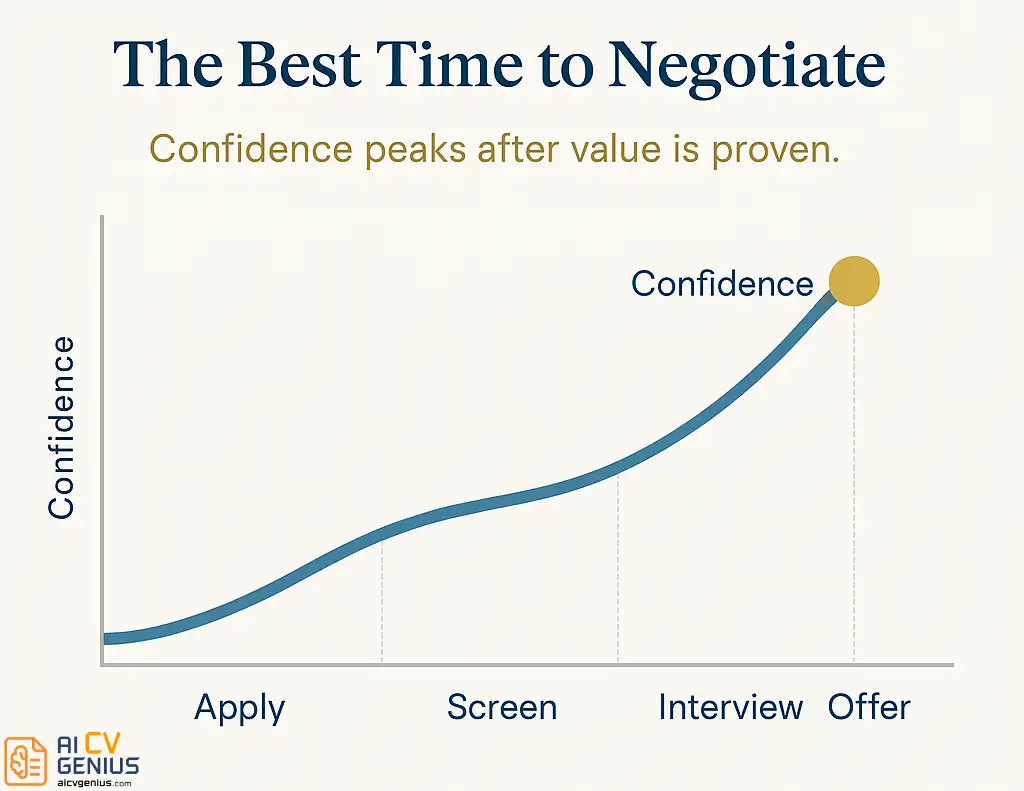
You cannot, and must not, enter a negotiation without data. “Feeling” like you’re worth $90,000 is useless. Knowing you’re worth $90,000 is leverage. Your confidence to ask for more money comes directly from the research you do beforehand. This is the single most important step.
Your goal is to build an objective, evidence-based case for your value. Here’s how:
- 1️⃣ Use Online Data Aggregators: These are your starting point.
- Glassdoor: Good for company-specific data and reported salaries for specific titles at that company.
- Payscale: Excellent for filtering by years of experience, location, industry, and specific skills.
- Levels.fyi: The non-negotiable standard for tech roles. It provides granular breakdowns of base salary, stock options (RSUs), and bonuses.
- Bureau of Labor Statistics (BLS): Official government data. It’s often broad and slightly dated, but it’s an indisputable source for median wages by occupation and region.
- 2️⃣ Conduct Informational Interviews (The Secret Weapon): Data from websites is good. Data from people is better. Find people on LinkedIn who have the title you want, in the industry and location you’re targeting. Send a message like: “Hi [Name], I’m currently exploring a [Role Title] role in [City] and deeply respect your experience at [Their Company]. Would you be open to a brief chat? I’m trying to get a better sense of the current market compensation for this type of position.” You will be shocked at how many people are willing to share a “typical range.”
- 3️⃣ Analyze the Job Description: The company tells you what they value most. If the job description mentions “PMP Certification Required” and “Salesforce expertise a must,” and you have both, those are specific leverage points that put you at the higher end of any salary band.
- 4️⃣ Factor in Cost of Living: If you’re moving from a low-cost-of-living area to a high-cost one, your previous salary is irrelevant. Use a “Cost of Living” calculator (like NerdWallet’s) to understand what your equivalent salary would be.
After this research, you must identify three critical numbers:
| Number Type | What It Means | How to Determine It |
|---|---|---|
| 1. Your Walk-Away Point | The absolute minimum you will accept (base salary + benefits). If the final offer is below this, you must be prepared to decline. | Based on your non-negotiable financial needs, cost of living, and personal budget. You never, ever reveal this number. |
| 2. Your Target Salary | The realistic, data-backed number you believe you are worth. This is the goal you’re happy with. | This should be the 50th-75th percentile of your research, adjusted for your specific skills and experience. |
| 3. Your “Anchor” Ask | The initial number you will state in your counter-offer. This is the high anchor you set. | This should be 10-20% above your Target Salary. This gives you room to be “negotiated down” and still land at or above your target. |
Example:
Your budget shows your Walk-Away is $75,000.
Your research shows the market Target is $85,000 – $90,000.
Therefore, your initial “Anchor” Ask should be ~$100,000 – $105,000.
This preparation is your armor. It’s what allows you to stay calm and objective. This is just one part of a larger job-seeking strategy, which you can explore in our career resources for job seekers.
Tip 3: The “Thank You and Pause” Technique (Your 24-Hour Shield)
The offer comes in, likely over the phone. Let’s say it’s $82,000. You’re disappointed; you were targeting $90,000. Your immediate instinct is a fight-or-flight response: either you accept out of fear (“Oh, okay, that sounds fine!”) or you react defensively (“That’s a lot lower than I was expecting…”). Do neither.
Your first move is to deploy the “Thank You and Pause” technique. This is a critical psychological tool that shifts the pressure off you and gives you the space to become strategic.
The Script (On the Phone):
Hiring Manager: “We’re so excited to offer you the position with a starting salary of $82,000.”
You: (Sound genuinely enthusiastic and appreciative) “That’s fantastic news! Thank you so much for the offer. I’m really excited about the opportunity to join the team and work on [Specific Project].”
(Now, the pause and request for time)
You: “This is a big decision, and I want to give it the thorough consideration it deserves. Could I have 24-48 hours to review the full compensation package in detail? I’d be happy to schedule a follow-up call for tomorrow afternoon to discuss.”
No legitimate employer will ever have a problem with this. If they do, that’s a massive red flag. This pause achieves several crucial things:
- It prevents an emotional reaction. You cannot negotiate effectively when you’re surprised, disappointed, or overly excited.
- It signals you’re a serious professional. You are thoughtful and deliberate, not impulsive or desperate. This subconsciously increases your value.
- It gives you time to strategize. Now you can sit down, look at your research, and analyze the total compensation.
Analyzing Total Compensation (What to Do in Your 24 Hours)
During your pause, you’re not just thinking about the base salary. You must analyze the entire offer. Sometimes a lower base is offset by incredible benefits, or a high base is a trap for a terrible benefits package.
Look for:
• Health Insurance: What are the premiums, deductibles, and co-pays? A high-deductible plan could cost you $5,000+ more per year than a good PPO.
• Retirement: Is there a 401(k) or 403(b) match? A 6% match on an $82,000 salary is an extra $4,920 in free money.
• Bonus Structure: Is there a guaranteed bonus? A performance-based bonus? What has the actual payout been for the last few years?
• Paid Time Off (PTO): How many weeks? What are the sick day and holiday policies? An extra week of PTO is worth nearly 2% of your salary.
• Equity: (For startups/public companies) Are there stock options or RSUs? What is the vesting schedule? (This is a complex topic – see our FAQ).
• Other Perks: Professional development stipend, remote work allowance, wellness benefits, commuter benefits. These all have a real dollar value.
Only after you’ve valued the total package can you craft your counter-offer (Tip 4). The pause gives you the time to do this right.
Tip 4: Build Your Case (Justify, Don’t Demand)
You’ve done your research. You’ve analyzed the total package. Now it’s time to make your counter-offer. The most common mistake people make here is simply stating a number. “I’d like $90,000.” This is weak. It’s a demand, not a proposal. It invites a “no” because you haven’t given them a “why.”
Your counter-offer must be a concise, confident, and evidence-based business case for why you are worth the higher number. You must tie your request directly to value.
Your justification should be a 2-3 part argument:
- Market Value: “My research indicates that the market rate for this role, for someone with my qualifications in [Location], is…”
- Your Specific Value: “Beyond the market rate, I bring specific experience in [Key Skill 1] and [Key Skill 2], which were high priorities in the job description…”
- Your Past Performance: “…for example, in my last role, I [Quantifiable Achievement, e.g., ‘grew my territory by 30%’ or ‘automated a process that saved 10 hours a week’].”
This turns the conversation from “what I want” to “what I am worth.”
This case is best presented in a clear, professional email. This gives you the power to state your case perfectly, without being interrupted, and it provides a written record.
Here is a detailed, effective email script based on our example. This is how to negotiate salary after a job offer in a way that gets results.
Subject: Re: Job Offer – Marketing Manager Position
Dear Sarah,
Thank you again for the offer to join the team as Marketing Manager. After our conversations, I’m even more excited about the opportunity and confident I can help [Company Name] achieve its goals, especially regarding [specific company goal you discussed].
After reviewing the full compensation package and comparing it with my research, I would like to propose a starting base salary of $89,500.
This figure is based on a few factors:
1. Market Alignment: My research on Glassdoor, Payscale, and industry reports shows the competitive market rate for a Marketing Manager in [Location] with my 5+ years of experience is typically in the $88,000 – $96,000 range.
2. Specific Expertise: The job description places a strong emphasis on HubSpot automation and demand generation. In my current role, I led the entire HubSpot migration and built a lead-nurturing workflow that increased marketing-qualified leads by 40% in six months.
3. Past Performance: Beyond that, I also managed a content campaign that reduced our customer acquisition cost by 22% year-over-year.
I am very enthusiastic about this role and know I can deliver significant value from day one. I am also open to discussing other aspects of the total compensation, such as a performance bonus or a one-time signing bonus, to reach an agreement that is fair and works for both of us.
Thank you again for your time and for this wonderful opportunity. I look forward to hearing from you.
Best,
[Your Name]
This email is powerful because it is:
• Grateful: It starts and ends with appreciation.
• Collaborative: It uses language like “propose” and “discuss.”
• Data-Backed: It cites market research.
• Value-Driven: It links directly to their job description and provides a hard, quantifiable metric (40% MQL increase).
• Confident: It asks for a specific, non-rounded number ($89,500 sounds more calculated and less arbitrary than $90,000).
• Flexible: It opens the door to negotiate perks (Tip 6).
For more examples of professional, persuasive writing, see our guide on writing cover letters that stand out.
Tip 5: A Second Plug-and-Play Email Template
Here is another powerful salary negotiation email sample 2026. This one is slightly different – it’s for a scenario where the base offer is close to your target, but you want to use a competing offer or your unique skillset to get a final “bump” and secure some perks.
Subject Line: Re: [Job Title] Offer – [Your Name]
Dear [Hiring Manager’s Name],
Thank you so much for extending the offer for the [Job Title] position. I truly enjoyed our conversations and was particularly excited by [mention something specific from the interview, e.g., “the plan for the new product launch”].
I’ve had time to review the offer of $[X]. It’s a strong offer, and I am very appreciative.
Given my unique background in [Your Specific Niche Skill, e.g., “enterprise-level FinTech compliance”] and my track record of [Your Key Achievement, e.g., “passing three consecutive regulatory audits with zero citations”], I was hoping for a base salary closer to $[Y – Your Anchor Ask]. This figure is more in line with my advanced certifications and the market value for this specific skillset.
(Optional: If you have another offer): This also aligns more closely with another offer I am currently considering. However, I want to reiterate that [Company Name] is my first choice, and I am confident we can find a way to bridge this gap.
I am flexible in how we get there. If the base salary is firm, I would be very open to discussing a one-time signing bonus of $[Z] or an additional week of PTO to make the total package align with my expectations.
Thank you again for your time and for this fantastic opportunity. I am very eager to make this work.
Sincerely,
[Your Name]
This template is effective because it justifies the ask based on niche skills (not just general market rate) and immediately shows flexibility by offering alternative solutions (signing bonus, PTO), making it easy for the manager to say “yes” to something.
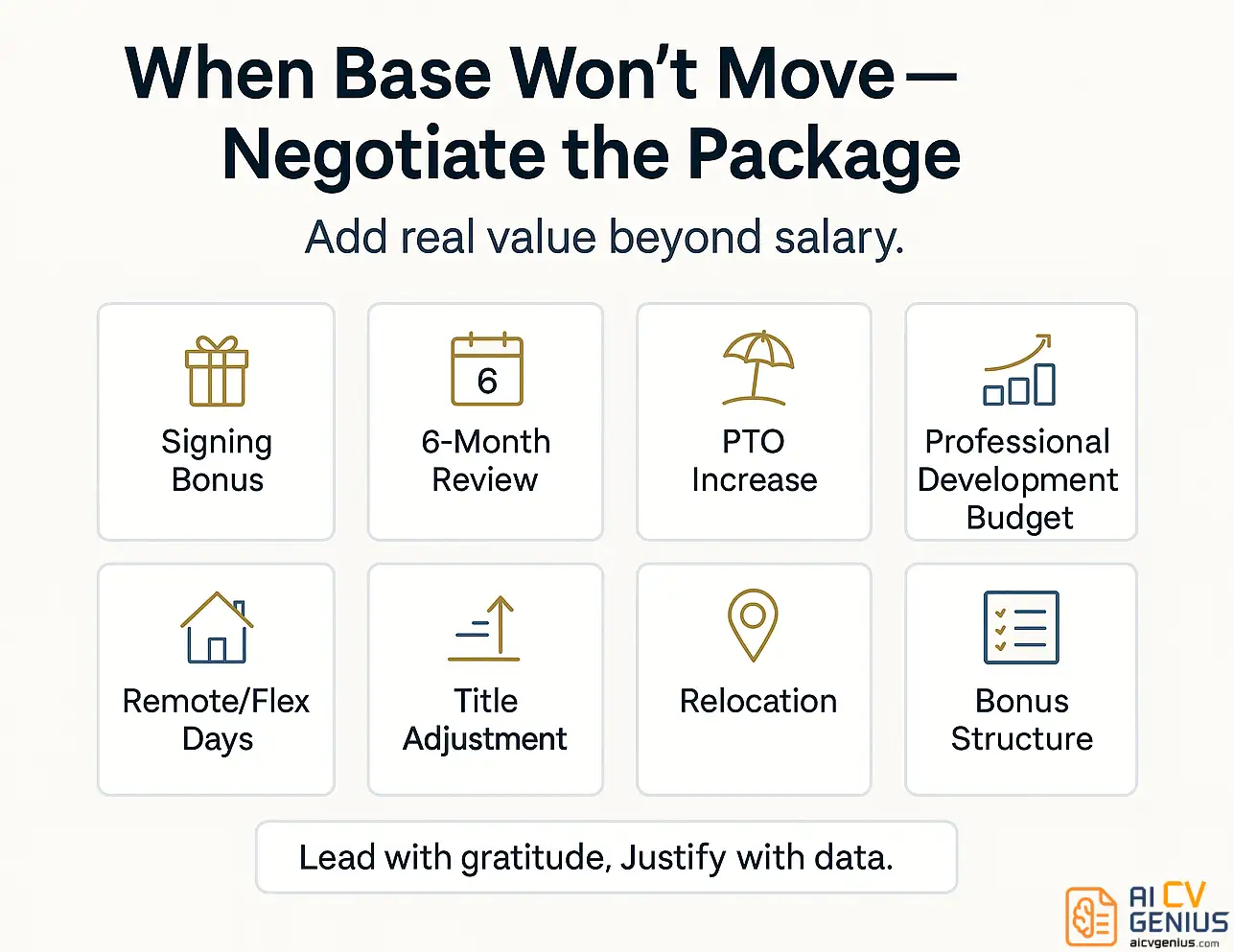
Tip 6: Negotiate the Total Package (When the Base Won’t Budge)
You’ve sent your counter. The hiring manager calls you back and says, “We’d love to have you, but our hands are tied. The base salary of $82,000 is the absolute maximum for this pay grade. I can’t go any higher.”
This is not a “no.” This is an invitation to negotiate other things. Do not hang up. Pivot immediately.
The Pivot Script (On the Phone):
“I understand completely and I appreciate you checking on that. I’m still very excited about the role. Given that the base salary is firm, would there be flexibility on other parts of the compensation? I’d love to discuss a few things that could help us bridge the gap.”
Now, you open a discussion on a menu of valuable, non-salary items. These are often in different budgets and are much easier for a manager to get approved.
Your Negotiation Menu (Have this list ready):
- Signing Bonus: “Could we do a one-time signing bonus of $5,000 or $10,000 to offset the difference in base?” (This comes from a one-time budget, not recurring payroll.)
- Professional Development: “What is the annual budget for professional development? Could we get a guaranteed $3,000 per year in writing for certifications and conferences?”
- Earlier Review: “I’m confident I can hit the ground running. Would you be open to a formal performance and salary review at 6 months instead of the standard 12?” (This gets you a raise faster.)
- Additional Vacation Time: “Could we increase the PTO from 2 weeks to 3 weeks?” (This has a high lifestyle value and is often easy to grant.)
- Remote Work / Flexibility: “Can we put in writing that this role is approved for 3 days remote per week?” (This saves you real money on commuting and food.)
- A Title Bump: “If the salary is firm for a ‘Manager’ role, could we adjust the title to ‘Senior Manager’ to better reflect my experience?” (This costs them nothing and gives you huge leverage for your next job.)
- Relocation Assistance: If you’re moving, this is a standard ask. Ask for a specific amount to cover movers and travel.
Often, you can add $5,000 – $15,000 in real value to your offer just by negotiating these perks. If you’re new to an industry, understanding what’s standard is key. Our resume templates by industry can provide clues on what different fields value.
Tip 7: Be Willing (and Know When) to Walk Away
Your greatest source of power in any negotiation is your willingness to walk away from a bad deal. This doesn’t mean you should be arrogant or quick to decline. It means you must have a clear understanding of your “Walk-Away Point” (from Tip 2) and the self-respect to honor it.
If you’ve negotiated politely, provided data, shown flexibility, and the employer still refuses to budge on a final offer that is significantly below your market value and your minimum needs, you must decline.
Accepting a lowball offer does more than just hurt your finances this year. It re-sets your entire career’s earning potential at a lower level. Your next job will likely base their offer on your current (low) salary, and the gap will compound over decades, costing you hundreds of thousands of dollars.
Negotiation Red Flags (Signs of a Toxic Culture):
Sometimes, the negotiation itself tells you not to take the job. Be wary if the employer:
• Rescinds the offer: A company that pulls an offer over a polite, professional negotiation request is not a place you want to work. You dodged a bullet.
• Uses “Exploding Offers”: “We need an answer in the next 24 hours, or the offer is off the table.” This is a high-pressure tactic designed to prevent you from researching or getting competing offers.
• Is Dismissive or Aggressive: If they mock your request, belittle your research, or make you feel greedy for asking, imagine how they’ll treat you when you ask for a raise or have a disagreement about a project.
• Is Incredibly Vague: “The bonus is ‘discretionary’ and ‘up to 20%.'” Ask them: “What was the actual, average payout for this role over the last three years?” If they can’t answer, assume the bonus is $0.
How to Decline Professionally (and Keep the Door Open):
Subject: Re: Job Offer – [Job Title]
Dear [Hiring Manager’s Name],
Thank you again for your time and for offering me the [Job Title] position. I’ve genuinely enjoyed our conversations and am very impressed with [Company Name].
After careful consideration of the full compensation package, I have decided to decline the offer at this time. While this was a difficult decision, the final offer does not align with my salary requirements for my level of experience.
I truly appreciate you taking the time to speak with me. I wish you and the team all the best in finding the right candidate, and I hope our paths cross again in the future.
Best regards,
[Your Name]
This is polite, firm, and professional. It leaves the door open. It’s not uncommon for a company to come back 24 hours after a polite decline with a new, higher offer.
The Flip Side: When to Accept Enthusiastically
Negotiation is not a requirement. If an offer meets or exceeds your Target Salary (from Tip 2) and includes a strong benefits package, it is perfectly acceptable and often a great move to accept with enthusiasm. You don’t have to negotiate just for the sake of it, especially if the offer is already fair and respectful of your value.
5 Salary Negotiation Mistakes That Kill Your Leverage
Strategy is useless if you sabotage yourself with a simple mistake. Avoid these at all costs:
- ❌ Mistake 1: Negotiating Before You Have the Written Offer. Never negotiate based on a verbal “we’d like to offer you…” conversation. Always get the full, official offer in writing first (Tip 3). A verbal offer isn’t real, and all the details (benefits, bonus) aren’t confirmed.
- ❌ Mistake 2: Making It Personal. Never justify your ask with personal reasons. “I need $90,000 because I have high student loans,” “My rent is expensive,” or “I have a family to support.” Your personal finances are not the employer’s concern. Your justification must be 100% about your professional value (market rate, skills, performance).
- ❌ Mistake 3: Getting Emotional or Aggressive. This is a business conversation, not a personal fight. If you get defensive, angry, or entitled, you lose. You are simultaneously auditioning for the role of “future colleague.” Be calm, collaborative, positive, and firm.
- ❌ Mistake 4: Negotiating Against Yourself. This is a common panic move. You say, “I’d like $95,000,” the manager is silent for a second, and you panic and say, “…but I could do $90,000, or maybe $88,000.” Never. State your number, then stop talking. Let them be the next one to speak.
- ❌ Mistake 5: Negotiating After Accepting. Once you have formally, in writing, accepted an offer (“I accept your offer of $82,000…”), the negotiation is over. Going back a day later and saying, “Actually, I’d like to ask for more” is unprofessional and can get your offer rescinded. Do all negotiations before you say “I accept.”
Confidence is key. If you’re worried about this part, our guide on interview preparation has tips on building and projecting confidence.
Advanced FAQ: Your Toughest Negotiation Questions Answered
Final Thoughts: You Don’t Get What You Deserve – You Get What You Negotiate
The uncomfortable truth about salary negotiation tips 2026 is this: your qualifications don’t automatically translate into fair pay. Most companies are not trying to pay you “the most you are worth”; they are trying to hire you for “the lowest number you will agree to.” That is the simple reality of business. If you do not negotiate, you are volunteering to be underpaid.
But negotiation does not have to be a scary, adversarial conflict. It is a conversation about value. When you come prepared with objective market data, a clear business case for your skills, and a positive, collaborative attitude, you are not being “difficult” – you are being a professional. Most employers respect that.
The seven strategies in this guide – mastering deflection, doing meticulous research, using the “thank you and pause,” building your business case, negotiating the total package, and knowing your walk-away point – give you a complete framework that works. Use the email templates. Practice the scripts. Banish the fear that they’ll pull the offer (they won’t).
And remember: every dollar you negotiate now is compounded for the rest of your life. That $5,000 raise you secure today isn’t just $5,000. It’s $5,000 plus every future raise that’s based on it. It’s tens, if not hundreds, of thousands of dollars over your career. You are worth the 15-minute uncomfortable conversation.
Ready to put your negotiation skills to work? Explore our career resources hub for more guides on resumes, interviews, and professional development.