
- Why it matters: A thank-you email is a strategic final impression that signals EQ, follow-through, and reliability when two candidates look similar.
- Core timing and structure: Send within 24 hours and use a tight 5-part flow (Clear subject, Appreciation, Specific hook, Value reaffirmation, Forward-looking close).
- What makes it memorable: Personalize one line with a real detail from the conversation, then connect that detail to how you would help in the role.
- How to adapt by scenario: Write separate emails for panels (Different hooks), keep phone-screen notes shorter, and match tone for creative or informal teams without getting sloppy.
- Smart moves and common traps: Use the note to strengthen a weak answer, follow up by replying in the same thread, respond to rejections to keep doors open, and avoid mistakes like late sending, misspelled names, generic language, pushy asks, or re-attaching your resume.
Introduction: The Strategy of the Thank-You Email
The Interview Isn’t Over When You Walk Out the Door
The interview concludes. You log off the video call or shake hands, feeling a wave of relief. The hardest part is over, right? Not quite. The most overlooked – and often decisive – part of the interview process is just beginning. The thank you email after interview is not a quaint formality or an outdated tradition. It is a critical, strategic tool of professional communication.
In a competitive market, where candidates often have similar skills and experience, the decision can come down to something as subtle as emotional intelligence. Your thank-you note is the first and best piece of evidence you can provide of that intelligence. It is a non-verbal signal that you are thoughtful, organized, respectful, and thorough. It is the final “work sample” the hiring manager reviews before making a choice.
Many candidates skip it. Most who do send one rely on generic, forgettable templates. This is your opportunity. This guide will move beyond simple etiquette and into advanced strategy, showing you how to transform a simple “thank you” from a passive formality into an active, persuasive, and memorable final impression.
“Your resume got you the interview. Your answers proved your skills. Your thank-you email confirms your character.”
The Psychology: Why This Small Gesture Has a Huge Impact
To a busy hiring manager, an inbox is a battlefield of demands, emergencies, and internal politics. Your thank-you note is one of the few messages they will receive all day that asks for nothing, and instead, offers simple, professional appreciation. This act alone makes it stand out.
The Psychology of Recency and Closure
In psychology, the “recency effect” is a cognitive bias where people remember the last item in a series better than the first or middle items. Your interview is a long series of data points. Your thank-you email is the final data point. It is your chance to frame the entire conversation in a positive, professional light. It leaves a lasting, positive flavor and demonstrates that you “close the loop” – a highly valued trait in any colleague.
Furthermore, it shows you understand that hiring is not a transaction; it is the beginning of a relationship. A genuine note shifts the dynamic from “applicant” to “potential colleague.” It demonstrates you are not just focused on what you can get (the job) but also on what you can _give_ (professionalism, respect, and thoughtfulness).
How a Thank-You Note Builds Trust
Hiring is fundamentally an exercise in risk reduction. A manager is betting their reputation, their team’s morale, and their department’s results on a stranger. Every interaction is a clue to your reliability. A prompt, well-written thank-you email is a powerful clue. It subconsciously communicates:
- ✅ Attention to Detail: You spelled their name correctly. You referenced a specific topic. You used professional formatting.
- ✅ Follow-Through: You did what you said you would do (even if unstated). You are dependable.
- ✅ Emotional Intelligence (EQ): You recognized the time and energy they invested and showed appreciation for it.
In a choice between two equal candidates, the one who demonstrated superior EQ and follow-through will win, every single time.
Anatomy of the Email and Core Templates
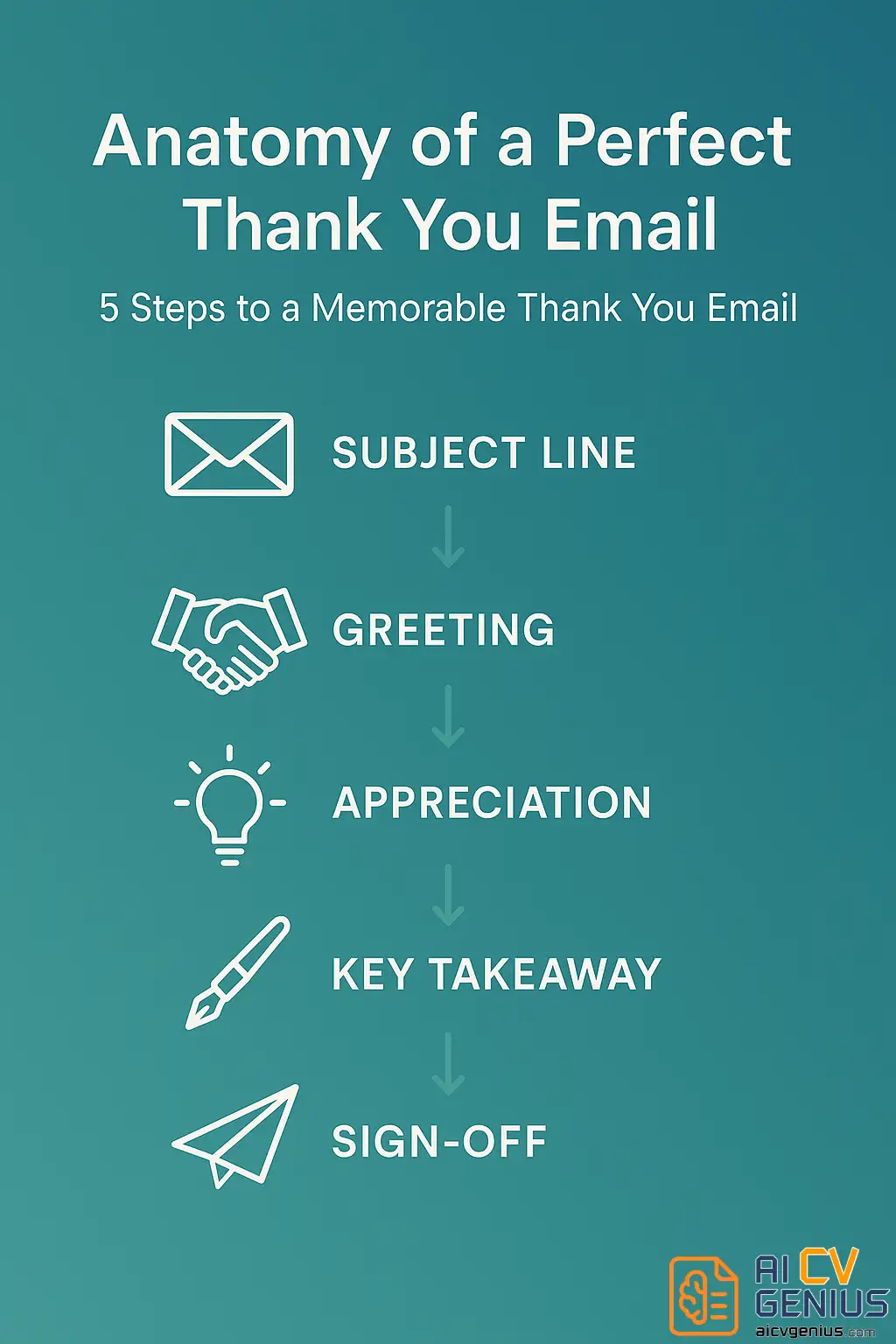
The Anatomy of a Powerful Thank-You Email: A 5-Sentence Structure
Perfection is not the goal; genuine, professional connection is. Long essays feel desperate, while one-line texts feel lazy. This simple, five-part structure is the professional standard for a reason. It is brief, effective, and customizable.
1. The Strategic Subject Line: Clarity and Warmth
The subject line is your email’s “first impression.” It must be clear, professional, and easy for a busy manager to find later. Avoid generic phrases like “Following Up.”
✅Good Examples:
- Thank You – Interview for [Role Name]
- Thank You – [Your Name] & [Interviewer’s Name]
- Great Conversation About [Role Name]
- Following Up on our [Topic] Discussion
- Appreciated Our Conversation Today
❌Bad Examples:
- RE: Interview
- (no subject)
- Thank you!!!!
- Checking in on the [Role Name] job
2. The Opening: Appreciation
Get straight to the point. Use their name (spelled correctly!) and thank them for their time. This shows respect and acknowledges their busy schedule.
Example: “Dear [Name], Thank you so much for taking the time to speak with me today about the [Position] role.”
3. The Hook: A Specific, Personal Connection
This is the most important sentence in your email. It is what separates you from every other candidate. Reference one specific, positive moment from the conversation. This proves you were present and actively listening.
How to find your “hook”:
- Did they mention a specific challenge? (e.g., “I’m still thinking about your point on scaling the customer support system…”)
- Did you discuss a specific company goal? (e.g., “I was particularly excited to hear about the upcoming launch into the European market…”)
- Did you share a laugh or common interest? (e.g., “I really enjoyed our brief chat about [Shared Hobby/Book/Interest]…”)
Example: “I especially enjoyed our discussion about your team’s approach to data-driven content and the success you had with the [Project Name] campaign.”
4. The Reaffirmation: Your Value and Interest
Briefly and confidently, reiterate your enthusiasm for the role. Connect your “hook” back to your own value. This is a subtle, high-level sales pitch.
Example: “Our conversation confirmed my excitement. My experience in [Your Skill] aligns perfectly with that goal, and I am even more eager about the possibility of contributing to your team.”
5. The Closing: A Professional Call to Action
End on a positive, forward-looking note. Do not be pushy. Simply open the door for the next step and sign off professionally.
Example: “Please don’t hesitate to reach out if any additional information is needed. I look forward to hearing about the next steps.”
Professional Sign-offs:
- Best regards,
- Sincerely,
- All the best,
- Warm regards,
Templates and Examples for Every Scenario
A template is a starting point, not a final product. Use these frameworks and adapt the “hook” (Sentence 3) to make them your own.
Example 1: The Classic Format (Post-First Interview)
Subject: Thank You – Great to Meet You Today
Hi [Name],
Thank you so much for taking the time to speak with me today about the [Position] role. I really enjoyed learning about your team’s philosophy on [Specific Topic Discussed] and appreciated your insights on the company’s future goals.
Our conversation confirmed my excitement about the opportunity. My background in [Your Key Skill] feels like a strong fit for the challenges you described, and I am very enthusiastic about the possibility of joining [Company Name].
Please don’t hesitate to reach out if you need any additional information from me.
Best regards,
[Your Name]
Example 2: Following Up with Multiple People (The Panel)
If you were interviewed by a panel of three people, you must send three separate, unique emails. They will compare notes. Sending a group email is a fatal error – it is the definition of impersonal. Sending identical emails is almost as bad.
Your strategy is to use a different “hook” for each person.
Email to Interviewer A (Hiring Manager):
Hook: “I especially valued our conversation about the team’s Q4 goals and your leadership style.”
Email to Interviewer B (Potential Teammate):
Hook: “I really enjoyed our discussion about the day-to-day workflow and the collaborative process between your team and the marketing department.”
Email to Interviewer C (HR/Recruiter):
Hook: “Thank you for sharing the detailed overview of the company’s culture and the onboarding process. I was so impressed by [Specific Program].”
Each email is 90% the same, but that 10% of personalization makes all the difference.
Example 3: After a Phone Screen (Short and Sweet)
A thank-you after a brief phone screen is just as important. It secures your spot in the next round. Keep it shorter and focused on enthusiasm.
Subject: Thank You – [Role Name] Conversation
Hi [Name],
Thank you for the great chat today. I enjoyed learning more about the [Position] role and [Company Name].
My experience in [Key Skill] seems to be a strong match for your needs, and I am very interested in moving forward.
I look forward to hearing about the next steps.
All the best,
[Your Name]
Example 4: For Creative or Informal Roles (Relaxed but Professional)
For startups or creative agencies, you can relax the tone slightly, but do not lose the professionalism. Show you “get” their culture.
Subject: Great Chat Today! (Re: [Role Name])
Hi [Name],
Thanks again for such an engaging conversation. I left the call feeling really energized by your approach to [Company Mission or Project] – it’s rare to see a team blend [Quality A] and [Quality B] so well.
It feels like a fantastic fit for my background in [Your Skill]. I’d be thrilled to contribute to that mission if given the chance.
Best,
[Your Name]
Advanced Strategies and Common Mistakes
Advanced Strategies: Using the Thank-You Email to Your Advantage
This is where you move from “polite” to “strategic.”
Strategy 1: Fixing a Weak Interview Answer (The “Re-do”)
We have all been there. You walk out of an interview and instantly think of the perfect answer to a question you fumbled. Your thank-you note is your one chance to fix it.
Do not apologize or draw attention to the mistake. Simply add a small, confident addendum. Frame it as “further reflection.”
“Hi [Name],
…[Standard thank you and hook]…
I’ve also been thinking more about your question on how I handle [Fumbled Topic]. I was so focused on [Part A] that I forgot to mention a relevant example: In my last role, I [brief, 1-sentence example of what you WISH you had said]. It’s another reason I feel so aligned with this role.
…[Standard closing]…”
This move is incredibly powerful. It replaces the memory of your fumbled answer with a new, stronger one. It also shows humility, self-awareness, and resilience – three things managers crave.
Strategy 2: The Strategic Follow-Up (When You Hear Nothing)
Your thank-you note is “Follow-up #1.” If the timeline they gave you passes (or it has been a week), it is time for “Follow-up #2.” Do not send a new email. Reply directly to your original thank-you note. This keeps everything in one thread and looks organized.
Your tone should be polite, calm, and patient – not desperate or accusatory.
Subject: Re: Thank You – [Role Name] Conversation
Hi [Name],
I hope you’re having a great week.
I’m writing to politely follow up on our conversation last [Day] regarding the [Position] role. I remain very interested in the opportunity and am eager to hear about any updates on the timeline.
Please let me know if there is anything else I can provide.
Best regards,
[Your Name]
If another week passes after that, you can send one final “closing the loop” email, which politely withdraws you from consideration and wishes them well. This often triggers a response and leaves the relationship on a positive, professional note.
Strategy 3: Replying to the Rejection Email (The Long-Term Play)
You got the “no.” Your instinct is to archive it and feel disappointed. The professional move is to reply.
Why? Because the hiring world is small. That manager may have another opening in six months, or move to a different company and remember you. Your gracious reply costs you nothing and builds a bridge.
Subject: Re: Your Application for [Role Name]
Hi [Name],
Thank you for letting me know, I appreciate the update.
While I’m disappointed, I truly enjoyed our conversation and learning about [Company Name]. I was so impressed with [Specific Thing] and wish you and the team all the best in finding the right candidate.
Please keep me in mind for any future roles that may be a good fit.
Sincerely,
[Your Name]
I have personally seen this exact email lead to a job offer 3-6 months later. It is the ultimate act of professional maturity.
Common Mistakes That Ruin a Good Email
Avoid these common traps that turn a good gesture into a negative signal.
| The Mistake | Why It’s Bad | The Fix |
|---|---|---|
| Waiting Too Long (2+ Days) | Shows a lack of enthusiasm or poor time management. The “recency effect” is lost. | Send it within 24 hours. If you miss the window, “better late than never” still applies. |
| Spelling Names Wrong | The fastest way to look sloppy and disrespectful. “If they can’t spell my name, will they misspell a client’s?” | Double-check their name from their email or LinkedIn. Triple-check it. |
| Being Too Generic | “Thank you for your time.” A generic note feels like an obligation, not a genuine connection. | You must include the “hook.” Find one specific, personal detail from the conversation. |
| Using “Corporate Speak” | “I would like to extend my sincerest gratitude for your esteemed consideration.” It sounds robotic and inauthentic. | Write like a human. “Thank you so much for the great conversation today.” |
| Being Too Casual or “Salesy” | “Hey!! I KNOW I’m the perfect fit!” or using emojis/slang. It reads as unprofessional and desperate. | Maintain a “professionally warm” tone. Confident, not arrogant. Enthusiastic, not giddy. |
| Asking “What’s Next?” Too Soon | Your first thank-you is not the place to ask, “So, when will I hear back?” It sounds pushy. | Use the “forward-looking” closing: “I look forward to hearing about the next steps.” |
| Attaching Your Resume (Again) | This is unnecessary clutter. They already have your resume. Do not attach anything unless they specifically asked you to. | Keep the email text-only. The gesture is the message. |
FAQs and Final Thoughts
In-Depth FAQs: Your Toughest Follow-Up Questions
1. Check the calendar invite. Their email is often there.
2. Ask the recruiter. Send a note to your HR contact: “I’d love to send a brief thank-you note to [Interviewer 1] and [Interviewer 2]. Would you be able to share their email addresses or pass along my thanks?”
3. Use LinkedIn. As a last resort, send a brief (non-salesy) connection request with your thank-you in the note.
Final Thoughts: The Interview Is a Story, You Write the Ending
A thank you email after interview isn’t just a strategy – it’s a signal of your character. It tells an employer that you notice the human effort behind the hiring process and that you respect their time. In a world where automation is everywhere, choosing to write a thoughtful, human email is a powerful act of differentiation.
The best candidates don’t just prepare well; they follow up flawlessly. The interview might get you considered, but the thank-you note, with its blend of gratitude and strategy, is often what gets you remembered. And in competitive hiring, being remembered is everything.
If you’d like to refine your communication for other parts of the process, explore how to improve your CV or read why some resumes get ignored. Mastering these small, professional gestures is how you turn opportunities into offers.