
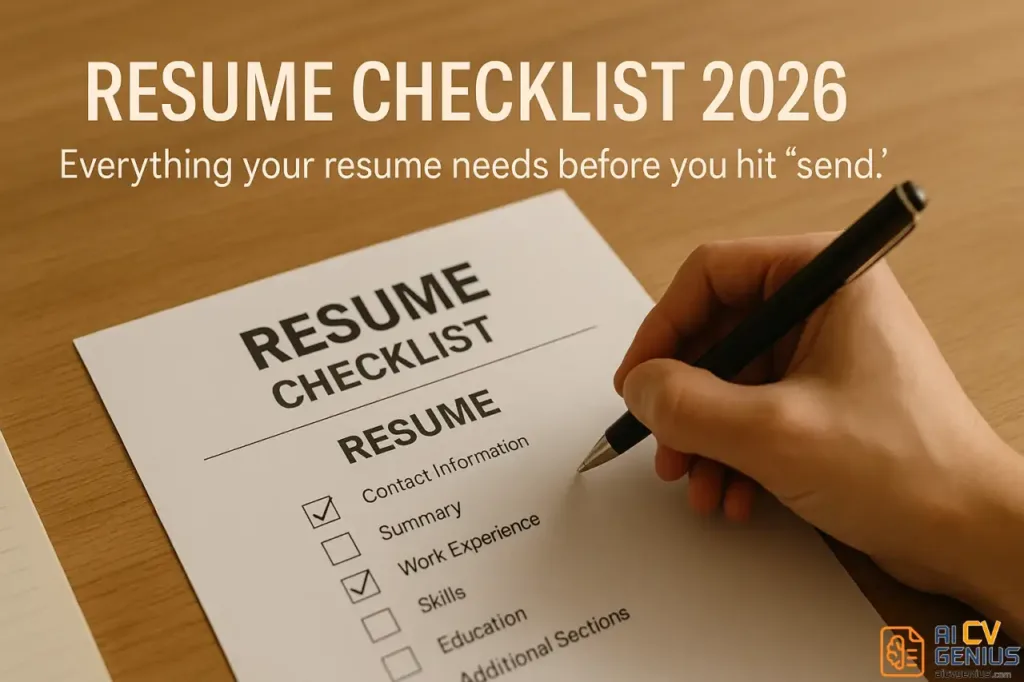
- Start With Targeting: Define the exact role, then pick the 2 to 3 skills your resume must prove.
- Make The Header Trustworthy: Verify contact details, keep location minimal, and only include links you would click yourself.
- Earn The Summary: Write 3 to 4 lines that show proof, then make every experience bullet lead with an action verb and a measurable result.
- Keep It ATS Clean: Tailor skills to the posting, place education based on seniority, and use a simple single-column layout with consistent formatting.
- Do The Final Pass: Proofread hard, align keywords naturally, then run a last pre-submit checklist on focus, format, links, file type, and length.
Why Every Resume Needs a Checklist: Beyond the Obvious
It’s frustratingly easy to overlook minor details when immersed in the complex task of writing your resume. Yet, in the high-speed world of recruitment, those seemingly small details – a typo, inconsistent formatting, a vague achievement – often become the deciding factors between securing an interview and facing silent rejection.
A structured resume checklist 2026 serves as your essential quality control mechanism. It compels you to pause, critically evaluate each component, and ensure every single line actively contributes to your professional narrative. It isn’t about simply adding more content; it’s about rigorously ensuring that the content already present is optimized for maximum impact and clarity.
Imagine walking into an interview with the unshakeable confidence that your resume is polished, strategically aligned, and free from detrimental weak spots. That level of assurance begins with meticulous preparation. This comprehensive guide provides a systematic checklist covering every crucial element – from foundational goal-setting and precise formatting to effective writing techniques and the subtle psychological cues that capture and retain employer interest.
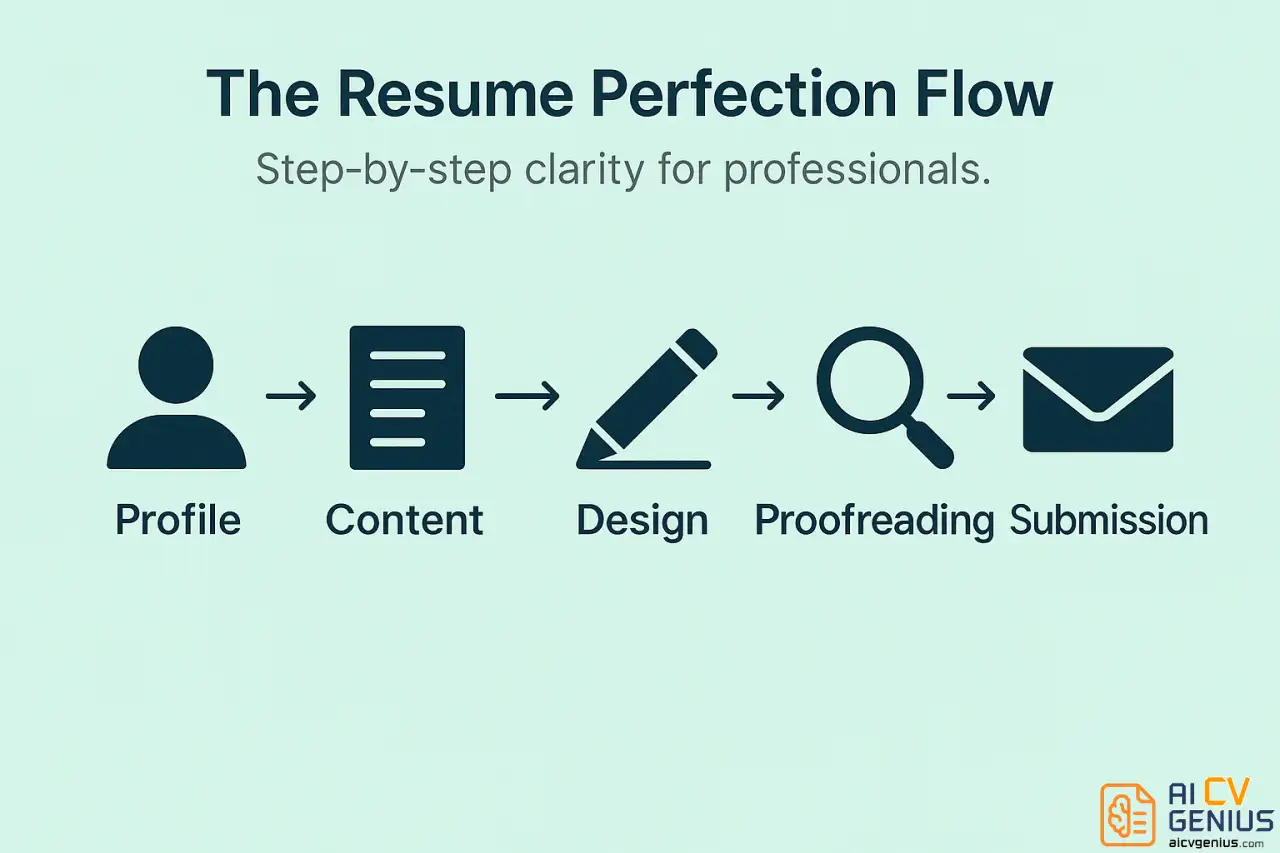
Your Complete Step-by-Step Resume Perfection Checklist
Follow these steps methodically to transform your resume from a simple document into a powerful career tool.
Step 1: Clarify Your Strategic Goal
Before adjusting layout or refining wording, define the precise objective of this specific resume. What exact type of role are you targeting? Which 2-3 core skills or experiences must this resume absolutely highlight to align with that target? Defining a clear goal transforms your resume from a generic historical record into a targeted marketing document. Many professionals skip this foundational step, resulting in resumes that sound competent but fail to resonate because they lack specific relevance.
Ask yourself: What specific job title(s) am I applying for? What are the top 3 requirements listed in typical job descriptions for these roles? How does my career history directly address those requirements? When your purpose is sharply defined, your writing naturally becomes more specific, confident, relevant, and persuasive.
Step 2: Scrutinize the Header and Contact Information
Your header occupies prime real estate – it’s the very first section recruiters and Applicant Tracking Systems (ATS) process. Ensure it is impeccably clean, completely accurate, and unequivocally professional. Verify these critical elements:
- ✅ Full Name: Presented clearly, typically the largest text on the page.
- ✅ Professional Title or Target Role: Immediately signals your field (e.g., “Senior Marketing Manager,” “Software Engineer,” “Entry-Level Financial Analyst”). Tailor this to the application.
- ✅ Updated Contact Details: Current phone number and a professional-sounding email address (e.g., firstname.lastname@email.com). Avoid casual or outdated addresses.
- ✅ Relevant Online Presence Links: Include your LinkedIn profile URL (ensure it’s updated and mirrors your resume). Add a link to a professional portfolio or personal website if relevant to your field (e.g., design, writing, development).
- ✅ Location: City and State/Country are sufficient. Omit your full street address for privacy and to avoid potential bias.
Recruiters frequently search your name online immediately after reviewing this section. Ensure your LinkedIn profile is consistent with your resume narrative. Utilizing professional structures, like those found in FreeResumeHub resume templates, can help achieve this clarity without unnecessary design clutter.
Step 3: Craft a Compelling and Targeted Summary
“Your summary shouldn’t just state your ambition; it should immediately provide evidence of your capability.”
Your professional summary (or objective for entry-level candidates) serves as your resume’s critical first impression in narrative form. It must concisely articulate who you are professionally, highlight your key expertise relevant to the target role, and showcase your primary value proposition – all within 3–4 impactful lines. Avoid vague, subjective claims like “highly motivated” or “results-oriented.” Instead, provide concrete evidence through key skills and quantifiable achievements where possible.
Strong Example (Marketing Manager):
“Data-driven Marketing Manager with 7+ years of experience specializing in B2B SaaS growth. Proven ability to increase qualified leads by over 150% through integrated SEO and content strategies. Expertise in HubSpot, Google Analytics, and leading cross-functional teams to exceed campaign goals.” (Highlights experience level, specialization, key quantifiable achievement, relevant tools, and leadership).
Step 4: Evaluate Experience and Quantify Achievements
When reviewing the Work Experience section using this resume checklist for job seekers, rigorously shift your focus from describing activities to demonstrating impact. Recruiters and hiring managers prioritize understanding what changed or improved because of your actions, not merely listing your daily responsibilities.
- ✅ Ensure every bullet point begins with a strong, specific action verb (e.g., Led, Developed, Managed, Implemented, Increased, Reduced, Optimized, Negotiated). Avoid passive phrases like “Responsible for…”
- ✅ Quantify results whenever feasible using numbers, percentages, or dollar values (e.g., “Reduced operational costs by 12% in FY2025,” “Managed a project budget of $500K,” “Increased customer retention by 8%”). Even well-reasoned estimates are better than vague claims.
- ✅ Prioritize bullet points showcasing achievements directly relevant to the target role’s requirements. Place the most impactful achievements first under each position.
- ✅ Maintain reverse-chronological order (most recent job first). Consider summarizing or removing very old (10-15+ years) or irrelevant positions to maintain focus and brevity (typically 1-2 pages).
For creative, technical, or project-based roles, strategically include links to relevant work samples, portfolios, or GitHub repositories within your experience descriptions or a dedicated career resources section. Tangible examples transform abstract claims into verifiable proof.
Step 5: Optimize and Tailor the Key Skills Section
Your skills section provides a quick snapshot of your core competencies, crucial for both rapid human scanning and ATS keyword matching. Ensure it is focused, relevant, and balanced.
- Combine technical (hard) skills (e.g., software proficiency, programming languages, specific techniques) with essential soft skills (e.g., leadership, communication, problem-solving, collaboration).
- Crucially, tailor this section for each application. Prioritize listing skills explicitly mentioned in the target job description. Use the exact terminology found in the posting where appropriate.
- Avoid listing generic or universally expected skills (e.g., “Microsoft Word,” “Internet Browsing”) unless specifically required. Focus on skills that differentiate you.
- Consider categorizing skills for improved readability (e.g., “Technical Skills,” “Software Proficiency,” “Languages,” “Certifications”).
While visual representations like icons or skill bars can look modern, ensure they are implemented in an ATS-friendly manner (often, plain text lists are safer). The primary goal is clarity and relevance.
Step 6: Strategically Position Education and Certifications
Include only educational credentials and certifications that actively strengthen your candidacy for the target role. Relevance and recency matter.
- For experienced professionals, place the Education section towards the end of the resume. Include Degree Name, Institution, and Graduation Year. Omit GPA unless it was exceptionally high and you are relatively early in your career (within ~5 years of graduation).
- For students or recent graduates, place Education prominently near the top. Include GPA (if strong), relevant coursework, academic honors (Dean’s List, scholarships), or significant projects/thesis work.
- List relevant professional certifications (e.g., PMP, CPA, AWS Certified, SHRM-CP) clearly, often in a dedicated section or combined with Skills, including the issuing body and date/expiration if applicable. These demonstrate commitment to ongoing professional development.
Consider adding brief context for certifications if space allows and it adds value, e.g., “Certified Project Manager (PMP) – Validates expertise in leading cross-functional project teams.”
Step 7: Refine Design, Formatting, and Readability
A visually cluttered or inconsistent resume signals carelessness. Ensure your design choices enhance readability and professionalism, facilitating quick scanning by recruiters.
- Maintain consistent margins (typically 0.5 to 1 inch), line spacing (1.0 to 1.15 for readability), font styles, and font sizes throughout the document.
- Stick to one or two professional, easily readable fonts maximum (e.g., Calibri, Arial, Georgia, Garamond, Lato, Roboto). Avoid decorative or script fonts.
- Use formatting elements (bolding, italics, bullet points) sparingly and consistently for emphasis (e.g., bold job titles and company names).
- Ensure ample white space. Avoid dense blocks of text. Break up information logically with clear section headings.
- Prioritize a clean, single-column layout for maximum ATS compatibility. Avoid complex tables, text boxes, or graphics that can confuse parsing software.
If design isn’t your strength, browsing professional resume design guides or using well-vetted templates can ensure a balance between aesthetics and crucial readability/ATS compliance. A professional design should feel effortless to read.
Step 8: Proofread Meticulously – Then Proofread Again
Typos, grammatical errors, or inconsistencies can instantly undermine your credibility, suggesting a lack of attention to detail – a critical flaw in almost any profession. Implement a multi-stage proofreading process:
- Read your resume slowly aloud. Hearing the words can help catch awkward phrasing or errors your eyes might miss.
- Ask a trusted friend, mentor, or career advisor to review it. Fresh eyes are invaluable for spotting mistakes you’ve become blind to.
- Print a physical copy. Errors often become more apparent on paper than on screen.
- Utilize grammar and spell-checking tools (like Grammarly, ProWritingAid, or built-in word processor checks), but don’t rely on them solely. They can miss contextual errors or suggest awkward phrasing.
- Double-check all names (companies, universities), dates, titles, and numerical figures for absolute accuracy and consistency in formatting (e.g., date formats).
Step 9: Align Keywords With the Specific Job Description
Every application warrants a final review and subtle customization to ensure maximum alignment with the target role. This step is crucial for passing both ATS filters and impressing human reviewers.
- Carefully re-read the job description, identifying the most critical required skills, qualifications, and responsibilities (keywords).
- Naturally integrate these specific keywords and phrases into your resume where they genuinely fit within your summary, skills section, and experience bullet points. Mirror the employer’s language when appropriate, but avoid forced or awkward repetition (“keyword stuffing”).
- Prioritize highlighting the experiences and achievements from your background that most directly address the core requirements outlined in the posting.
Maintain a comprehensive “master resume” document containing all your experiences and skills. For each application, create a tailored copy, strategically emphasizing the most relevant aspects for that specific opportunity. This ensures consistency while allowing for targeted optimization.

Step 10: Final Pre-Submission Review Checklist
Before clicking “submit” or attaching that file, conduct one last rapid review using this master checklist. Assess each point honestly – the objective is absolute clarity and professionalism, leaving no room for doubt.
| Category | Checklist Item | Self-Assessment (Yes/No/Needs Improvement) |
|---|---|---|
| Goal & Targeting | Is the resume clearly focused on a specific type of role? | |
| Is the summary/objective tailored to this specific job application? | ||
| Contact Info | Are all contact details accurate and professional (name, phone, email, LinkedIn)? | |
| Summary/Objective | Is it concise (3-4 lines), impactful, and results-oriented? | |
| Experience | Do all bullet points start with strong action verbs? | |
| Are achievements quantified with numbers/percentages where possible? | ||
| Is the focus on impact and results, not just daily duties? | ||
| Skills | Are the listed skills highly relevant to the target job description? | |
| Is there a good balance between technical (hard) and soft skills? | ||
| Education/Certs | Is this section placed appropriately based on experience level? Includes relevant details only? | |
| Design & Format | Is the layout clean, uncluttered, and easy to scan (single-column preferred)? | |
| Are fonts, margins, and spacing consistent throughout the document? | ||
| Proofreading | Is the resume completely free of typos and grammatical errors? | |
| Are dates, titles, and company names accurate and consistent? | ||
| ATS Compatibility | Does the resume avoid excessive graphics, images, tables, or complex formatting? | |
| Are standard section headings used (e.g., “Work Experience,” “Skills”)? | ||
| Links | Do all included links (LinkedIn, portfolio) work correctly and lead to professional profiles/pages? | |
| File Format | Is the resume saved as a PDF for submission (unless DOCX is specifically requested)? | |
| Length | Is the resume concise (ideally 1 page for entry-level, max 2 pages for experienced)? |
Once you can confidently answer “Yes” to these critical checks, you’re not just ready to apply – you’re positioned to make a compelling first impression.
FAQ: Resume Checklist Essentials
Final Thoughts: Clarity as a Competitive Advantage
Your resume checklist 2026 transcends being a simple to-do list – it embodies a commitment to professionalism and strategic communication. In a competitive job market, a truly great resume doesn’t overwhelm with excessive detail; it communicates value with precision and confidence. Every meticulously polished detail conveys a powerful unspoken message to employers: this candidate possesses exceptional attention to detail and genuinely cares about presenting themselves effectively.
Invest the necessary time to rigorously review, strategically refine, and consistently update your resume using this checklist. The right career opportunity often hinges on making the right first impression. Ensure your resume not only opens that initial door but does so with undeniable clarity and professional impact.