

- What it means: Time management on a resume signals reliability, low supervision needs, and quality under pressure.
- What to avoid: Skip empty clichés and replace them with evidence that shows impact, not personality claims.
- How to write bullets: Use Action verb + Specific context + Measurable result, ideally with a number or a credible estimate.
- How to find proof: Pull examples from deadlines, high volume work, concurrent projects, and time saved via systems or templates.
- How to position it: Tie it to prioritization and autonomy, name the tools you use, and make sure the resume layout itself looks organized.
Why Time Management Matters More Than Ever
Everyone is given the same twenty-four hours in a day. The single greatest differentiator between a good employee and a great one is how they use them. Talent is common. Discipline is rare. Employers know this, which is why a time management skills resume does not just get a glance – it gets serious consideration.
In a world of constant distraction, hybrid work models, and shrinking deadlines, the ability to self-manage is the most valuable and bankable skill you can possess. It is the meta-skill that makes all other skills possible.
When a hiring manager scans your resume, they are not just looking for experience. They are hunting for evidence of reliability. Can you be trusted to handle a complex project without constant supervision? Will you be a source of calm efficiency or a source of chaos and stress? A well-articulated resume that demonstrates time management is a promise: “I am a low-risk, high-return hire. I bring order, not chaos.” In today’s economy, that promise is everything.

The Recruiter’s Psychology: What “Time Management” Really Means to Them
Time management is not about being busy; it is about being effective. It is not about racing against the clock; it is about controlling your attention and energy. From a recruiter’s perspective, a candidate who demonstrates strong time management skills is signaling several crucial, underlying traits:
- ✅ Lower Management Overhead: You are seen as autonomous. You will not require constant hand-holding, check-ins, or micro-management. You will reduce your manager’s workload, not add to it.
- ✅ Reliability & Predictability: You will meet your deadlines. This predictability is the foundation of all team projects. If your output is reliable, the entire team’s workflow becomes more stable.
- ✅ Quality Under Pressure: You signal that you do not just get things done, but you have a process to get them done well, even when things get stressful. You do not cut corners when the pressure is on.
- ✅ Strategic Thinking: You show that you can differentiate between “urgent” and “important.” This (as we will see) is the core of prioritization, a key leadership indicator.
Think about the best coworker you have ever had. Chances are, they were not the most talented, but the most dependable. Your resume is your first chance to prove you are that person.
The Cardinal Sin: Avoid These Empty Phrases at All Costs
Before we build, we must clear away the clutter. Your resume will be weaker if you use these meaningless, cliché phrases. They are filler, and recruiters’ eyes glaze right over them.
- ❌ “Excellent time management skills”
- ❌ “Works well under pressure”
- ❌ “Proven ability to multitask”
- ❌ “Deadline-oriented”
- ❌ “Strong organizational skills”
These are claims, not evidence. The rest of this guide will teach you how to replace these generic phrases with specific, compelling proof.
How to Demonstrate Time Management on Your Resume
How to Describe Time Management: The 3-Part Formula
The secret to how to describe time management on a resume is to show it, not say it. Every strong bullet point that demonstrates time management has three parts:
[Strong Action Verb] + [The Specific Task or Context] + [The Quantifiable Result]
Let’s look at the transformation. The “Strong Example” provides context and, most importantly, a number. That number is your proof.
| Weak Example (Generic Claim) | Strong Example (Specific Proof) |
|---|---|
| Handled multiple projects efficiently. | Planned and executed five concurrent marketing campaigns, delivering all project milestones 10% ahead of schedule. |
| Met daily goals consistently. | Prioritized daily workflow to complete all high-impact client tasks by 4 PM, reducing team overtime by 30%. |
| Organized the team’s files. | Streamlined the team’s digital assets into a new shared drive, cutting average search time for files from 10 minutes to under 30 seconds. |
| Helped the team stay on track. | Coordinated a 12-member project team, successfully meeting 100% of deadlines over a six-month product launch. |
The strong examples work because they tell a complete story of how you managed your time and what the benefit was.
Step-by-Step: A Workshop to Find Your Time Management Achievements
Follow these steps for each job you have held. You have these examples; you just need to uncover them.
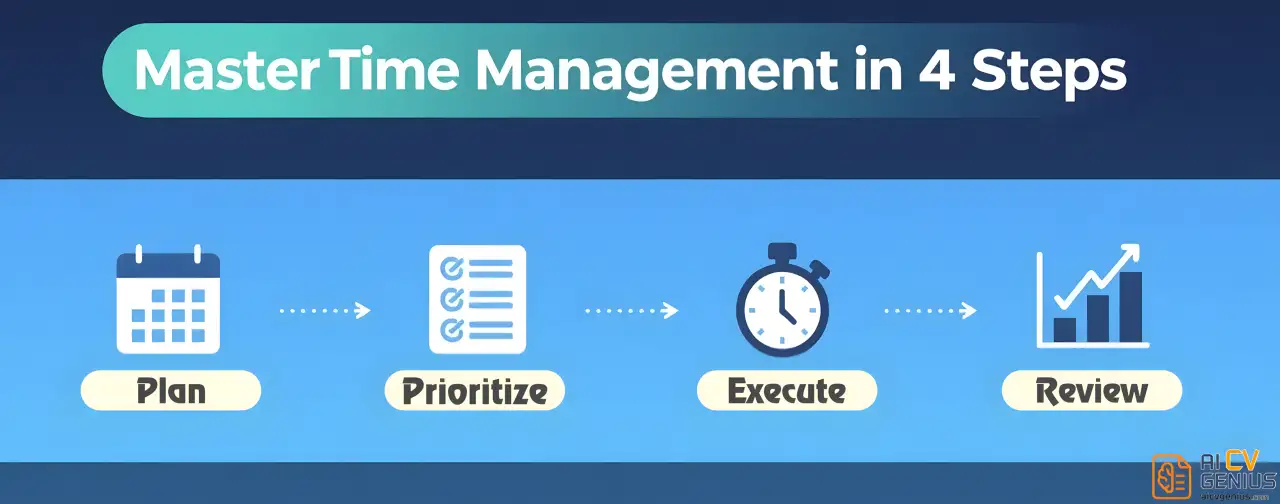
Step 1: Identify Time-Bound Achievements (The “When”)
Scan your work history and ask yourself, “When was the clock ticking?” Look for achievements related to:
- Deadlines: Did you deliver a project on time? Or even better, ahead of time?
- Volume: Did you handle a high number of tasks (e.g., tickets, clients, reports) in a set period?
- Concurrency: Did you juggle multiple projects or responsibilities at the same time?
- Efficiency: Did you create a process, template, or system that saved time for you or your team?
These are the raw materials for your bullet points.
Step 2: Quantify Your Results (The “How Much”)
Numbers are the most powerful tool on your resume. They make your achievements concrete and believable. If you do not have an exact number, a good estimate is better than no number at all.
Look for metrics related to:
- Time Saved: “Saved 5+ hours per week,” “Reduced meeting time by 30%.”
- Volume Completed: “Managed 50+ client accounts,” “Processed 200 invoices daily.”
- Percentage: “Delivered 100% of projects on time,” “Increased team efficiency by 25%.”
- Frequency: “Submitted weekly reports 2 days ahead of schedule.”
Step 3: Use Action-Driven Verbs (The “How”)
Strong verbs imply control and ownership. They are the engine of your bullet points. Use these resume time management phrases to start your sentences, replacing weak verbs like “Managed” or “Handled.”
| Instead of “Organized” | Streamlined, Coordinated, Systematized, Re-structured, Centralized |
| Instead of “Led” | Orchestrated, Executed, Planned, Spearheaded, Piloted |
| Instead of “Fixed” | Optimized, Automated, Improved, Enhanced, Reduced, Cut |
| Instead of “Handled” | Prioritized, Delegated, Scheduled, Balanced, Executed |
Step 4: Highlight Tools and Systems (The “Proof of Process”)
Mentioning the tools you use is a powerful signal that you have a real system. It shows you think professionally about productivity. Weave them into your bullet points or list them in your skills section.
- Project Management Tools: Asana, Trello, Jira, Monday.com, ClickUp
- Planning Tools: Notion, Google Calendar, Outlook Calendar, Todoist
- Collaboration Hubs: Slack, Microsoft Teams
Example: “Orchestrated a 3-month product launch using Asana, coordinating 5 stakeholders and delivering the final release on schedule.”
Real-World Story: From “Busy” to “Effective”
A client named Marisa, an administrative assistant, came to me frustrated. Her resume was a long list of “responsibilities” that made her sound busy but not effective. One line read: “Responsible for customer calls and scheduling.”
We dug deeper. She was not just “responsible”; she was managing a chaotic inbox and calendar. We reframed her story around her process and impact.
Her new bullet point: “Prioritized and managed 50+ customer requests daily through a shared ticketing system, achieving a 98% resolution rate within the 24-hour SLA.”
This one change transformed her from a passive “handler” to an active “manager” of time and quality. She landed three interviews the following week.
“Good time management isn’t about doing more – it’s about doing what matters most, consistently, and with a process.”
More Time Management Examples for Resume (By Industry)
Here are practical examples you can adapt. Notice how each one contains a verb, context, and a number.
| Industry | Resume Example Bullet Point |
|---|---|
| Marketing | “Orchestrated three concurrent product launches, developing and managing a master content calendar that ensured all 50+ assets were delivered 2 weeks ahead of schedule.” |
| Education | “Planned and executed a semester-long curriculum for 120 students, efficiently grading and returning all assignments within a 48-hour window.” |
| Healthcare | “Scheduled and managed 40+ patient appointments daily using EPIC, maintaining 100% record accuracy and reducing average patient wait time by 15%.” |
| Hospitality / Retail | “Balanced cash-out, inventory, and shift-change duties during peak hours, successfully closing the store 100% on time for 6 months straight.” |
| Software Engineering | “Managed development tickets in Jira for a 6-person agile pod, helping the team consistently achieve 90%+ of our sprint goals and delivering the Q3 epic on time.” |
| Administrative | “Streamlined the executive team’s travel booking process by creating a centralized intake form, saving an estimated 5-8 hours of manual email work per week.” |
| Project Management | “Implemented a new project tracking dashboard in Asana, providing real-time visibility for stakeholders and reducing status update meetings by 40%.” |
The “X-Factor” Skill: Prioritization
This is the most advanced component. Time management and prioritization skills resume sections are closely linked, but they are not the same. Time management is doing things efficiently. Prioritization is doing the right things efficiently.
Recruiters want to know you can distinguish between “urgent” (a ringing phone) and “important” (a project deadline). Showing this skill signals maturity and strategic thinking.
How to show it:
- ✅ “Analyzed and prioritized a backlog of 100+ support tickets, focusing on high-impact bugs first to improve system stability.”
- ✅ “Re-negotiated three project deadlines with stakeholders to allocate resources to a mission-critical, high-revenue client, saving the account.”
- ✅ “Instituted a ‘triage’ system for all incoming team requests, ensuring high-priority tasks were always addressed within one business day.”
These examples show you are not just a task-doer; you are a decision-maker who understands business value.
The “Multitasking” Myth: Balancing Quality with Speed
A common mistake is bragging about “multitasking.” Modern neuroscience shows that true multitasking is a myth; it is actually “task-switching,” which is inefficient and leads to errors. Do not use this word.
Instead, show your ability to balance quality with speed. Recruiters want someone who is fast, but also accurate. A line like “Delivered 10+ detailed reports weekly while maintaining 100% accuracy” is far more powerful than “multitasked on reports.”
Strategic Advice for Your Resume
How to Strategically Integrate Time Management in Your Skills Section
Do not just list “Time Management” under “Soft Skills.” This is a waste of space. Make it tangible by grouping it with the tools and processes that prove it.
Instead of this:
Soft Skills: Time Management, Communication, Organized.
Try this:
Core Competencies:
- Productivity & Planning: Strategic Prioritization, Deadline Management, Process Optimization
- Collaboration Tools: Asana, Trello, Notion, Slack
- Workflow: Agile Methodologies, Project Lifecycle Management
This looks far more professional and credible. You can explore more examples of powerful skill combinations in our Career Resources section.
The #1 Skill for Remote Work: Proving Autonomy
In a remote or hybrid job, “time management” is code for “trust.” Your manager cannot see you working, so they must trust that you are. Your resume is your first opportunity to build that trust.
Highlight your ability to work autonomously and communicate asynchronously.
- ✅ “Managed a full project lifecycle remotely, coordinating a team across three time zones and delivering the final product on time.”
- ✅ “Utilized Slack and Asana for asynchronous communication, keeping all stakeholders updated without requiring unnecessary meetings.”
- ✅ “Maintained a 100% on-time delivery rate for all personal tasks while working fully remote for 18 months.”
These lines directly counter a manager’s biggest fear about remote work: “Will this person be productive when I am not watching them?”
Pros & Cons of Emphasizing Time Management on a Resume
| Pros | Cons |
|---|---|
|
|
Final Check: Is Your Resume Itself Organized?
Recruiters have a simple test: if you claim to be organized and have good time management, your resume must be organized. A sloppy, inconsistent, or typo-filled resume is an instant contradiction that makes all your claims look false.
Ensure your resume has:
- ✅Consistent fonts and formatting.
- ✅Clear, logical sections.
- ✅Aligned bullet points and dates.
- ✅Zero spelling or grammar errors.
Your resume’s design is the first demonstration of your time management skills. Using a clean, professional layout from our Resume Templates Finder is an easy way to ensure your design reinforces your message.
In-Depth FAQs About Time Management Skills
- Did you create a new template? (Efficiency)
- Did you organize a messy file system? (Organization)
- Did you handle a consistent daily, weekly, or monthly task flawlessly? (Reliability)
- Did you automate a manual report? (Process Improvement)
Example: “Automated a weekly data-entry task, saving the team 4 hours of manual work per week.” This is a powerful time management skill.
- Academic: “Successfully managed a full-time course load (5 classes) while working 15 hours per week, maintaining a 3.8 GPA.”
- Project: “Coordinated a 4-person capstone project, creating a detailed project plan and timeline that led to our team finishing 1 week early.”
- Job: “Balanced customer service, cash handling, and restocking duties during peak 4-hour shifts, serving 100+ customers daily.”
- Before-and-After: “Transformed a chaotic, manual filing system into an organized, searchable digital database.”
- Adoption: “Created a new meeting agenda template that was adopted by the entire 10-person department.”
- Quality: “Submitted all reports with zero errors for an entire quarter.”
- Consolidation: “Consolidated three different tracking spreadsheets into one master source of truth.”
These outcomes imply time-saving and organization, even without a hard number.
Final Thoughts: Your Resume as a Promise
A time management skills resume is ultimately a promise to a future employer: “I respect my time, I respect your time, and I respect deadlines. I am a professional who delivers what I start.”
When you replace vague clichés with specific, quantified, and proven examples, that promise becomes undeniable. It is not about working faster; it is about working smarter and proving – through every line of your professional story – that you are the most reliable candidate for the job.