
- Behavioral interviews: They judge how you actually acted under pressure, not what you would do in theory.
- STAR-L framework: Keep context short, spend most time on your actions, then end with a result plus what you learned.
- Common mistakes: Avoid “we” answers, vague philosophy, overlong stories, and blaming other people.
- Story bank prep: Build 5 to 7 reusable stories across teamwork, leadership, failure, success, adaptability, communication, and time management.
- Practice and reuse: Rehearse from bullet notes, use concrete details, and write a quick post-interview log to refine stories for next time.
Introduction to Behavioral Interviews
The Interview Moment That Freezes Time
Picture this: you are in a bright, minimalist office, a cup of coffee you have not touched resting on the table. The interviewer smiles, leans forward, and asks the one question you were dreading: “Tell me about a time you had to deal with a difficult colleague.”
Your mind goes blank. Every project you have ever worked on, every person you have ever met, vanishes in a fog of mild panic. You suddenly cannot remember anything except your own name. Welcome to the high-stakes world of the behavioral interview – a place where your past performance is the only crystal ball the interviewer has to predict your future success.
Unlike traditional, “forward-looking” questions (“What are your strengths?”), behavioral questions are designed to be surgical. They operate on the proven psychological principle that past behavior is the single best predictor of future behavior. They are not asking what you would do. They are asking what you did.
They are designed to see how you think, how you act under pressure, and how you recover from the inevitable chaos of the modern workplace. They are looking backward to predict forward: “If this person handled a high-pressure deadline with clear communication and ownership, they will likely do the same here. If they blame others for a failure, they will likely do that here, too.”
This guide is your map. We are not just going to define the STAR method; we are going to explore the psychology behind it, so you can turn a moment of panic into an opportunity for connection and trust.
What Behavioral Questions Actually Measure
Every behavioral question, no matter how it is phrased, is a covert investigation into your core competencies. The interviewer is not just listening to the story; they are tagging your answer against a hidden scorecard of soft skills.
They are not looking for perfection. They are looking for process, self-awareness, and a growth mindset. Here is what they are really testing:
- ✅ Problem-Solving vs. Panic: When a fire started, did you run for the exit, or did you grab the fire extinguisher and direct people to safety? They want to see your analytical process, not just the solution.
- ✅ Ownership vs. Blame: When a project failed, did you say “We missed the mark, and here is what I learned,” or did you say “The sales team gave us the wrong data”? Accountability is one of the rarest and most valued traits.
- ✅ Collaboration vs. Isolation: When you worked with a difficult colleague, did you find common ground, or did you just “put your head down and do your own work”? They want to know if you are a collaborator or a solo artist.
- ✅ Resilience vs. Defeat: When you made a mistake, did it shut you down, or did you use it as data for the next attempt? They are testing your ability to learn and adapt.
It is not about having a perfect, heroic story. It is about how you think, how you decide, and, most importantly, how you learn. The best interview answers show honesty, ownership, and a clear, reflective arc of growth. The interviewer wants to see you reflect, not recite.
The STAR Method: Structure and Examples
Method & Structure
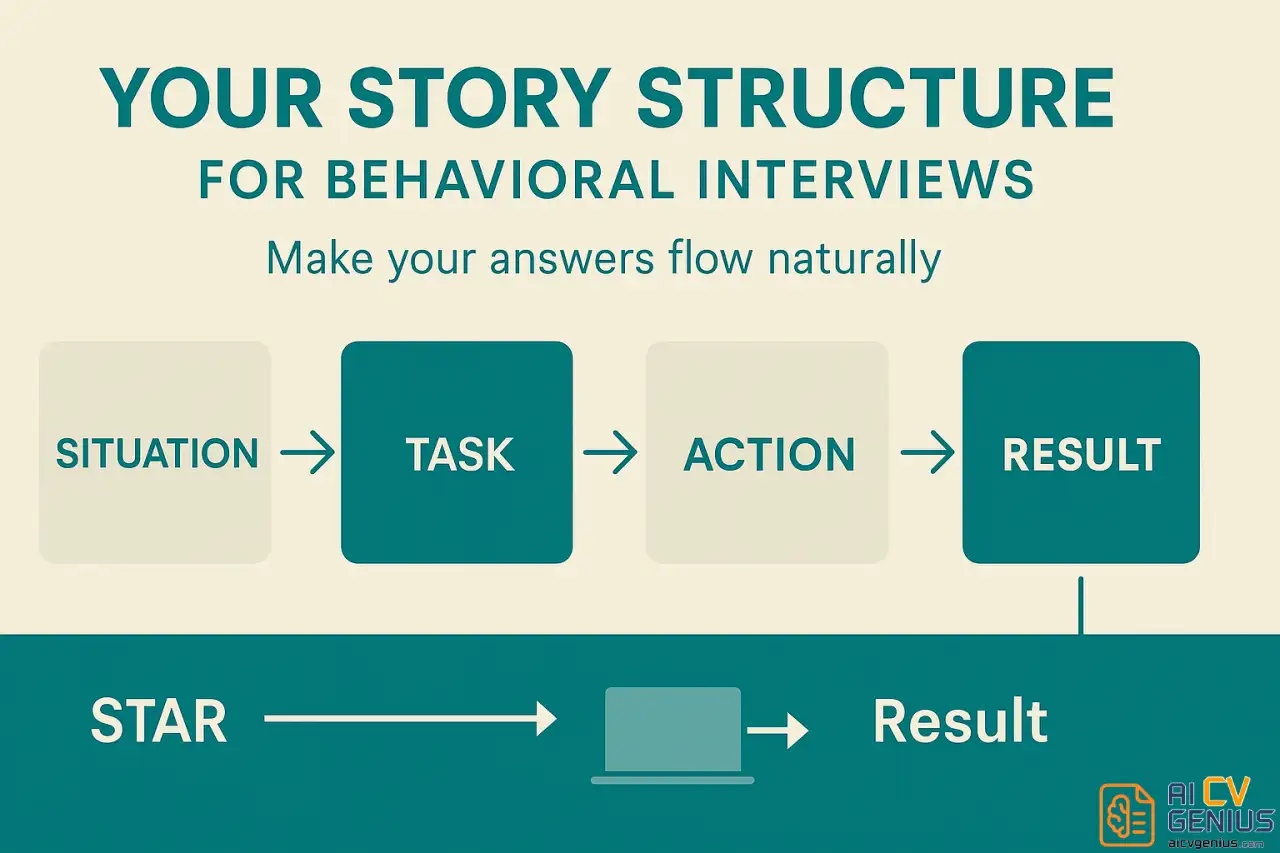
Enter the STAR Method: Your GPS for Storytelling
The STAR method is not a buzzword; it is your neurological life raft. Our brains are not wired to remember lists of adjectives (“I’m hardworking, organized, and a team player”). They are wired to remember stories. A story has a beginning, a conflict, a climax, and a resolution. The STAR method provides that exact narrative structure, ensuring you give the interviewer precisely the information they need, in the order their brain wants to receive it.
It stands for:
- Situation – Set the scene. Give just enough context for the story to make sense. (The “Before” picture).
- Task – Explain your specific role or challenge in that situation. What was the goal or problem? (The “Conflict”).
- ️ Action – Describe what you specifically did. This should be 60% of your answer. (The “Climax”).
- Result – Share what changed or improved as a direct outcome of your actions. (The “Resolution”).
Use it as a story template, not a rigid script. You are not reading from a manual – you are walking someone through a moment in your professional life. This is your “highlight reel,” and STAR is just the editing software.
The Story Formula That Works Every Time (And Why It’s Not Just STAR)
The basic STAR method is good. But the great behavioral answer adds one more letter: R (for Reflection) or L (for Learning).
The STAR-L Formula: “Here’s the problem (S/T) → Here’s what I did (A) → Here’s what happened (R) → And here’s what I learned from it (L).”
That last part is where the magic happens. Growth beats perfection every single time. Even if your story did not end with a perfect, billion-dollar success, ending with a sharp, insightful reflection wins respect. It shows you are a conscious professional who thinks about their work, not a robot who just completes tasks.
Example of a “Learning” add-on:
“…And as a result, we launched the project on time. But more importantly, I learned that my initial assumption was wrong. I now make it a rule to bring in the engineering team during the initial planning phase, not after the brief is already set.”
This single sentence shows humility, growth mindset, and cross-functional wisdom. That is the moment you get hired.
Behavioral Answer Examples
Example #1 – “Tell me about a time you worked in a team.”
❓What they are really asking: “Do you make the people around you better, or do you just do your own work?”
Situation: “In my last role as a marketing coordinator, I was part of a five-person team assigned to launch a major holiday campaign for a new client. We had a tight, two-week deadline, and the team was composed of people from design, copy, and analytics who had never worked together before.”
Task: “My specific role was to manage the project timeline and act as the central point of communication between our internal team and the client’s marketing head. The primary challenge was that we had no established workflow, and tension was high.”
️Action: “Instead of just emailing, I first scheduled a 15-minute ‘rules of engagement’ kickoff where we all agreed on how we would communicate. I then created a simple, shared timeline in Asana so everyone could see their dependencies. I also implemented a daily 10-minute check-in – not for status updates, but to ask one question: ‘What is your biggest blocker today?’ When our designer was blocked by unclear client feedback, I didn’t just forward the email. I called the client, got a concrete visual example of what they wanted, and relayed that directly to the designer, unblocking them in under an hour.”
Result: “As a result of that clear, proactive communication, we launched the campaign on time and with zero last-minute emergencies. The campaign itself boosted the client’s Q4 engagement by 35%.”
Learning (Bonus): “It taught me that communication isn’t about having more meetings – it’s about creating clarity and consistency so everyone feels empowered to do their best work.”
Example #2 – “Tell me about a mistake you made.”
❓What they are really asking: “Do you have the self-awareness to see your mistakes, the courage to own them, and the intelligence to learn from them?”
Situation: “About six months into my previous role as a project coordinator, I was managing a product manual translation for a European market launch. I was working from our usual template and timeline.”
Task: “I made an assumption that the German translation would take the same amount of time as the French one. I miscommunicated this timeline to our vendor and, more importantly, to my internal stakeholders. I was wrong. The German translation required technical reviews we had not planned for.”
️Action: “The moment I realized the error, I knew I had to fix it fast and transparently. First, I immediately called my manager, explained the assumption I made, the new timeline I got from the vendor, and the 2-day delay it would cause. I owned it completely. Second, I sent an update to all stakeholders, clearly stating the new launch date – I didn’t blame the vendor. Third, I worked with the vendor to see if they could expedite any part of the review, which they were able to do by one day.”
Result: “The project launched one day late, not two, and our stakeholders appreciated the immediate transparency. There was no panic or anger because they were informed. The biggest result, however, was internal: I created a new checklist for all translation projects that includes a ‘Technical Review’ sign-off, which is now a standard part of our workflow.”
Learning: “That experience taught me the critical difference between assumption and confirmation. I learned to never assume a process is the same twice and to always double-check critical path timelines before communicating them.”
Owning errors builds trust. Blaming others, even subtly, is a major red flag. Behavioral interviews reveal character, not just charisma.
Example #3 – “Describe a time you disagreed with your manager.”
❓What they are really asking: “Can you ‘disagree and commit’? Are you a constructive force who brings data, or a difficult person who brings drama?”
Situation: “In my marketing role, my manager proposed a new campaign strategy to focus 100% of our Q3 budget on paid ads, as our last campaign had seen good results there. Based on my analysis, I was concerned we were ignoring the long-term value of our organic content.”
Task: “My goal was not to ‘win’ the argument, but to present a more complete picture so we could make the best decision. I needed to present my case with data, not just emotion, and in a way that respected my manager’s authority.”
️Action: “I asked for 20 minutes in our next one-on-one. Before the meeting, I pulled a report showing that while paid ads drove initial spikes, our organic blog content drove 50% more qualified leads over a 6-month period. I presented this data not as ‘your idea is wrong,’ but as ‘I think we have an opportunity to create a hybrid model.’ I proposed a 70/30 split: 70% for the paid ads my manager wanted, and 30% to create new, high-intent organic content based on those ad learnings.”
Result: “My manager was receptive to the data. We agreed on the 70/30 split. That hybrid strategy was a huge win – it not only drove 20% more leads than the previous quarter but also built a content asset we used for the next six months. My manager made it clear they valued me bringing data-driven proposals, even if they differed from their initial idea.”
Learning: “It reinforced for me that disagreement is productive when it’s backed by data and aimed at a shared goal, not just a personal opinion.”
Advanced Techniques & Common Pitfalls
Techniques & Pitfalls
The 4 Common Pitfalls: What to Avoid in Your Answers
Telling a great story is as much about what you leave out as what you put in.
- ❌ The “We” Answer: “We had a tough project, and we worked hard, and we delivered it.” This is the most common mistake. The interviewer is hiring you, not your team. Use “I.” What did you do? What was your contribution? (e.g., “While the team was responsible for the code, I was specifically responsible for…”).
- ❌ The “Philosophical” Answer: Q: “Tell me about a time you handled conflict.” A: “Well, I believe conflict is just a matter of miscommunication. I think it’s important to listen…” This is a_voiding the question. They asked for a time, a story. Give them one.
- ❌ The “Too-Long” Answer: Keep answers under 2 minutes. The interviewer needs just enough detail to get the point. Focus 20% on S/T, 60% on your Actions, and 20% on the Result/Learning.
- ❌ The “Blame Game” Answer: “My last manager was a micromanager and my teammate dropped the ball, so I had to…” This is toxic. Even if it’s true, it shows a lack of ownership. The hero of your story is always you and your ability to adapt, not you saving the day from idiots.
Think of your answers like movie trailers: concise, impactful, and making the audience want to see more.
The Power of Detail: Make Your Story Concrete
Specifics show ownership. Vague answers show hesitation or, worse, that you are making it up. Add details that make the story credible.
❌ Vague: “I worked on a project that was late.”
✅ Concrete: “I joined a 6-month data migration project for 3 departments that was already 4 weeks behind schedule with over 200,000 customer records at stake.”
Which person sounds more credible? The second one. Use real numbers, tool names (“Asana,” “Jira,” “Excel”), and team sizes. This makes your story tangible and real.
Show, Don’t Tell: The Golden Rule of Interviews
Anyone can say “I’m a great team player” or “I’m a proactive problem-solver.” It’s an empty claim. You must prove it with your stories. Let the interviewer label you.
Instead of claiming traits, demonstrate them:
| Instead of | Say |
|---|---|
| “I’m a good leader.” | “When my manager was on leave, I volunteered to lead the daily check-ins and mentored two interns on the new software, which kept the project on track.” |
| “I’m very organized.” | “I created a new digital filing system in Notion for our team’s creative assets, which cut down search time for our designers by an estimated 30%.” |
Each “show” example quietly screams the trait without you ever having to say the buzzword.
Match Your Resume and Cover Letter: Building a Coherent Brand
Your stories should align perfectly with the achievements on your resume. If your resume has a bullet point that says: “Improved onboarding process, reducing ramp-up time by 20%,” your behavioral interview story is your chance to describe how you did it.
This continuity builds incredible trust. It shows you are not just listing accomplishments; you have a deep understanding of your own work and impact. You can explore ways to link resume data and storytelling flow inside our Resume Templates Finder – all layouts are built to keep narratives consistent across sections.
Preparation and Special Cases
Preparation & Practice
Building Your “Story Bank”: Common Behavioral Topics
You do not need 50 stories. You need 5-7 core stories that are versatile. A good story about a “difficult project” can often be adapted to answer questions about teamwork, time management, or communication. This is your interview toolkit.
Have at least one story ready for each of these core themes:
| Category | Sample Question | What They Really Want to Know |
|---|---|---|
| Teamwork / Conflict | “Tell me about a time you worked with a difficult colleague.” | Your conflict-resolution style, empathy, and patience. |
| Leadership / Initiative | “Describe a time you motivated others or took the lead.” | If you take ownership without being asked. (Can be informal leadership). |
| Adaptability / Change | “How did you handle a sudden change in priorities?” | Your flexibility, resilience, and ability to stay calm under pressure. |
| Failure / Mistake | “Tell me about a time you failed or made a mistake.” | Your self-awareness, accountability, and ability to learn. (Crucial!) |
| Success / Achievement | “Tell me about your proudest achievement.” | What you define as “success” and if you can link your work to a bigger impact. |
| Communication | “Give an example of explaining something complex to a non-technical person.” | Your ability to simplify, your empathy for your audience. |
| Time Management | “Describe a time you had to juggle multiple competing deadlines.” | Your prioritization process, your organizational skills. |
Bonus Tip: Mirror the Company’s Values
Before your interview, spend five minutes on the company’s “About” or “Culture” page. Find their stated values. (e.g., “Move Fast,” “Customer Obsession,” “Default to Transparency”).
Then, subtly frame your stories to echo those values. If they value “Customer Obsession”:
“The project was on time, but I knew the client was still confused. So I took the extra step to create a simple ‘how-to’ video for their team over the weekend. That’s the part that really mattered.”
It’s not flattery; it’s alignment. You are showing you already think like they do.
How to Practice Without Sounding Scripted
The goal is to sound prepared, not rehearsed. Never memorize your stories word-for-word. It kills authenticity and you will panic if you forget one line.
Instead, practice the bullet points of your story. For example, for the “mistake” story, your notes might be:
- S/T: German translation, wrong timeline assumption.
- A: Owned it. Called manager. Emailed stakeholders. Worked with vendor.
- R: 1 day late, not 2. Trust maintained.
- L: Assumption vs. Confirmation. New checklist created.
Practice telling the story from these bullet points. Record yourself on your phone. Yes, it feels awkward. But hearing your own tone reveals filler words (“um,” “like,” “you know”), pacing issues, and confidence gaps. Do this three times, and you will sound 100x more polished.
For Students & Career Changers
The “When I Have No Story” Trick (For Students & Career Changers)
If you are new to the workforce or switching careers, you may not have a direct corporate example. This is fine. Use examples from school, volunteering, or even complex personal projects. Behavioral interviews value transferable skills, not just corporate titles.
Question: “Tell me about a time you managed a complex project.”
Answer (Student):
“For my final-year capstone project (S), my task was to lead a team of four to design and code a functioning mobile app in 10 weeks (T). One of our coders dropped out, putting us 3 weeks behind. I re-scoped the project, took on the front-end coding myself by learning basic React on the fly, and re-assigned the backend tasks based on the remaining team’s strengths (A). We delivered the core app on time and still received an A. It taught me how to lead through a crisis by being flexible and decisive (R/L).”
This is a perfect leadership, time management, and initiative story. The skills are 100% transferable.
Conclusion and FAQ
After the Interview
Post-Interview Reflection
After your interview, while it is still fresh, jot down the questions they asked and the stories you told. This builds your private “Behavioral Library” for all future interviews. Over time, you’ll refine stories that feel more natural, vivid, and confident.
You can keep building your self-awareness and reflection skills with our guides in Career Resources – they’ll help you keep your narrative consistent throughout your career journey.
In-Depth FAQ: Your Behavioral Interview Questions
Example: “…And as a result, we missed the deadline, and the client was not happy. What I learned from that failure was invaluable: I was trying to manage everything in email. I immediately got our team trained on Asana, and in the next quarter, our on-time delivery rate went up 80%. That failure was the catalyst for our single biggest process improvement.”
A situational question asks about the future (“What would you do if…”).
They test similar things, but behavioral is preferred by recruiters because it’s based on fact, not theory. If you get a situational question, you can still use STAR: “I haven’t faced that exact situation, but I faced a similar one…” and then tell your story.
Spend only 20% of your answer on the failure itself. Spend 80% on the “Action” and “Learning” parts – how you fixed it, what you did immediately, and what system you put in place to ensure it never happened again.
Final Thoughts – Interviews Are Story Exchanges
Every behavioral interview is just two people trading stories: one about the company’s needs, and one about your journey. Your mission is to make the stories fit. They are not trying to trick you; they are trying to trust you. And trust is built on specific, authentic, and reflective stories.
Do not chase perfection. Chase connection. Be honest, be clear, and be human. Because the best answers do not sound rehearsed – they sound remembered.
That is how you turn a Q&A into a conversation – and a conversation into an offer.