
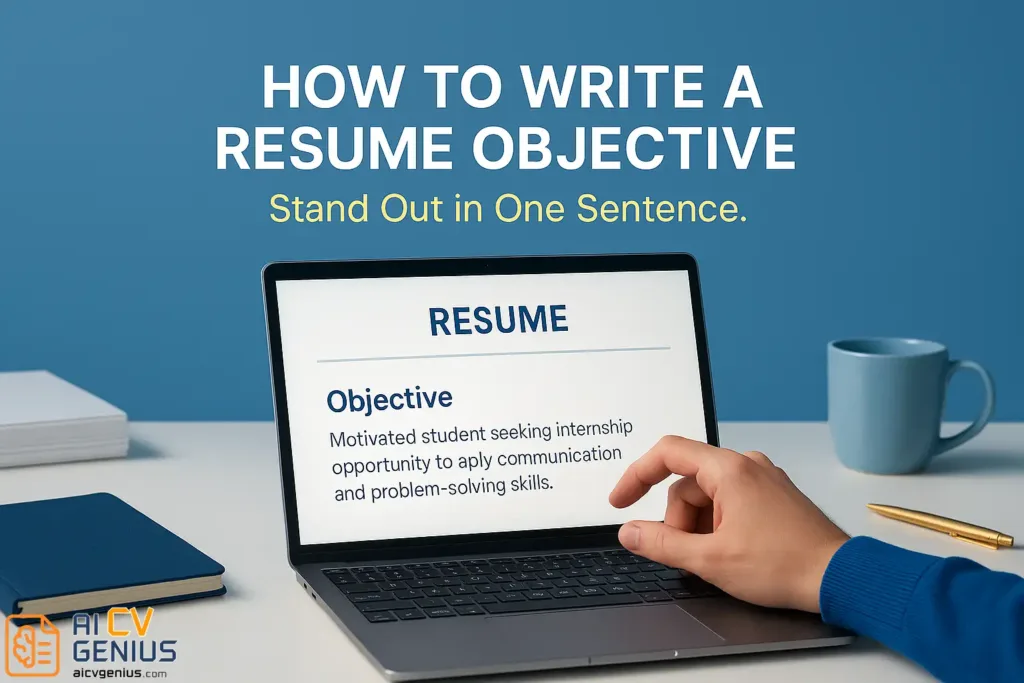
- What a resume objective does: It is a 2 to 3 sentence elevator pitch placed directly under your name that frames your whole resume before any bullets, and it works best when your path is not “obvious” (Student, Career Change, Re-entry, Or a Big Step Up).
- Objective vs summary rule: A summary proves past results for a clear, linear career, while an objective proposes future value and explains direction. If your past titles do not instantly explain why you are applying for this job, use an objective to bridge the gap.
- The writing formula: Build it as Who You Are + What You Offer + How You Will Apply It For Their Goal, then keep it tight (One to two sentences, Three lines max) and contribution-focused, not “I want to learn” or “I hope to get.”
- Tailoring is mandatory: Use the company name, the exact role, and 2 to 3 job-posting keywords woven naturally, and match the posting’s tone (Formal vs energetic) so it reads like you belong in that environment.
- Final strategy and mistakes: Put it only at the top, remove clichés you cannot prove, never paste generic templates, proofread for impact and typos, and switch to a Professional Summary once you have 3+ years of relevant experience.
Why Your Resume Objective Still Matters: The resume objective is your elevator pitch – a short, powerful statement at the top of your resume that tells employers who you are, what you’re looking for, and what specific value you are prepared to bring. It is your first, best chance to frame the entire narrative of your resume before the recruiter reads a single bullet point.
While often associated with students or entry-level professionals, a resume objective is a critical strategic tool for anyone whose career path is not perfectly linear. This includes career changers, those re-entering the workforce, or professionals targeting a role that is a significant “step up.” It’s your opportunity to connect the dots for the hiring manager, showing purpose and direction.
When done right, this single paragraph makes the difference between a confused recruiter and an engaged one. It transforms you from a “maybe” into a “must-read.” This guide will deconstruct how to write an objective that is compelling, confident, and highly effective, moving beyond generic templates into a statement that truly represents your value.
The Core Concept: Objective vs. Summary (And Why It Matters)
Understanding the difference between an objective and a summary is the most critical first step. Choosing the wrong one can send a confusing message.
Step 1 – Know What a Resume Objective Is (and Isn’t)
A resume objective is a 2-3 sentence statement that clearly states your immediate career goal and how it aligns with the employer’s needs. It is forward-looking. It focuses on your potential and your intention to contribute.
It is NOT a plea for a job. It is a confident proposal of value. The biggest mistake candidates make is focusing on what they want to get (e.g., “a challenging role to grow my skills”). A strong objective focuses on what you intend to give.
| ❌ Resume Objective (Weak & Self-Centered) | ✅ Resume Objective (Strong & Contribution-Focused) |
|---|---|
| Looking for a challenging position where I can grow my skills and learn from experts. | Dedicated marketing graduate eager to apply proven data analysis and social media strategy skills to help XYZ Company expand its online reach and engage new audiences. |
| Seeking an opportunity in a reputable organization to utilize my education. | Detail-oriented accounting student aiming to leverage recent internship experience with SEC filings to support ABC Firm’s financial reporting and analysis processes. |
Step 2 – Understand When to Use an Objective vs. a Summary
This choice depends entirely on your career context. A summary proves your past value; an objective proposes your future value.
| Resume Objective | Resume Summary |
|---|---|
| Focuses on your goals, your potential, and what you aim to contribute. | Focuses on your experience, your key achievements, and what you’ve already done. |
| Best for: Students, recent graduates, career changers, or those re-entering the workforce. | Best for: Experienced professionals with a clear, linear career path. |
| Future-oriented: “I aim to apply my skills to achieve…” | Past-oriented: “I am a senior manager who has achieved…” |
The simple rule: If your past job titles do not perfectly explain why you are applying for this specific job, you need an objective to bridge the gap.
How to Write a Powerful Resume Objective (Step-by-Step)
A compelling objective is built, not just written. It requires careful selection of your skills and clear alignment with the company’s needs.
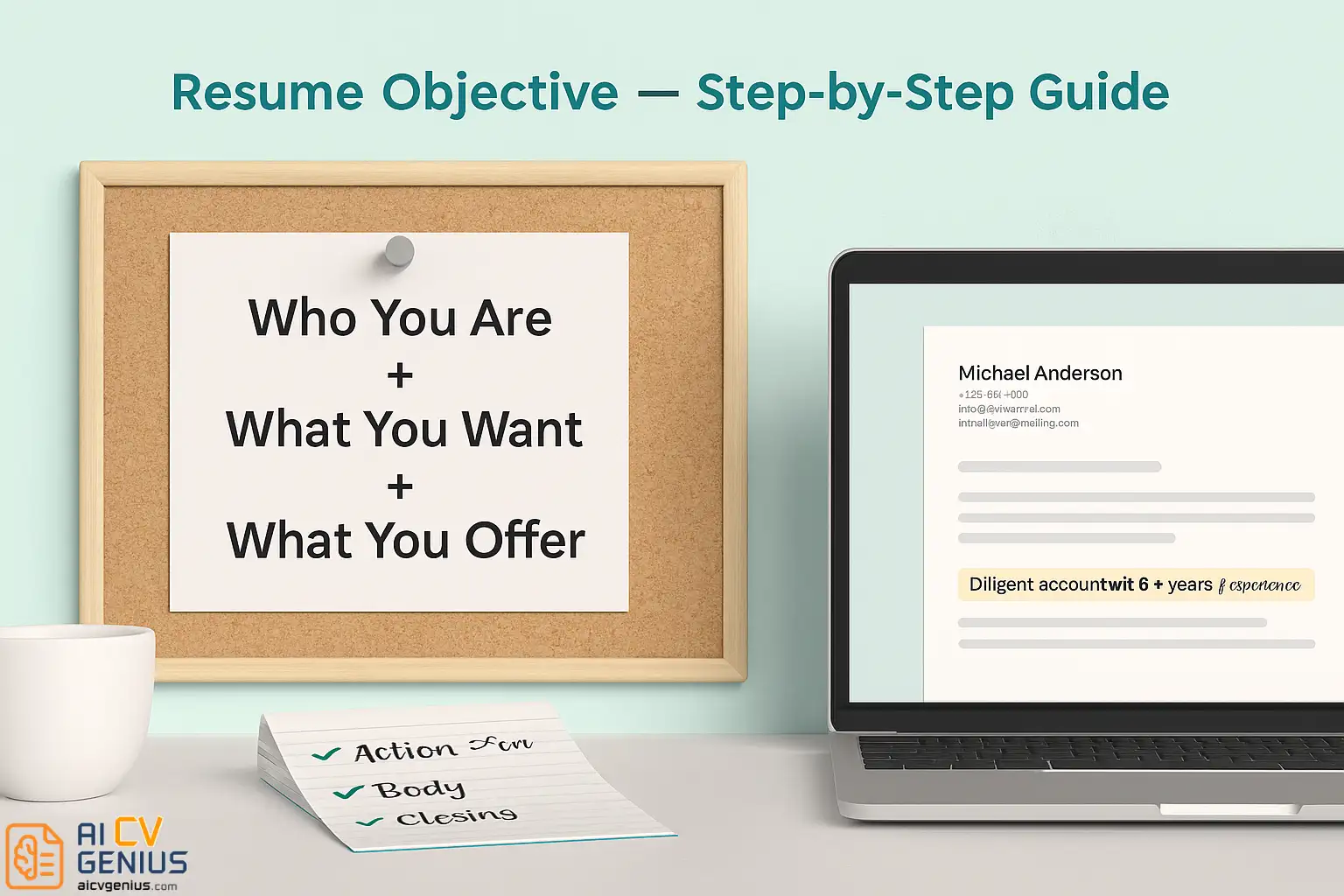
Step 3 – Use the 3-Part Formula (Who + What + How)
The simplest and most effective way to write a resume objective is to combine these three elements into one or two smooth sentences:
[Part 1: Who You Are] + [Part 2: What You Offer] + [Part 3: How You'll Apply It (The Goal)]
- Part 1: Who You Are: Your professional identity or core trait. (e.g., “Detail-oriented finance graduate,” “Creative marketing professional,” “Enthusiastic computer science student”).
- Part 2: What You Offer: Your 1-2 most relevant skills for this job. (e.g., “with skills in Python and problem-solving,” “with experience in market research and data analysis”).
- Part 3: How You’ll Apply It: Your goal, framed as a contribution to their company. (e.g., “seeking to build scalable applications,” “aiming to support ABC Firm’s financial reporting”).
Example putting it all together:
“[Enthusiastic computer science student] (Who) [seeking a software development internship] (The Goal) [where I can apply my Python and problem-solving skills] (What) [to help build and optimize scalable applications].” (How)
Step 4 – Be Specific, Not Generic (Tailoring is Everything)
A generic objective is worse than no objective at all. It signals that you are mass-applying to jobs and have no specific interest in this company. You MUST tailor your objective for each application. Specificity shows effort, research, and genuine direction.
Notice the difference:
❌ Generic:
“Looking for an opportunity to work in marketing and grow my skills.”
✅ Specific:
“Seeking a marketing assistant role at BrightEdge Agency to apply my data-driven campaign analysis and creative storytelling skills to your B2B client portfolio.”
The second example uses the company’s name, the specific role, and keywords (“B2B client portfolio”) that show the candidate has read the job description.
Step 5 – Use a Confident and Proactive Tone
Your tone should be confident, focused, and proactive – not passive or desperate. The language you choose matters. Avoid weak or self-focused phrases.
- Avoid (Weak/Passive): “I’m hoping to find…”, “I would like to…”, “A role where I can learn…”, “I want a job…”
- Use (Confident/Active): “Seeking to apply…”, “Aiming to contribute…”, “Ready to leverage…”, “A dedicated professional focused on…”
You are not a student asking for a favor; you are a professional offering a valuable skill set.
Step 6 – Add Keywords Naturally (For the ATS and the Human)
Read the job posting and identify the top 2-3 required skills. These are your keywords. Weave them into your objective naturally. This accomplishes two goals: it helps your resume pass the initial Applicant Tracking System (ATS) scan, and it immediately signals to the human recruiter that you are a match.
If the job description mentions “data-driven decisions,” “cross-functional collaboration,” or “SEO strategy,” your objective should reflect that language.
Examples for Every Career Stage & Situation
The 3-part formula is flexible. Here is how to adapt it for your specific situation.
Step 7 – Tailor to Your Career Stage
For Students or Interns
Focus: Enthusiasm, academic knowledge, and relevant projects.
“Motivated business student with strong research and analytical skills developed through coursework and a capstone project on market entry. Seeking an internship at [Company Name] to apply classroom knowledge to real-world business challenges.”
For Career Changers
Focus: Bridging the gap. Highlight transferable skills and explicitly state your new direction.
“Experienced educator and team leader transitioning into Human Resources. Ready to leverage 8+ years of communication, mentoring, and program development skills to support [Company Name]’s employee engagement and talent development initiatives.”
For Professionals Seeking Growth (Internal Promotion)
Focus: Proven value and readiness for the next step.
“Project coordinator with 3 years of proven experience at [This Company] seeking to expand into a full Project Manager role. Aiming to apply my certification (PMP) and deep knowledge of our internal systems to drive larger-scale team efficiency and project success.”
️ For Remote or Hybrid Roles
Focus: Self-discipline, reliability, and communication tools.
“Self-disciplined marketing professional with 4+ years of remote work experience, proficient in Asana, Slack, and Zoom. Eager to contribute to a distributed team by delivering clear communication and high-quality creative assets on schedule.”
Step 8 – 10 Real Resume Objective Examples by Industry
Here are 10 more strong examples you can adapt:
- Marketing: “Creative marketing graduate passionate about social media analytics and content strategy. Aiming to apply data-driven campaign insights to help [Brand Name] grow its Gen Z audience.”
- Software Engineer (Entry-Level): “Computer science student with project experience in full-stack development (React, Node.js) eager to apply coding and problem-solving skills to develop and optimize user-friendly applications for XYZ Tech.”
- Graphic Designer (Freelancer to Full-Time): “Detail-oriented visual designer with 3+ years of freelance experience seeking a full-time role at [Agency Name] to craft compelling visual solutions that enhance brand storytelling and user engagement.”
- Finance (Graduate): “Analytical finance major (GPA 3.8) with internship experience in financial modeling. Seeking an entry-level position to apply quantitative analysis and reporting skills in a corporate environment.”
- Customer Service (Career Change): “Empathetic communicator with 5+ years in hospitality, transitioning to a customer success role. Aiming to leverage proven problem-solving and client relationship skills to deliver exceptional customer experiences.”
- Human Resources (Entry-Level): “People-focused SHRM-CP certified professional eager to support HR operations at [Company Name]. Seeking to apply knowledge of benefits administration and inclusive onboarding practices.”
- Sales: “Goal-driven sales associate with strong interpersonal skills and a track record of exceeding KPIs. Seeking to bring persuasive communication and relationship-building abilities to the B2B sales team at [Company Name].”
- Teacher (New Graduate): “Passionate and newly licensed educator (K-6) aspiring to inspire lifelong learning. Seeking a 3rd-grade teacher position at [School District] to implement creative teaching methods and foster a supportive classroom environment.”
- Data Analyst (Entry-Level): “Curious problem-solver with strong Excel, SQL, and Tableau skills developed through academic projects. Seeking to translate complex data into actionable insights for the business intelligence team.”
- Healthcare (Admin): “Compassionate and organized administrative professional with 4+ years in fast-paced office environments. Aiming to apply patient scheduling and EMR (Epic) skills to support clinical operations at [Hospital Name].”
Final Polish: Mistakes, Placement, and Strategy
How you finalize and place your objective is just as important as how you write it.
Step 9 – Common Mistakes to Avoid
A simple mistake can undermine a great objective. Watch out for these common pitfalls.
- ❌ Using vague clichés. Banish “hard-working,” “team player,” and “detail-oriented” unless you can prove it in the same sentence.
- ❌ Copying generic samples. Recruiters can spot a copied-and-pasted objective instantly. It shows a lack of effort.
- ❌ Writing too long. Keep it under 3 lines. It’s an objective, not a cover letter.
- ❌ Focusing only on what you want. The “I want a job where I can learn” problem. Always frame it around what you can give.
- ❌ Typos. A spelling or grammar error in your very first section is a fatal flaw. Proofread it three times.
- ✅ The Fix: Use fresh, specific language that sounds like a real, confident human. Read it aloud. Does it sound like you?
Step 10 – Adjust for Job Posting Language (Tone Matching)
Mirror the company’s tone. Read the job description and “About Us” page. Are they formal and corporate? Or energetic and creative? Your objective should match.
- If they sound formal: “Seeking to apply rigorous analytical methodologies…”
- If they sound casual: “Eager to collaborate with a creative team to build exciting user experiences…”
“Results-driven marketing intern who thrives in fast-paced, collaborative environments and loves turning innovative ideas into measurable outcomes.”
Step 11 – Positioning on the Resume
Your resume objective has one, and only one, correct location: right under your name and contact info. It must be the first section the recruiter reads. This ensures it frames their perception of all the experience and education sections that follow. Do not place it below your skills or education.
Step 12 – When to Evolve to a Resume Summary
The objective is not forever. Once you have 3+ years of relevant experience in your field, it is time to switch to a Resume Summary (also called a Professional Summary).
A summary confidently states your experience and top achievements, rather than your goals. It is a sign of an established professional.
Example of a Summary:
“Senior project manager with 5+ years of experience leading cross-functional teams in the tech industry. Proven track record of delivering enterprise-level software projects on time and 10% under budget, specializing in Agile methodologies and stakeholder communication.”
Step 13 – Proofread for Impact, Not Just Typos
Once you have a draft, do a final “impact check.” Read it aloud. Does it sound confident? Is it clear? Is it specific? You’re not writing poetry – you’re writing for clarity. If any word feels weak or unnecessary, cut it. A 2-line objective is often stronger than a 3-line one.
Step 14 – Bonus: The “Career Goal” Variation for Long-Term Vision
For some roles, especially in mission-driven organizations (non-profits, education, healthcare), showing long-term alignment can be powerful. This variation is less about the job and more about the mission.
“Aspiring public health advocate, recent MPH graduate, committed to leveraging data analysis and community outreach skills to support [Organization’s Name] in its mission to reduce health disparities.”
This shows you are not just looking for a job, but for a place to build a meaningful career.
Where to Learn More
Want to match your new objective with a polished, ATS-friendly design? Browse our resume templates, built for students, career changers, and professionals.
Or explore our cover letter examples that align your goals with a compelling personal narrative.
Need more inspiration for your job search? Check career resources for personal branding tips, interview strategies, and more.
Pros & Cons of Resume Objectives
| ✅ Strengths | ⚠️ Pitfalls |
|---|---|
| Instantly clarifies career direction and intent. | Can sound generic or self-centered if not carefully tailored. |
| Essential for students, career changers, and gap-year returners. | Less useful (and can look junior) for senior professionals. |
| Personalizes your application beyond just a list of jobs. | Takes up valuable “above the fold” resume space if written poorly. |
| Shows you’ve done your research on the company and role. | A single typo can kill your credibility immediately. |