
- Why teamwork belongs on a resume: Recruiters want proof you can deliver with others, not just technical competence.
- What recruiters are screening for: Lower risk, smoother collaboration, stronger cultural fit, and less management overhead.
- How to prove it fast: Use Verb + Collaborative context + Measurable result inside your experience bullets.
- Where teamwork hides in your work: Co-leading, mentoring, cross-team communication, brainstorming, client handling, and feedback loops.
- How to make it sound real: Replace buzzwords with specific behaviors, strong verbs, and industry language, including remote and hybrid tools.
Why Teamwork Skills Belong on Your Resume (And Not Just as a Buzzword)
When a hiring manager skims through a stack of applications, they are not just searching for technical competence. They are looking for something harder to measure and infinitely more valuable: someone who can get things done with others. A teamwork skills resume demonstrates more than isolated experience – it showcases emotional intelligence, adaptability, and the ability to contribute to a shared purpose. In today’s hyper-connected job market, this is no longer a soft skill; it is your competitive edge.
Think about it: no significant project is a solo mission. Designing an app, launching a product, managing a restaurant, or preparing a legal case – all require seamless coordination. Even freelancers must collaborate with clients, editors, and vendors. Employers are trained to read between the lines of your resume, hunting for clues that you can communicate clearly, compromise effectively, and contribute reliably to a group. That’s why highlighting teamwork is not optional. It is a powerful differentiator that answers the recruiter’s biggest unspoken question: “Will this person make my team better, or will they be a drain on its energy?”

The Recruiter’s Psychology: Why They Obsess Over Teamwork
Studies in organizational psychology consistently link team effectiveness with overall company performance, innovation, and employee retention. When you show you are someone who can foster that effectiveness, you instantly elevate your perceived value. A technically brilliant individual who cannot collaborate is a net negative; they create friction, lower morale, and require constant management. A strong team player, however, is a “force multiplier.”
Recruiters associate proven teamwork with:
- ✅ Reliability and Reduced Risk: You are seen as a safer hire, less likely to cause interpersonal conflicts that derail projects.
- ✅ Lower Management Overhead: You are perceived as more autonomous, able to resolve minor issues without escalating them.
- ✅ Higher Cultural Fit: You signal that you can integrate smoothly into their existing ecosystem, adopting shared goals and workflows.
That is why resumes that emphasize collaboration feel more human and compelling. They tell a story of shared wins, not just isolated victories. And stories, unlike a dry list of technical skills, are what make you memorable. Let’s explore how to tell that story naturally – without falling back on empty buzzwords.
How to Demonstrate Teamwork on Your Resume
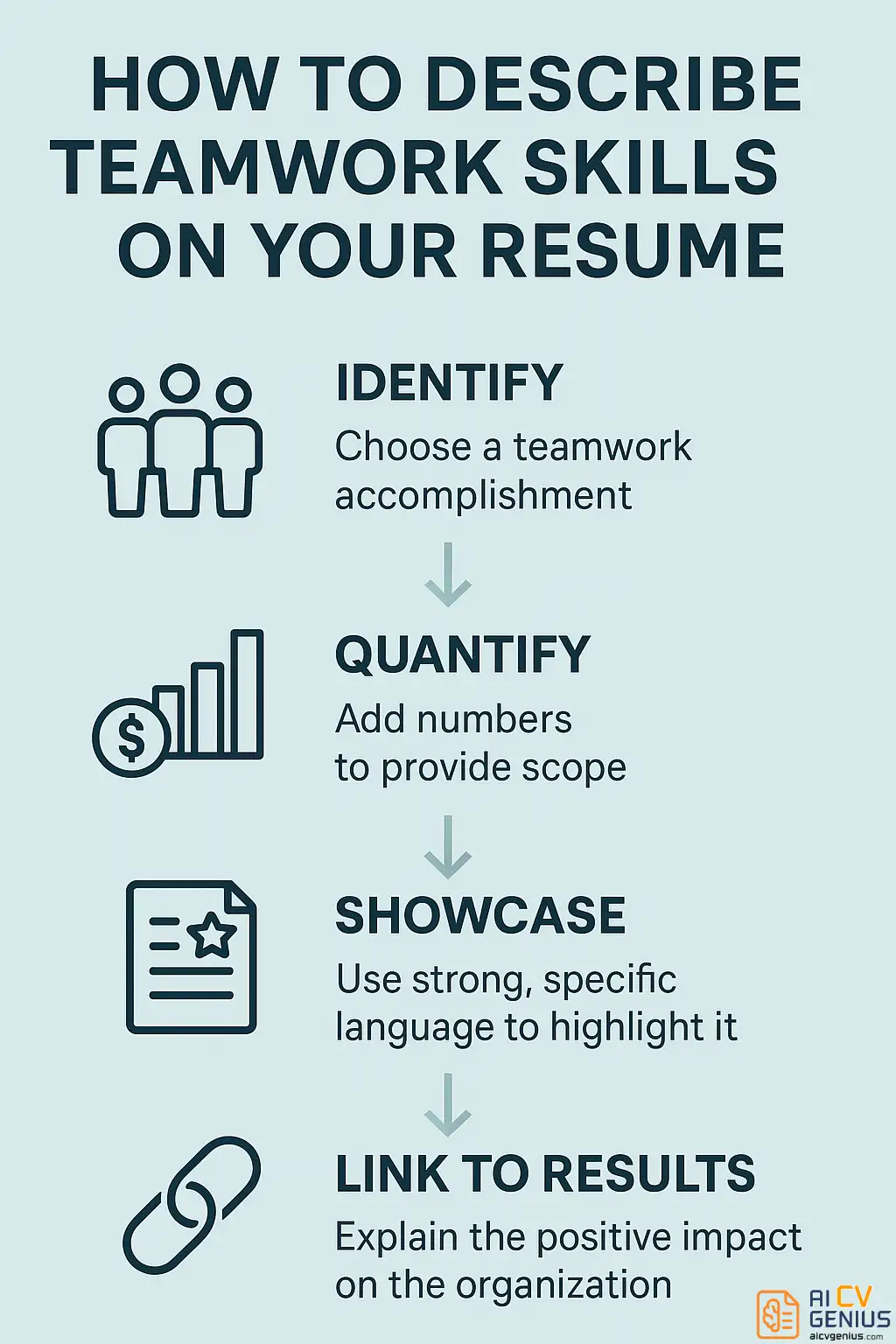
How to Find and Describe Teamwork: A Step-by-Step Guide
Do not just state “team player” in your skills section. You must prove it with evidence woven directly into your experience bullet points. Follow this process for every role you have held.
Step 1: Identify Where Teamwork Happened (The Context)
Scan your work history. Teamwork is not just about formal “team projects.” It is hidden in everyday interactions. Ask yourself:
- Did I co-lead or co-author anything?
- Did I train or mentor a new hire or junior colleague?
- Did I manage communication between my department and another (e.g., “liaised with marketing”)?
- Did I join brainstorming sessions that led to a new idea?
- Did I handle a difficult client alongside a colleague?
- Did I provide or receive feedback that improved a project?
These moments are your raw material.
Step 2: Use the “Teamwork Bullet Point” Formula
A weak statement is “Worked with a team.” A strong statement proves your role in that team’s success. Use this formula:
[Action Verb] + [The Collaborative Context] + [The Measurable Result]
| Weak | Strong |
|---|---|
| “Responsible for team projects.” | “Collaborated with a team of five engineers [Context] to reduce bug reports by 30% [Result].” |
| “Attended marketing meetings.” | “Partnered with the marketing department [Context] to develop a campaign that grew our user base by 15% [Result].” |
The result is critical. It converts your collaboration from a simple activity into a business impact.
Step 3: Showcase Collaborative Behaviors, Not Just Roles
Avoid the generic claim “excellent team player.” Instead, reveal how you are a team player through your specific actions. Mention moments when you displayed key collaborative traits:
- Communication: “Facilitated weekly syncs between the design and development teams to ensure project alignment.”
- Conflict Resolution: “Mediated a disagreement between two stakeholders, leading to a successful compromise on project scope.”
- Reliability: “Volunteered to take on extra data entry during a team crunch, ensuring the project was delivered on time.”
- Empathy & Support: “Mentored a junior analyst in advanced Excel functions, helping them increase their reporting efficiency.”
Step 4: Reflect on Growth (For Your Summary or Interview)
While this is harder to put in a bullet point, it is crucial for your narrative. The best resumes hint at personal evolution. Be ready to discuss what teamwork taught you. For example: “My time leading that cross-functional project taught me how to adapt my communication style to build trust with engineers, which was a new skill for me.” This reveals maturity and self-awareness.
Teamwork Skills Examples for Your Resume
Here are several teamwork skills examples for resume inspiration, organized by industry and role. Notice the Verb + Context + Result formula in action.
| Industry / Role | Example Achievement Bullet Point |
|---|---|
| Marketing | “Partnered with content and design teams to launch an integrated campaign that increased qualified leads by 45% in one quarter.” |
| Technology (IT/Software) | “Collaborated with QA engineers and developers in an Agile workflow to streamline software testing, reducing post-release bugs by 25%.” |
| Hospitality / Food Service | “Worked with a kitchen team of eight to optimize service timing and food prep, improving customer satisfaction ratings by 15%.” |
| Education | “Co-led student mentorship workshops with three fellow teachers, boosting student participation in after-school programs by 40%.” |
| Healthcare (Nursing) | “Coordinated with a multidisciplinary team (doctors, physical therapists, social workers) to implement a unified patient care plan, reducing average patient discharge time by one day.” |
| Retail | “Supported a team of 10 associates during the holiday peak season by cross-training on POS and inventory, helping the store exceed its sales goal by 12%.” |
| Project Management | “Facilitated weekly status meetings between engineering, marketing, and sales to ensure alignment on a new product launch, resulting in a successful go-live on the target date.” |
Powerful Verbs for Teamwork and Collaboration Resume Phrases
When recruiters scan your resume, their eyes jump to the action verbs at the start of each bullet point. Avoid the passive “Was part of a team…” and use dynamic, credible verbs. Mix up your phrasing so it feels alive.
Below are dynamic teamwork and collaboration resume verbs that instantly signal active participation:
- ✅ Collaborated
- ✅ Partnered
- ✅ Facilitated
- ✅ Coordinated
- ✅ Supported
- ✅ Mentored
- ✅ Unified
- ✅ Contributed
- ✅ Brainstormed
- ✅ Liaised
- ✅ Co-authored
- ✅ Integrated
Combine these verbs with specific achievements. For example: “Facilitated cross-department brainstorming sessions that generated three new service improvement ideas, one of which was implemented company-wide.”
Real-World Story: From Individual Contributor to Team Catalyst
Let’s bring this to life. A client named Daniel – a brilliant data analyst in fintech – once came to me frustrated. He had strong technical achievements but kept getting rejected after interviews. His resume read like a list of equations: all data, zero collaboration.
We dug into his actual work and found moments of teamwork he had dismissed as “not important.” We reworked his experience to highlight them. One line changed everything:
“Partnered with the engineering team to automate reporting dashboards (using a Python script), saving the department 10 hours of manual work weekly.”
That small addition reframed him. He was no longer just an isolated coder; he was a collaborator who used his technical skills to solve a team’s problem. Within three weeks, he landed an offer. The hiring manager’s feedback? “We loved that you’re not just a data-head; you clearly know how to work with other departments to get things done.”
“Your technical skills tell them what you can do. Your teamwork stories tell them who you are as a colleague.”
Before & After: The Impact of Adding Teamwork Achievements
Adding teamwork achievements changes how employers perceive you. It transforms dry, individual metrics into proof of human value and business impact. Here’s a comparison:
| Before (Individual-Focused) | After (Collaborative & High-Impact) |
|---|---|
| Analyzed user feedback data weekly. | Collaborated with design and UX teams to analyze user feedback, shaping new onboarding flows and raising retention by 18%. |
| Completed quarterly reports on time. | Worked closely with finance and operations to gather data, finalizing quarterly reports two days ahead of schedule. |
| Wrote code for new software features. | Partnered with a senior developer to pair-program a new feature, resulting in a 99% crash-free rollout to users. |
| Managed social media accounts. | Coordinated with the sales team to align social media content with their promotions, contributing to a 10% increase in demo requests. |
Strategic Advice and Deeper Context for Teamwork
Why Teamwork Skills Are Rising in Demand (Especially in Hybrid Work)
The global shift to hybrid and remote work has reshaped expectations. Managers cannot observe teamwork by walking around the office anymore. They cannot see you brainstorming at a whiteboard or helping a colleague at their desk. This “unseen” nature of modern work makes it more critical, not less.
Managers rely on your resume and interview to gauge your collaboration potential. If you can show clear evidence of shared ownership, proactive communication, and digital collaboration (e.g., “managed projects in Asana,” “facilitated virtual meetings”), you stand out immediately. This is why every modern resume template on our platform gives space for both soft and technical achievements – because recruiters expect both.
Teamwork is Not the Opposite of Leadership; It’s the Foundation
A common mistake is thinking that emphasizing teamwork makes you look like a “follower.” The opposite is true. Teamwork is not the opposite of leadership – it is the foundation of it. In fact, the leaders who rise fastest are often those who first mastered collaboration. True leadership is not about command; it is about influence, support, and facilitation.
You can demonstrate micro-leadership through teamwork:
- A senior designer mentoring juniors is leadership.
- A barista training newcomers on the workflow is leadership.
- An assistant coordinating between departments is leadership.
If you are aiming for a management role, do not remove teamwork. Instead, upgrade it. Use hybrid phrases like “Led a team of 5 in a project that collaborated cross-functionally…” It shows that you can both guide and contribute simultaneously.
How to Strategically Integrate Teamwork in Your Skills Section
Most job seekers bury “Teamwork” in a “Soft Skills” list. This is a waste. To make it strategic, group it with similar attributes to form a powerful “Core Competencies” block.
Instead of this:
Soft Skills: Teamwork, Communication, Problem-Solving.
Try this:
Core Competencies: Cross-Functional Collaboration, Project Management, Stakeholder Communication, Conflict Resolution, Agile Methodologies.
This sounds more professional and specific. For tech-oriented roles, combine it with the tools that enable collaboration (e.g., Jira, Slack, Asana, Trello). It subtly reinforces that you do not just talk about teamwork – you practice it daily within a professional framework.
Teamwork Beyond the Office: Using Volunteer and Project Experience
Do not discount your experience outside of a 9-to-5 job. Volunteer experiences and extracurricular projects can be powerful proof of teamwork, especially for students or career changers.
- Did you co-organize a nonprofit event? That’s project management and team coordination.
- Did you contribute to an open-source project? That’s remote collaboration and feedback integration.
- Did you play on a sports team? That’s communication, reliability, and shared goals.
Recruiters love well-rounded candidates who thrive in diverse settings. A bullet point like “Coordinated with a team of 10 volunteers to organize a charity run, raising $5,000″ can be just as powerful as an office-based one.
Common Mistakes When Writing About Teamwork
- ❌ The Empty Buzzword: Writing “team player” in your skills section with no examples in your experience section to back it up.
- ❌ Overusing “We”: It’s a balance. If you only say “we” (e.g., “We launched a product”), the recruiter wonders what you actually did. Use “I” for your specific action and “we” for the shared result. “I analyzed the data that allowed us to pivot our strategy.”
- ❌ Ignoring Personal Contribution: Hiding your individual achievements inside the group. Be proud of your part.
- ❌ Using Meaningless Buzzwords: Avoid clichés like “synergy” or “collaborative mindset.” Use strong verbs instead (e.g., “facilitated,” “coordinated,” “resolved”).
How to Rephrase Teamwork for Different Industries
The language of teamwork changes by industry. Tailor your phrasing to match the job description.
| Industry | Suggested Phrases / Keywords |
|---|---|
| Healthcare | “Worked with multidisciplinary teams,” “Coordinated patient care plans,” “Liaised with patient families and staff.” |
| Education | “Partnered with faculty,” “Co-designed curriculum,” “Collaborated with parents and administration.” |
| Retail / Hospitality | “Supported colleagues during peak hours,” “Coordinated front-of-house and back-of-house,” “Ensured team adherence to service standards.” |
| IT / Software | “Collaborated in agile sprints,” “Integrated QA feedback,” “Pair-programmed with senior devs,” “Liaised with product managers.” |
| Marketing | “Coordinated campaign strategy,” “Partnered with sales and design,” “Managed cross-functional content calendars.” |
| Finance / Accounting | “Worked with auditors,” “Coordinated with department heads on budget,” “Reconciled accounts with the finance team.” |
How Recruiters Interpret Teamwork Statements (The “Halo Effect”)
Recruiters are subconsciously scanning for signs of maturity and reliability. When they see teamwork described through specific actions and empathy, they translate it as high “emotional intelligence” (EQ). This triggers a powerful psychological shortcut: good teammates equal good hires. It creates a “Halo Effect” – because you are clearly a good collaborator, they are more likely to view your other skills (like technical ability) more favorably. You trigger trust faster than applicants who rely solely on technical jargon.
Bringing It All Together: The Perfect Teamwork Bullet Point
Here’s how a strong teamwork bullet point should look after applying everything you’ve learned. It blends action, context, and a quantifiable result seamlessly.
“Partnered with the HR and operations teams [Context] to redesign the employee onboarding process, cutting new-hire confusion by 40% [Result] and improving 90-day retention scores [Bigger Impact].”
This line tells a complete story in one breath. It proves you can work across departments to solve a real business problem.
Pros & Cons of Emphasizing Teamwork
| Pros | Cons |
|---|---|
|
|
Teamwork and Your Long-Term Career Growth
Strong collaboration doesn’t just get you hired – it gets you promoted. In almost every company, the path to senior and leadership roles is not through individual technical skill alone. It is through the ability to influence, guide, and multiply the effectiveness of others. Managers remember those who uplift others. If you have helped onboard peers, organized team learning sessions, or resolved friction, weave that into your resume. It signals future leadership potential and a strategic mindset.
Learn More About Crafting Balanced Resumes
If you’re building or refreshing your resume, explore Career Resources on our site for detailed guides on showcasing both soft and hard skills with balance. Every article is designed to help you sound confident, genuine, and ready for any role.
In-Depth FAQ About Teamwork Skills on a Resume
- Who gave you the project? (e.g., “Liaised with the Product Manager to define project specs.”)
- Who did you give your work to? (e.g., “Delivered weekly analysis to the sales team to help them target leads.”)
- Did you ask for or give feedback? (e.g., “Integrated feedback from senior engineers to refactor code, improving performance.”)
- Did you present your findings? (e.g., “Presented data-driven insights to department heads.”)
That is all teamwork.
- Teamwork can be internal (e.g., “Supported my immediate team of 5 analysts”).
- Collaboration often implies cross-functional work (e.g., “Collaborated with Marketing, Sales, and Engineering…”).
Use “Collaboration” when you want to sound more strategic and “Teamwork” or “Supported” for internal team dynamics.
Final Thoughts
A teamwork skills resume is not just about telling employers you work well with others – it is about proving you are a catalyst who elevates the people around you. When written with authenticity and backed by specific examples, every collaborative bullet point reveals more than just your skills; it shows your humanity, your humility, and your potential to grow alongside any team you join. That is how you get hired.