
- Main point: A restaurant manager cover letter is a first-service test that must show operator-level detail, not generic “hospitality passion.”
- What owners want: Proof across leadership (Lower turnover), P&L control (Lower food and labor costs), and guest experience systems (Fewer complaints, faster service).
- Winning structure: Use a 3-paragraph formula, Hook with specific research, Value with 2 to 3 metrics, Close with a confident next step.
- What to include: Quantified wins like ticket time, review scores, repeat guests, COGS, labor %, and onboarding improvements, written as situation, action, result.
- Common mistakes: Copy-paste openings, listing duties instead of results, sloppy typos, weak closings, plus tone shifts for no-management-experience or fine-dining roles.
You’re applying to manage a restaurant. This isn’t an office job. It’s a high-stakes, fast-paced environment where every single detail – from the temperature of the soup to the timing of the check to the wattage of the lightbulbs – directly impacts the bottom line. So when your cover letter is generic, full of fluff, or worse, riddled with typos, the hiring manager (likely the owner or Director of Ops) doesn’t just see “bad writer.” They see “sloppy manager.”
Your restaurant manager cover letter example isn’t a formality. It is your first, best chance to prove you understand what this job actually is. It’s not just about loving food. It’s about obsessive attention to detail, militant cost control, and the rare leadership ability to keep a team motivated and smiling through a disastrous Friday night rush.
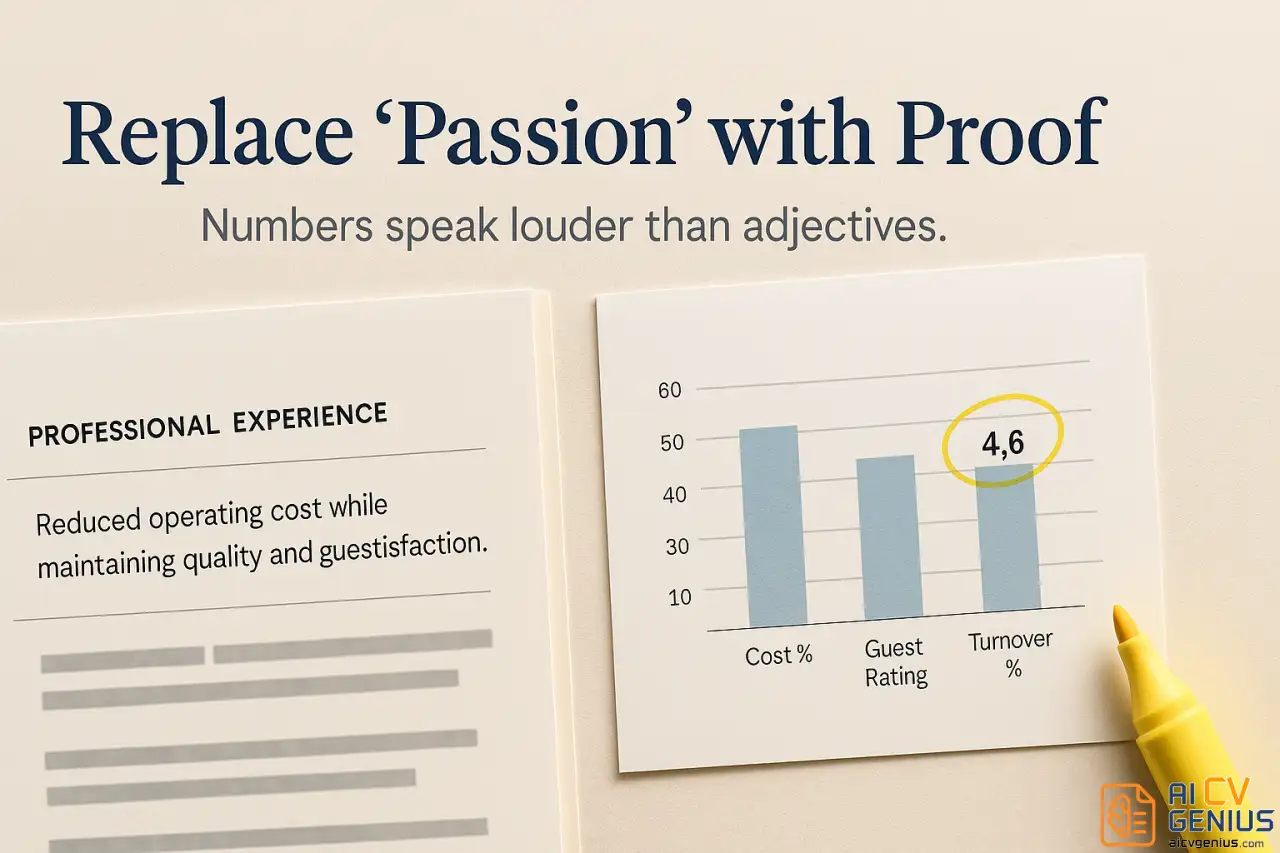
Most cover letters for this role fail spectacularly. They talk about “passion for hospitality” instead of “proof of profit.” Saying “I love creating memorable experiences” doesn’t convince a stressed-out owner. But showing how you cut food costs by 15% while simultaneously improving guest satisfaction scores? That gets you the interview. This guide will show you how to write the letter that proves you’re ready to protect their investment and run their dining room on day one.
The Mindset: What Makes a Restaurant Manager Cover Letter Different
A restaurant manager is a unique hybrid: one part front-line general, one part emotional-support specialist, and one part ruthless accountant. You aren’t just managing spreadsheets in a quiet office; you are managing controlled chaos. A Friday night with three call-outs, a walk-in party of twenty, and a critical review from a food blogger – all at the same time.
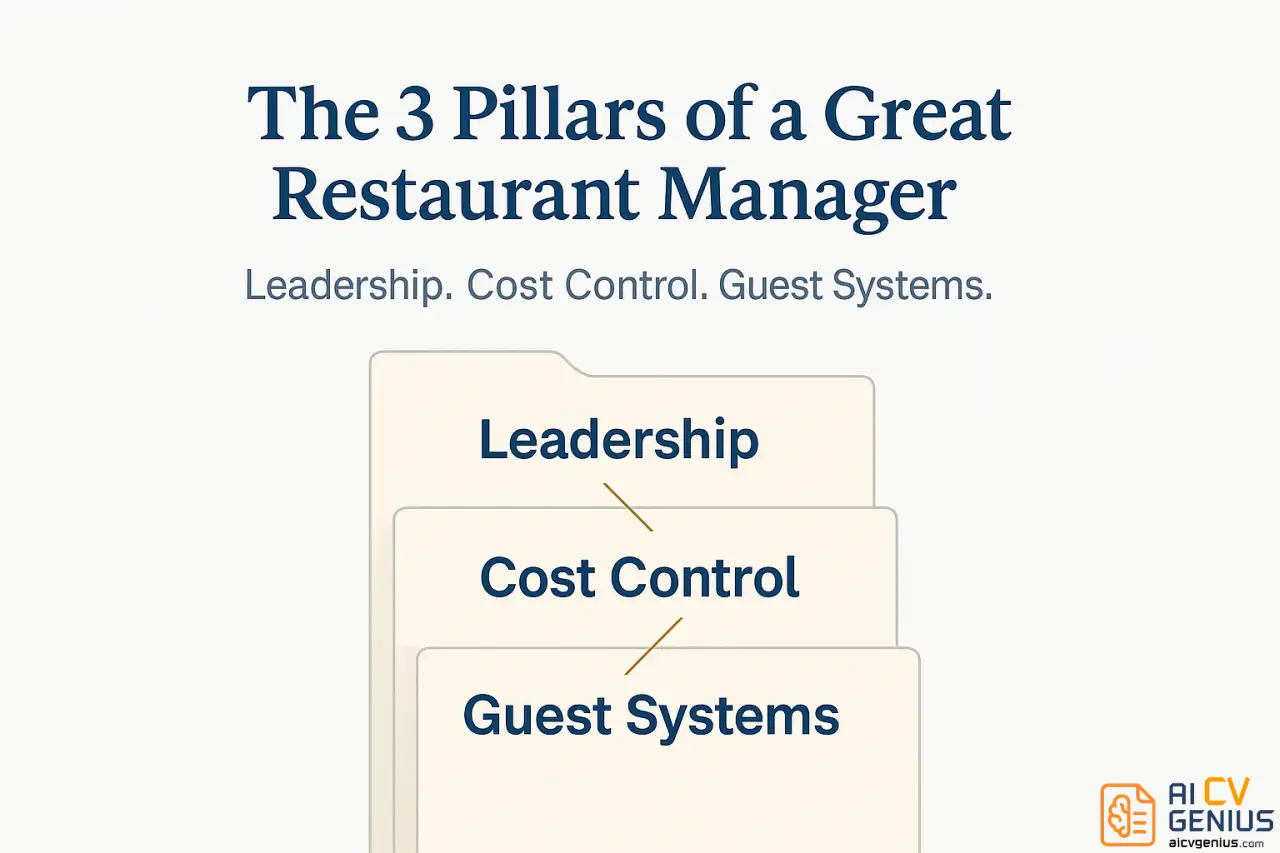
Your cover letter must prove you are a business operator who thrives on this pressure. It must immediately signal your mastery of the “Big Three” pillars of restaurant survival.
Pillar 1: Leadership That Stops the Revolving Door
Restaurant staff turnover averages a staggering 75% annually. An owner knows that every time a server quits, it costs them thousands in tangible (recruiting, training) and intangible (mistakes, slow service, team morale) costs.
If you can’t hire, train, and retain good people, nothing else you do matters. Your cover letter must show you’re a team-builder, not just a boss who barks orders.
Weak Phrasing: “Managed a team of 15 employees.”
Strong Phrasing: “Reduced FOH staff turnover from 80% to 45% by implementing a structured 10-day onboarding program and weekly 1-on-1 check-ins, creating a core team of top-performing servers.”
Pillar 2: P&L Literacy and Ruthless Cost Control
Full-service restaurant profit margins are razor-thin, often 3-5%. An owner lives and dies by their food cost (COGS) and labor percentages. They need a manager who treats the restaurant’s money like it’s their own. Every wasted ingredient, every minute of unnecessary overtime, every comped check, and every broken wine glass is a leak in the boat.
Show you are a “P&L-literate” manager.
Weak Phrasing: “Handled inventory and ordering.”
Strong Phrasing: “Cut food costs by 12% (from 34% to 30%) by renegotiating supplier contracts and implementing a strict ‘first-in, first-out’ inventory system that nearly eliminated daily waste.”
Pillar 3: Guest Experience as a System, Not an Apology
Amateurs solve complaints. Professionals build systems that prevent complaints from ever happening. The best restaurants are built on their regulars, and regulars are created by consistency.
Your letter must show you are a systems-thinker. This includes everything from server training SOPs and table-touching strategies to kitchen-to-table coordination and reservation management.
Weak Phrasing: “Ensured high-quality customer service.”
Strong Phrasing: “Redesigned our reservation and seating system, which cut average Saturday wait times by 18 minutes. This led to a 23% increase in positive online review scores (Yelp/Google) and a noticeable spike in tracked repeat guest visits.”
The 3-Paragraph Formula That Gets You the Interview
Restaurant owners are busy. They don’t have time for a five-paragraph essay on your life story. This proven structure tells them exactly what they need to know, fast.
Paragraph 1: The Hook (Prove You’ve Done Your Research)
Your opening line is a test. A generic opening like “I am writing to apply for the restaurant manager position” is an immediate fail. It signals a mass-application and a lazy candidate.
Your hook must be specific to them. It proves you want this job, not just any job.
Weak Opening (Generic):
“I am excited to apply for the restaurant manager position at your establishment. I have always been passionate about food and hospitality and my skills would be a great fit.”
Strong Opening (Specific):
“When I saw that The Grove won ‘Best New Restaurant’ in Chicago Magazine and your team doubled your covers in six months – all while maintaining a 4.8 Google rating – I knew this was the kind of high-growth, high-quality operation I want to help scale. My background in managing similar-volume casual dining aligns perfectly with where you’re headed.”
How to find your hook (10 minutes of research):
- Read their reviews: What do guests consistently praise? “Your team’s incredible service” or “the amazing local sourcing.”
- Read recent news: Did they just open a second location? Win an award? Launch a new menu?
- Study their brand: Mention something specific – their focus on local ingredients, their unique cocktail program, their family-style concept.
- Visit the restaurant (if possible): This is the ultimate pro move. “After dining at your restaurant last week, I was incredibly impressed by the floor team’s efficiency and poise during the dinner rush…”
Paragraph 2: Your Value (Metrics, Metrics, Metrics)
This is the body of your letter. It is where you prove your value. Do not list your responsibilities (they know what a manager does). Show your achievements. Use the Situation + Action + Result formula.
Weak Phrasing (Lists duties):
“I have extensive experience managing all restaurant operations and training staff. I am proficient in inventory, scheduling, and customer service.”
Strong Phrasing (Shows results):
“At Riverside Bistro, I inherited a struggling team with 30-minute average ticket times and high food waste. Within six months, I restructured the floor plan, trained servers on a new POS sequence, and implemented a kitchen communication system that cut ticket times to 18 minutes. By also renegotiating supplier contracts, I reduced food costs from 34% to 29%. These changes directly led to a rise in our guest satisfaction scores from 3.2 to 4.6 stars and a 35% increase in repeat customers.”
Key Metrics to Include (Pick Your Strongest 2-3):
- Financials: Revenue growth (“Increased lunch revenue by 28% YOY”), food/labor cost savings (“Reduced labor costs by 9% through optimized scheduling”).
- ⭐ Guest Metrics: Review scores (“Improved Yelp rating from 3.5 to 4.5”), wait times (“Decreased table turn time by 10 minutes”), repeat business (“Grew loyalty program by 40%”).
- Team Metrics: Staff turnover (“Cut FOH turnover by 40%”), training time (“Reduced onboarding from 3 weeks to 10 days”).
Paragraph 3: The Close (Confident Call to Action)
End with confidence, not desperation.
Weak Closing (Passive):
“I hope you will consider me for this position. Thank you for your time and I look forward to hearing from you.”
Strong Closing (Active):
“Your focus on locally-sourced ingredients is exactly the model I’m passionate about. I’d welcome the chance to discuss how my experience in scaling operations can help The Grove maintain quality while handling your impressive growth. I’m available for a conversation this week at (555) 123-4567. Thank you for your consideration.”
This closing shows you’re ready, professional, and makes the next step easy for them.
Full Sample Restaurant Manager Cover Letter
Here is a complete restaurant manager cover letter example that puts all these principles into practice. This is for an experienced manager applying to a high-growth, respected casual dining restaurant.
Marcus Rodriguez
(555) 234-5678
marcus.rodriguez@email.com
Chicago, IL 60614October 29, 2025
Sarah Chen, Owner
The Grove Restaurant
1234 N Ashland Avenue
Chicago, IL 60622Dear Ms. Chen,
When I saw that The Grove won “Best New Restaurant” in Chicago Magazine and your team managed to double your covers in six months – all while maintaining a 4.8 Google rating – I knew this was the kind of high-growth, high-quality operation I want to help scale. My background managing high-volume casual dining aligns perfectly with where you’re headed; I’ve helped two restaurants successfully navigate rapid expansion while protecting the quality that built their reputations.
At Riverside Bistro, I inherited a 120-seat restaurant with 30-minute average ticket times, staff turnover at 85%, and food costs eating 38% of revenue. Within nine months, I implemented a full operational turnaround: I restructured the floor plan to create efficient server stations, implemented a kitchen expediting system that cut ticket times to 18 minutes, and renegotiated supplier contracts to reduce COGS to 31% without changing our farm-to-table commitment. The results were clear: customer satisfaction scores rose from 3.2 to 4.7 stars, repeat guest visits increased by 35%, and we reduced FOH turnover to 48% through a mentorship program that paired new hires with veteran servers.
Your focus on locally-sourced ingredients and community engagement resonates deeply with my management philosophy. I would be excited to discuss how my experience in scaling systems and developing teams could help The Grove maintain its exceptional quality while handling this impressive growth. I am available for a conversation this week at (555) 234-5678 or marcus.rodriguez@email.com.
Thank you for your consideration,
Marcus Rodriguez
5 Fatal Flaws That Sink Restaurant Manager Cover Letters
Even experienced candidates make these errors. Avoid them, and you’re already ahead of 80% of applicants.
1. The “Copy-Paste” Generic Letter
If you can swap out the restaurant name and send the same letter to ten different places, it’s a terrible letter. Owners can spot this lazy approach instantly. The Fix: Spend 10 minutes researching. Find one specific detail (their award, their menu, their chef) and put it in the first paragraph.
2. Being a “Foodie,” Not a “Manager”
Owners don’t hire managers because they “love food and people.” They hire managers who can increase revenue, reduce costs, and run a smooth service. Your passion is a given; your business acumen is what they’re buying.
Bad: “I’ve always had a passion for creating memorable dining experiences.”
Better: “I thrive in high-volume environments. At my last restaurant, I managed 250+ covers on Saturday nights and maintained sub-20-minute ticket times even during our busiest service.”
3. Typos and Formatting Errors
Your cover letter is your first service test. If you can’t be bothered to proofread a one-page document, how will you handle a 200-item opening checklist? A typo (especially in the restaurant’s name or the owner’s name) is a fatal error. The Fix: Read your letter out loud. Your ears will catch mistakes your eyes miss.
4. Listing Duties, Not Results
They know a manager is “responsible for scheduling, inventory, and training.” That’s the job description. Don’t waste space telling them what you were supposed to do. Tell them what you achieved.
Bad: “Responsible for managing staff of 20.”
Better: “Led and developed a team of 20, reducing staff turnover by 40%.”
5. The “Hope to Hear From You” Weak Close
Confidence is a key management trait. If your final paragraph sounds desperate or passive, it undermines your entire letter.
Bad: “I hope you will consider me… I look forward to hearing from you.”
Better: “I am confident my experience can help you… I am available for an interview next week.”
Specialized Cases: “No Experience” and “Fine Dining”
What If You Have No Management Experience? (The Shift-Lead-to-Manager Playbook)
You’re a server, bartender, or shift lead. You’re ready to move up. You have the experience, but not the title. Your cover letter’s job is to reframe your experience. You weren’t “just a server”; you were a business-driver.
Focus on transferable skills and moments you stepped up:
| Instead of | Say |
|---|---|
| “Trained new servers” | “Acted as lead trainer for all new FOH hires, developing a 3-day onboarding checklist that reduced training time by 20%.” |
| “Handled guest complaints” | “Empowered to handle all guest recovery situations at the table, successfully de-escalating issues and maintaining a 99% guest satisfaction rate on my shifts.” |
| “Upsold wine and appetizers” | “Consistently led the team in sales, and developed a simple ‘suggestive selling’ script that increased our attachment rate for appetizers by 15%.” |
Your letter must show you already think like a manager. For more guidance, explore our career resources section.
Fine Dining vs. Casual: How the Tone Changes
Applying to a high-end or Michelin-starred restaurant? The core principles are the same, but the language must be elevated. Your tone should be more formal, polished, and refined.
You must emphasize different skills:
- Expertise: Wine program knowledge (CMS/WSET certifications), sommelier training, experience with tasting menus.
- Service: Mastery of French service, tableside presentations, crumbing, and silent, unobtrusive service steps.
- Poise: Experience managing a formal dining room and handling high-profile, demanding clientele.
- Metrics: Focus on check averages (“Increased PPA from $120 to $135”) and service-standard scores.
Fine-Dining Opening Example: “Having managed service at The French Laundry, I was immediately drawn to your restaurant’s singular focus on elevating regional cuisine. Your recent James Beard nomination is a testament to that commitment, and I believe my background in precise, high-touch service standards would be an asset to your team.”
Frequently Asked Questions
Your Cover Letter Is Your First Service Test
Here’s what an owner or Director of Operations sees when they read your restaurant manager cover letter example: They see a direct reflection of your management style.
Is it detailed, professional, and specific? They’ll assume you manage your floor the same way. Is it sloppy, generic, and full of excuses? They’ll assume you run a chaotic, unprofitable shift.
Your cover letter isn’t just a formality – it’s your first service test. It’s proof that you can communicate clearly, that you understand the business of hospitality (not just the “passion”), and that you have the attention to detail required to protect their margins and their reputation.
Don’t phone it in with a generic template. Take 20 minutes to research the restaurant. Quantify your achievements. Craft a letter that shows you’re the operator they can trust with their keys. That extra effort is what separates the candidates from the new hires.
Ready to complete your application package? Explore our full collection of cover letter examples and see how to create documents that actually get responses.