
- Why it matters: A graduate cover letter turns limited experience into a clear story of potential, fit, and energy.
- Recruiter mindset: They look for trainability, attitude, and alignment, so a clean, error-free letter signals seriousness and attention to detail.
- Winning structure: Open with the exact role and a specific hook, prove value with 1 to 2 examples and measurable outcomes, close with confident interest.
- Transferable skills: Translate projects, internships, volunteering, and part-time jobs into professional skills like teamwork, research, communication, and problem solving.
- Make it land: Customize each company, keep it one page with simple formatting, avoid generic templates, and proofread like it is part of the interview.
The First Handshake: Why Fresh Graduates Need a Great Cover Letter
Stepping into the professional world without years of experience listed on your resume can feel like arriving at a party slightly underdressed – a little uncertain, a bit exposed. But here’s the secret weapon many overlook: a compelling cover letter for fresh graduates. It matters precisely because you don’t have extensive experience. Employers reviewing entry-level applications aren’t expecting a decade of accomplishments; they are scouting for potential, curiosity, commitment, and confidence. Your cover letter is the bridge connecting that potential to tangible proof.
Think of it this way: your resume outlines the what – your education, projects, perhaps a part-time job. Your cover letter illuminates the who and the why – who you are as a budding professional, why you’re drawn to this specific role and company, and what unique energy and perspective you’ll bring. In a sea of similar academic backgrounds, it’s often the personality, clarity, and genuine enthusiasm conveyed in the cover letter that make all the difference, transforming you from just another applicant into a memorable candidate.
Decoding the Recruiter’s Mindset: What Employers Really Look For
Hiring managers reading graduate applications operate with a different lens. They aren’t hunting for seasoned experts or flawless track records. Instead, they are primarily evaluating trainability, attitude, and alignment. A thoughtful, well-structured, and error-free cover letter serves as immediate evidence that you possess crucial foundational qualities: organization, self-awareness, attention to detail, and a serious commitment to professional growth. These aren’t just soft skills; they are predictors of success in any role. That initial positive impression often separates the applications that earn an interview call from those lost in digital silence.
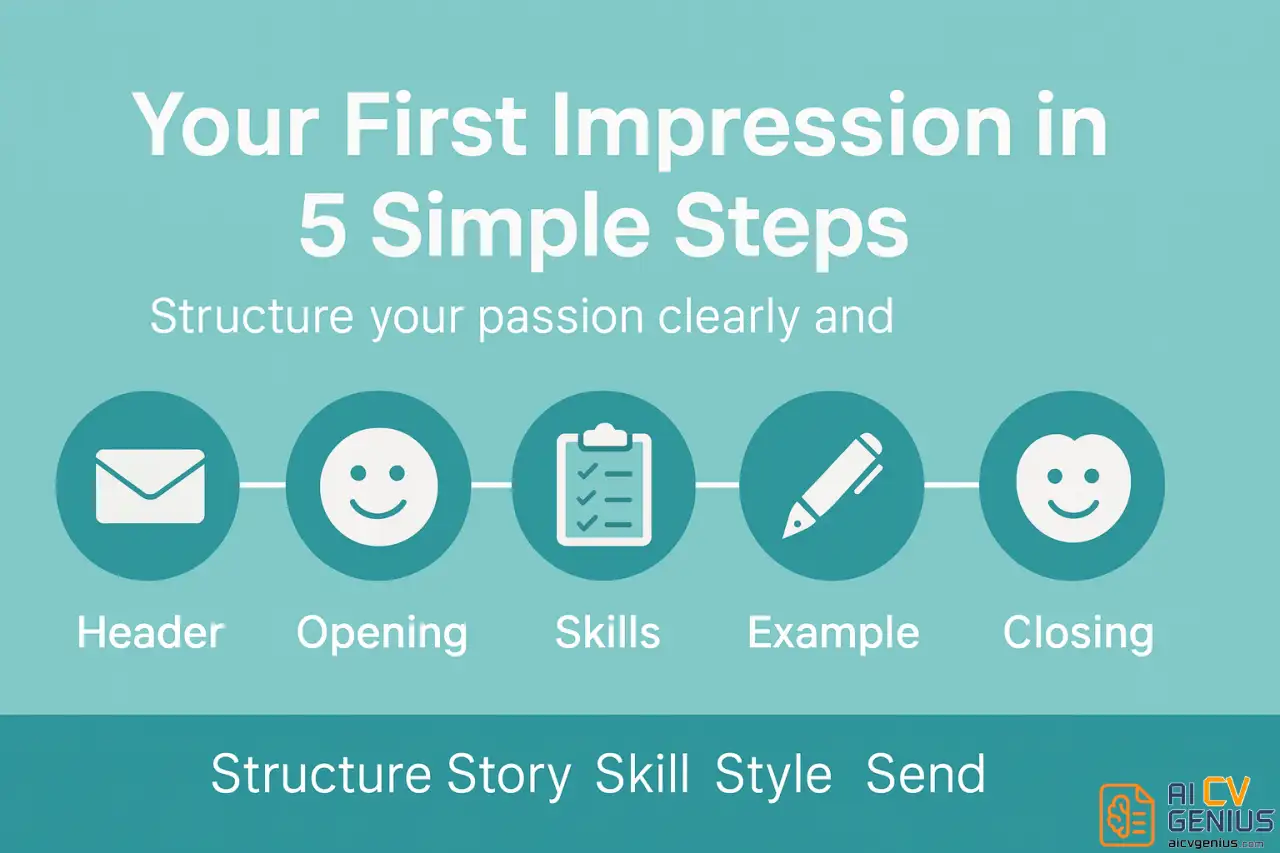
Blueprint for Success: Structure of a Winning Graduate Cover Letter
The structure of a graduate cover letter is straightforward, but its effectiveness lies in its strategic execution. Each section builds upon the last, creating a concise yet compelling narrative. You can adapt the fundamental logic explained in our comprehensive Cover Letters guide, which emphasizes introducing yourself with purpose, demonstrating value, and closing with confidence.
| Section | Purpose & Key Elements |
|---|---|
| Header | Standard professional format: Your full name, phone number, professional email address, city/state, and optionally a link to your LinkedIn profile or online portfolio (if relevant). Below this, include the date and the recipient’s details (Name, Title, Company, Address). Accuracy here shows attention to detail. |
| Greeting | Personalize whenever possible. Address the hiring manager by name (e.g., “Dear Ms. Clarke,”). Research LinkedIn or the company website. If the name is truly unavailable, use a specific title like “Dear Hiring Manager,” or “Dear [Department Name] Team,” avoiding the overly generic “To Whom It May Concern.” |
| Opening Paragraph (The Hook) | State the specific position you’re applying for and where you saw it advertised. Immediately convey your enthusiasm for the role and the company. Briefly mention your recent graduate status and one key strength or area of study relevant to the position. Make it clear why this job excites you. |
| Body Paragraph(s) (The Evidence) | This is where you connect the dots. Select 1-2 key experiences (academic projects, relevant coursework, internships, volunteer work, part-time jobs) and explain how they equipped you with skills relevant to the job description. Focus on transferable skills. Use specific examples and quantify outcomes if possible. Show, don’t just tell. |
| Closing Paragraph (The Clincher) | Reiterate your enthusiasm for the specific role and company. Briefly summarize why you believe you’re a strong fit, emphasizing your eagerness to learn and contribute. Express gratitude for their time and consideration. End with a polite and professional call to action, indicating your interest in discussing your application further. |
| Professional Closing | Use a standard closing like “Sincerely,” or “Best regards,” followed by your typed full name. |
Crafting the Opening Hook: Example Introduction
Your first sentences need to grab attention and establish relevance immediately.
“Dear Ms. Clarke,
I am writing with genuine enthusiasm to apply for the Marketing Assistant position at Brightline Media, which I discovered on [Platform, e.g., LinkedIn]. As a recent Magna Cum Laude graduate with a B.A. in Communication Studies from [Your University], I have developed a strong foundation in digital storytelling, social media analytics, and content creation – skills I am eager to apply and further develop within your innovative team.”
This opening works because it is:
- Specific: Names the role and company.
- Enthusiastic: Uses positive language (“genuine enthusiasm,” “eager”).
- Relevant: Mentions degree and directly related skills.
- Confident: Highlights a key achievement (Magna Cum Laude) briefly.
It avoids sounding insecure about lack of experience and instead projects readiness and alignment.
Your Untapped Superpower: Focusing on Transferable Skills
Even without direct professional experience in the field, you possess a wealth of valuable skills honed through your academic journey, extracurricular activities, internships, volunteer work, or even part-time jobs unrelated to your target career. These are your transferable skills, and they form the bedrock of a strong cover letter with no work experience for fresh graduates. Employers understand that potential often outweighs a polished resume, especially for entry-level roles.
Identify and highlight skills that employers universally value:
- ✅ Teamwork and Collaboration: Proven through group projects, sports teams, or club activities.
- ✅ Time Management and Organization: Demonstrated by juggling coursework, deadlines, and possibly part-time work.
- ✅ Research and Analytical Skills: Developed through essays, lab reports, thesis work, or data analysis projects.
- ✅ Written and Verbal Communication: Evidenced by presentations, reports, campus event organization, or customer-facing roles.
- ✅ Problem-Solving: Shown by overcoming challenges in projects, adapting to unexpected changes, or finding creative solutions.
- ✅ Adaptability and Eagerness to Learn: Implicit in your application and explicitly stated enthusiasm for growth.
- ✅ Digital Literacy: Proficiency with standard software (Microsoft Office, Google Suite) or specific tools learned in coursework (e.g., basic Python, Canva, SPSS).
The key is to translate these academic or extracurricular experiences into professional language. Frame them not just as things you did, but as evidence of skills you possess. Instead of vaguely stating “I led a group project,” provide context and impact: “Coordinated a team of 5 students to research, write, and present a comprehensive market analysis, delivering the final presentation two days ahead of the deadline.” Precision elevates your narrative and sounds inherently more professional.
Bringing Skills to Life: Body Paragraph Example
Connect your transferable skills directly to the requirements mentioned in the job description.
“During my final semester capstone project, I led a 4-person team tasked with developing a social media marketing plan for a local non-profit. This involved conducting audience research using online survey tools, analyzing engagement metrics from their existing platforms, and presenting our strategic recommendations to the organization’s board. This experience honed my ability to gather actionable insights from data, collaborate effectively under tight timelines to produce a cohesive strategy, and communicate findings clearly – skills I see directly aligning with the data-driven marketing approach emphasized in the Marketing Assistant role description at Brightline Media.”
This paragraph succeeds because it provides:
- Context: A specific project (capstone).
- Action: What you did (research, analyze, present).
- Skills Demonstrated: Data analysis, collaboration, communication.
- Relevance: Explicitly connects these skills to the target role’s requirements (“data-driven marketing approach”).
It transforms an academic exercise into a compelling example of professional capability.
Setting the Right Tone and Formatting for Clarity
Projecting Confidence, Not Arrogance: Using the Right Tone
Your cover letter’s tone should strike a balance between confidence and humility. You want to sound capable and enthusiastic, but also aware that you are entering a new professional environment and are eager to learn. Avoid phrases that sound apologetic or defensive about your lack of experience, such as “Although I have no direct experience in this field…” or “Despite my limited work history…”
Instead, use forward-focused language that emphasizes your readiness and potential:
| Replace | With |
|---|---|
| “I lack experience but I am willing to learn.” | “I am eager to apply my strong academic foundation and quickly develop practical expertise within your team.” |
| “I hope my skills are sufficient.” | “I am confident that my skills in [Skill 1] and [Skill 2], combined with my dedication, will allow me to contribute effectively from the start.” |
This subtle but significant switch in phrasing transforms the tone from one of apology to one of potential and proactive engagement.
Designing for Readability: Formatting for Clarity
A clean, professional format ensures your message is easy to read and digest quickly. Recruiters appreciate documents that respect their time.
- ✅ Font: Choose a professional, readable font like Inter, Lato, Calibri, Arial, or Georgia. Stick to a size between 10.5 and 12 points for the body text.
- ✅ Margins: Use standard margins, typically 1 inch on all sides. This provides ample white space, making the page feel less cluttered.
- ✅ Length: Keep it concise and focused – strictly one page. Aim for approximately 250–400 words.
- ✅ Alignment: Left-align your text for standard business letter format. Avoid justified text, which can create awkward spacing.
- ✅ Paragraphs: Use short paragraphs (3-5 lines each) to break up the text and improve scannability. Use a blank line between paragraphs.
- ✅ ATS Compatibility: Avoid overly complex templates with columns, text boxes, or excessive graphics, as these can confuse Applicant Tracking Systems (ATS). A clean, standard format is safest.
If you’re looking for layout inspiration that balances professionalism with modern aesthetics, browse sample letter templates and cohesive designs in the Resume Templates Finder. Using a template ensures your cover letter visually complements your resume, presenting a unified and polished application package.
Putting It All Together: Example of a Full Graduate Cover Letter
Here’s a complete example applying the structure, tone, and formatting principles:
[Your Name]
[Your Phone Number] | [Your Email Address] | [City, State] | [LinkedIn Profile URL – Optional][Date]
Mr. David Alvarez
Hiring Manager
Noven Consulting
[Company Address]Dear Mr. Alvarez,
I am writing with great interest to apply for the Junior Analyst position at Noven Consulting, as advertised on the City University career portal. As a recent honors graduate with a B.S. in Economics, I am deeply passionate about leveraging data analysis to solve complex, real-world business problems. During my academic projects, I developed and applied analytical models that successfully identified efficiency improvements in team simulations, and I am eager to translate those principles into tangible results for your clients.
Beyond my coursework in econometrics and statistical analysis, I gained practical organizational and communication skills during my internship at [Local NGO Name]. In this role, I coordinated event logistics for fundraising galas serving over 200 participants, which involved managing vendor communications, tracking budgets in Excel, and ensuring smooth execution on event days. This experience strengthened my ability to manage multiple priorities under pressure and communicate effectively with diverse stakeholders – abilities I am confident would make me a valuable and quickly contributing member of your dynamic consulting team.
What particularly excites me about Noven Consulting is your demonstrated commitment to fostering sustainable economic growth within local communities. I deeply admire your recent projects supporting small enterprise development, and I would be honored by the opportunity to contribute my research skills and analytical mindset toward furthering that important mission.
Thank you sincerely for considering my application. I have attached my resume for your review and welcome the chance to discuss further how my analytical aptitude, collaborative spirit, and dedication to continuous learning can benefit Noven Consulting.
Sincerely,
[Your Typed Name]
The Finishing Touches: Small Details That Make a Big Impression
Subtle elements can significantly enhance the professionalism and impact of your cover letter:
- ✅ Mention the Company Name Specifically: Weaving the company’s name into the body (e.g., “…contribute to Noven Consulting’s mission”) shows genuine interest and customization, proving it’s not a generic template.
- ✅ Include One Line About Why Them: Briefly explain what specifically attracts you to this company (their values, a recent project, their culture). This demonstrates thoughtful research and alignment beyond just needing a job.
- ✅ End with Gratitude, Not Pressure: Close politely by thanking them for their time. Phrases like “I look forward to the opportunity to discuss my qualifications further” sound more professional and less demanding than “I expect to hear from you soon.”
- ✅ Proofread Meticulously: Typos or grammatical errors undermine your credibility and suggest carelessness. Read your letter aloud, use spell-check and grammar tools (like Grammarly), and consider asking a friend or career advisor to review it one last time.
Avoiding Common Pitfalls: Mistakes Fresh Graduates Often Make
Steer clear of these frequent errors:
- ❌ Copying Templates Verbatim: Sending a generic letter without personalization screams lack of effort.
- ❌ Simply Repeating Resume Bullets: The cover letter should add context, personality, and narrative – not just rehash facts.
- ❌ Sounding Robotic or Overly Formal: Aim for professional warmth, not stiff corporate jargon. Let your genuine enthusiasm show.
- ❌ Forgetting to Proofread: Errors in grammar, spelling, or even the hiring manager’s name are immediate red flags.
- ❌ Focusing Only on What You Want to Gain: Frame your application around what you can contribute, not just what you hope to learn or receive.
Tone Balance in Action: Another Entry-Level Example Snippet
Here’s another short example demonstrating the balance of enthusiasm, relevance, and gratitude:
“Dear Hiring Manager,
As a 2026 graduate with a B.A. in Psychology and a minor in Sociology, I am eager to bring my understanding of human behavior, empathetic communication, and data interpretation skills to client-facing roles. My coursework in behavioral analysis, combined with volunteer experience at a local community helpline where I provided active listening support, has significantly strengthened my ability to connect with individuals and communicate calmly and clearly under pressure – qualities I would be thrilled to apply to the Customer Success Associate position at [Company Name].”
… [Continue with more skills/experiences and closing] …
This opening is direct, highlights relevant academic background and volunteer work, connects skills to the role, and maintains a professional yet genuinely interested tone – everything you want for a strong first impression.
The Intangible Asset: Why Confidence Matters More Than Experience
Ultimately, confidence – demonstrated through clear writing, proactive language, and genuine enthusiasm – often signals a readiness to learn and contribute effectively. Even the most impressive academic credentials can’t fully replace the impact of palpable curiosity and a positive, can-do attitude conveyed in your letter. A cover letter filled with authentic interest and a belief in your own potential often captures more attention than one listing buzzwords without conviction.
“Fresh graduates don’t sell years of experience – they sell energy, a fresh perspective, and the capacity to learn quickly.”
Creating a Cohesive Brand: Linking Resume and Cover Letter Together
Employers appreciate consistency across your application materials. Ensure your cover letter and resume share a similar professional tone, use consistent formatting (fonts, headings), and highlight complementary skills and experiences. This creates a unified personal brand. If you’re unsure how to achieve this visual and tonal consistency, the templates available in resources like Cover Letters are often designed to match corresponding resume layouts – a small detail that lends your entire application package a polished, professional edge.
Beyond the Letter: Building Confidence Beyond the Application
Writing your first professional cover letter isn’t just about landing a job – it’s a valuable exercise in self-reflection and communication. Every draft you write helps sharpen your ability to articulate your strengths and aspirations. This process builds self-awareness that extends far beyond the application itself.
If you’re looking to build professional habits and confidence more rapidly as you start your career, explore guides on interview preparation, networking effectively, building resilience, and developing essential soft skills in comprehensive sections like our Career Resources hub.
FAQ: Answering Your Top Questions
Final Thoughts: Your Story Starts Now
Writing a cover letter for fresh graduates is fundamentally about showcasing who you’re becoming, not apologizing for where you currently stand. With sincerity in your tone, clarity in your structure, and a touch of well-placed optimism, your application will stand out far more effectively than those relying on generic templates or buzzwords.
Employers remember candidates who sound human, motivated, and self-aware. That’s why your letter should reflect your authentic voice – honest, curious, and focused on the future.
Experience is something you build over time. Character, curiosity, and the courage to take the first step start now. Let your cover letter convey that message – clearly and confidently – opening the door to your first significant professional opportunity.