
- Main reason letters get ignored: Generic openings signal the whole letter will be copy-paste and forgettable.
- What the “before” letter does wrong: Repeats the resume, uses empty adjectives, stays vague, and gives no specific value.
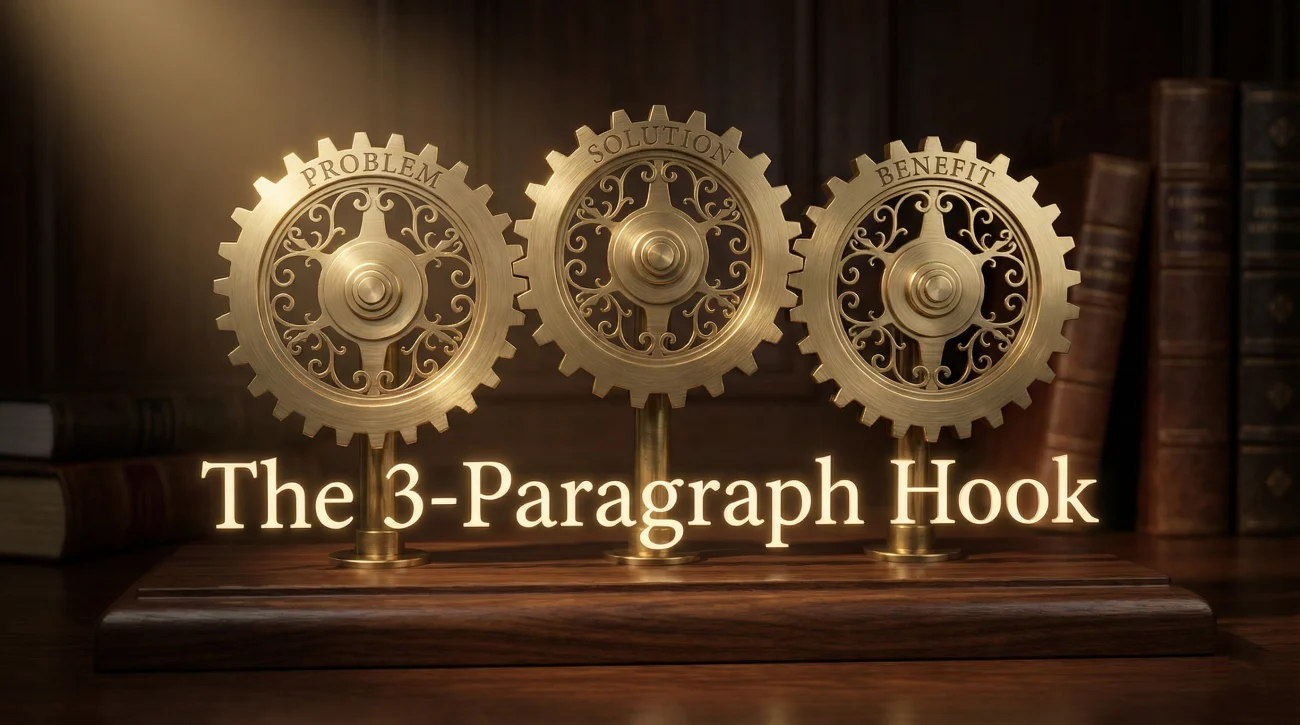
- The fix framework: Three paragraphs that Hook with company research plus one result, Prove value with 1 to 2 quantified wins, Close with a confident invite.
- Why the “after” letter worked: Shorter, specific, numbers included, and every sentence earns its place, which made recruiters mention the opening.
- Common killers to avoid: “I am writing to,” passive begging, too much length, and generic enthusiasm that fits any company.
Why 99% of Cover Letters Get Ignored
Most cover letters fail in the first sentence. They open with “I am writing to express my interest in…” or “To whom it may concern” and the recruiter stops reading.
Not because the candidate is unqualified. Not because the rest of the letter is poorly written. But because the opening signals that everything that follows will be generic, rehearsed, and forgettable.
Rachel applied to 31 marketing positions over two months using a cover letter she’d spent hours perfecting. It was polite, professional, and utterly ineffective. She got three responses – all form rejections.
This cover letter teardown shows exactly what was wrong with her approach, how we fixed it, and why the revised version landed her five interview requests in two weeks.
The “Before” Letter: Polite, Generic, Forgettable
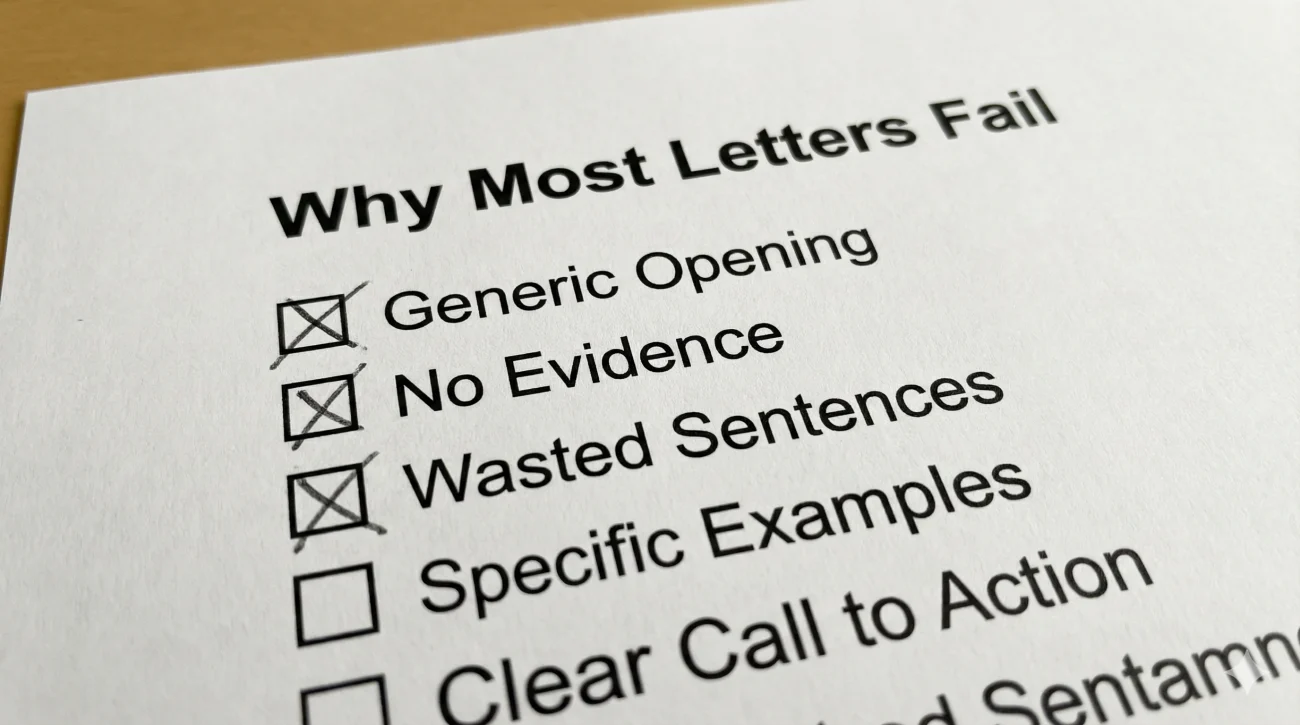
Rachel’s original cover letter followed the template she found online. It checked all the boxes: formal greeting, introduction, body paragraphs explaining her background, polite closing. It looked professional.
It also looked exactly like every other cover letter the recruiter had read that day.
The Original Letter
Opening:
Dear Hiring Manager,
I am writing to express my interest in the Marketing Coordinator position at your company. I believe I would be a great fit for this role based on my background and skills. I am a hardworking and motivated individual who is passionate about marketing.
Body Paragraphs:
In my previous role at ABC Company, I was responsible for managing social media accounts and creating content. I worked closely with the marketing team on various campaigns and projects. I have experience with tools like Canva and Mailchimp, and I’m comfortable working in fast-paced environments.
I have strong communication skills and enjoy collaborating with cross-functional teams. I’m detail-oriented and always strive to deliver high-quality work. I’m excited about the opportunity to bring my skills to your organization and contribute to your marketing efforts.
Closing:
Thank you for considering my application. I look forward to hearing from you soon and would welcome the opportunity to discuss how I can contribute to your team.
Sincerely,
Rachel
What’s Wrong With This
Line by line, here are the problems:
| Line | Problem |
|---|---|
| “I am writing to express my interest…” | Wasted sentence. Everyone knows why you’re writing. |
| “I believe I would be a great fit…” | Vague claim with no evidence. Everyone says this. |
| “hardworking and motivated” | Empty adjectives. Show it, don’t say it. |
| “responsible for managing social media” | Repeats resume. No new information. |
| “various campaigns and projects” | Too vague. Which campaigns? What results? |
| “strong communication skills” | Another claim without proof. |
| “excited about the opportunity” | Generic enthusiasm. Why this company specifically? |
The letter says nothing memorable, provides no specific value, and gives the recruiter no reason to call Rachel instead of the other 200 applicants.
The Fix: The 3-Paragraph Hook
We rebuilt Rachel’s cover letter using a three-paragraph structure designed to grab attention, prove value, and invite action.
Paragraph 1: The Hook
The opening paragraph needs to accomplish two things: show you’ve researched the company, and give the recruiter a reason to keep reading.
Skip the “I am writing to…” opening. Instead, lead with something specific about the company that connects to your experience.
Rachel’s revised opening:
Dear [Hiring Manager’s Name],
When I saw that BrandCo recently launched its sustainability initiative with the “Green Future” campaign, I knew this was the kind of mission-driven marketing I want to be part of. Your approach – combining storytelling with measurable impact – mirrors the strategy I used to grow engagement for EcoStart’s product launch by 60% in three months.
This opening does three things the original didn’t:
- 🎯 Shows research (mentions specific campaign)
- 💡 Makes a relevant connection (sustainability focus)
- 📊 Includes a concrete result (60% engagement growth)
The recruiter now knows Rachel didn’t copy-paste this letter to 50 companies. She researched BrandCo specifically and has relevant experience.
Paragraph 2: The Value
This paragraph proves you can do the job. Pick one or two specific accomplishments that directly relate to the job description. Use numbers and details.
Rachel’s revised body:
In my role at ABC Company, I didn’t just manage social media – I rebuilt our content strategy from the ground up. Within six months, I increased our Instagram following from 2,000 to 12,000 and drove a 40% increase in website traffic through targeted campaigns. I also created a content calendar system that reduced our posting inconsistency from 3-4 times a week to daily, maintaining quality while scaling output. This experience taught me how to balance creative storytelling with data-driven decision-making – exactly what your job posting emphasizes.
Compare this to the original “I was responsible for managing social media accounts.” The new version shows scale, initiative, and measurable results. It proves capability instead of just claiming it.
Paragraph 3: The Close
End with confidence and a clear call to action. Don’t beg for consideration – invite conversation.
Rachel’s revised closing:
I’d welcome the chance to discuss how my experience with content strategy and campaign execution can support BrandCo’s growth. I’m available for a conversation at your convenience.
Best regards,
Rachel
This is direct and confident. It assumes the conversation will happen, not that it might happen if the recruiter feels generous.
For more strategies on writing compelling application materials, see our comprehensive resume and cover letter writing guide.
The “After” Letter: Specific, Confident, Memorable
The revised letter was shorter than the original – about 250 words instead of 350. But every sentence served a purpose.
| Element | Before | After |
|---|---|---|
| Opening | Generic statement of interest | Specific company research + relevant result |
| Body | Vague responsibilities | Concrete accomplishments with numbers |
| Closing | Polite but passive | Confident invitation to connect |
| Length | 350 words | 250 words |
| Tone | Hopeful | Confident |
The “after” letter reads like it was written by someone who knows their value and understands the company’s needs. The “before” letter reads like someone hoping to get lucky.
The Result: 5 Interviews in 2 Weeks
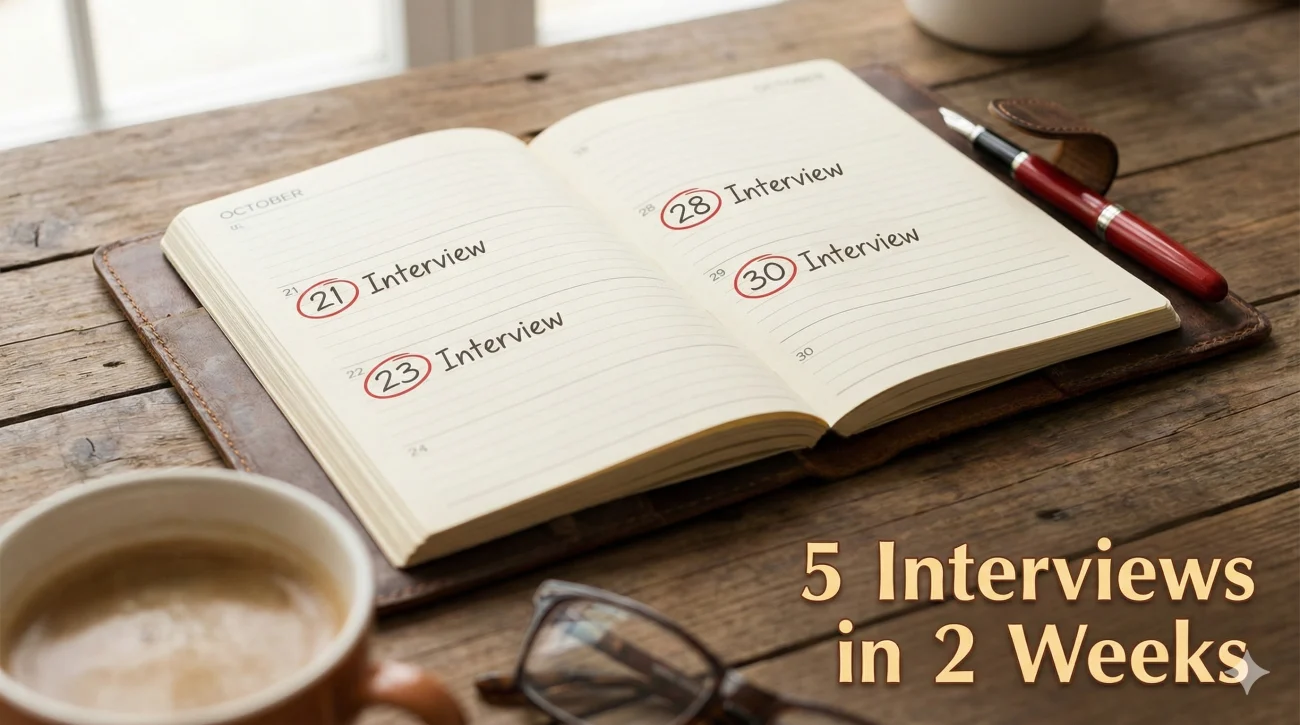
Rachel sent the revised cover letter to 18 companies over two weeks. She received five interview requests – a 28% response rate compared to less than 10% with her original letter.
Three of those interviews came from the opening paragraph alone. Recruiters mentioned they appreciated that she’d done research and could speak specifically about their company’s work.
One hiring manager told her directly: “Most cover letters are identical. Yours showed you actually looked at what we do and thought about how you’d fit. That’s rare.”
Rachel accepted an offer from a mid-sized marketing agency that specifically cited her cover letter as a deciding factor in bringing her in for an interview.
Common Cover Letter Mistakes That Kill Applications
Starting With “I Am Writing To…”
This opening wastes the most important sentence in your letter. The recruiter already knows you’re writing to apply. Use that space to say something memorable instead.
Repeating Your Resume
Your cover letter shouldn’t list your job duties – your resume does that. Use the cover letter to tell a story, provide context, or highlight one or two accomplishments in detail.
Using Empty Adjectives
“Hardworking,” “motivated,” “detail-oriented,” “team player” – these words mean nothing without proof. Everyone uses them. Show these qualities through specific examples instead.
Being Too Passive
Phrases like “I hope you will consider” or “I would be grateful for the opportunity” sound desperate. Confidence matters. Write as if you’re offering value, not begging for a chance.
Writing Too Much
A cover letter should be half a page, three paragraphs maximum. If it’s longer than that, you’re including too much detail. Edit ruthlessly.
For additional examples of effective cover letters across different industries, explore our ultimate cover letter guide.
The 3-Paragraph Framework You Can Use
Here’s the template Rachel used, adapted for any role:
Paragraph 1: Company Research + Your Connection
Structure: [Specific thing about the company] + [How your experience relates] + [One impressive result]
Example for software engineer: “When I read about [Company’s] migration to microservices architecture, it reminded me of the challenge I faced at [Previous Company], where I led the transition from a monolith to distributed services – reducing deployment time from 3 hours to 15 minutes.”
Paragraph 2: Your Most Relevant Achievement
Structure: [Specific accomplishment] + [How you did it] + [Measurable outcome] + [Connection to job requirements]
Example: “At [Company], I didn’t just [basic responsibility] – I [specific initiative]. By [actions you took], I [measurable result]. This experience directly aligns with your emphasis on [requirement from job posting].”
Paragraph 3: Confident Close
Structure: [Statement of interest in discussing further] + [Availability]
Example: “I’d welcome the opportunity to discuss how my experience with [specific skill] can contribute to [company’s specific goal]. I’m available at your convenience.”
FAQ
Your Cover Letter Is Your First Impression – Make It Count
Rachel’s transformation shows that the difference between a ignored cover letter and one that gets interviews isn’t talent or qualifications. It’s clarity, specificity, and confidence.
The original letter was polite, professional, and forgettable. It said nothing that distinguished Rachel from hundreds of other applicants. The revised letter showed she’d done her research, could deliver measurable results, and understood what the company needed.
A strong cover letter doesn’t need to be long or elaborate. It needs to answer three questions:
- ✅ Why this company? (Show research)
- ✅ Why you? (Prove value with specific examples)
- ✅ What happens next? (Invite conversation)
Three paragraphs. 250 words. That’s all it takes to stand out from the pile of generic applications sitting in the recruiter’s inbox.
Stop saying you’re “excited about the opportunity.” Start showing you understand the company’s challenges and have the experience to help solve them. That’s what gets you interviews.
For more tools to strengthen your job applications, check out our guide to the best resume builders with professional templates.